
Inquire Now
Key strategic points
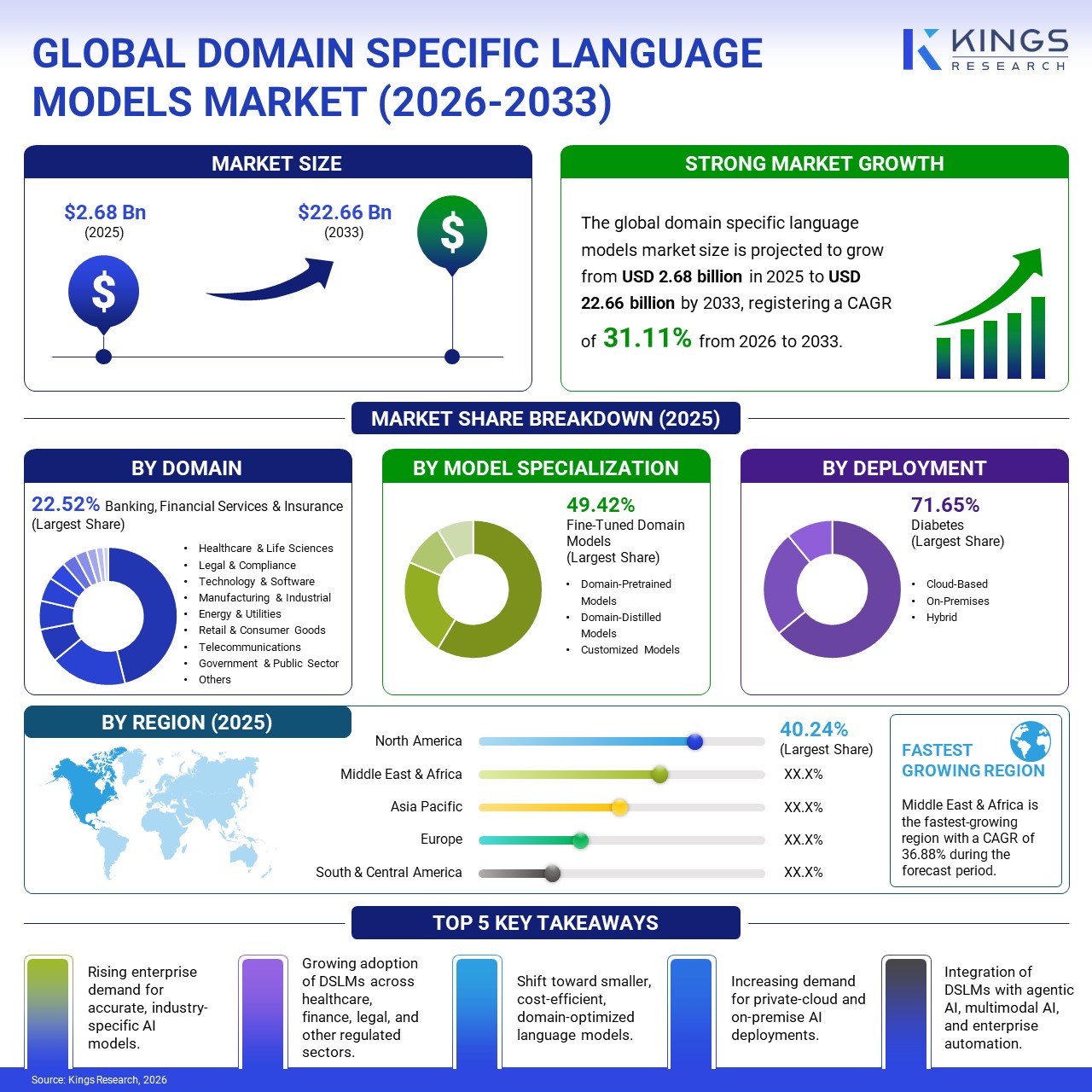
According to Kings Research analysis, the global domain-specific language model (DSLM) market size was recorded at USD 2.68 billion in 2025 and is projected to reach USD 22.66 billion by 2033, growing at a CAGR of 31.11% over the forecast period from 2026 to 2033.
AI solutions tailored to specific industries and business functions. DSLMs are trained and fine-tuned on specialized data, domain-specific terminology, workflows, and regulatory requirements to deliver accurate and context-aware outputs. The rising demand for secure, reliable, and compliant AI is driving adoption across diverse end-use verticals, while advancements in fine-tuning and retrieval-augmented generation are facilitating the deployment of DSLMs that are accessible to small- and medium-scale enterprises.
Limitations of general-purpose large language models (LLMs), when applied to complex, high-stakes fields including law, medicine, and finance, create a strong demand for DSLMs. Specialized end-use verticals operate with highly distinct language styles, intricate jargon, and rigorous objective functions that general-purpose LLMs cannot replicate.
Additionally, professional tasks demand deep, real-time, and highly accurate knowledge, which is generally based on proprietary intellectual property, thus restricting general LLMs from generating responses that may underrepresent niche concepts and generate frequent factual inaccuracies. DSLMs transform broad, general-purpose conversational models into precise, secure, and compliant domain experts, thereby providing production-ready AI models that are context-aware and suitable for high-stakes enterprise applications.
The presence of fragmented data silos, proprietary databases, and inconsistently structured domain-specific datasets creates significant barriers to the training and deployment of DSLMs. The dynamic nature of domain knowledge creates continuous maintenance challenges for DSLM deployment. Banking regulations, financial products, customer policies, technical procedures, and enterprise documentation change continuously, making models trained on historical data prone to becoming outdated.
This necessitates continuous evaluation, retraining, retrieval-augmented generation, knowledge-base updates, and model-drift monitoring, leading to increased deployment costs. Additionally, the high cost associated with training and deploying DSLMs necessitates significant GPU infrastructure and specialized AI talent for training large teacher models for data generation, full-parameter fine-tuning, or repeated experimentation.
To address this challenge, enterprises are combining data integration, data quality, lineage, privacy controls, and governance with agentic retrieval-augmented generation to connect LLMs to continuously updated enterprise knowledge without repeatedly retraining models.
For instance, in April 2025, NTT DATA and Weights & Biases partnered to accelerate enterprise GenAI by enabling advanced fine-tuning of LLMs and Small Language Models (SLMs). The integration strengthens NTT DATA’s GenAI Tech Hub, enabling businesses to develop more customized, accurate, and cost-effective AI solutions.
Capability gaps between general-purpose LLM offerings and the specialized technical requirements of enterprise security operations are presenting growth opportunities. Off-the-shelf generative AI models often lack the domain depth required for high-value applications such as cyber threat intelligence (CTI) analysis, vulnerability assessment, compliance mapping, and security documentation generation.
Additionally, the rising demand for automated compliance analysis against regulatory frameworks, including NIST (National Institute of Standards and Technology), ISO (International Organization for Standardization), and ENISA (European Union Agency for Cybersecurity), is supporting adoption. Other key use cases include scalable vulnerability detection and remediation support, natural-language interfaces for log and configuration analysis, and augmented SOC (Security Operations Center) alert triage. These capabilities can help address cybersecurity talent shortages and reduce operational bottlenecks associated with manual and reactive security workflows.
|
Segmentation |
Details |
|
|
By Domain |
Banking, Financial Services & Insurance (BFSI), Healthcare & Life Sciences, Legal & Compliance, Technology & Software, Manufacturing & Industrial, Energy & Utilities, Retail & Consumer Goods, Telecommunications, Government & Public Sector, Others |
|
|
By Model Specialization |
Domain-Pretrained Models, Fine-Tuned Domain Models, Domain-Distilled Models, Customized Models |
|
|
By Deployment |
On-Premises, Cloud-Based, Hybrid |
|
|
By Organization Size |
Small and Medium Enterprises (SMEs), Large Enterprises |
|
|
By Region |
North America |
U.S., Canada, Mexico |
|
Europe |
France, UK, Spain, Germany, Italy, Russia, Rest of Europe |
|
|
Asia-Pacific |
China, Japan, India, Australia, ASEAN, South Korea, Rest of Asia-Pacific |
|
|
Middle East and Africa |
Turkey, U.A.E., Saudi Arabia, South Africa, Rest of Middle East & Africa |
|
|
South and Central America |
Brazil, Argentina, Rest of South and Central America |
|
The banking, financial services & insurance (BFSI) segment accounted for the largest share of 22.52% in 2025. This growth was largely attributable to the vast volume of document-heavy workflows, strict regulatory compliance demands, and the critical need for high data accuracy. The adoption of domain-specific language models by financial institutions to automate complex processes, including fraud detection, credit risk assessment, KYC pack assembly, and regulatory reporting, contributed significantly to segmental expansion.
The small and medium-sized enterprises (SMEs) segment is likely to grow at a CAGR of 38.25% over the forecast period. Domain-specific AI emerges as a cost-effective alternative to large, general-purpose LLMs, offering potential inference cost reductions of nearly 60%-80%. Faster response times, on-premises deployment, and private cloud environment capabilities further enable enhanced efficiency, data privacy, and operational control, thereby boosting the widespread adoption of DSLMs across customer support, professional services, retail, healthcare, manufacturing, and other end-use sectors.
By region, the global domain-specific language models market is segmented into North America, Europe, Asia Pacific, the Middle East and Africa, and South and Central America.
North America accounted for the largest share of 40.24% in 2025, valued at USD 1.08 billion. The region emerged as a premier hub for the AI market, owing to its vast software development ecosystem, which fostered the innovation and deployment of artificial intelligence products and services. Government policies such as the AI Action Plan introduced in January 2025 established a national framework to guide AI infrastructure initiatives and federal policymaking across priority areas, creating a growth trajectory for the deployment and utilization of language models trained specifically for specific domains across commercial, industrial, and government sectors in the U.S.
Additionally, the presence of robust federal funding systems enables large-scale public investment through primary agencies, including the National Science Foundation (NSF), which provides the foundational capital necessary to drive cutting-edge artificial intelligence development.
The Middle East and Africa is estimated to register the fastest CAGR of 36.88% over the forecast period. The high growth rate is attributed to the booming commercial ecosystem across the region, particularly BFSI, retail, and e-commerce, leading to the development of industry-specific AI models to leverage localized data, language capabilities, and domain-specific requirements.
Countries in the region are increasingly developing Arabic-focused LLMs to address the linguistic and cultural limitations of general-purpose models. Models such as Jais, ALLaM, and Fanar are designed to support Arabic dialects, cultural contexts, and the growing demand for localized AI solutions.
Market dynamics across Europe, Asia Pacific, and South and Central America vary significantly, driven by enterprise AI adoption, regulatory requirements, data sovereignty, and demand for localized, industry-specific LLMs. Europe is witnessing strong demand for secure and compliant DSLMs, particularly across BFSI, healthcare, and manufacturing, driven by stringent data protection and AI governance requirements.
The market in Asia Pacific is likely to grow steadily in the forthcoming years, driven by rapid digitalization, sovereign AI initiatives, and increasing deployment of industry-specific language models. South and Central America represent an emerging opportunity, with adoption gradually expanding across financial services, healthcare, and other end-use verticals seeking AI capabilities.
Key players operating in the domain-specific language models market are focusing on strategic collaborations, partnerships, and technological innovation to improve operational efficiency and expand market share. They are prioritizing the development and deployment of DSLMs, which are trained on proprietary and extensive domain-specific data, thereby enhancing decision-making, operational efficiency, and scalability across diverse end-use verticals.
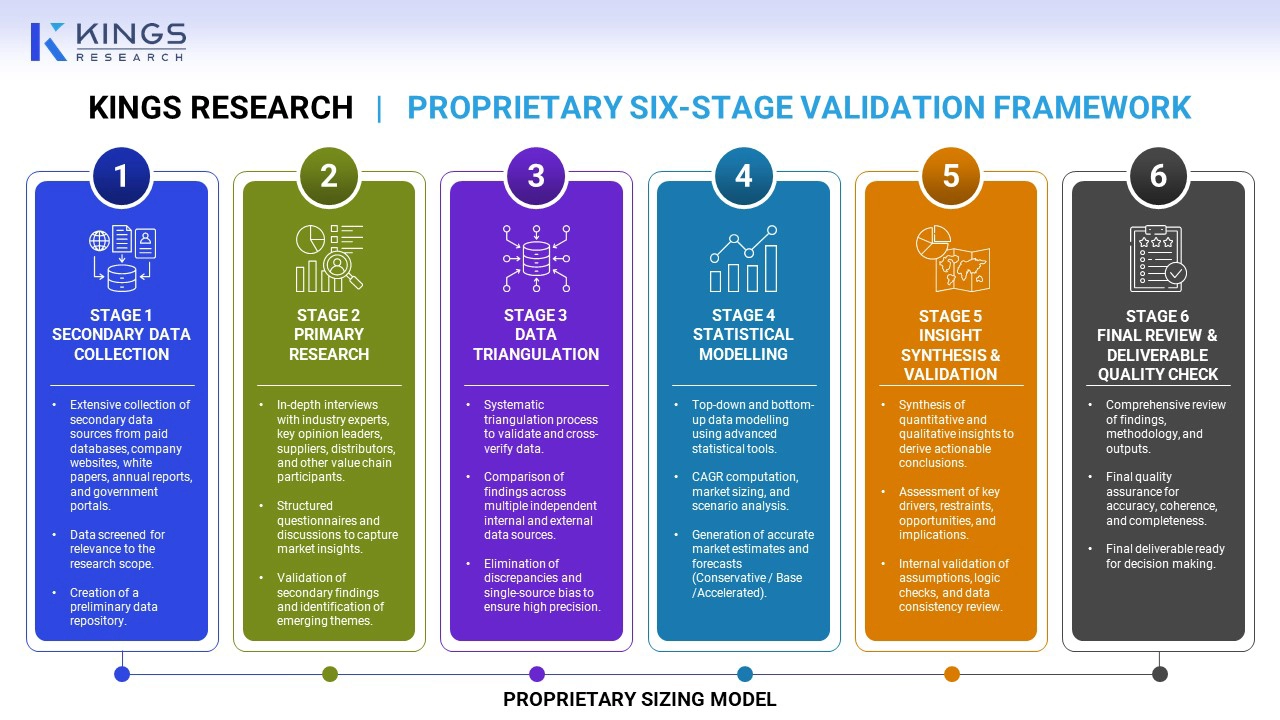
Our methodology triangulates insights from multiple independent and publicly available research databases and is further validated against regulatory filings and public company disclosures. All estimates are cross-verified; no single-source data is presented without validation.
Our custom offerings deliver tailored, data-driven intelligence and strategic guidance to help organizations identify, evaluate, and capitalize on key market opportunities.
Frequently Asked Questions

Faizy brings over four years of experience in market research and consulting, with a proven ability to support strategic engagements across diverse industries and business environments. His work focuses on understanding complex market structures, identifying emerging opportunities, and translating research findings into clear, commercially relevant insights. With strong analytical capabilities and a structured approach to problem-solving, he evaluates industry trends, competitive landscapes, customer dynamics, and evolving business models. His expertise encompasses market research, competitive intelligence, market sizing and forecasting, industry assessment, company benchmarking, and strategic analysis. Faizy combines technical proficiency with a strong research orientation, enabling him to interpret both qualitative and quantitative information effectively. He has contributed to projects that help organizations assess growth potential, strengthen market positioning, and evaluate strategic priorities. His adaptable approach allows him to work across sectors while maintaining a consistent focus on accuracy, relevance, and delivering insights that support informed decision-making for clients and stakeholders.
Habi is a seasoned research and consulting leader with renowned experience in guiding clients on strategic growth and transformation initiatives across global markets. He has led high-performing research teams that deliver actionable insights on market expansion, M&A strategies, opportunity assessment, new business development, and product launches. His project portfolio spans large petrochemical producers, electronic device manufacturers, lubricants companies, and other leading enterprises across diverse industrial and consumer sectors. He currently heads the research department at Kings Research, where he is responsible for setting the research agenda, mentoring analysts, and ensuring client-ready deliverables that support executive decision-making. With extensive experience in market intelligence, strategic research, and consulting, Habi brings a strong understanding of evolving industry dynamics, competitive landscapes, emerging opportunities, and business growth challenges. His expertise includes developing research frameworks, translating complex market data into actionable strategic recommendations, and working closely with senior stakeholders to address critical business questions. He has also contributed to building research capabilities, strengthening analytical methodologies, and driving a culture of quality and insight-led decision-making within research teams. His cross-industry exposure enables him to connect market trends with broader business implications and provide perspectives that help organizations identify opportunities, mitigate risks, and make informed strategic decisions.