
Inquire Now
Key Strategic Points
The NAND flash market refers to the ecosystem of non-volatile storage technology, which is widely utilized in solid-state drives (SSDs), USB flash drives, and memory cards. The scalable, cost-effective, and high-performance capabilities of NAND flash drive its adoption across end-use verticals, spanning consumer electronics, enterprise IT, and hyperscale cloud data centers. The booming data center landscape in the U.S. further fuels the demand for high-performance, energy-efficient storage solutions to handle data-intensive workloads.
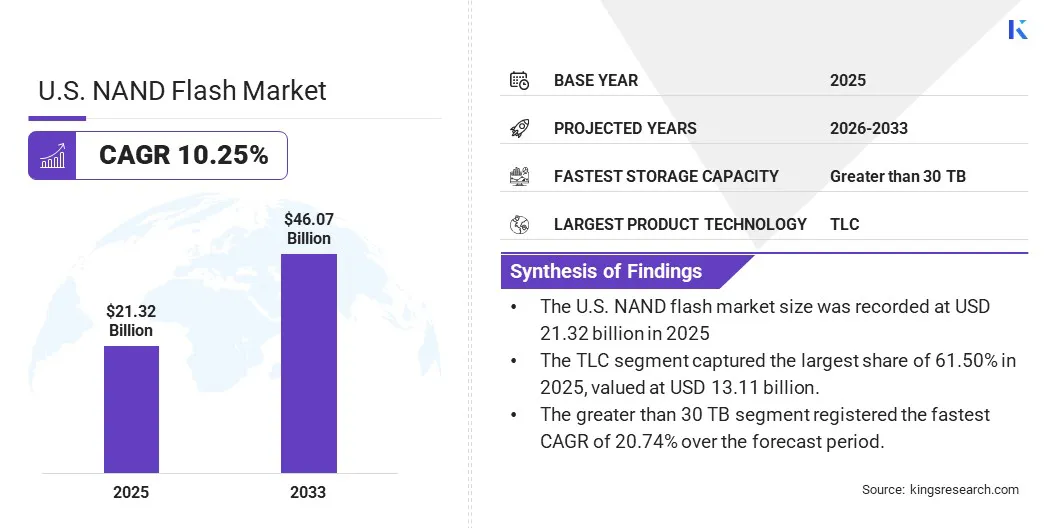
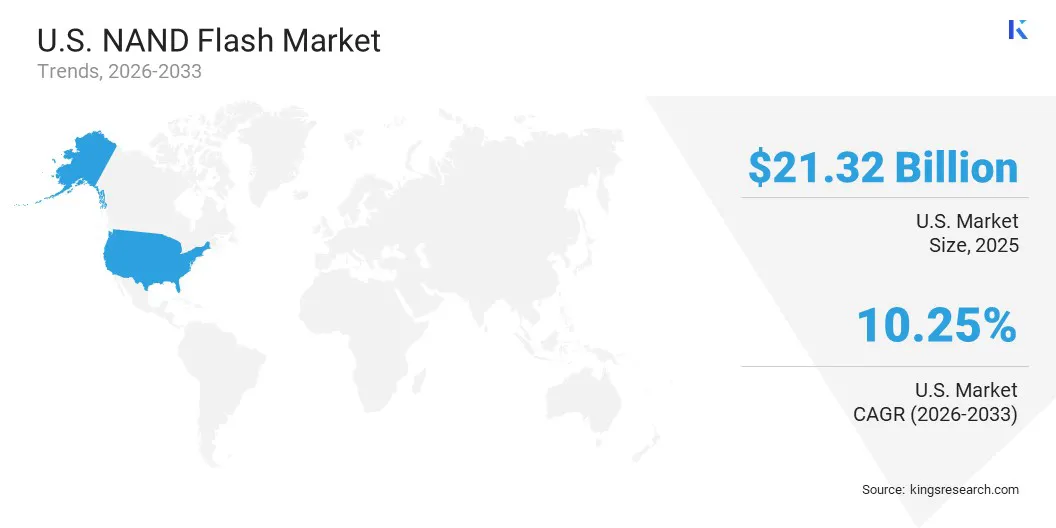
The U.S. NAND flash market size was valued at USD 21.32 billion in 2025 and is projected to reach USD 46.07 billion by 2033, representing a CAGR of 10.25% over the forecast period. This growth is mainly propelled by the ability of NAND flash to deliver faster read/write speeds, higher storage capacity, and improved power efficiency compared to conventional storage solutions. Additionally, the surge in data center development to support AI infrastructure, cloud computing, and edge applications across the commercial and industrial landscape of the U.S. is creating growth opportunities.
Key players operating in the market, including Samsung, Micron Technology, Inc., SK Hynix Inc., KIOXIA Corporation, Western Digital Corporation, SanDisk Corporation, Kingston Technology, Seagate Technology LLC, Marvell, and Transcend Information, Inc., are focusing on developing AI-optimized solid-state drives and next-generation NAND technologies to address the rising AI computing demands from enterprises and hyperscale data centers.
AI training and inference workloads process enormous datasets, which create unprecedented demand for enterprise-grade solid-state drives that rely on advanced high-layer NAND flash technologies. The expansion of AI computing infrastructure by major cloud service providers (CSPs), including Microsoft, Amazon, and Google, to train large language models (LLMs) further boosts the demand for high-end NAND-based SSDs. The evolution of the AI ecosystem from model training to real-time inference and the deployment of LLMs is presenting growth opportunities.
Inference AI workloads operate continuously to generate responses and predictions across millions of connected devices, resulting in substantially higher requirements for memory bandwidth, storage capacity, and energy efficiency. This evolving workload characteristic creates demand for NAND flash memory technologies that offer high-speed performance with minimal power consumption.
The sharp rise in the prices of NAND flash and DRAM in the global semiconductor industry is attributed to constrained supply, shifting capacity allocation, and surging AI and data center demand, which is highlighting the need for enterprise-grade, high-capacity, and high-performance storage solutions. Furthermore, chipmakers are reallocating wafer capacity towards more profitable AI-related memory products, including HBM (High Bandwidth Memory), thereby tightening the general-purpose NAND supply.
For instance, Samsung announced plans to hike NAND flash prices by up to 100% in Q2 2026, following similar increases in Q1 2026, resulting in an overall rise of more than 200% in NAND prices during 2026. Similarly, Kingston reported a 246% increase in NAND wafer pricing compared to Q1 2025, with a 70% price increase occurring within 60 days, resulting in significant hikes in NAND flash prices. Additionally, KIOXIA reported a complete sell-out of its NAND flash production for 2026, with the supply-demand imbalance expected to persist until 2027 due to the global AI boom. Moreover, NAND flash production expansion from Chinese manufacturers, due to their domestic substitution policies and intensifying global market competition, further intensifies pricing pressure. This dual pressure from surging AI demand and limited production capacity is fueling the significant upward trend in NAND flash pricing in the U.S.
To address this challenge, market players are transitioning to higher-stacked cell layers, which enable higher-capacity NAND chips and eventually reduce costs and the number of chips required in solid-state drives (SSDs).
High bandwidth flash (HBF) memory architecture offers high-storage capacity, enhanced energy efficiency, improved thermal stability. This fuels its applicability in emerging AI workloads and high-performance computing. HBF architectures utilize parallelism, advanced logic scaling, and custom stacking techniques to deliver low latency and high bandwidth, enabling large language models to stream data at near-DRAM speeds. This property further enhances their applicability across AI data centers, enterprise AI infrastructure, edge AI devices, cloud computing platforms, and other data-intensive applications, thereby creating new growth opportunities. Moreover, the migration of artificial intelligence (AI) workloads from hyperscale data centers to enterprise-grade environments and the network edge is presenting growth opportunities.
Additionally, the introduction of advanced QLC (Quad-Level Cell) and 200+ layer 3D NAND architectures is further transforming the NAND flash market dynamics in the U.S.
|
Segmentation |
Details |
|
By Product Technology |
SLC, MLC, TLC, QLC, Others |
|
By Storage Capacity |
Less than 128 GB, 128 GB - 512 GB, 512 GB - 2 TB, 2 TB - 8 TB, 8 TB - 30 TB, Greater than 30 TB |
|
By Application |
Internal Storage (eMMC-based Storage, UFS-based Storage, SSD, Others), Portable Storage (External SSDs, USB Flash Drives, SD Cards, microSD Cards, Others) |
|
By End-Use Industry |
Consumer Electronics (Smartphones, Tablets, PCs/Laptops, Gaming Consoles, Wearables & Cameras, Others), Enterprise IT, Cloud & Hyperscale, Automotive, Industrial & Telecom, Aerospace & Defense, Others |
|
By Country |
U.S. |
The U.S. is designated as a major hub for data centers, which drive artificial intelligence computing infrastructure. Artificial intelligence (AI) chips are crucial to training, deploying, and improving AI models. The demand for high computing power from AI companies is transforming the NAND flash memory market in the country.
The development of advanced LLMs and increasing applicability of generative AI across the commercial and industrial landscape of the U.S. further fuel the demand for high-capacity and high-speed storage solutions capable of handling rising computing workloads. Additionally, market players are operationalizing artificial intelligence, transitioning beyond pilot projects to embed AI directly into core business operations. This trend is propelling demand for efficient storage and processing solutions, thereby boosting the demand for NAND flash storage in the U.S.
Key players operating in the U.S. NAND flash market are focusing on strategic mergers, acquisitions, and technical collaborations to strengthen their competitive positioning, capture a larger market share, and leverage NAND flash shortages in the U.S. Market players are prioritizing storage density enhancement through 3D NAND layer stacking and exhibiting extreme production discipline to maintain high margins.
For instance, Samsung reduced its annual NAND wafer target from 4.9 million to 4.68 million, while SK Hynix reduced its annual NAND wafer target from 1.9 million in 2025 to 1.7 million in 2026. This artificial tightening reflects the strategic allocation of limited wafer supply and helps keep NAND supply constrained.
Industry players are further phasing out legacy NAND production and adopting innovative memory architectures capable of handling AI workloads and advanced computing workloads.
Frequently Asked Questions

Faizy brings over four years of experience in market research and consulting, with a proven ability to support strategic engagements across diverse industries and business environments. His work focuses on understanding complex market structures, identifying emerging opportunities, and translating research findings into clear, commercially relevant insights. With strong analytical capabilities and a structured approach to problem-solving, he evaluates industry trends, competitive landscapes, customer dynamics, and evolving business models. His expertise encompasses market research, competitive intelligence, market sizing and forecasting, industry assessment, company benchmarking, and strategic analysis. Faizy combines technical proficiency with a strong research orientation, enabling him to interpret both qualitative and quantitative information effectively. He has contributed to projects that help organizations assess growth potential, strengthen market positioning, and evaluate strategic priorities. His adaptable approach allows him to work across sectors while maintaining a consistent focus on accuracy, relevance, and delivering insights that support informed decision-making for clients and stakeholders.
Habi is a seasoned research and consulting leader with renowned experience in guiding clients on strategic growth and transformation initiatives across global markets. He has led high-performing research teams that deliver actionable insights on market expansion, M&A strategies, opportunity assessment, new business development, and product launches. His project portfolio spans large petrochemical producers, electronic device manufacturers, lubricants companies, and other leading enterprises across diverse industrial and consumer sectors. He currently heads the research department at Kings Research, where he is responsible for setting the research agenda, mentoring analysts, and ensuring client-ready deliverables that support executive decision-making. With extensive experience in market intelligence, strategic research, and consulting, Habi brings a strong understanding of evolving industry dynamics, competitive landscapes, emerging opportunities, and business growth challenges. His expertise includes developing research frameworks, translating complex market data into actionable strategic recommendations, and working closely with senior stakeholders to address critical business questions. He has also contributed to building research capabilities, strengthening analytical methodologies, and driving a culture of quality and insight-led decision-making within research teams. His cross-industry exposure enables him to connect market trends with broader business implications and provide perspectives that help organizations identify opportunities, mitigate risks, and make informed strategic decisions.