

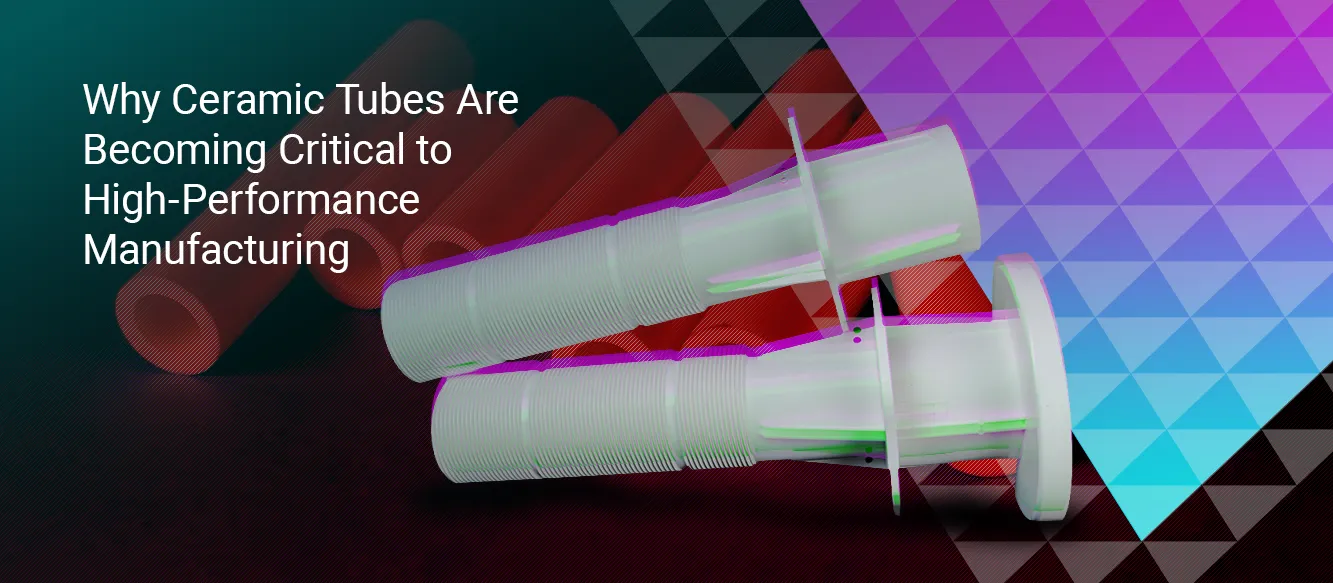
Ceramic tubes are becoming critical to high-performance manufacturing because they help industrial systems operate reliably under conditions that conventional materials often struggle to withstand. As manufacturing processes become hotter, more electrically demanding, chemically aggressive, and precise, the performance of individual components directly impacts equipment reliability, operational efficiency, and product quality.
Unlike traditional materials, ceramic tubes combine high thermal resistance, electrical insulation, chemical resistance, and mechanical stability in a single solution. These characteristics make them valuable in applications such as high-temperature furnace systems, semiconductor equipment, aerospace assemblies, medical devices, and industrial processing environments. For manufacturers, ceramic tubes serve a role that extends beyond basic functionality. They help protect sensitive equipment, maintain process stability, and support longer service life in demanding operating conditions.
What is a Ceramic Tube?
A ceramic tube is a high-purity, hollow cylindrical component manufactured from advanced inorganic materials such as alumina, silicon carbide, or zirconia. Engineered to withstand extreme operating conditions, these industrial tubes offer superior thermal resistance, excellent electrical insulation, high mechanical strength, and exceptional corrosion resistance for high-performance manufacturing applications.
Market expansion reflects the growing importance of ceramic tubes. Our analysts valued the global ceramic tube market at USD 1,320.3 million in 2024 and project that it will reach USD 2,125.5 million by 2032. This growth reflects a broader shift toward advanced materials that improve reliability, withstand extreme operating environments, and support the next generation of high-performance manufacturing systems.
Market Expansion Reflects Growing Industrial Adoption
Regional demand patterns illustrate where industrial adoption is occurring most rapidly. Asia-Pacific accounted for 38.10% of the global market in 2024, generating revenue of USD 503.0 million. The region's strong manufacturing base, expanding semiconductor industry, and continued investment in advanced materials are supporting market growth, particularly in applications that require high-temperature processing, electrical insulation, and precision manufacturing capabilities.
Although ceramic tubes can present higher material and manufacturing costs than some conventional alternatives, their thermal resistance, electrical insulation, chemical stability, and durability often make them the preferred choice in mission-critical applications. As a result, ceramic tubes are becoming an important enabling component in advanced manufacturing technologies and critical industrial infrastructure.
The Manufacturing Shift: From Standard Materials to Advanced Ceramics
Manufacturers are using advanced ceramics because industrial systems now operate at higher temperatures, handle greater electrical loads, and face stricter performance requirements. In many cases, traditional metals and polymers can't offer the thermal stability, electrical insulation, and chemical resistance required for long-lasting reliability.
Investment in advanced manufacturing continues to increase demand for materials that perform in heat-intensive and electrically sensitive environments. In the United States, the CHIPS and Science Act provides USD 52.7 billion to strengthen semiconductor manufacturing, research, and workforce development. This investment highlights the scale of funding directed toward next-generation electronics infrastructure.
Material performance remains a key driver of this transition. Manufacturers use advanced ceramics in environments where resistance to heat, corrosion, wear, and electrical stress is essential. In these applications, component failure can directly affect operational uptime and product quality.
Key Demand Driver: Thermal Resistance and Electrical Insulation
Thermal resistance and electrical insulation are important in high-temperature furnace systems, thermal processing equipment, semiconductor manufacturing tools, power electronics, and aerospace applications. According to the U.S. Energy Information Administration, total U.S. manufacturing energy consumption increased by 6% between 2018 and 2022. These environments require materials that withstand prolonged exposure to extreme heat without losing performance.
Electrical performance is becoming equally important. Semiconductor packaging and advanced electronics rely on materials that provide effective thermal management and dependable insulation. The Semiconductor Industry Association reported that global semiconductor sales reached a record USD 627.6 billion in 2024, representing a 19.1% increase from the previous year. This growth reflects demand for advanced computing, artificial intelligence infrastructure, power electronics, communication systems, and other technologies that depend on effective thermal management and reliable electrical performance.
Material Focus: Why Alumina Leads, and Where SiC, Zirconia, and Boron Nitride Fit
The overall structural dynamics of the ceramic tube market segments reveal distinct engineering trade-offs among cost, thermal performance, and mechanical stress. Material selection plays a critical role in ceramic tube performance, with each composition designed for specific operating conditions.
Industrial Ceramic Material Comparison
|
Material Type |
Key Properties & Strengths |
Primary Applications |
Cost Tier |
|
Alumina |
High electrical insulation, excellent thermal stability, wide availability. |
Furnace components, industrial machinery, thermal processing. |
Budget-Friendly / Standard |
|
Silicon Carbide |
Superior thermal shock resistance, extreme mechanical strength, heat management. |
Power electronics, semiconductor tools, electric vehicles. |
Premium / High Performance |
|
Zirconia |
Superior fracture toughness, high dimensional stability under stress. |
Specialized wear components, precision mechanical tools. |
Premium / High Toughness |
|
Boron Nitride |
Unique combination of elite thermal performance and electrical insulation. |
Specialized electronics, high-vacuum engineering, shielding. |
Niche / Highly Specialized |
Alumina remains the leading material, generating USD 555.8 million in revenue in 2024. Its strong electrical insulation, high-temperature stability, wide availability, and cost-effectiveness make it a preferred choice for furnace components, industrial machinery, and thermal processing systems.
Silicon carbide (SiC) is gaining adoption in applications that require superior thermal shock resistance, mechanical strength, and heat management. Growth in power electronics, semiconductor manufacturing, and electric vehicles is supporting demand. The International Energy Agency reported that global electric vehicle sales reached 17 million units in 2024. Such industries depend on high-performance materials that operate reliably under demanding thermal and electrical conditions.
Zirconia and boron nitride support more specialized applications. Manufacturers value zirconia for its fracture toughness and dimensional stability. Boron nitride offers a distinctive combination of thermal performance and electrical insulation. Together, these materials allow manufacturers to align ceramic tube performance with specific engineering, operational, and reliability requirements.
Where Ceramic Tubes Deliver the Greatest Performance Value
1. Aerospace and Defense
Aerospace and defense remain important growth markets. The aerospace and defense segment is projected to generate USD 585.8 million by 2032. Manufacturers use ceramic tubes in aircraft engines, sensors, communication systems, satellite components, and defense platforms that require lightweight, heat-resistant, and electrically insulating materials. IATA reported that global air passenger demand reached a record high in 2024, with full-year traffic rising 10.4% compared with 2023 and exceeding 2019 levels by 3.8%. This growth highlights continued demand for aircraft production, maintenance, and supporting aerospace technologies.
2. Healthcare and Medical Devices
Healthcare is another important application area. Manufacturers use ceramic materials in precision-engineered medical components because of their dimensional stability, wear resistance, and biocompatibility. According to the World Health Organization, the global population aged 60 years and older is projected to increase from 1.1 billion in 2023 to 1.4 billion by 2030. This demographic trend is expected to support long-term demand for medical devices and healthcare infrastructure.
How Manufacturing Innovation is Expanding Ceramic Tube Capabilities
Technologies such as additive manufacturing, diamond machining, and laser finishing allow manufacturers to produce ceramic tubes with greater accuracy and application-specific characteristics. One of the most significant developments is the adoption of 3D printing. Additive manufacturing enables the production of complex internal geometries that are difficult or expensive to achieve through conventional machining methods. This capability is valuable in industries that require customized ceramic components with specialized performance requirements.
According to the Semiconductor Industry Association, the U.S. semiconductor industry has announced more than 90 new manufacturing projects across 28 states since the CHIPS Act was introduced. As advanced manufacturing capacity expands, demand for ceramic components that meet strict dimensional and reliability standards is increasing. Diamond tooling and laser machining help manufacturers achieve the tight tolerances required for semiconductor equipment, medical devices, and other high-performance systems.
Why Asia-Pacific Leads While Europe Accelerates
Regional growth in the ceramic tube market reflects the manufacturing strength of Asia-Pacific and the specialized engineering capabilities of Europe. Asia-Pacific accounted for 38.10% of the global market in 2024, generating USD 503.0 million in revenue. Strong manufacturing sectors across China, Japan, India, South Korea, and Taiwan support this position. Extensive semiconductor production capacity and continued investment in advanced ceramics also contribute to regional growth.
The region continues to strengthen its market position through ongoing industrial investment. In August 2024, Kyocera held a groundbreaking ceremony for a new facility in Nagasaki, Japan, to expand production of fine ceramic components and semiconductor packaging.
Europe is expected to record the fastest growth during the forecast period, with a projected CAGR of 6.25% through 2032. Demand for advanced ceramic components continues to grow in industries that require strict performance and reliability standards.
Precision Ceramics announced a strategic partnership with MillenniTEK in August 2025 to expand the availability of Boron Carbide materials, including for neutron absorption and shielding applications.
What Buyers Should Consider Before Selecting Ceramic Tubes?
As ceramic tubes become more application-specific, selecting the right solution requires careful consideration of both performance requirements and supplier capabilities. Before making a procurement decision, manufacturers should assess the following factors:
- Operating temperature: Can the ceramic tube withstand the application's maximum temperature and thermal cycling conditions?
- Electrical insulation requirements: Does the operating environment require dielectric strength to protect sensitive electronic or power systems?
- Chemical exposure: Will the component be exposed to corrosive chemicals, moisture, or reactive processing conditions?
- Dimensional precision: Does the application require tight tolerances to ensure proper fit, alignment, and process consistency?
- Material suitability: Will alumina meet performance requirements, or would silicon carbide, zirconia, or boron nitride offer a better fit for the operating conditions?
- Manufacturing complexity: Does the design require custom geometries, specialized internal structures, or precision-machined features?
- Supplier capabilities: Can the supplier consistently provide the required quality, technical expertise, and production capacity?
- Lifecycle value: Will the component help reduce maintenance needs, improve equipment uptime, or extend service life?
The most effective ceramic tube solution is not always the most advanced material available. The right choice aligns material properties, manufacturing requirements, and long-term operational objectives with the specific needs of the application.
Get the Full Report: Understanding Where the Market is Headed
The growing use of ceramic tubes across industrial applications reflects rising demand for materials that withstand extreme temperatures, corrosive environments, and precision manufacturing requirements. As manufacturers focus on improving reliability, reducing downtime, and extending equipment lifespan, understanding these market trends has become increasingly important for long-term planning and investment decisions.
The full Ceramic Tube Market report provides detailed insight into these developments, including market forecasts through 2032, material segmentation, end-use demand trends, regional developments, regulatory considerations, competitive activity, and technological advances. For manufacturers, suppliers, investors, and procurement leaders, the report helps identify emerging demand opportunities, monitor material adoption trends, and understand how advanced ceramics are shaping the future of industrial manufacturing.
Frequently Asked Questions (FAQ)
What temperature can ceramic tubes withstand?
The maximum operating temperature depends entirely on the material composition. High-purity alumina tubes typically operate at up to 1,800°C. Advanced compositions such as Silicon Carbide and specialized Boron Nitride can withstand temperatures exceeding 1,900°C to 2,000°C in controlled atmospheres.
Alumina vs. Silicon Carbide ceramic tubes: What is the difference?
Alumina is an excellent electrical insulator with strong high-temperature stability, making it a cost-effective, standard choice for industrial furnace components. Silicon Carbide provides vastly superior thermal shock resistance, extreme mechanical strength, and exceptional thermal conductivity, but it lacks the high electrical insulation capabilities of alumina.
Why are ceramic tubes preferred over metals in semiconductor manufacturing?
High-performance manufacturing components require absolute dimensional control and chemical inertness. Conventional manufacturing metals or alloys melt or deform at extreme temperatures and degrade or corrode when exposed to harsh plasma or chemical processing gases. Ceramic tubes provide robust electrical insulation, extreme-heat tolerance, and zero contamination of structural components during delicate fabrication steps.
What types of corrosive environments can ceramic tubes handle?
Advanced ceramic tubes exhibit exceptional chemical stability and are highly resistant to acids, alkaline solutions, and strongly reactive gases even at extreme temperatures. Unlike metals, which are prone to rapid oxidation or galvanic corrosion, materials such as alumina and silicon carbide do not degrade, making them ideal for chemical processing and industrial manufacturing environments.
Why is dimensional precision so critical when selecting a ceramic tube?
Advanced industrial systems, such as semiconductor equipment and medical instruments, require tight tolerances to prevent mechanical misalignment, process fluid leakage, or unstable electrical isolation. Because advanced ceramics cannot be easily modified after firing, precision diamond machining or laser finishing is necessary to meet exact dimensional specifications prior to deployment.