
Inquire Now
Key Strategic Points
The plywood market involves the production, distribution, and sale of plywood, which is an engineered wood product made from thin layers or plies of wood veneer that are glued together, with adjacent layers having their wood grain rotated up to 90 degrees relative to one another. This market covers various types of plywood, including softwood, hardwood, and tropical plywood, and has a wide application base, comprising construction, furniture manufacturing, packaging, and industrial applications. The market includes activities across the supply chain, from raw material sourcing to end-user delivery, involving manufacturers, suppliers, distributors, and retailers.
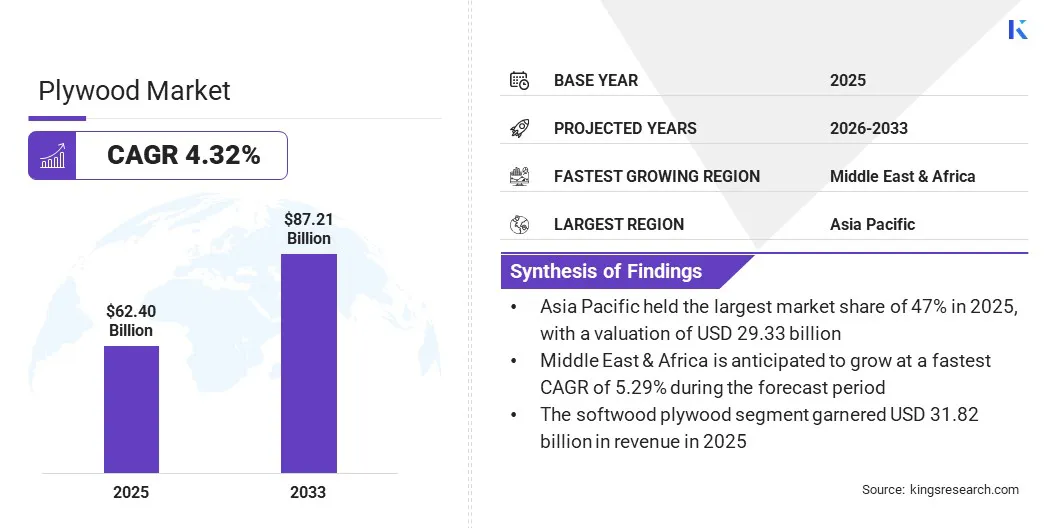
The global market size was valued at USD 62.40 billion in 2025 and is projected to reach USD 87.21 billion by 2033, exhibiting a CAGR of 4.32% during the forecast period. This growth is fueled by the rising demand for durable and easy-to-use construction materials in residential, commercial, and industrial construction projects. The market is also experiencing innovations in manufacturing processes, such as the adoption of advanced adhesive technologies and automated production lines, which ensure product quality and consistency.
Major companies operating in the global plywood market are Georgia-Pacific, Weyerhaeuser Company, West Fraser Timber Co., Boise Cascade, UPM, SVEZA, Metsä Group, ARAUCO, AS Latvijas Finieris, Columbia Forest Products, Juken New Zealand, CenturyPly, Eksons Corporation Berhad, Linyi Dingyu Wood, and Kronoplus Limited.
Companies are also incorporating precision engineering methods to manufacture plywood that offers high strength, moisture resistance, and dimensional stability to achieve industry standards. These advancements ensure that plywood products offer superior performance for applications in furniture, flooring, and structural components. As a result, the use of high-quality plywood continues to expand, supporting the market’s upward trajectory.
Rapid urbanization remains a primary catalyst for market progress, as the massive migration of populations to urban centers necessitates substantial infrastructure development. This influx of urban living contributes to growing government-led Smart City projects, public transport stations, as well as private residential complexes and commercial office spaces. The government continues to invest heavily in the public sector, particularly in government-funded projects such as social housing, educational institutions, and transport infrastructure.
Plywood is a core material in such developments and is widely used as structural frameworks, concrete formwork, and interior partitions. The combination of large-scale public and private sector growth offers the plywood industry a stable, long-term demand base, supporting its long-term growth trajectory in both developing and developed economies.
The market faces significant operational hurdles due to the scarcity and severe price volatility of essential raw materials. The cost of manufacturing is under constant pressure, as rising procurement costs for high-quality timber veneers continue to strain the profit margins across the industry. This inflationary environment is further compounded by record-high costs for chemical adhesives and stringent environmental mandates, such as the EU Deforestation Regulation (EUDR), which have limited the global supply of certified wood.
To reduce such risks, major manufacturers are entering into long-term agroforestry collaborations to stabilize timber pipelines and ensure a steady flow of sustainable feedstock. In addition, firms are using AI-driven inventory control and predictive analytics to cushion against market instability and to maintain price competitiveness.
The market is undergoing a structural transformation driven by the dual forces of digitalization and sustainability. With increasing environmental restrictions, manufacturers are shifting toward environmentally friendly production practices. To meet the growing need for non-toxic, carbon-neutral building materials, they are using formaldehyde-free resins and timber from FSC-certified plantations.
Alongside these green projects, the introduction of Industry 4.0 technologies is streamlining the value chain. AI-based scanning systems are minimizing wood waste during the peeling process, and blockchain traceability is providing transparent evidence of legal sourcing. These innovations are improving operational efficiency, ensuring compliance, and helping companies gain a competitive advantage in a global market that is rapidly becoming more eco-conscious.
|
Segmentation |
Details |
|
By Wood Type |
Softwood Plywood, Hardwood Plywood, and Tropical Plywood |
|
By Application |
Construction, Furniture & Cabinetry, Flooring, and Packaging & Industrial |
|
By End Use |
Residential, Commercial, and Industrial/Other |
|
By Region |
North America: U.S., Canada, Mexico |
|
Europe: France, UK, Spain, Germany, Italy, Russia, Rest of Europe |
|
|
Asia-Pacific: China, Japan, India, Australia, ASEAN, South Korea, Rest of Asia-Pacific |
|
|
Middle East & Africa: Turkey, U.A.E., Saudi Arabia, South Africa, Rest of Middle East & Africa |
|
|
South America: Brazil, Argentina, Rest of South America |
Based on region, the global plywood market has been classified into North America, Europe, Asia Pacific, Middle East & Africa, and South America.
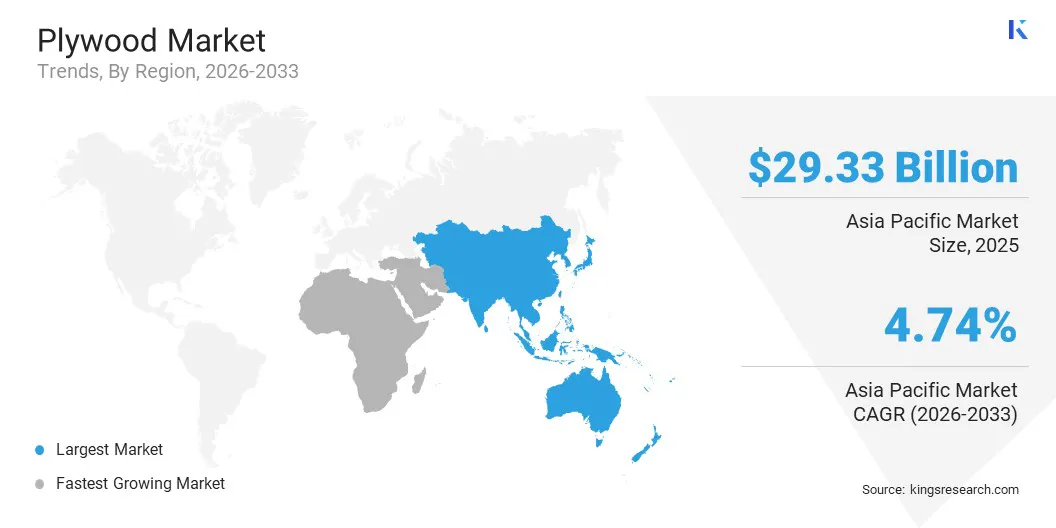
Asia Pacific plywood market share stood at 47% in 2025, valued at USD 29.33 billion. The region’s leading position is supported by sustained growth in the construction, interior design, and furniture manufacturing industries. Growing urbanization and rising consumer expenditure on residential and commercial projects have resulted in tremendous demand for plywood across these sectors.
The presence of an extensive supply chain and access to raw materials ensures a steady flow of production, contributing to the region’s competitive advantage. Furthermore, advancements in manufacturing technologies and an increasing emphasis on sustainable practices are enhancing product quality and marketability, establishing Asia Pacific as a key hub in the development and distribution of plywood.
The Middle East & Africa plywood industry is set to grow at a CAGR of 5.29% over the forecast period. This growth is supported by rising construction activities, especially in urban infrastructure, hospitality, and commercial projects. Rising investment in affordable housing and government-led development initiatives is also contributing to increased demand for plywood in the region.
The market is also experiencing growing interest in interior renovation and modernization, along with a shift toward sustainable and versatile building materials. Logistics and distribution chains are improving, thereby enhancing the supply of plywood products in the region. As a result, the Middle East & Africa region is emerging as an attractive market for plywood manufacturers seeking to capitalize on expanding construction and design opportunities.
The competitive environment of the plywood industry is dynamic and characterized by the presence of many global and regional manufacturers, resulting in a highly fragmented yet highly competitive landscape. Companies compete on factors such as product quality, pricing, innovation, and distribution reach. The industry is increasingly focused on the production of advanced plywood products that offer greater durability, moisture resistance, and environmental sustainability to meet changing customer preferences.
Strategic partnerships, capacity expansions, and investments in research and development are common strategies adopted to gain a competitive edge. Moreover, manufacturers are placing increased emphasis on sustainable sourcing of raw materials and adherence to environmental standards, which have become key differentiators in the market. Continuous technological advancements and customization options further intensify the competition among market participants.
Frequently Asked Questions

Aswathi holds cross-domain expertise, translating market trends and competitive intelligence into decision-ready insights. Her work helps clients interpret evolving market conditions and identify growth opportunities. She brings a focused, insight-led approach to research execution. She translates these findings into clear, prioritized action plans that align with client capabilities. Her research often includes scenario modeling to test growth strategies under varying economic conditions. She maintains a rigorous validation process, cross-checking primary and secondary sources to ensure reliability. Clients value her ability to synthesize noisy data into concise executive summaries that drive board-level discussions. Her sector-specific lens, combined with a pragmatic focus on execution, consistently delivers high-impact, commercially sound recommendations. Her structured yet flexible research frameworks adapt to client timelines without compromising depth. She is known for distilling complex trade-offs into straightforward, defensible positions that facilitate confident decision-making.
Habi is a seasoned research and consulting leader with renowned experience in guiding clients on strategic growth and transformation initiatives across global markets. He has led high-performing research teams that deliver actionable insights on market expansion, M&A strategies, opportunity assessment, new business development, and product launches. His project portfolio spans large petrochemical producers, electronic device manufacturers, lubricants companies, and other leading enterprises across diverse industrial and consumer sectors. He currently heads the research department at Kings Research, where he is responsible for setting the research agenda, mentoring analysts, and ensuring client-ready deliverables that support executive decision-making. With extensive experience in market intelligence, strategic research, and consulting, Habi brings a strong understanding of evolving industry dynamics, competitive landscapes, emerging opportunities, and business growth challenges. His expertise includes developing research frameworks, translating complex market data into actionable strategic recommendations, and working closely with senior stakeholders to address critical business questions. He has also contributed to building research capabilities, strengthening analytical methodologies, and driving a culture of quality and insight-led decision-making within research teams. His cross-industry exposure enables him to connect market trends with broader business implications and provide perspectives that help organizations identify opportunities, mitigate risks, and make informed strategic decisions.