


Which workflows are suitable for agents? Agentic AI is ushering in a new era of automation for enterprises worldwide. Understanding why agentic AI and other AI-related markets are changing could point organizations in the right direction. As the human resources approach changes from a basic administrative role to strategic business decision-making, streamlining HR workflows becomes essential. Repetition, frequent handoffs, and defined triggers are key signals in identifying workflows that are suitable for AI agent adoption.
Enterprise efforts to promote integration of advanced AI tools and improve ROI across different divisions also drive AI agent demand. When it comes to AI, the question is mostly “Where should we put an AI agent?” However, the question should be “Which business workflows contain repetitive coordination, clear rules, multiple systems, and frequent handoffs?” Kings Research can help your business identify the insights beyond what data shows.
AI agent adoption in HR workflows is expected to jump 327% by 2027, as per a Salesforce survey. The same survey states that more than four in five HR chiefs are reskilling or are planning to reskill their workers to be more competitive in a market shaped by AI agents. These statistics point towards a market with immense potential, but whether it can be realized is what will matter in the long run. What does it cost, and what does it save? The question that would be asked before any deployment is the one that matters. While the cost is completely dependent on the specific workflow and preference, savings can be estimated to a certain extent.
Reduction in Labor Costs through AI Agents
The more useful question is not simply how large the opportunity is, but where the economics, workflow complexity, and readiness of an organization make that opportunity actionable. Apart from productivity gains, AI agent adoption in HR workflows can also help companies make significant savings in labor costs. Reduced requirement of HR professionals per employee due to AI agent adoption automatically translates to more profits and reduced expenses.
CHROs expect a 19% reduction in labor costs once AI agents are implemented fully in organizations. This is equivalent to USD 12,313 per employee based on the OECD (Organisation for Economic Co-operation and Development) average annual wage for 2025.
The cost savings change based on wage levels, workflow intensity, employee volumes, and other factors, which makes identifying the workflows more imperative as per our analysis.
Per Employee Cost Reduction as Per OECD Averages
Our analysts have compared the cost reduction for major countries, and this shows significant per-employee savings can be achieved for a firm in the said countries. The most substantial savings can be seen in the United States due to it being a leader in overall agentic AI adoption globally. The cost reduction will not be identical across countries due to differences in adoption and labor costs. For businesses evaluating adoption, geography is therefore not just a market statistic but a part of the business case.
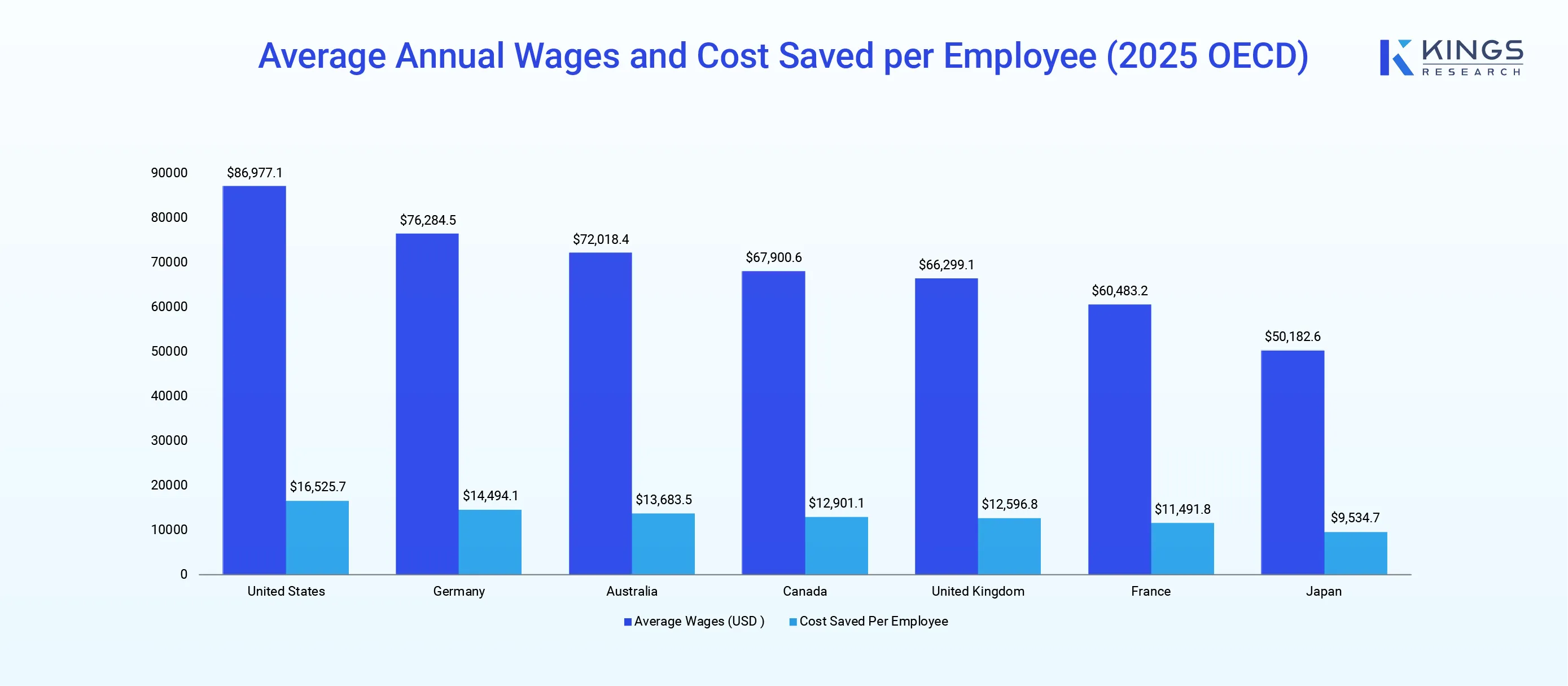
Kings Research Analysis & OECD
Global Agentic AI Adoption Stage by Company Size, 2026
|
Adoption Stage |
Enterprise (%) |
Mid-Market (%) |
SMB (%) |
|
Experimentation |
60-65 |
68-72 |
75-80 |
|
Partially Deployed |
12-15 |
15-20 |
8-12 |
|
Fully Deployed |
8-10 |
5-7 |
3-5 |
|
Fully Deployed at Scale |
10-15 |
3-5 |
1-3 |
Source: Secondary and Primary Research, Kings Research Analysis
Our research depicts how enterprises are leading the agentic AI adoption charge irrespective of the stage of adoption. This can be attributed to their high spending potential and access to a vast pool of resources. However, experimentation with AI agents is quite substantial in SMBs owing to their organizational agility and operational necessity. This indicates that a unified and predictable approach to AI agent adoption cannot be devised; the signal is the variation between experimentation and deployment.
Will Agentic AI Eliminate the Need for Human Input in HR Workflows?
Our take is that eliminating human input in HR workflows would not be a smart decision. Offering an AI agent that works with human input or oversight is a much better and preferred approach.
Traditional automation follows predefined rules: if an employee submits a request, it routes it to a particular queue. Generative AI adds a layer of intelligence, allowing HR business partners (HRBPs) to generate content, summarize information, or answer questions using natural language. Agentic AI adds agency.
An AI agent can receive a goal, determine the steps needed to achieve it, use connected tools and systems, monitor the outcome, and adapt when conditions change. Instead of answering a question about onboarding, for instance, an agent could initiate the onboarding workflow, check which tasks have been completed, remind the relevant stakeholders, and escalate an exception.
- SAP's research involving 4,019 employees globally found that 80% of employees believe AI agents should assist their work rather than oversee it. Meanwhile, 58% said they would have a positive perception of their manager if that manager were augmented by AI agents.
This points to a future where human-agent collaboration is a priority instead of replacing humans with AI agents. However, the agentic AI market is moving faster in expectation than in implementation, which is why evaluation of workflows is necessary before deployment of any AI agent.
In Which HR Workflows Can AI Agents Be Deployed?
Onboarding, training, employee engagement, performance management, talent acquisition, and HR administration are some of the key HR workflows that can benefit from agentic AI adoption. AI agents can initiate actions, coordinate tasks across teams and systems, follow predefined rules, and hand off exceptions to HR teams, making them essential in almost all HR workflows.
Talent Acquisition
AI agents can analyze a vast amount of resumes in a short time and shortlist candidates much faster than any HR professional. This is especially useful for organizations handling a massive amount of applications. AI agents can schedule interviews, offer better candidate assessment, and employ generative AI for communication as well. The need for candidates and HR professionals to wait around for responses can be eliminated or at least fast-tracked through AI agent adoption.
- As per statistics listed in a FirstPageSage report, a 40% reduction in time-to-hire is expected to be recorded as AI agents are deployed in HR talent acquisition workflows.
Onboarding and Training
Automation of document verification, background checks, and IT requests can help smooth out the employee onboarding experience. AI agents can also answer common questions, helping new hires transition into their new roles. AI agents can also suggest new training and learning programs to help employees upskill and enhance their productivity.
- AI agent deployment is anticipated to improve employee productivity by up to 30% as per a Salesforce survey.
- As per recent surveys, organisations that invest in upskilling and reskilling are 2.5 times more likely to achieve positive business outcomes from AI.
Performance Management
AI agents can create actionable goals and career development plans for employees to enhance productivity. If access to employee data is provided, AI agents can continually update and offer real-time feedback for performance and productivity improvement. Integration with different HR and employee tools is also necessary for proactive performance management.
Streamlining HR Management and Administration
Benefits administration, compliance management, payroll processing, and interview summarization are some key tasks of human capital management. AI agents can automate most of these processes with minimal oversight requirements. AI self-service agents and portals allow employees to submit requests and get a proper resolution without increasing administrative load on HR professionals.
Employee Engagement and Retention
AI agents can proactively analyze data to address employee needs before they arise. This helps in improving the overall work culture and reducing friction. AI agents can recommend new career paths and link them with appropriate growth opportunities in the organization. Personalization of employee experience and communication helps maintain a healthy work culture and allows HR professionals to focus on intricate matters.
As per Kings Research, recruitment, onboarding, employee service, and offboarding are particularly well suited for agentic AI adoption because they involve repeatable processes with defined triggers and outcomes.
How Agentic AI Helped AMD Transform Its HR Workflows?
AMD partnered with Kore.ai to transform HR support for its 30,000-employee global workforce. The company applied its AI expertise internally to simplify HR workflows and improve the overall employee experience as well.
The Challenge
AMD needed to support a large, globally distributed workforce through a relatively small HR contact-center team, while working across multiple HR systems.
- Inconsistent user experience across multiple HR tools and channels
- HR transactions and processes were lengthy, with some taking up to 12 minutes to complete
- High volume of repetitive queries from managers and employees
The Solution
AMD deployed a generative AI-powered HR Agent that:
- Offered unified support across SAP SuccessFactors, ServiceNow, and Microsoft SharePoint for seamless HR workflows
- Delivered role- and region-specific responses to ensure relevance.
- Enabled managers to approve transactions in Microsoft Teams, including HR, travel, expenses, and finance approvals.
- Escalated critical issues to HR professionals.
- Used an API-based orchestration layer for cross-system actions and process automation.
Business Impact
AMD reported:
- 80% reduction in HR resolution time
- 50% self-service deflection
- 95% intent recognition rate
- 70% increase in employee satisfaction
Key Takeaway
AMD's deployment demonstrates how a generative AI-powered HR Agent can bring self-service, transactions, approvals, escalation, and cross-system orchestration into a single HR support experience. The case study is a testament to what a good workflow redesign in combination with agentic AI can do. AMD shows how investment translates into workflow redesign, employee interaction, and measurable operational outcomes.
American technology firms such as AMD are expected to lead the transformation of HR workflows through the deployment of AI agents. According to Kings Research, the software and technology industry held a USD 1.24 billion valuation in 2025 in the U.S. agentic AI market. Robust tech executive confidence in AI adoption, coupled with significant AI investments around the world, is making tech companies leaders in agentic AI adoption.
According to recent surveys, nearly half of executives working at tech companies stated that more than half of their total AI budget is allocated toward agentic AI. This shows how important agentic AI is expected to be in almost all companies in the future. If the outlook for tech is so bright, the potential for other industries is expected to be positive in the long run as well. The boom of agentic AI is also giving birth to new organizational structures and blueprints that could rewrite the way businesses operate.
What are Frontier Firms?
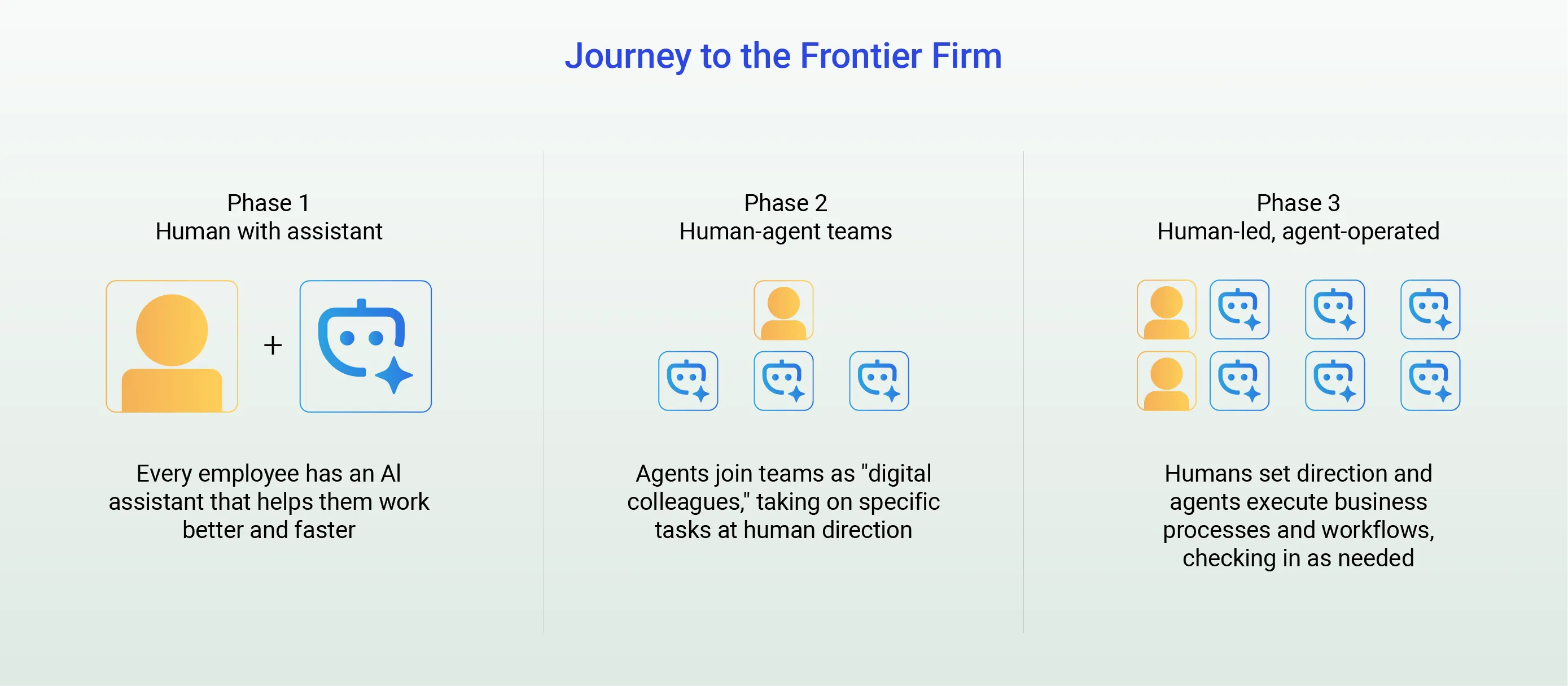
Frontier firms are organizations that are powered by intelligence on tap, human-agent teams, and a new role for all employees as agent bosses. Microsoft published a new report detailing the journey of organizations becoming Frontier Firms in April 2025. This new organizational blueprint is expected to take years to deliver on its promise, just like previous technological revolutions. However, understanding the roadmap of frontier firms can help HR leaders map the organizational challenges and changes required to boost human-agent collaboration potential.
Microsoft’s report has provided a visual representation of how it expects an organization to transform into a frontier firm going forward.
Does your organization have the potential to be a frontier firm? Our analysts can help you identify the possibilities and reduce friction towards becoming a frontier firm.
When Can We See HR Teams Fully Embracing Agentic AI?
As per analysts at Kings Research, agentic AI use is slated to rise in HR workflows over the next five years. Around 50% of current HR activities could be AI-automated or be performed by AI agents by 2030. AI agents alone won’t be transforming HR workflows, but a careful redesign of enterprise processes and workflows will be necessary for successful agentic AI adoption. So, HR workflows with repetitive processes are expected to be most suitable for agentic AI adoption.
- Just 15% of CHROs say their organization has fully implemented agentic AI.
- 73% say their employees remain unaware of how AI agents will impact their work.
These statistics from Salesforce prove that despite the high potential of AI agents in HR workflows, the adoption remains limited at present.
Kings Research has also found that around 90% of organizations are utilizing AI in at least one business function, and most report they have delivered an earnings impact of only around 5%. This further complicates agentic AI deployment, as companies cautiously explore their ROI on AI investments. In conclusion, the use of agentic AI in HR workflows is expected to ramp up, but meticulous planning and redesigning of workflows is necessary to make it successful.
Find out more about how HR technology is expected to change with the advent of agentic AI with Kings Research.