Inquire Now
Key Strategic Points
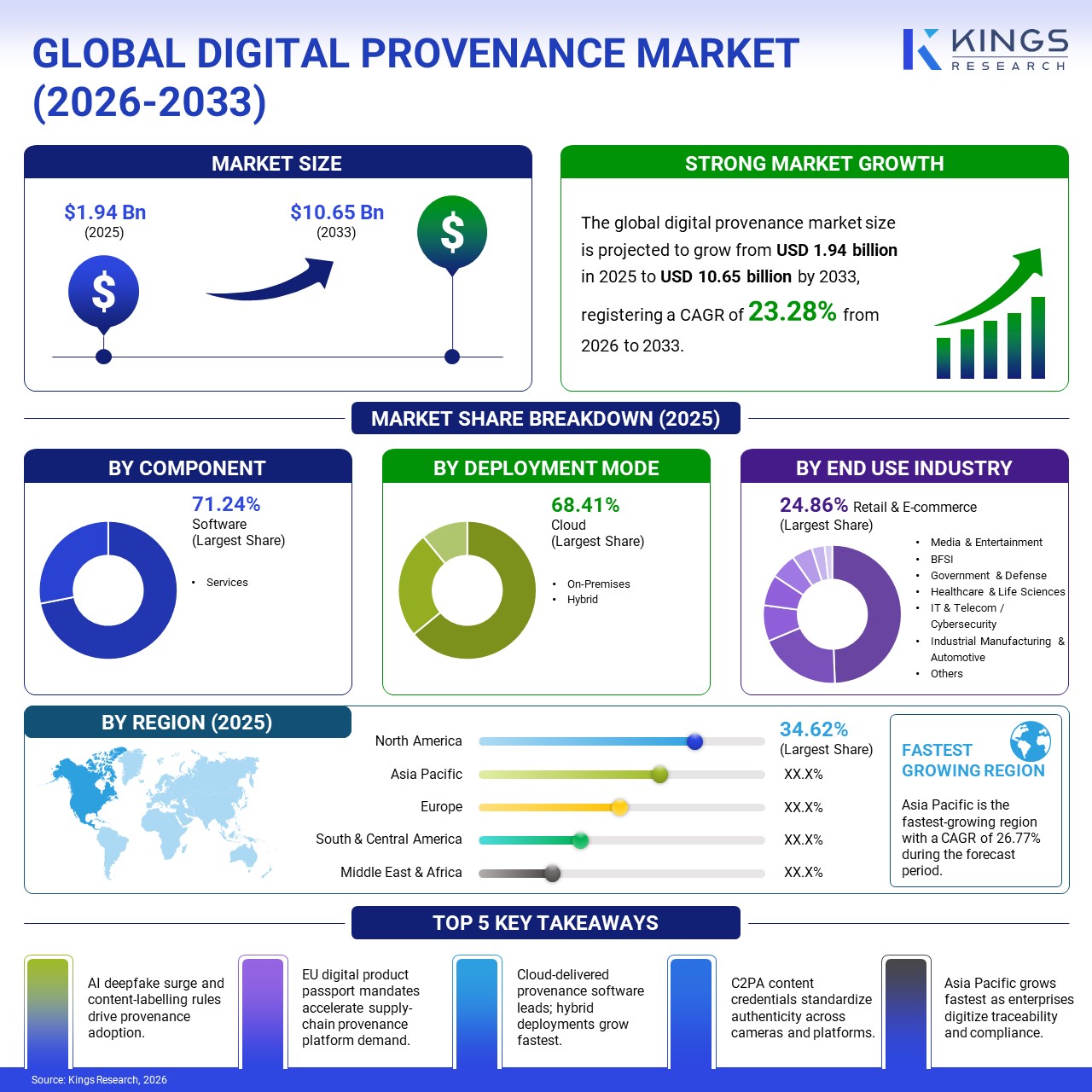
According to Kings Research, the global digital provenance market size was USD 1.94 billion in 2025 and is projected to grow from USD 2.46 billion in 2026 to USD 10.65 billion by the end of 2033, exhibiting a CAGR of 23.28% during the forecast period (2026-2033).
Market growth is driven by tightening regulations on AI-generated content and rising concerns over deepfakes in fraud, impersonation, and disinformation. Digital product passport rules and supply chain traceability programs are further fostering demand from manufacturers and retailers. The evolution of the digital content industry toward verifiable media is changing how images, video, audio, and product records are created and shared.
Content credentials based on the C2PA standard, invisible watermarks, and AI-based detection are being integrated with cameras, creative software, cloud platforms, and enterprise workflows. Software remains the primary commercial layer of the market, as publishers, platforms, banks, insurers, and brands license signing, watermarking, detection, and traceability tools. Cloud delivery and application programming interfaces (APIs) make it easier for organizations to add provenance checks to existing systems without large upfront investment.
Increasing regulatory requirements around AI-generated and manipulated content are driving demand for digital provenance solutions by creating a greater need for content authenticity, transparency, and traceability. Identifying AI-generated data has become imperative for organizations to ensure the credibility of digital assets. This is encouraging the adoption of provenance technologies that enable reliable verification of digital content and help preserve data authenticity throughout its lifecycle.
Governments are emphasizing making AI-content labeling a regulatory standard, which significantly fuels demand for solutions that enable AI providers, platforms, and publishers to identify and disclose AI-generated content at scale. Article 50 of the European Union Artificial Intelligence Act introduces transparency requirements for AI-generated and manipulated content, including machine-readable markings to identify synthetic content. Effective August 2, 2026, the Act requires relevant AI providers and deployers to disclose certain AI-generated content and deepfakes.
China’s measures for identifying AI-generated and synthetic data, effective September 2025, mandate explicit labeling and embedded metadata identifiers for AI-generated text, images, audio, and video. The regulations further encourage digital watermarking and require online platforms to identify and disclose synthetic content, strengthening traceability and transparency.
Additionally, technology providers are scaling their marking and verification tools in response to these rules. In May 2026, Google expanded its content transparency and verification tools across Search, Gemini, Chrome, Pixel, and Google Cloud, thereby creating checkpoints for its users. The company applied SynthID watermarks to more than 100 billion images and videos, thus improving content authenticity, traceability, and verification across digital platforms.
The alteration of provenance data during content transfer, editing, and distribution poses a significant challenge to consistent content verification. Metadata removal and watermark manipulation create authentication gaps, increasing verification risk and limiting buyer confidence across media, insurance, and legal applications. To address the challenge, industry stakeholders are strengthening provenance solutions through standardized frameworks and integrated technologies that preserve content authenticity, enable credential recovery, and improve verification across digital platforms.
The Content Credentials Deployment Guidance (version 1.0, released on July 8, 2026) by the Coalition for Content Provenance and Authenticity (C2PA) outlined a standardized framework for establishing verifiable digital provenance and AI transparency across images, video, audio, and documents. This prevents records from being altered by securing metadata with invisible watermarking and digital fingerprinting to create "Durable Content Credentials." The framework further promotes integrity through cryptographically signed metadata, verification tools, and the integration of watermarking and fingerprinting technologies.
Furthermore, technology providers are translating these standards into operational solutions by embedding provenance and verification capabilities directly into AI workflows. In May 2026, Digimarc Corporation introduced provenance and verification infrastructure for autonomous AI workflows, built on the C2PA standard. The infrastructure features a Model Context Protocol (MCP) server powered by the Digimarc Illuminate platform that enables organizations to stamp, verify, and audit AI-driven content via policy-gated trust seals.
Hardware-signed capture integrates cryptographic signing directly into camera and smartphone silicon. Hardware-signed C2PA camera credentials establish provenance of digital images by embedding cryptographic signatures. The increasing emphasis on data integrity, auditability, and regulatory compliance highlights the importance of implementing robust access controls, logging mechanisms, and secure record-retention practices.
Hardware-signed capture creates secure, tamper-resistant digital signatures that establish media provenance and prevent undetected manipulation. Market players are increasingly adopting hardware-based authentication to enhance digital content provenance and authenticity verification. In September 2025, Google introduced C2PA Content Credentials across its Pixel 10 smartphone lineup and Google Photos, strengthening its position in digital content authenticity and provenance. The technology leverages hardware-backed security, cryptographic signatures, and trusted timestamps to verify the origin and editing history of digital images.
|
Segmentation |
Details |
|
|
By Component |
Software and Services |
|
|
By Technology |
AI & ML, Cryptographic Signing/PKI (C2PA), Digital Watermarking, Blockchain/Distributed Ledger, Digital Forensics, NLP Analytics, and Others |
|
|
By Deployment Mode |
Cloud, On-Premises, and Hybrid |
|
|
By Enterprise Size |
Large Enterprises and SMEs |
|
|
By End Use Industry |
Media & Entertainment, BFSI, Government & Defense, Retail & E-commerce, Healthcare & Life Sciences, IT & Telecom/Cybersecurity, Industrial Manufacturing & Automotive, and Others |
|
|
By Region |
North America |
U.S., Canada, and Mexico |
|
Europe |
France, UK, Spain, Germany, Italy, Russia, and Rest of Europe |
|
|
Asia Pacific |
China, Japan, India, Australia, ASEAN, South Korea, and Rest of Asia Pacific |
|
|
Middle East & Africa |
Turkey, U.A.E., Saudi Arabia, South Africa, and Rest of Middle East & Africa |
|
|
South & Central America |
Brazil, Argentina, and Rest of South & Central America |
|
The cryptographic signing/PKI (C2PA) segment is expected to register a CAGR of 28.28% over the forecast period. The C2PA standard enables creators, publishers, and consumers to verify the origin, history, and integrity of digital content through tamper-evident content credentials, thus supporting informed decisions about digital media authenticity while complementing fact-checking and media literacy. The segment growth is driven by the adoption of the open C2PA standard by camera makers, smartphone brands, creative software companies, and social platforms, along with the need for public key infrastructure (PKI) certificates to sign and verify content.
In February 2026, the Coalition for Content Provenance and Authenticity (C2PA) the Coalition for Content Provenance and Authenticity (C2PA) introduced Content Credentials 2.3, expanding digital provenance capabilities across live video, audio, documents, and other media formats. The adoption of Content Credentials by over 6,000 members and affiliates reflects growing industry adoption of content authentication, traceability, and transparency solutions.
The retail & e-commerce segment held the largest share of 24.86% in 2025, driven by brand protection programs, anti-counterfeiting tools, and product traceability platforms that verify the origin of goods sold online. Data provenance enables effective tracking of key product and transaction details, including materials, production dates, inventory updates, and order histories. This prevents stock discrepancies and unfulfilled orders, empowering retailers to maintain accurate historical records, resolve customer disputes, provide accurate order statuses, and protect brand loyalty.
According to the Organization for Economic Co-operation and Development (OECD) and the European Union Intellectual Property Office (EUIPO) report published in May 2025, counterfeit goods pose significant risks to consumer safety, intellectual property rights, and legitimate businesses. Clothing, footwear, and leather goods accounted for 62% of seized counterfeit products, while counterfeiters increasingly expanded into sectors such as medicines, automotive parts, cosmetics, and food. This scale of counterfeit trade underscores the need for retailers and brands to verify product authenticity across online sales channels.
The global digital provenance market is segmented into North America, Europe, Asia Pacific, Middle East & Africa, and South & Central America.
North America
North America held the largest share of 34.62% in 2025. The U.S. leads regional demand owing to the presence of major generative AI providers and specialist vendors offering digital watermarking, content authentication, and deepfake detection solutions. Rising regulatory scrutiny and the need for digital data accountability are further driving regional market growth.
Asia Pacific
Asia Pacific is expected to register the fastest CAGR of 26.77% during the forecast period. China, Japan, South Korea, and India are home to large generative AI providers, social platforms, and electronics makers that must now label or verify synthetic content. Strong smartphone and camera manufacturing in the region also supports the spread of signed capture. The Sumsub Identity Fraud Report published in November 2025 found that deepfakes accounted for 11% of first-party fraud cases across the globe in 2025. This mandates stronger legal frameworks, detection technologies, digital watermarking, and standardized metadata to track the origin and modification of digital content.
Europe, Middle East & Africa, and South & Central America
Germany, France, and the UK lead demand in Europe, supported by the AI Act's transparency rules, strong public broadcasting and news sectors, and early adoption of product traceability in automotive, battery, and textile supply chains.
The prevalence of suspected AI-generated or manipulated child imagery has increased significantly, with 397 reports of suspected fabricated imagery recorded in 2025 in the UK, according to the Internet Watch Foundation (IWF) data published in August 2026. The figure reached 420 reports in the first six months of 2026 alone, indicating a notable upward trend in reported cases.
The data encompasses all reports submitted by children, regardless of whether the imagery met the legal threshold for classification as child sexual abuse material (CSAM). This highlights the growing need for robust AI-generated content detection, digital provenance solutions, and content authentication technologies to strengthen child safety and trust in digital media ecosystems.
The digital provenance market remains fragmented, with competition spanning technology providers and specialist authentication and deepfake detection vendors. Key differentiators include authentication accuracy, digital signature and watermarking capabilities, C2PA compliance, and seamless integration with enterprise workflows. Market participants are strengthening their competitive positions through strategic technical partnerships, platform integrations, and product enhancements to expand industry reach and address growing demand for trusted digital content.
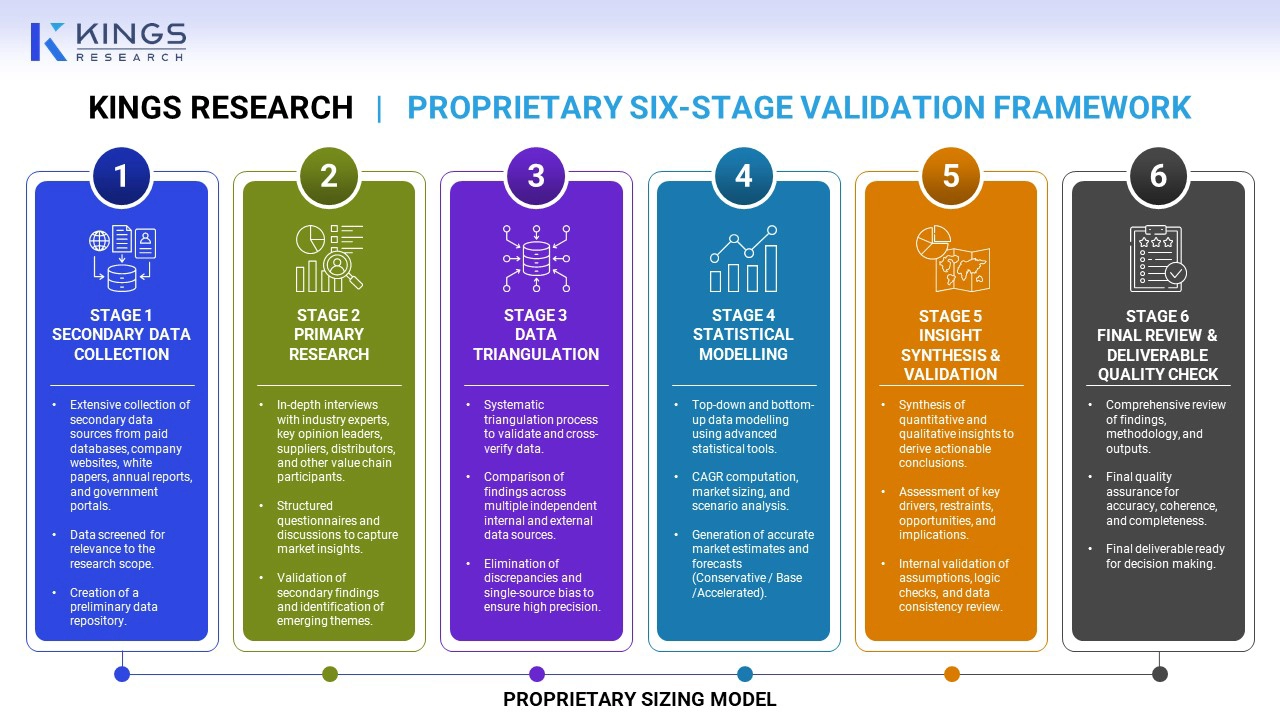
Our methodology triangulates insights from multiple independent and publicly available research databases, which are further validated against regulatory filings and public company disclosures. All estimates are cross-verified; no single-source data is presented without validation.
 Custom Offerings
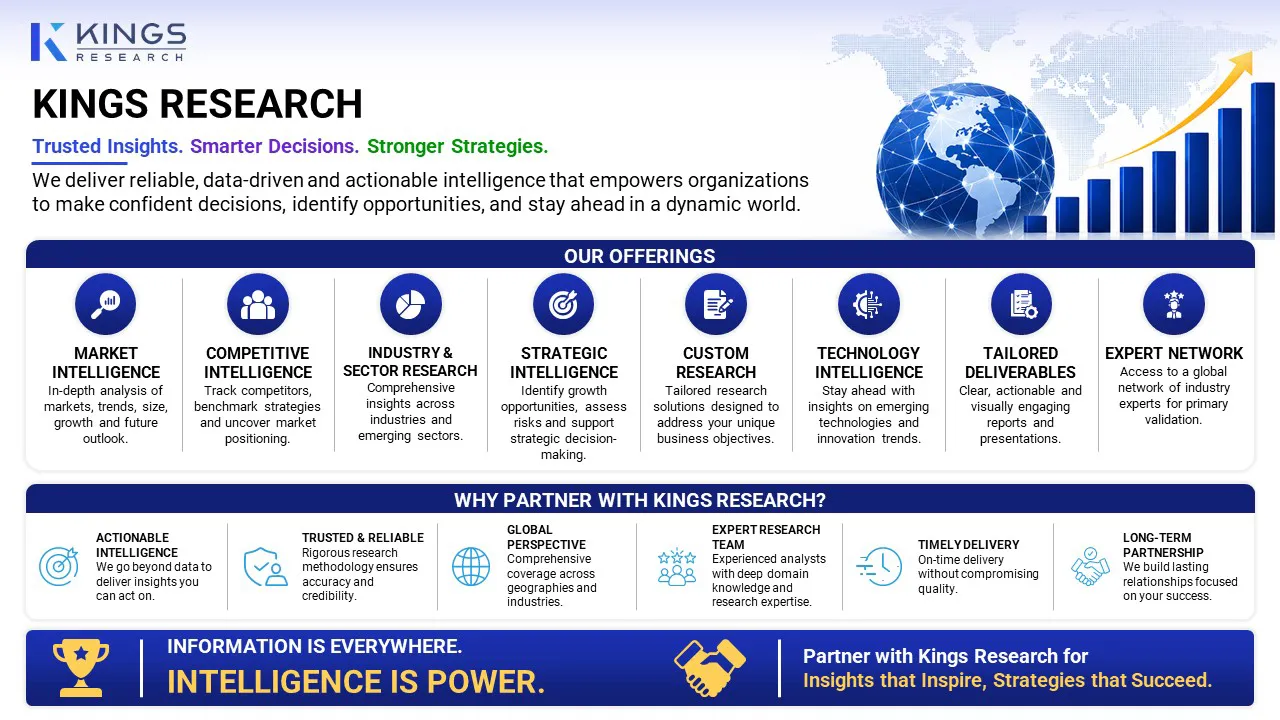
We deliver tailored, data-driven intelligence and strategic guidance to help organizations identify, evaluate, and capitalize on key market opportunities.
Frequently Asked Questions

Faizy brings over four years of experience in market research and consulting, with a proven ability to support strategic engagements across diverse industries and business environments. His work focuses on understanding complex market structures, identifying emerging opportunities, and translating research findings into clear, commercially relevant insights. With strong analytical capabilities and a structured approach to problem-solving, he evaluates industry trends, competitive landscapes, customer dynamics, and evolving business models. His expertise encompasses market research, competitive intelligence, market sizing and forecasting, industry assessment, company benchmarking, and strategic analysis. Faizy combines technical proficiency with a strong research orientation, enabling him to interpret both qualitative and quantitative information effectively. He has contributed to projects that help organizations assess growth potential, strengthen market positioning, and evaluate strategic priorities. His adaptable approach allows him to work across sectors while maintaining a consistent focus on accuracy, relevance, and delivering insights that support informed decision-making for clients and stakeholders.
With many years of consulting experience across global pharma, biotech, and MedTech markets, Minaz brings deep domain expertise, strategic clarity, and analytical rigor to every engagement. She has led 130+ consulting assignments spanning market entry, competitive landscaping, and portfolio prioritization, helping clients navigate complex, high-stakes decisions with confidence. Known for her ability to synthesize primary and secondary research into executive-ready recommendations, Minaz has built forecasting models and market sizing frameworks that have informed multi-million dollar investment decisions in oncology, diagnostics, and peptide therapeutics. Beyond her analytical strength, Minaz is a trusted client partner, translating complex datasets into clear, actionable insights for senior stakeholders. She currently leads a team of research analysts, driving business expansion, and shaping client engagement strategy.