Inquire Now
Key Strategic Points
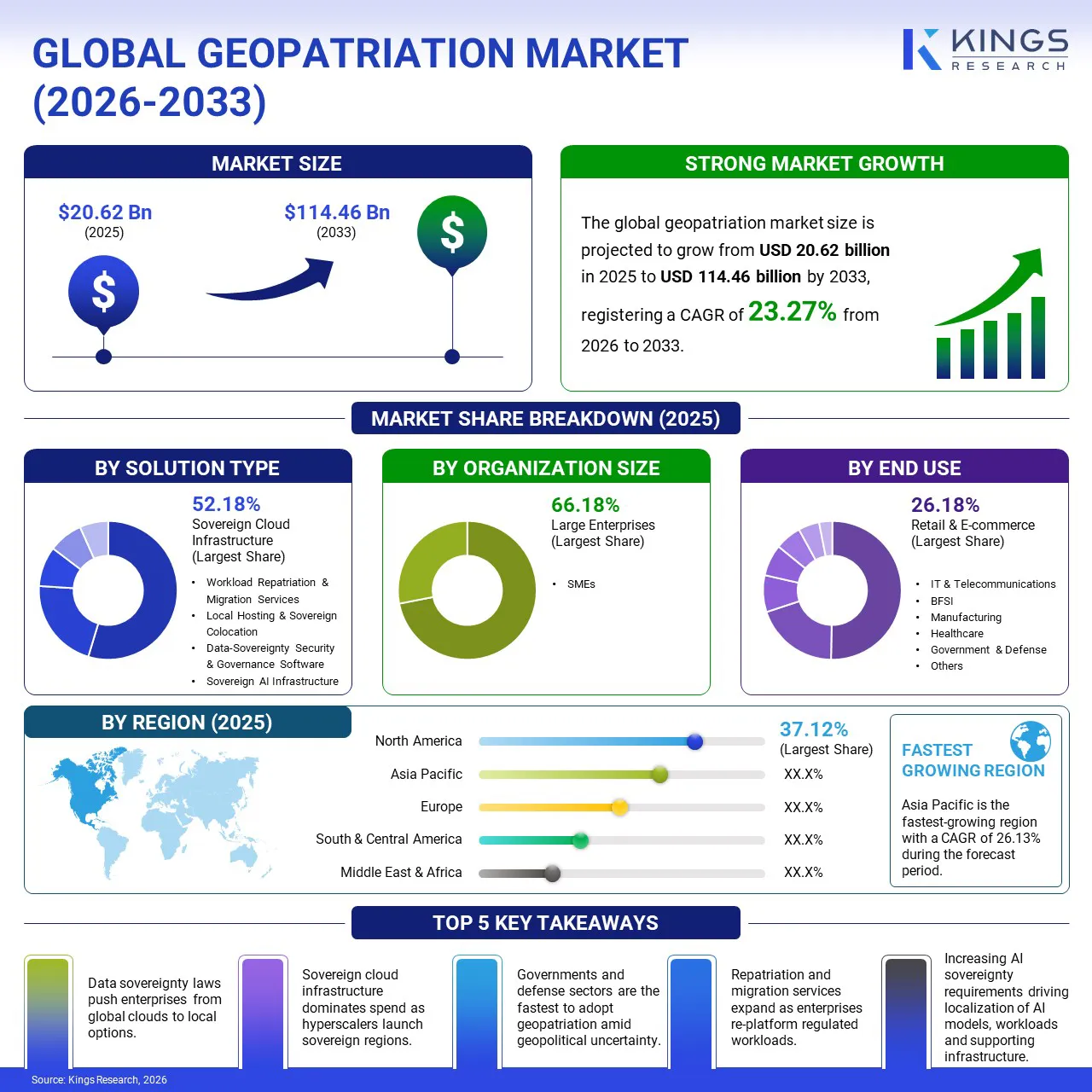
According to Kings Research, the global geopatriation market size was USD 20.62 billion in 2025 and is projected to grow from USD 26.47 billion in 2026 to USD 114.46 billion by the end of 2033, exhibiting a CAGR of 23.27% during the forecast period (2026-2033).
Market growth is driven by rising concerns over foreign jurisdiction and service continuity, prompting enterprises and governments to shift data and applications from global public clouds to sovereign, regional, or on-premises environments. Data sovereignty regulations, cloud-switching rights, and public-sector procurement requirements are further accelerating adoption.
In response, global hyperscalers are expanding sovereign cloud offerings, while regional cloud providers, telecommunications operators, and system integrators are developing locally governed infrastructure, certified cloud services, and workload migration capabilities. Sovereign cloud infrastructure represents the largest solution category, supported by demand for locally hosted compute, storage, and networking resources.
Adoption is particularly pronounced among government entities and regulated industries, where data localization, operational autonomy, and compliance requirements are key procurement considerations.
Increasing geopolitical uncertainties and stringent data protection regulations across regions are accelerating enterprise adoption of geopatriation solutions to ensure greater control over data location, jurisdiction, and regulatory compliance. This rising need for operational resilience, reduced dependence on foreign cloud providers, and secure management of sensitive enterprise and AI workloads is further accelerating the shift from global public cloud environments to regional sovereign clouds, private infrastructure, and on-premises deployments. Enterprises and public-sector organizations across regions are prioritizing data localization, jurisdictional control, and flexibility in cloud infrastructure by adopting sovereign cloud environments that operate independently of global cloud infrastructure and remain under regional operational control.
In October 2026, AWS successfully conducted an exercise demonstrating the operational independence of its European Sovereign Cloud by operating without connectivity to its global network infrastructure. The exercise validated the ability of AWS to function entirely within the EU using EU-based personnel and infrastructure. The initiative illustrates how hyperscalers are responding to sovereignty requirements through technical and regulatory compliance across European markets.
Moreover, regulatory developments and sovereign cloud investments are further enabling organizations to reduce reliance on foreign cloud infrastructure and retain greater control over sensitive data and workloads. According to the European Commission, the EU Data Act, applicable since September 12, 2025, establishes safeguards against unlawful third-country government access to non-personal data held within the EU. Furthermore, from January 12, 2027, cloud providers will be prohibited from imposing switching charges, including data egress fees, reducing financial barriers to cloud migration. These regulatory provisions are anticipated to facilitate workload migration to sovereign and regional cloud providers while strengthening data sovereignty, reducing vendor lock-in, and driving geopatriation market growth.
The high dependence of enterprises on globally distributed cloud infrastructure and challenges associated with data migration restrain geopatriation market growth. Migrating data workloads to sovereign or geographically localized environments requires organizations to address data residency, regulatory compliance, application architecture, security, and infrastructure standardization. Applications built around hyperscaler-managed databases, analytics platforms, and AI services often require substantial architectural modifications, rigorous testing, and re-certification before migration to a sovereign or private cloud environment.
Data migration further requires careful planning to avoid downtime and, in some cases, the loss of features that local providers do not yet offer. These costs lengthen project timelines and lead some organizations to move only their most sensitive workloads. According to Eurostat, 53% of businesses in the EU bought cloud computing services in 2025, including 85% of large businesses and 52% of SMEs. This high level of reliance on public cloud means that geopatriation projects often involve many deeply integrated workloads, which raises migration costs and complexity.
To address the challenge, vendors are introducing portability tools to reduce this burden, enabling seamless workload migration. In October 2025, Nutanix, Inc., and OVH Groupe SA launched Nutanix Cloud Clusters on OVHcloud across EMEA, giving enterprises a European-based option to move and scale workloads between environments without changing their platform. Such offerings help lower re-platforming effort for organizations planning to repatriate workloads.
Governments constitute a major demand segment for cloud services, driven by large-scale public procurement requirements and the need to securely manage sensitive government data. Incorporating clearly defined data sovereignty, jurisdictional control, and security requirements into public procurement frameworks provides cloud service providers with greater regulatory and commercial certainty. This additionally enables public-sector organizations to diversify their infrastructure away from foreign-controlled platforms, thereby strengthening demand for sovereign cloud solutions. Additionally, the transition of governments and regulated enterprises towards the deployment of AI within controlled legal and operational environments is creating growth opportunities for locally hosted compute capacity, sovereign cloud platforms, and AI infrastructure. This ensures data residency, regulatory compliance, and control over model deployment and operations.
In June 2026, the European Commission proposed the Cloud and AI Development Act (COM(2026) 502) to strengthen Europe's cloud and AI ecosystem and expand regional infrastructure capacity. If adopted and implemented, the proposed measures could support sovereign infrastructure investment and influence public-sector cloud procurement, potentially creating additional opportunities for geopatriation providers. The introduction of a single EU-wide cloud and AI sovereignty assessment framework paired with a public-sector adoption mechanism enables the creation of strong procurement demand for sovereign infrastructure. The act, supported by the EU Open Source Strategy and Chips Act 2.0, enables workload migration away from foreign hyperscalers, acting as a major growth catalyst for the European geopatriation market.
|
Segmentation |
Details |
|
|
By Solution Type |
Sovereign Cloud Infrastructure, Workload Repatriation & Migration Services, Local Hosting & Sovereign Colocation, Data-Sovereignty Security & Governance Software, and Sovereign AI Infrastructure |
|
|
By Deployment Model |
Sovereign Public Cloud, Hybrid/Multi-Cloud, and Private Cloud/On-Premises |
|
|
By Organization Size |
Large Enterprises and SMEs |
|
|
By End Use |
IT & Telecommunications, BFSI, Manufacturing, Healthcare, Government & Defense, and Others |
|
|
By Region |
North America |
U.S., Canada, and Mexico |
|
Europe |
France, UK, Spain, Germany, Italy, Russia, and Rest of Europe |
|
|
Asia Pacific |
China, Japan, India, Australia, ASEAN, South Korea, and Rest of Asia Pacific |
|
|
Middle East & Africa |
Turkey, U.A.E., Saudi Arabia, South Africa, and Rest of Middle East & Africa |
|
|
South & Central America |
Brazil, Argentina, and Rest of South & Central America |
|
The sovereign cloud infrastructure segment held the majority share of 52.18% in 2025. The segment's dominance is attributed to the increasing shift of data and digital infrastructure by organizations from foreign-controlled cloud providers to locally governed platforms. Rising geopolitical tensions, data privacy regulations, and concerns over foreign government access are accelerating this transition, enabling companies to maintain regulatory compliance, ensure local operational control, and protect sensitive workloads from extraterritorial jurisdiction. In January 2026, Amazon Web Services, Inc. launched the AWS European Sovereign Cloud in Brandenburg, Germany, backed by an investment of more than EUR 7.8 billion (USD 8.8 billion) and operated exclusively by EU residents through a new parent company and three local subsidiaries in Germany.
The IT & telecommunications segment held the largest share of 26.18% in 2025, supported by telecom operators and IT service providers that both repatriate their workloads and build sovereign cloud platforms for their customers. Telecom operators are rapidly transforming their existing fiber, data center, and edge footprints into sovereign cloud platforms, driven by enterprise and government demands for strict legal jurisdiction. Carriers including Deutsche Telekom, Vodafone, Orange, Telefónica, and TIM are building hyperscaler-grade clouds and federated edge networks. This shift transforms cloud sovereignty into a network-level engineering challenge, requiring architects to enforce strict regional boundaries across control planes, routing policies, identity management, and AI GPU workloads.
In February 2026, Deutsche Telekom AG reported that its T Cloud Public served more than 4,000 enterprise customers and that its Industrial AI Cloud would raise available GPU capacity in Germany by 50%. The platform provides scalable cloud infrastructure, managed services, and AI capabilities, supported by integration with its Industrial AI Cloud. It emphasizes European data sovereignty, regulatory compliance, and advanced security standards, targeting enterprise and public sector customers. This indicates that telecom operators are turning sovereign cloud into a core business line.
The global geopatriation market is segmented into North America, Europe, Asia Pacific, Middle East & Africa, and South & Central America.
North America
North America held the largest share of 37.12% in 2025. The U.S. hosts leading global cloud service providers, which drives substantial revenues from sovereign cloud regions, dedicated local zones, and private cloud deployments. Additionally, federal agencies and defense organizations operate sensitive and classified workloads within isolated, government-specific cloud environments, reinforcing domestic demand for sovereign cloud infrastructure and secure data environments. The country remains at the forefront of the geopatriation market, driven by regulatory developments mandating domestic data storage and strengthening demand for sovereign cloud infrastructure. As of November 2026, 48 CFR 239.7602-2 requires Department of Defense cloud computing service providers to store all non-DoD-premise government data within the 50 U.S. states, the District of Columbia, or outlying areas of the U.S. Exceptions to this domestic storage mandate are only allowed if an authorizing official approves them in accordance with DoD Instruction 8510.01 and the Security Requirements Guide (SRG).
Moreover, growing concerns around data sovereignty, privacy protection, cybersecurity, foreign jurisdiction, and regulatory compliance create market growth opportunities in Canada. Data localization frameworks in Canada are targeted rather than broadly mandated, with requirements concentrated in specific federal and provincial public-sector segments and certain regulated data categories. This creates demand opportunities for domestic data centers, Canadian cloud-hosting providers, sovereign cloud infrastructure, and cloud workload migration services.
In May 2026, the Government of Canada and TELUS Corporation advanced work on a proposed large-scale sovereign AI data center in British Columbia under the initiative for enabling large-scale sovereign AI data centers announced in Budget 2025. The initiative aims to keep Canadian data, intellectual property, and economic advantage in Canada, supporting demand for domestic cloud and AI infrastructure.
Asia Pacific
Asia Pacific is expected to register the highest CAGR of 26.13% during the forecast period. The growing digitization, rising cloud adoption, and increasing investments in sovereign data infrastructure are strengthening demand for localized data storage and management solutions.
Additionally, stringent data protection and localization rules across Asian economies and government initiatives aimed at strengthening national cloud and AI capacity drive the demand for the geopatriation market. For instance, Rule 13(4) of the Digital Personal Data Protection (DPDP) Act in India, enforceable tentatively from April 2027, restricts significant data fiduciaries from transferring specified personal data outside India. Its requirements for annual audits, data protection assessments, and restrictions on cross-border data transfers are expected to accelerate growth of the geopatriation market, encouraging organizations to shift sensitive data to India-based infrastructure.
Europe, Middle East & Africa, and South & Central America
Demand in Europe is driven by the presence of stringent data sovereign cloud initiatives and regulations and surging adoption of localized infrastructure across government and regulated industries, primarily across Germany, France, and the UK. In September 2026, OVH Groupe SA received SecNumCloud qualification from France's national cybersecurity agency ANSSI for its SNC Cloud Platform, its third qualified offering. The qualification follows French rules that require certified cloud services for sensitive data held by the state and its operators, giving public bodies and regulated sectors a certified public cloud option. The Middle East & Africa market is led by Saudi Arabia and the U.A.E., with growth supported by national cloud and AI investments, data localization mandates, and rising demand from public-sector and regulated industries.
In August 2026, Amazon Web Services, Inc. confirmed that its first cloud infrastructure region in Saudi Arabia is on track to launch in December 2026, backed by more than USD 5.3 billion in planned investment, and that it will make up to 50 MW of capacity available in the Kingdom's first AI Zone by 2028. This investment allows organizations to run applications and serve users from within the Kingdom. The market growth in South & Central America is driven by government-led sovereign cloud initiatives, data residency requirements, and modernization of banking and public-sector infrastructure across Brazil and Argentina.
In August 2026, Brazil's federal government reported that Serpro's government cloud keeps classified data in a sovereign environment under Brazilian jurisdictional control, operated from data centers in Brasília and São Paulo, with migration targeted for completion by 2027. This program is expected to drive demand for sovereign cloud and migration services in the region.
The geopatriation market is moderately fragmented, with global hyperscalers, regional cloud providers, telecom operators, enterprise software companies, and system integrators competing for sovereign workloads. Market competition is based on operational sovereignty, local certifications, data residency guarantees, feature parity with global cloud platforms, migration support, and pricing.
Companies are launching sovereign cloud regions, obtaining national certifications, partnering with local providers, and expanding managed migration services. These efforts enable vendors to gain contracts with public-sector and regulated industries, where data sovereignty is a key purchasing requirement.
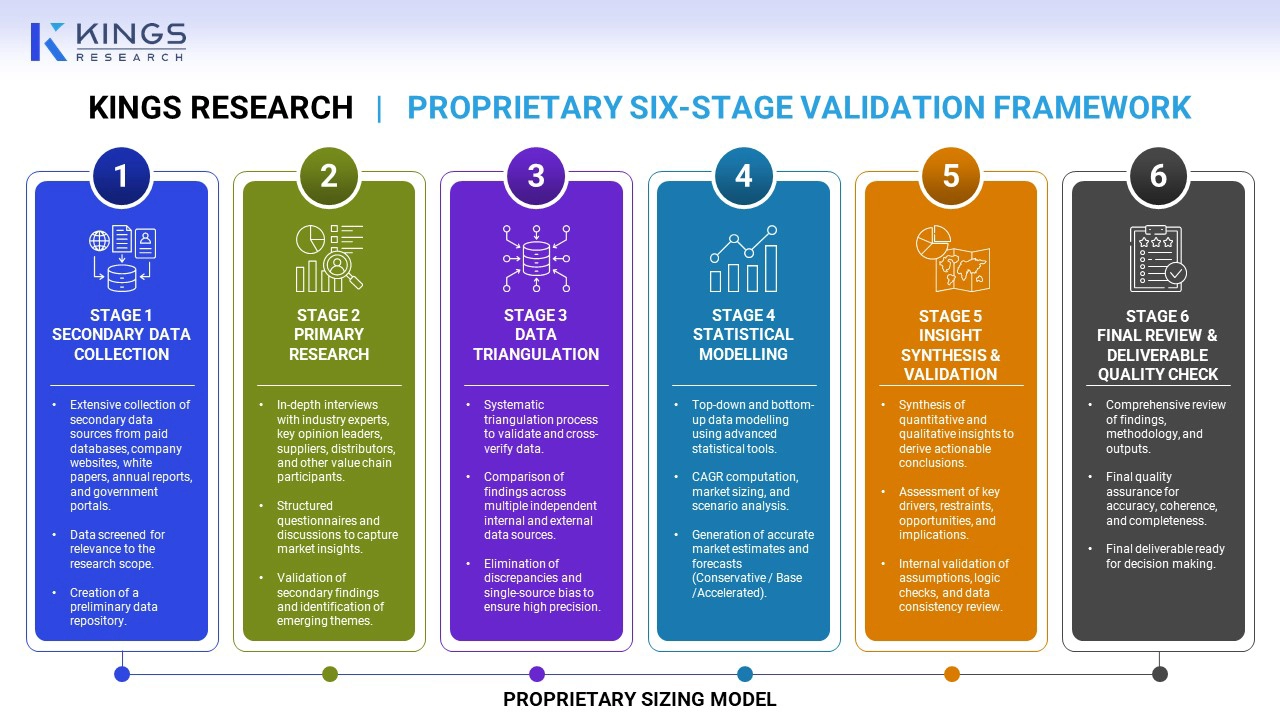
Our methodology triangulates insights from multiple independent and publicly available research databases, which are further validated against regulatory filings and public company disclosures. All estimates are cross-verified; no single-source data is presented without validation.
We deliver tailored, data-driven intelligence and strategic guidance to help organizations identify, evaluate, and capitalize on key market opportunities.
Frequently Asked Questions

Faizy brings over four years of experience in market research and consulting, with a proven ability to support strategic engagements across diverse industries and business environments. His work focuses on understanding complex market structures, identifying emerging opportunities, and translating research findings into clear, commercially relevant insights. With strong analytical capabilities and a structured approach to problem-solving, he evaluates industry trends, competitive landscapes, customer dynamics, and evolving business models. His expertise encompasses market research, competitive intelligence, market sizing and forecasting, industry assessment, company benchmarking, and strategic analysis. Faizy combines technical proficiency with a strong research orientation, enabling him to interpret both qualitative and quantitative information effectively. He has contributed to projects that help organizations assess growth potential, strengthen market positioning, and evaluate strategic priorities. His adaptable approach allows him to work across sectors while maintaining a consistent focus on accuracy, relevance, and delivering insights that support informed decision-making for clients and stakeholders.
With many years of consulting experience across global pharma, biotech, and MedTech markets, Minaz brings deep domain expertise, strategic clarity, and analytical rigor to every engagement. She has led 130+ consulting assignments spanning market entry, competitive landscaping, and portfolio prioritization, helping clients navigate complex, high-stakes decisions with confidence. Known for her ability to synthesize primary and secondary research into executive-ready recommendations, Minaz has built forecasting models and market sizing frameworks that have informed multi-million dollar investment decisions in oncology, diagnostics, and peptide therapeutics. Beyond her analytical strength, Minaz is a trusted client partner, translating complex datasets into clear, actionable insights for senior stakeholders. She currently leads a team of research analysts, driving business expansion, and shaping client engagement strategy.