Inquire Now
Key Strategic Points
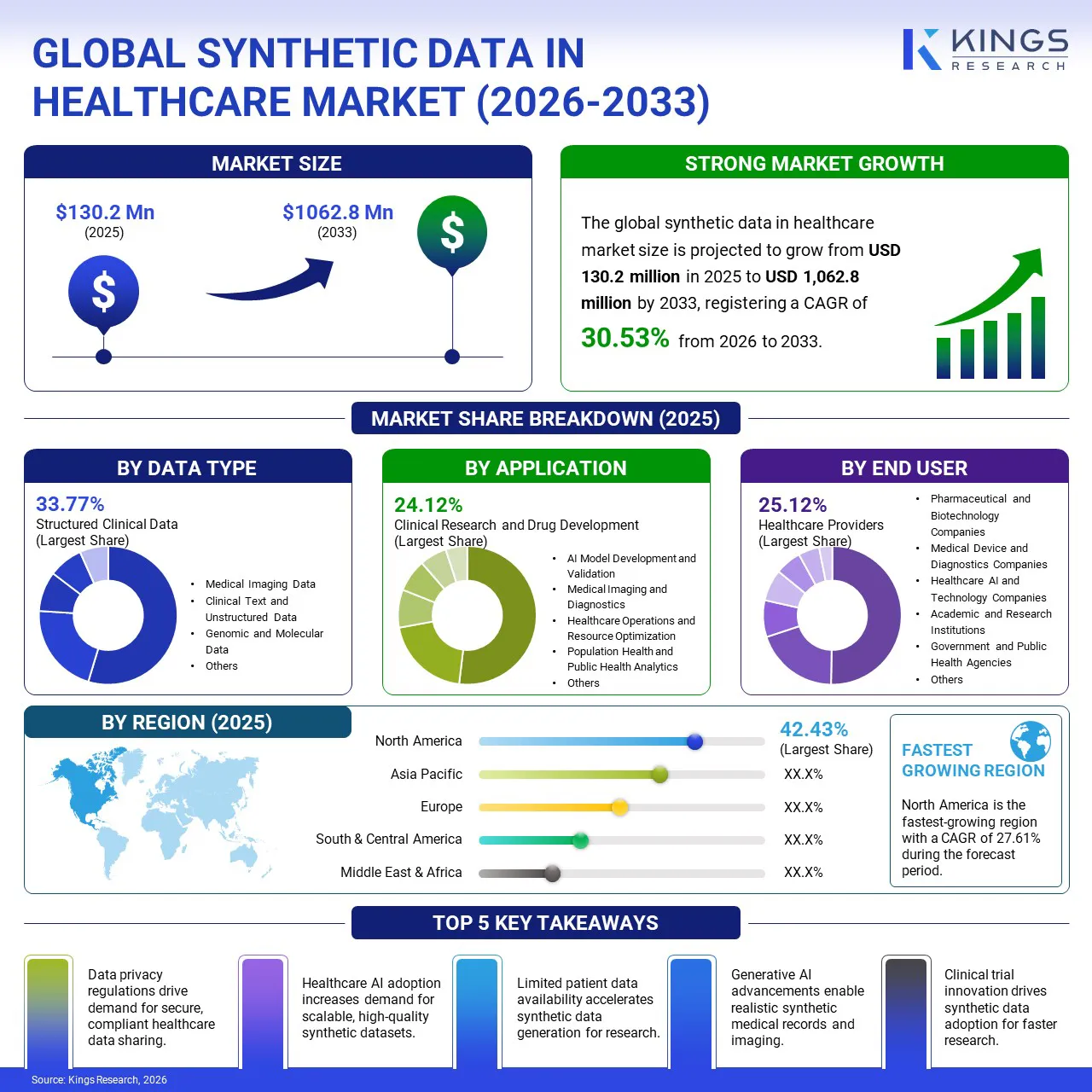
According to Kings Research analysis, the global synthetic data in the healthcare market size was recorded at USD 130.2 million in 2025 and is projected to reach USD 1,062.8 million by 2033, growing at a CAGR of 30.53% over the forecast period from 2026 to 2033.
Synthetic healthcare data consists of artificially generated information that mirrors the statistical properties of real patient records without containing any actual, traceable protected health information. Rising data acquisition costs drive market growth, demand for scalable AI training datasets, and patient privacy. Synthetic data (SD) enables healthcare organizations to develop, validate, and improve AI models while reducing reliance on sensitive patient information.
It also helps address data scarcity, mitigate algorithmic bias, and support rare disease research, strengthening SD adoption across clinical research, diagnostics, and drug development, particularly where regulatory requirements restrict access to sensitive data.
Healthcare research requires large amounts of patient data owing to variations in diseases, symptoms, treatments, and patient responses. Diverse, representative datasets help medical researchers identify disease patterns, train artificial intelligence (AI) models, detect rare conditions, reduce the cost and complexity of data acquisition, and identify risk factors. High-quality synthetic healthcare data also supports patient care, resource optimization, and the discovery of new medical insights. As AI adoption grows, market players are increasingly using advanced synthetic data platforms to overcome data privacy barriers and high acquisition costs, enabling faster, privacy-compliant AI development and clinical research.
Data bias in artificial intelligence (AI) models creates demand for synthetic data in the healthcare market. Real-world healthcare datasets often contain demographic and geographic imbalances due to differences in healthcare access, patient populations, and data collection practices. AI models trained on such datasets may produce inaccurate diagnoses, inappropriate treatment recommendations, and unequal healthcare outcomes for underrepresented populations.
Synthetic data supports bias mitigation by generating artificial patient records that improve the representation of underrepresented demographics, disease characteristics, and clinical outcomes. By supplementing existing datasets, healthcare organizations can evaluate model performance across diverse patient populations, identify potential algorithmic bias, and develop more inclusive and reliable healthcare AI solutions. This boosts adoption among healthcare providers, pharmaceutical companies, and medical technology developers.
Furthermore, privacy concerns and societal stigma associated with conditions such as opioid use disorder (OUD) and human immunodeficiency virus (HIV) can restrict patient data collection. Synthetic data can provide simulated patient records for researching disease progression, risk factors, and treatment outcomes while reducing reliance on identifiable patient information.
Moreover, data collection and societal stigma associated with medical conditions, including opioid use disorder (OUD) or human immunodeficiency virus (HIV), create barriers to data collection and sharing. Synthetic data offers a potential solution by generating simulated longitudinal records, enabling researchers to study disease patterns, risk factors, and treatment effectiveness.
The sensitive nature of patient information and proprietary clinical research data necessitates legal and intellectual property protections against unauthorized access, transfer, and commercial exploitation. Frameworks such as the Health Insurance Portability and Accountability Act (HIPAA), General Data Protection Regulation (GDPR), and Health Information Technology for Economic and Clinical Health Act (HITECH) establish requirements for protecting health information. Noncompliance can result in financial penalties and operational consequences.
To address these challenges, governments and data regulatory authorities continue to strengthen accountability and revise healthcare data-sharing frameworks. In the U.S., HIPAA establishes requirements governing access to and disclosure of protected health information. Noncompliance may result in legal and financial penalties.
Moreover, the Washington My Health My Data Act (HB 1155) strengthens consumer health data privacy beyond HIPAA's scope. It requires covered businesses collecting, processing, sharing, or selling consumer health data to meet specific privacy and consent requirements. The law also grants consumers rights to request data deletion and restricts the sale of consumer health data without valid authorization. Violations may be enforced under the Consumer Protection Act of Washington.
AI architectures, including generative adversarial networks (GANs), variational autoencoders (VAEs), and large language models (LLMs), generate realistic synthetic patient records and medical imaging without compromising privacy. These algorithms use real-world patient data to create balanced datasets, supporting research and AI model training for underrepresented medical conditions.
LLMs, including GPT-3, GPT-4, and Claude, can generate coherent, contextually relevant sequential healthcare data. This expands synthetic data applications in medical education and training, enabling generative AI to create virtual patient cases and simulate conversations for safe, personalized learning. These advancements also enable market players to develop integrated generative AI platforms and data pipelines that leverage synthetic health datasets to reconstruct missing values and support healthcare AI development.
Synthetic medical datasets supplement real-world data with diverse patient details, including rare diseases and genetic conditions. They aid researchers in developing and validating AI and machine learning models by simulating rare disease cases across diverse demographics, genetic profiles, and clinical scenarios, including treatment responses. This expands sample sizes, supports clinical trial simulations, and enables predictive modeling when traditional studies are difficult to conduct. Synthetic data also protects patient privacy and facilitates global data sharing while supporting compliance with privacy and data sharing requirements.
Furthermore, synthetic data can accelerate drug development by modeling long-term outcomes and testing treatment strategies, provided validation studies ensure data accuracy and minimize bias from incomplete or skewed source data.
|
Segmentation |
Details |
|
|
By Data Type |
Structured Clinical Data, Medical Imaging Data, Clinical Text and Unstructured Data, Genomic and Molecular Data, and Others |
|
|
By Application |
Clinical Research and Drug Development, AI Model Development and Validation, Medical Imaging and Diagnostics, Healthcare Operations and Resource Optimization, Population Health and Public Health Analytics, and Others |
|
|
By End User |
Healthcare Providers, Pharmaceutical and Biotechnology Companies, Medical Device and Diagnostics Companies, Healthcare AI and Technology Companies, Academic and Research Institutions, Government and Public Health Agencies, and Others |
|
|
By Region |
North America |
U.S., Canada, and Mexico |
|
Europe |
France, UK, Spain, Germany, Italy, Russia, and Rest of Europe |
|
|
Asia-Pacific |
China, Japan, India, Australia, ASEAN, South Korea, and Rest of Asia-Pacific |
|
|
Middle East and Africa |
Turkey, U.A.E., Saudi Arabia, South Africa, and Rest of Middle East & Africa |
|
|
South and Central America |
Brazil, Argentina, and Rest of South and Central America |
|
The structured clinical data segment accounted for the largest share of 33.77% in 2025, with a valuation of USD 43.97 million. This notable growth is driven by the need for standardized, high-quality, and interoperable datasets for clinical research, data reuse, and AI-driven healthcare applications. The organized format of structured clinical data facilitates seamless data integration and analysis, reducing manual effort and errors while accelerating clinical trial timelines and decision-making.
The medical imaging and diagnostics segment is poised to register the fastest CAGR of 34.52% over the forecast period, reaching USD 266.12 billion by 2033. This rapid growth is primarily fueled by the scarcity and high cost of annotated medical images and strict patient data privacy regulations. Synthetic data enables the scalable generation of realistic, labeled medical images, including rare disease cases, accelerating AI model training and improving diagnostic capabilities. Its potential to reduce annotation costs, enhance model generalization, and support privacy-compliant data sharing is expected to boost adoption across radiology, pathology, and other diagnostic applications.
The global synthetic data in healthcare market analysis is segmented into North America, Europe, Asia Pacific, the Middle East & Africa, and South & Central America.
North America
The North America synthetic data in healthcare market share was estimated at 42.34% in 2025, registering a valuation of USD 55.25 million. This growth is largely attributed to the U.S.'s leadership in frontier AI innovation, supported by substantial private investment, advanced software ecosystems, and strategic research networks. Demand for synthetic data to train AI models, scale intelligence, improve generalization, and prevent systematic blind spots further supports regional market expansion. Moreover, the extensive medical, clinical, and insurance data generated by the U.S. healthcare sector creates demand for synthetic data in research, innovation, and healthcare analytics.
According to the Centers for Medicare & Medicaid Services (CMS), U.S. healthcare spending is to reach nearly USD 9 trillion by 2034, accounting for 20.6% of the economy. This projected spending highlights the potential for synthetic data to support cost-efficient research and accelerate treatment development.
Asia Pacific
Asia Pacific is projected to register the fastest CAGR of 35.55% during the projection period. This growth is propelled by healthcare digitization and expanding adoption of electronic health records across China, India, Japan, South Korea, and other Asian economies. The region's large, diverse patient pool creates demand for synthetic data to train healthcare-specific AI models. Data-protection laws, including the Digital Personal Data Protection Act (DPDP) in India, China’s PIPL (Personal Information Protection Law), and Japan’s APPI (Act on the Protection of Personal Information), restrict certain uses and disclosures of personal data, making privacy-preserving synthetic alternatives attractive.
Government investments in digital health and AI infrastructure also support pharmaceutical R&D and clinical trial activities, creating growth opportunities for the regional synthetic data healthcare market.
Europe, South and Central America, and the Middle East & Africa
The synthetic data in healthcare market in Europe is supported by stringent data privacy regulations, particularly the General Data Protection Regulation (GDPR), which applies to organizations processing personal data within its scope. The growing adoption of AI and digital health technologies increases demand for privacy-preserving healthcare data to support medical research, clinical trials, and AI model development.
The Middle East & Africa market is supported by increasing investments in healthcare digitalization and AI infrastructure, particularly in the UAE, Saudi Arabia, Turkey, and other Gulf countries. Demand for secure, privacy-preserving patient data for healthcare analytics, medical research, and AI-driven clinical applications further creates growth opportunities.
In South & Central America, the gradual adoption of electronic health records (EHRs), expanding digital health initiatives, and growing interest in AI-enabled healthcare solutions across emerging economies, particularly Brazil and Argentina, support market growth. Increasing attention to data privacy, healthcare research, and cost-effective access to diverse patient data is expected to further encourage synthetic data adoption across the region.
The global synthetic data in healthcare market is fragmented, with established technology providers, specialized synthetic data mining companies, and emerging AI-driven solution providers competing for market share. Key companies are investing in artificial intelligence (AI), machine learning (ML), and advanced synthetic healthcare data generation technologies to facilitate clinical research, accelerate AI model development, and enable secure data sharing. Strategic collaborations, product launches, and platform enhancements are reshaping competition as companies address data accessibility challenges, meet data protection requirements, and expand across pharmaceutical, biotechnology, healthcare provider, and medical research markets.
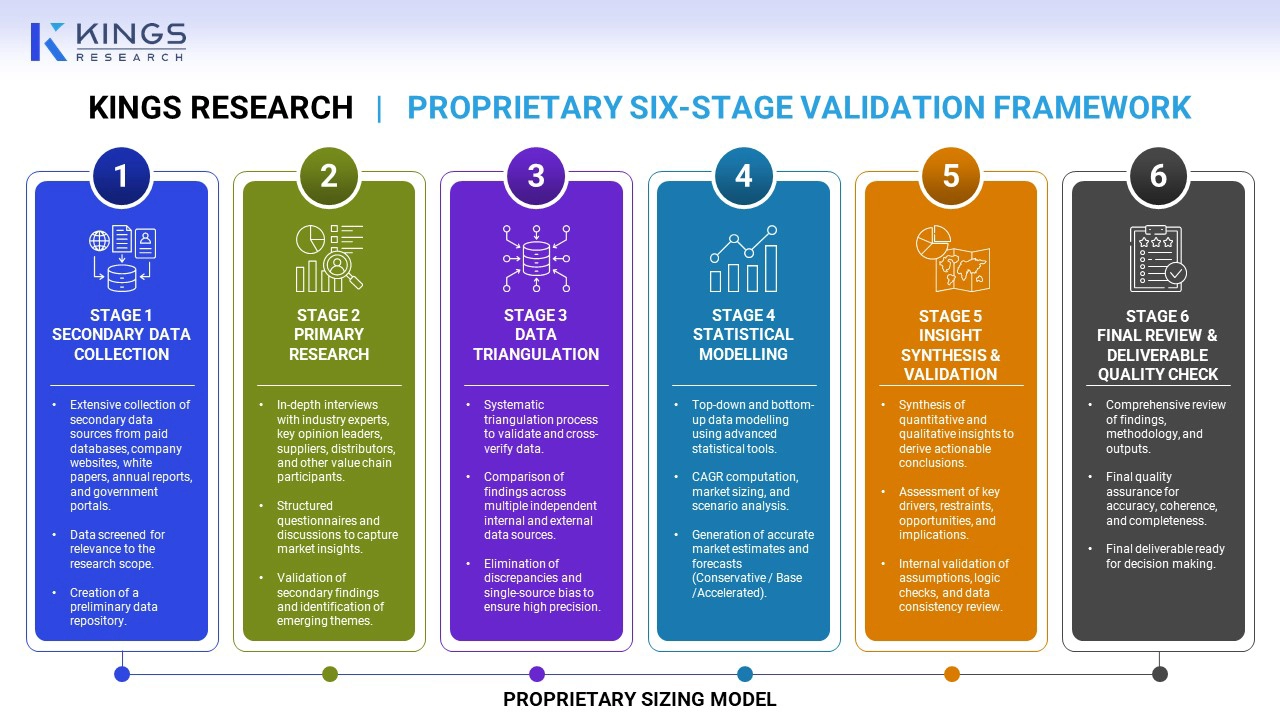
Our methodology triangulates insights from multiple independent and publicly available research databases and is further validated against regulatory filings and public company disclosures. All estimates are cross-verified; no single-source data is presented without validation.
Our custom offerings deliver tailored, data-driven intelligence and strategic guidance to help organizations identify, evaluate, and capitalize on key market opportunities.
Frequently Asked Questions

Faizy brings over four years of experience in market research and consulting, with a proven ability to support strategic engagements across diverse industries and business environments. His work focuses on understanding complex market structures, identifying emerging opportunities, and translating research findings into clear, commercially relevant insights. With strong analytical capabilities and a structured approach to problem-solving, he evaluates industry trends, competitive landscapes, customer dynamics, and evolving business models. His expertise encompasses market research, competitive intelligence, market sizing and forecasting, industry assessment, company benchmarking, and strategic analysis. Faizy combines technical proficiency with a strong research orientation, enabling him to interpret both qualitative and quantitative information effectively. He has contributed to projects that help organizations assess growth potential, strengthen market positioning, and evaluate strategic priorities. His adaptable approach allows him to work across sectors while maintaining a consistent focus on accuracy, relevance, and delivering insights that support informed decision-making for clients and stakeholders.
With many years of consulting experience across global pharma, biotech, and MedTech markets, Minaz brings deep domain expertise, strategic clarity, and analytical rigor to every engagement. She has led 130+ consulting assignments spanning market entry, competitive landscaping, and portfolio prioritization, helping clients navigate complex, high-stakes decisions with confidence. Known for her ability to synthesize primary and secondary research into executive-ready recommendations, Minaz has built forecasting models and market sizing frameworks that have informed multi-million dollar investment decisions in oncology, diagnostics, and peptide therapeutics. Beyond her analytical strength, Minaz is a trusted client partner, translating complex datasets into clear, actionable insights for senior stakeholders. She currently leads a team of research analysts, driving business expansion, and shaping client engagement strategy.