Inquire Now
Key Strategic Points
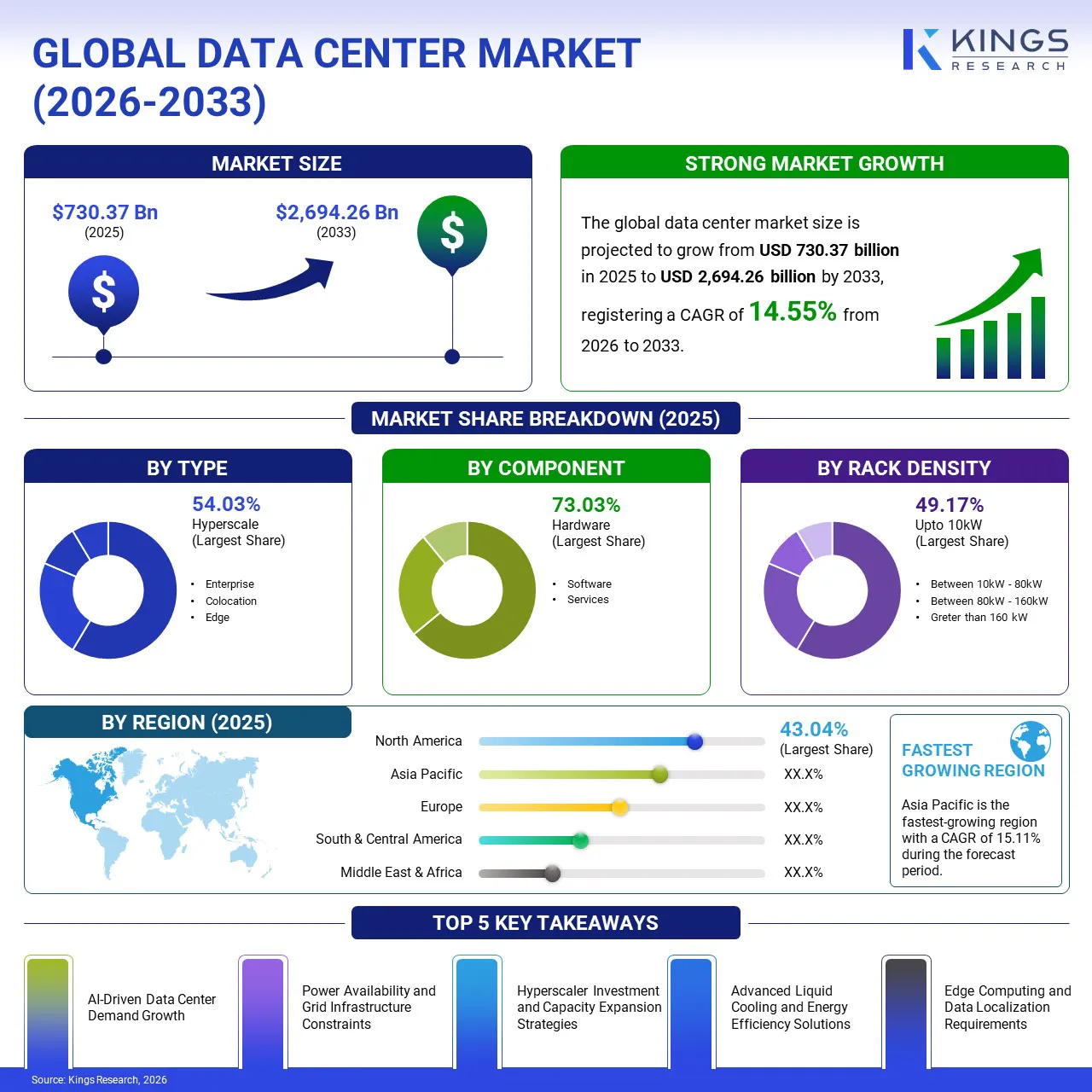
According to Kings Research, the global data center market size was USD 730.37 billion in 2025 and is projected to reach USD 2,694.26 billion by 2033, growing at a CAGR of 14.55% from 2026 to 2033.
The report covers global spending across IT systems, physical infrastructure, software, and services, including hyperscale, colocation, enterprise, and edge facilities. It analyses market trends, growth drivers, technological advancements, and end-use demand. The report further evaluates infrastructure expansion, power consumption, sustainability initiatives, and competitive dynamics shaping the data center industry.
Market growth is driven by rising demand for hyperscale, colocation, and edge capacity as artificial intelligence, cloud computing, and data-intensive applications expand. However, supply constraints persist, with record-low vacancies reported across prominent data center hubs, indicating future growth avenues for data center development. Power and land availability remain key challenges restraining data center market expansion. Market players are investing in renewable energy, liquid cooling, and energy-efficient designs to manage rising power density and sustainability requirements.
Growing AI inference, which involves running trained models to deliver real-time outputs, is further boosting demand for data center capacity beyond large-scale AI training facilities. Alongside cloud computing and data-intensive applications, this trend is expected to drive electricity consumption, with the International Energy Agency (IEA) projecting that global data center electricity demand will roughly double by 2030.
Surging utilization of AI, continued cloud adoption, enterprise digital transformation, streaming, e-commerce, connected devices, and increasing data-intensive applications are driving data center growth. Increasing reliance on digital technologies among businesses, governments, and consumers is fueling demand for infrastructure to store, process, and transmit data.
The growth is further supported by the development of AI inference and adoption owing to the demand for advanced models requiring significantly more computing power compared to conventional applications. Large language models and multimodal AI systems run on graphics processing unit (GPU) clusters that consume several kilowatts per server, thus increasing demand for high-performance computing infrastructure, advanced cooling technologies, and reliable power supply.
Moreover, government initiatives, including national AI strategies, data center investment incentives, and digital infrastructure programs such as the U.S. CHIPS and Science Act and the National AI Initiative Act, are supporting AI development and accelerating demand for data center capacity.
According to the Carnegie Endowment for International Peace, the biggest technology companies in the U.S. are planning to spend nearly USD 670 billion, or about 2 percent of U.S. GDP, targeted at building AI compute clusters. Additionally, global tech companies and governments are poised to invest nearly USD 1 trillion into data centers to build transformative AI. The U.S. currently dominates the buildout, capturing approximately three-quarters of the global advanced AI computing clusters.
Power requirements act as the major constraint on new data center capacity additions. AI workloads and denser racks are increasing electricity demand faster than local grids can expand, with cooling systems accounting for a major portion of the data center power requirements. According to the IEA, global data center electricity consumption increased by 17% in 2025, with AI-focused facilities growing even faster. The IEA expects data center electricity use to roughly double by 2030, reaching around 945 TWh in its base case. Renewables are expected to meet nearly half of the additional demand over the next five years, with natural gas, coal, and nuclear power supplying the rest.
Grid equipment lead times for high-capacity power transformers are further delaying capacity expansion, with timelines spanning up to four years, delaying grid connections for new campuses. Moreover, local opposition slows data center development, with reports that at least 75 U.S. projects worth approximately USD 130 billion were blocked or delayed in the first quarter of 2026.
Growing cloud computing, AI, and global data consumption, alongside tighter environmental requirements, are promoting the adoption of sustainable digital infrastructure. Green data centers combine operational performance with lower environmental impact through free cooling, liquid cooling, modular infrastructure, intelligent energy management, and waste heat recovery. Lower power usage effectiveness (PUE) reduces operating costs, supports regulatory compliance, and strengthens corporate sustainability credentials.
With data center electricity consumption set to roughly double by 2030, sustainability has become a strategic priority for operators seeking to reduce carbon emissions, water consumption, electronic waste, and operating costs. Meta’s Bowling Green Data Center in Ohio (U.S.), announced in April 2025 with an investment of over USD 800 million, supports Meta’s AI workloads, with Meta committing to match its electricity consumption with 100% clean and renewable energy.
ESG requirements, energy-efficiency regulations, and certifications such as LEED, ENERGY STAR, and ISO 50001 are further encouraging adoption.
In the EU, the Energy Efficiency Directive requires data centers with an IT power demand of at least 500 kW to report energy and sustainability indicators annually. A 2026 European Commission proposal would also introduce a sustainability rating label.
Operators are securing independent power to overcome grid constraints. In January 2026, Meta signed agreements with Vistra, TerraPower, and Oklo for up to 6.6 GW of nuclear power by 2035. Oracle also agreed with Bloom Energy to deploy up to 2.8 GW of fuel cells, including 1.2 GW in 2026. Sovereign and regional infrastructure investments offer further opportunities. In January 2026, AWS launched its European Sovereign Cloud in Brandenburg, Germany, backed by more than EUR 7.8 billion in planned investment, while Gulf governments are funding national AI data center capacity.
|
Segmentation |
Details |
|
|
By Type |
Hyperscale, Enterprise, Colocation, and Edge |
|
|
By Component |
Hardware, Software, and Services |
|
|
By Tier |
Tier 1, Tier 2, Tier 3, and Tier 4 |
|
|
By Rack Density |
Up to 10 kW, between 10 kW and kW–80 kW, Between 80 kW and 160 kW, and greater than 160 kW |
|
|
By PUE |
Below 1.2, between 1.2 and 1.6, between 1.6 and 1.8, between 1.8 and 2.0, and more than 2.0 |
|
|
By End Use |
Banking, Financial Services, and Insurance (BFSI), Retail & E-Commerce, Telecommunications, Healthcare, Entertainment & Media, Energy & Power, Manufacturing, Government, and Others |
|
|
By Region |
North America |
U.S., Canada, and Mexico |
|
Europe |
France, the UK, Spain, Germany, Italy, Russia, and the rest of Europe |
|
|
Asia Pacific |
China, Japan, India, Australia, ASEAN, South Korea, and the rest of Asia-Pacific |
|
|
Middle East & Africa |
Turkey, U.A.E., Saudi Arabia, South Africa, and the rest of the Middle East & Africa |
|
|
South & Central America |
Brazil, Argentina, and the rest of South & Central America |
|
Hyperscale data centers held the largest share of 54.03% in 2025, valued at USD 394.59 billion. The expansion of artificial intelligence (AI) applications, enterprise cloud migration, and the demand for centralized, high-density computing further fuel segmental growth. Hyperscalers offer redundant power, cooling, and network systems, making them suitable for demanding AI and financial workloads.
The banking, financial services, and insurance (BFSI) segment accounted for the largest share of 16.57% in 2025, with a valuation of USD 121.03 billion. This growth is driven by digital transformation, rising data volumes, and real-time analytics requirements. The need for secure, resilient infrastructure and AI applications in fraud detection, credit scoring, and customer analytics further supports this demand.
By region, the market is segmented into North America, Europe, Asia-Pacific, Middle East & Africa, and South & Central America.
North America held the largest share of 43.04% in 2025, valued at USD 314.34 billion. This dominance is reinforced by the presence of hyperscale cloud providers, rising AI infrastructure requirements, and strong enterprise demand. The U.S. leads global data center development, supported by its concentration of hyperscale cloud companies, extensive fiber-optic network, abundant land, and substantial AI investments. Northern Virginia remains the dominant U.S. data center hub.
According to CBRE, its vacancy fell to 0.2% in the first half of 2026 from 0.7% a year earlier, with 467.6 MW of net absorption, the highest among primary markets, despite power constraints. Dallas–Fort Worth is among the fastest-growing markets, with a 716.7 MW construction pipeline that is 88% pre-leased. In Chicago, vacancy declined to 2.2% amid strong demand from hyperscale, AI, enterprise, and financial services occupiers. Atlanta also strengthened its position as a major colocation hub, with inventory rising 14.5% year-over-year to 1,465.2 MW and vacancy falling to 1%, supported by sustained hyperscale and AI leasing activity. However, power constraints, zoning restrictions, local opposition, and regulatory uncertainty surrounding large-load customers are complicating new construction and shaping where new capacity is built in the region.
Emerging markets such as Tennessee and West Texas in the U.S. are attracting data center investments due to available land, competitive incentives, improved fiber connectivity, and planned power generation capacity. According to the Tennessee Valley Authority, data centers accounted for 18% of industrial load in Tennessee in 2025, a share projected to double by 2030.
The Europe data center market accounted for a share of 19.76% in 2025, valued at USD 144.30 billion, and is projected to grow at a CAGR of 12.75% from 2026 to 2033. Growth is driven by AI and hyperscale demand, sovereign digital infrastructure, cloud adoption, power availability, and regulatory conditions. The UK (London), Germany (Frankfurt), France (Paris), and the Netherlands (Amsterdam) remain the region's leading data center hubs.
Frankfurt recorded the strongest year-over-year inventory growth among major European markets, while London continued expanding despite increasing vacancy and persistent power constraints in 2025. Paris benefited from robust hyperscale and AI demand, with declining vacancy indicating absorption of new supply. The EU Energy Efficiency Directive (EED) promotes energy savings and improved efficiency across sectors, including data centers, supporting investment in energy-efficient infrastructure and technologies. Emerging markets such as Portugal are also attracting developer interest due to favourable power economics, renewable energy availability, and expansion opportunities. Large-scale projects, including the Sines campus, are expected to strengthen Portugal's position as an alternative destination for AI and hyperscale infrastructure.
Asia-Pacific is expected to register the fastest CAGR of 15.11% from 2026 to 2033. Growth is driven by hyperscale cloud expansion, AI adoption, enterprise digital transformation, demand for high-density computing infrastructure, and investment across established and emerging hubs. Singapore, Tokyo, Hong Kong, and Sydney are established data center hubs, supported by robust connectivity, mature digital ecosystems, and sustained demand from cloud providers and enterprises. Singapore benefits from strong colocation demand and controlled data center capacity expansion, while Tokyo is seeing increased demand for large-scale hyperscale facilities and GPU-intensive workloads. Hong Kong maintains its importance as a connectivity and cross-border data hub. However, legacy infrastructure, land constraints, and limited power availability restrict the expansion of power-intensive AI deployments.
China is the largest data center market in Asia-Pacific. Under its East Data, West Computing program, the country has established eight national computing hubs. Its intelligent computing capacity reached about 780 EFLOPS by August 2025, making it the world's second-largest, according to China's National Data Administration. Australia, particularly Sydney, remains an attractive investment destination, supported by stable market fundamentals, declining vacancy, and rising demand for campus-scale capacity. According to JLL, Australia ranks as the world's third-largest data center investment destination, with a USD 155 billion pipeline and capacity projected to grow 13-fold to over 16 GW by 2035.
Rising cloud adoption, expanding digital connectivity, domestic demand, and government incentives are further boosting expansion in emerging markets such as India, Vietnam, Thailand, and Indonesia. However, limited power availability, land and grid constraints, and strict regulation are restricting new development and keeping vacancy low across the region.
The Middle East and Africa data center market is poised to grow at a CAGR of 14.55% from 2026 to 2033, propelled by government-led digital transformation initiatives, cloud and AI adoption, and demand for sovereign digital infrastructure.
Robust connectivity infrastructure, subsea cable investments, government incentives, and participation from global cloud providers, including AWS and GCP, are presenting opportunities for market development. The Gulf Cooperation Council (GCC) countries are the key growth centers, with Saudi Arabia and the UAE accounting for the majority of planned capacity expansion. Colocation is the dominant operating model, while hyperscale and edge facilities are expected to gain share, supported by AI computing, smart city applications, and low-latency service demand.
Saudi Arabia is leading regional expansion through Vision 2030, sovereign investment, and large-scale digital infrastructure projects. The kingdom plans to develop substantial AI infrastructure, targeting 1.9 GW by 2030 and 6.6 GW by 2034, backed by around USD 77 billion in investments, propelling data center growth. The UAE is expected to record the fastest growth, driven by hyperscale cloud deployments, AI ambitions, and established operators in Dubai and Abu Dhabi. Its operational data center capacity is expected to increase substantially, fueled by an investment pipeline exceeding USD 46 billion and plans for 17 new facilities.
Qatar and Bahrain are also expanding their data center development pipelines, while Oman and Kuwait are progressing steadily, supported by connectivity investments, government and telecom demand, and local enterprise requirements. Continued investment is expected to strengthen the region's position as a hub for hyperscale, colocation, and AI-ready digital infrastructure.
The South and Central America data center market was valued at USD 29.75 billion in 2025, accounting for a share of 4.07%. Hyperscale cloud adoption, AI-driven demand, and enterprise digital infrastructure investments are fueling data center expansion. São Paulo remains the largest and most established market, while Santiago (Chile) recorded steady growth amid strong capacity utilization and limited near-term availability. Colombia (Bogotá) remained relatively stable, with demand primarily driven by domestic enterprises.
Expanding fiber networks, subsea cable investments, and increasing integration with North American digital infrastructure are creating development opportunities. However, power availability and grid reliability remain key constraints, particularly in high-growth markets including Brazil, Argentina, and Chile. Rising construction costs, skilled labor shortages, water resource considerations, and macroeconomic uncertainty further constrain regional development.
The global market is highly competitive, with hyperscale cloud providers, colocation operators, technology companies, and specialized infrastructure developers. High capital requirements, access to reliable power, advanced cooling technologies, land availability, network connectivity, and specialized engineering expertise create significant entry barriers, thereby strengthening established players. Strategic partnerships, joint ventures, mergers and acquisitions, and technology collaborations are helping companies expand capacity, accelerate infrastructure development, secure long-term customers, and strengthen their competitive positioning.
Companies in the global data center market specialize in hyperscale infrastructure, colocation services, cloud computing, data center power and cooling systems, IT infrastructure, and data center management solutions. Key players include:
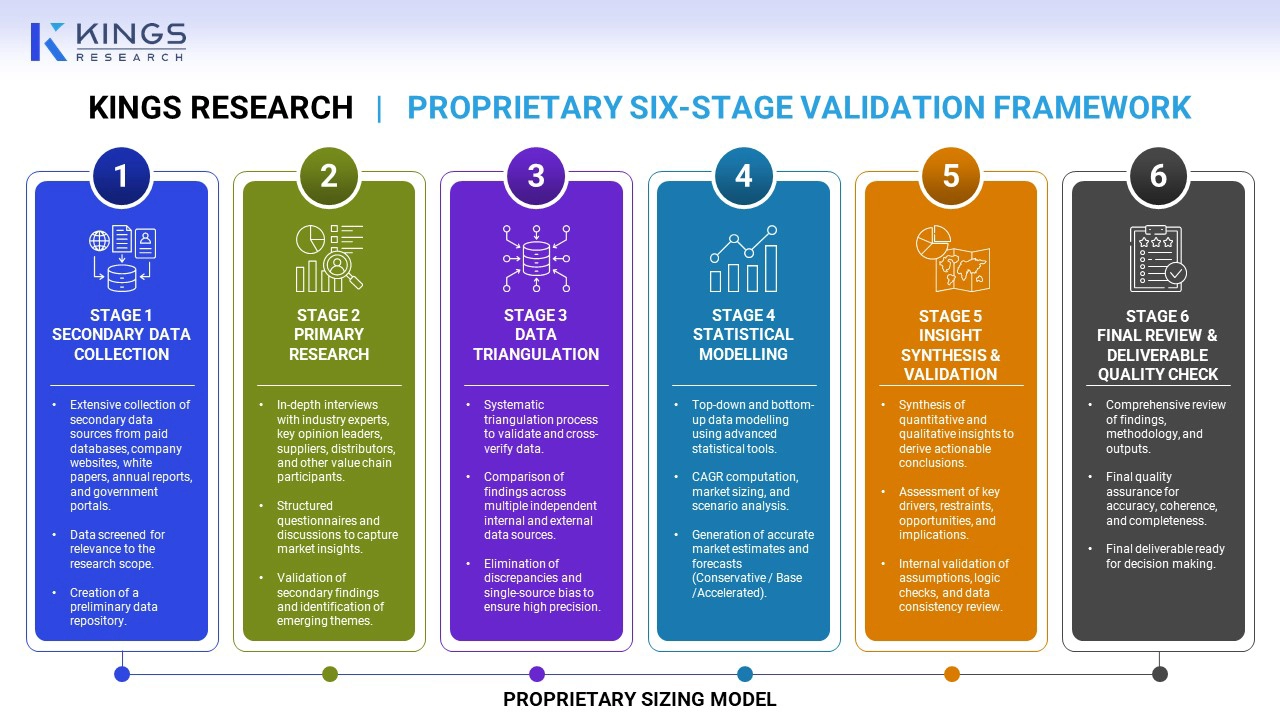
Our methodology triangulates insights from multiple independent and publicly available research databases, which is further validated against regulatory filings and public company disclosures. All estimates are cross-verified; no single-source data is presented without validation.
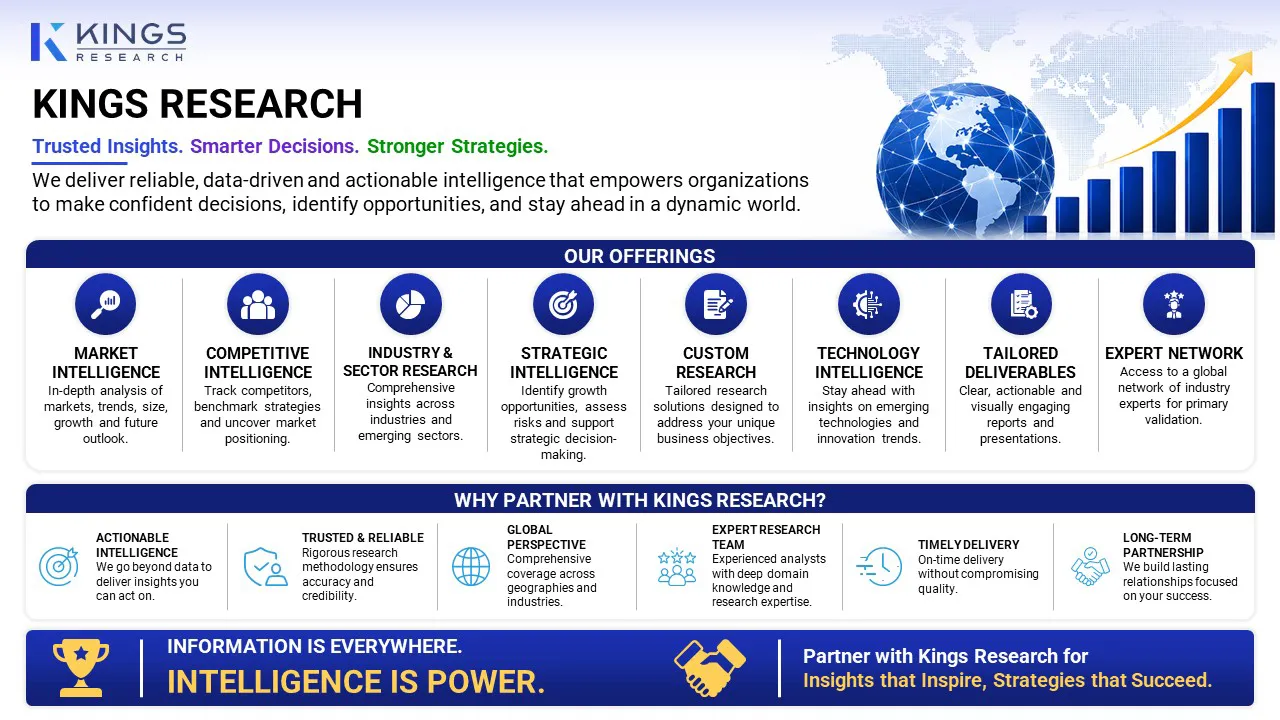
We deliver tailored, data-driven intelligence and strategic guidance to help organizations identify, evaluate, and capitalize on key market opportunities.
Frequently Asked Questions

Faizy brings over four years of experience in market research and consulting, with a proven ability to support strategic engagements across diverse industries and business environments. His work focuses on understanding complex market structures, identifying emerging opportunities, and translating research findings into clear, commercially relevant insights. With strong analytical capabilities and a structured approach to problem-solving, he evaluates industry trends, competitive landscapes, customer dynamics, and evolving business models. His expertise encompasses market research, competitive intelligence, market sizing and forecasting, industry assessment, company benchmarking, and strategic analysis. Faizy combines technical proficiency with a strong research orientation, enabling him to interpret both qualitative and quantitative information effectively. He has contributed to projects that help organizations assess growth potential, strengthen market positioning, and evaluate strategic priorities. His adaptable approach allows him to work across sectors while maintaining a consistent focus on accuracy, relevance, and delivering insights that support informed decision-making for clients and stakeholders.
With many years of consulting experience across global pharma, biotech, and MedTech markets, Minaz brings deep domain expertise, strategic clarity, and analytical rigor to every engagement. She has led 130+ consulting assignments spanning market entry, competitive landscaping, and portfolio prioritization, helping clients navigate complex, high-stakes decisions with confidence. Known for her ability to synthesize primary and secondary research into executive-ready recommendations, Minaz has built forecasting models and market sizing frameworks that have informed multi-million dollar investment decisions in oncology, diagnostics, and peptide therapeutics. Beyond her analytical strength, Minaz is a trusted client partner, translating complex datasets into clear, actionable insights for senior stakeholders. She currently leads a team of research analysts, driving business expansion, and shaping client engagement strategy.