
Inquire Now
Key Strategic Points
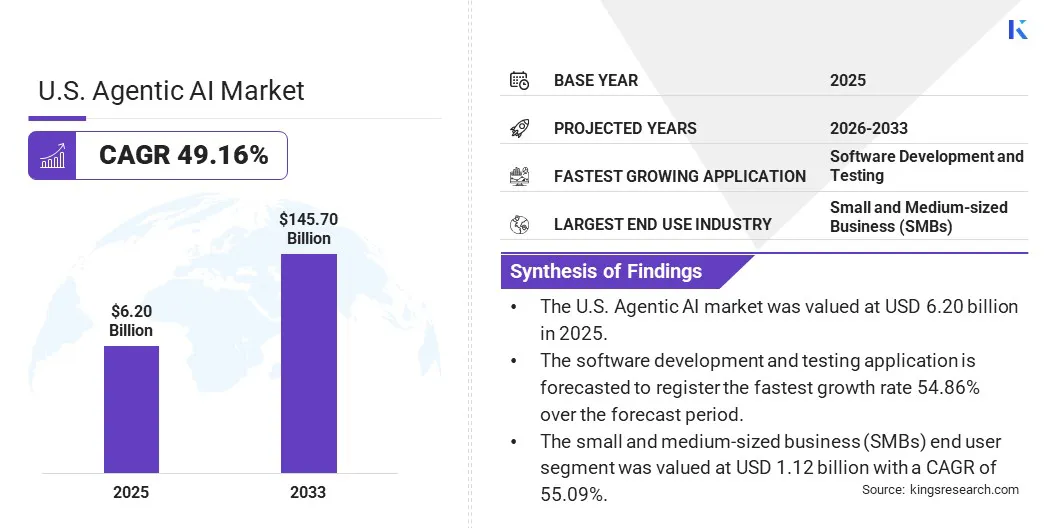
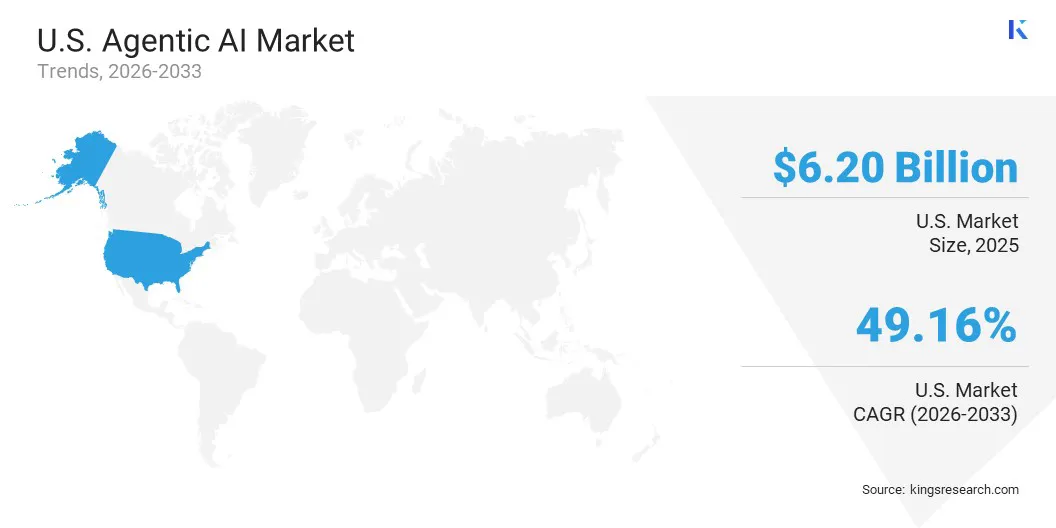
The U.S. agentic AI market size was valued at USD 6.20 billion in 2025 and is projected to reach USD 145.71 billion by 2033, representing a CAGR of 49.16% over the forecast period. Demand for automated platforms offering decision-making, workflow orchestration, and execution of complex tasks with minimal human intervention is fueling the growth and adoption of agentic AI systems in the U.S. Additionally, the presence of a strong research and innovation ecosystem, presence of global tech giants, availability of highly skilled AI engineers and researchers, and AI investments and funding programs are contributing towards the development of agentic AI market ecosystem in the U.S.
Key players operating in the market include AWS, Celonis, Cohere, Moveworks, Oracle Corporation, Pegasystems Inc., Salesforce, Inc., SAP SE, UiPath and others. These companies are improving operability of agentic AI system to enhance autonomous decision-making capabilities, improve enterprise productivity, expand AI-driven automation solutions, and enhance learning capabilities.
Companies across commercial sectors in the U.S. comprising banking and financial services, retail, education, healthcare and others are deploying agentic AI systems to enhance efficiency and improve workflows. Banking and financial firms are adopting AI agents to provide customized financial advisory services, detect fraud, automate loan approvals, and address legal and compliance processes. Payment intermediaries such as VISA and Mastercard are introducing tokenization technology to create unique Agentic Tokens that tie AI agents to individual users while safeguarding payment credentials.
Retail companies are developing LLM-powered AI agents to automate personal shopping experiences and facilitate swift merchandise planning and problem resolution. Moreover, consumers are adopting agentic AI to search, compare, and manually check out after delegating product discovery and purchases prompts to AI agents.
Market players are further unifying communication through innovations across shopping systems, enabling agentic AI to streamline product comparison, purchasing processes, and automate retail operations to improve business efficiency and scalability.
Concerns over agent transparency and decision-making restrain the widespread deployment and adoption of agentic AI. Enterprises are cautious about deploying autonomous agentic AI models due to their non-deterministic nature compared to conventional software-based systems. This makes their operations less predictable and increases the risk of errors in critical applications such as healthcare, financial services, and enterprise operations. Additionally, multi-agent and multi-cloud environments expand the attack surface which raises concerns over data privacy, cybersecurity, identity management, and unauthorized access. These obstacles highlight the absence of robust governance, continuous model validation, and real-time safety guardrails to ensure reliable AI performance.
To address the challenge, the U.S. Cybersecurity and Infrastructure Security Agency (CISA), in collaboration with the National Security Agency (NSA) has identified five major security risks associated with Agentic AI. The list includes excessive access privileges, poor system design, unpredictable agent behavior, vulnerabilities arising from interconnected multi-agent systems, and limited accountability due to autonomous decision-making. CISA has recommended implementing least-privilege access controls, strong identity management, continuous monitoring, comprehensive testing (including adversarial testing and red teaming), robust safety guardrails, detailed audit logs, and phased deployment of AI agents.
AI agent orchestration involves the coordination of multiple specialized AI agents within a unified system to efficiently achieve shared objectives. The models are gaining traction across enterprises owing to the deployment of a single AI agent that handles roles including customer support, data retrieval, and automation. This ensures parallel collaboration, efficient workflows and smooth communication between multiple agents, applications, and enterprise systems. This results in scalability, reliability, and operational accuracy by reducing agentic AI silos between systems and enabling better coordination. Moreover, the ability of AI agent orchestration to isolate faults helps prevent cascading failures. This ensures operational continuity as it facilitates allocated task execution in case of an agent failure, while the failed agent retries the task or the workflow is re-routed around the issue.
|
Segmentation |
Details |
|
By Offering |
Agentic AI Infrastructure, Agentic AI Development Platforms, Agentic AI Applications (SaaS), Agentic AI Professional Services |
|
By Application |
Customer Experience, Software Development & Testing, Knowledge Management & Retrieval, Sales, Data Analytics & BI, Security Operations, Finance & Accounting, Marketing, HR & Workplace Operations, Others |
|
By End-Use Industry |
Software & Technology, BFSI, Healthcare & Life Sciences, Retail & E-commerce, Professional Services, Manufacturing, Telecommunications, Government & Defense, Logistics & Transportation, Others |
|
By End User |
Large Enterprises, SMBs, Government Organizations, Individuals |
|
By Country |
U.S. |
The U.S. is designated as a premier hub for agentic AI development owing to the vast software development ecosystem, which is fostering the development of artificial intelligence products and services. The AI Action plan introduced in January 2025 establishes a national framework to guide AI infrastructure initiatives and federal policymaking across priority areas. This establishes a growth trajectory for the deployment and utilization of agentic AI across commercial, industrial, and government sectors in the U.S. For instance, federal agencies in the U.S. are testing limitations of agentic AI to boost mission delivery and operational growth. The focus is to emphasize designing, deployment and scaling of AI systems in high-impact environments such as defense, federal services, and government operations to boost operational efficiency.
Key players operating in the agentic AI market, such as Aisera, Celonis, Cohere, Google LLC, Moveworks, Pegasystems Inc., Salesforce, Inc., SAP SE, UiPath and others, are focusing on strategic collaborations, partnerships, and technological innovation to improve operational efficiency and expand market share. The players are prioritizing the development of multi-agent systems and AI copilots that improve decision-making, operational efficiency, and scalability across business functions.
Frequently Asked Questions

Faizy brings over four years of experience in market research and consulting, with a proven ability to support strategic engagements across diverse industries and business environments. His work focuses on understanding complex market structures, identifying emerging opportunities, and translating research findings into clear, commercially relevant insights. With strong analytical capabilities and a structured approach to problem-solving, he evaluates industry trends, competitive landscapes, customer dynamics, and evolving business models. His expertise encompasses market research, competitive intelligence, market sizing and forecasting, industry assessment, company benchmarking, and strategic analysis. Faizy combines technical proficiency with a strong research orientation, enabling him to interpret both qualitative and quantitative information effectively. He has contributed to projects that help organizations assess growth potential, strengthen market positioning, and evaluate strategic priorities. His adaptable approach allows him to work across sectors while maintaining a consistent focus on accuracy, relevance, and delivering insights that support informed decision-making for clients and stakeholders.
Habi is a seasoned research and consulting leader with renowned experience in guiding clients on strategic growth and transformation initiatives across global markets. He has led high-performing research teams that deliver actionable insights on market expansion, M&A strategies, opportunity assessment, new business development, and product launches. His project portfolio spans large petrochemical producers, electronic device manufacturers, lubricants companies, and other leading enterprises across diverse industrial and consumer sectors. He currently heads the research department at Kings Research, where he is responsible for setting the research agenda, mentoring analysts, and ensuring client-ready deliverables that support executive decision-making. With extensive experience in market intelligence, strategic research, and consulting, Habi brings a strong understanding of evolving industry dynamics, competitive landscapes, emerging opportunities, and business growth challenges. His expertise includes developing research frameworks, translating complex market data into actionable strategic recommendations, and working closely with senior stakeholders to address critical business questions. He has also contributed to building research capabilities, strengthening analytical methodologies, and driving a culture of quality and insight-led decision-making within research teams. His cross-industry exposure enables him to connect market trends with broader business implications and provide perspectives that help organizations identify opportunities, mitigate risks, and make informed strategic decisions.