Inquire Now
Key Strategic Points
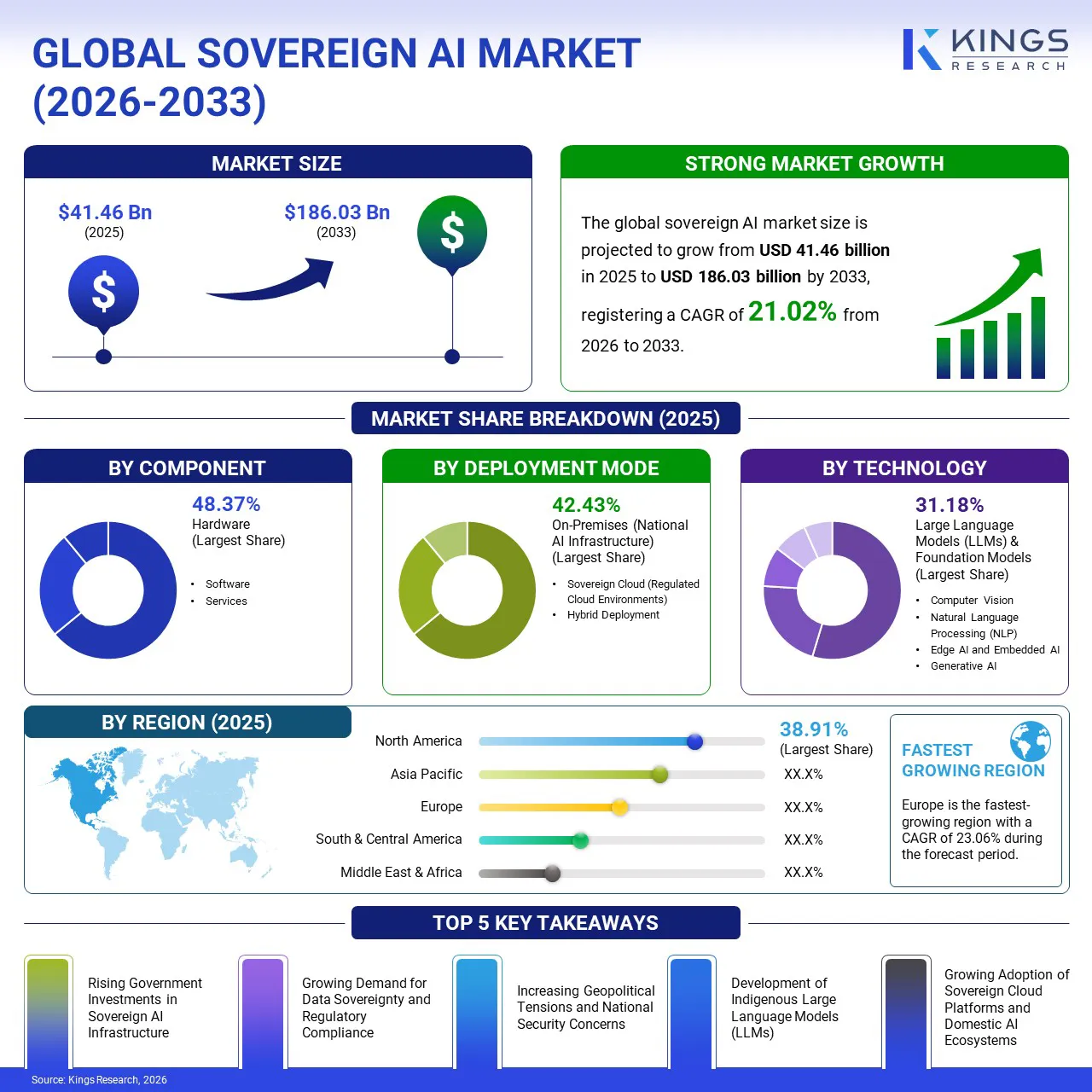
According to Kings Research, the global Sovereign AI market size was recorded at USD 41.46 billion in 2025 and is projected to reach USD 186.03 billion by 2033, growing at a CAGR of 21.02% over the forecast period from 2026 to 2033. The market is witnessing significant growth, mainly due to government-funded national compute programs, rising demand for AI that keeps data and operations within national borders, and expanding sovereign cloud regions and national AI models developed by domestic companies and global hyperscalers.
In this report, the sovereign AI market covers AI hardware, software, and services deployed under national or regional sovereign control, where data, models, and computing infrastructure are hosted within the jurisdiction and governed by domestic law. Buyers include governments, defense bodies, and regulated industries. The market excludes consumer devices and general-purpose commercial AI without data-residency or sovereignty controls.
Major companies operating in the sovereign AI industry are NVIDIA Corporation, Advanced Micro Devices, Inc., Amazon Web Services, Inc., Microsoft Corporation, Google LLC, Oracle Corporation, International Business Machines Corporation, HUMAIN, G42, Mistral AI, Axonwise Private Limited (Sarvam AI), Deutsche Telekom AG, Nscale Limited, CoreWeave, Inc., and Hewlett Packard Enterprise Company.
National programs across the European Union, Canada, the United Kingdom, India, South Korea, and the Gulf states are turning sovereign AI into an active procurement pipeline, driving multi-year demand for compute, cloud, models, and services.
Government-funded compute programs are driving the market by financing GPU capacity directly and creating anchor demand for domestic AI infrastructure. In February 2025, the European Commission. In July 2026, the EuroHPC Joint Undertaking launched a call for AI gigafactory projects, with public funding expected to unlock more than USD 22.83 billion in private investment. Selected facilities are expected to begin operations within 18 months of selection.
Governments in Asia are also expanding domestic AI compute capacity. In October 2025, NVIDIA Corporation announced plans to deploy more than 260,000 NVIDIA GPUs across South Korea's sovereign clouds and AI factories, including up to 50,000 GPUs for the Ministry of Science and ICT. In February 2026, the Government of India reported that more than 38,000 GPUs were available under the IndiaAI Mission at INR 65 per hour, expanding compute access for startups and researchers. These initiatives generate sustained demand for chips, networking, data center capacity, and managed services.
Data-protection regulations, public-sector procurement requirements, and concerns over foreign legal access are increasing demand for cloud environments governed and operated within specific jurisdictions. Hyperscalers are responding with dedicated sovereign offerings. In January 2026, Amazon Web Services, Inc. launched the AWS European Sovereign Cloud in Brandenburg, Germany, backed by an investment of USD 1.17 billion. The physically and logically separate infrastructure operates within the EU, and EU residents manage its operations exclusively.
In February 2026, Microsoft Corporation announced the expansion of its Sovereign Cloud portfolio, introducing disconnected operations for Azure Local, Microsoft 365 Local, and enhanced Foundry Local capabilities to support large AI models. The development enables enterprises and government organizations to operate mission-critical workloads, maintain data sovereignty, and ensure secure AI deployment within fully disconnected environments.
Sovereign AI facilities must operate within national borders, tying deployment to domestic grid capacity rather than the lowest-cost power available. As per the International Energy Agency (IEA), worldwide electricity demand from data centers is set to more than double to around 945 TWh by 2030, with AI as the primary growth factor. Countries with limited spare generation or slow grid-connection processes may therefore face delays in commissioning national AI factories.
To address these constraints, program owners are aligning compute investments with dedicated energy capacity and prioritizing sites with existing grid access. For instance, Canada introduced its Sovereign AI Compute Strategy in June 2026, committing USD 1.43 billion in investment over five years to strengthen domestic AI infrastructure and support research and innovation. The strategy includes mobilizing private-sector investment, developing public supercomputing infrastructure, and improving affordable access to AI computing resources.
Innovation, Science, and Economic Development Canada launched the AI Compute Challenge under the Canadian Sovereign AI Compute Strategy to demonstrate strong returns on public investment and sustainable compute solutions.
Most national programs rely on imported accelerators, making hardware access subject to export licensing. In November 2025, the U.S. Department of Commerce authorized G42 and HUMAIN to each purchase the equivalent of up to 35,000 NVIDIA GB300 chips. Such licensing requirements introduce compliance costs and procurement delays while potentially restricting hardware access for certain countries.
National facilities often operate at a smaller scale than global hyperscale regions and must maintain domestic operations, security, and staffing, increasing unit costs. Enterprises must weigh these expenses against legal, security, and data-residency requirements, potentially slowing adoption among cost-sensitive enterprises.
Countries are moving beyond procuring computing infrastructure to developing foundation models in local languages. In February 2026, the Government of India reported that several sovereign models launched at the India AI Impact Summit were tested against global benchmarks, with performance comparable to leading global models. In October 2025, NVIDIA Corporation announced a South Korean foundation model initiative involving LG AI Research, NAVER Cloud, NC AI, SK Telecom, and Upstage.
Telecom operators are transforming their national networks and data centers into sovereign AI platforms. In November 2025, Deutsche Telekom AG and NVIDIA Corporation announced a USD 1.14 billion Industrial AI Cloud in Munich, equipped with up to 10,000 NVIDIA Blackwell GPUs and SAP’s software stack. In October 2025, NVIDIA Corporation also announced that SK Telecom would develop an industrial AI cloud as part of South Korea's GPU infrastructure expansion.
Governments are increasingly acting as anchor customers rather than sole infrastructure owners, creating opportunities for private operators and investors. In July 2026, the EuroHPC Joint Undertaking announced joint procurement of computing access from the selected AI gigafactories alongside participating states. In April 2026, the UK government launched its Sovereign AI Unit, offering startups equity investment and access to up to 1 million GPU hours. These models create recurring revenue opportunities for neoclouds, systems integrators, and managed-service providers.
|
Segmentation |
Details |
|
|
By Component |
Hardware, Software, and Services |
|
|
BY Deployment Mode |
On-Premises (National AI Infrastructure), Sovereign Cloud (Regulated Cloud Environments), and Hybrid Deployment |
|
|
By Technology |
Large Language Models (LLMs) & Foundation Models, Computer Vision, Natural Language Processing (NLP), Edge AI & Embedded AI, and Generative AI |
|
|
By End-User Industry |
Government & Public Sector, Defense & Intelligence, Healthcare & Life Sciences, Financial Services & Banking, Energy & Utilities, Telecommunications, and Manufacturing & Industrial |
|
|
By Region |
North America |
U.S., Canada, and Mexico |
|
Europe |
France, the UK, Spain, Germany, Italy, Russia, and the Rest of Europe |
|
|
Asia Pacific |
China, Japan, India, Australia, ASEAN, South Korea, and the Rest of Asia Pacific |
|
|
Middle East and Africa |
Turkey, U.A.E., Saudi Arabia, South Africa, and the Rest of the Middle East & Africa |
|
|
South & Central America |
Brazil, Argentina, and the Rest of South & Central America |
|
The hardware segment led the sovereign AI market in 2025, with a 48.37% share valued at USD 20.06 billion. Hardware spending is a major component of national programs. In May 2025, HUMAIN and NVIDIA Corporation announced that the first phase of HUMAIN's build-out will be an 18,000-GPU NVIDIA GB300 supercomputer. Therefore, the majority of early program resources will go to accelerators, GPUs, and data center equipment.
The software segment is projected to grow at the fastest CAGR of 23.16% over the forecast period, reaching USD 63.76 billion by 2033. The AI platforms, frameworks, and MLOps tools that domestic models rely on for training and deployment are receiving an increasing portion of investment as national clusters come online. For instance, in February 2026, Microsoft Corporation announced that Foundry Local supports large multimodal models on customer hardware in fully disconnected environments.
The on-premises segment held the largest share in 2025, at 42.43%, because defense and classified workloads require national AI infrastructure under direct state control.
The sovereign cloud segment, valued at USD 16.14 billion in 2025, is projected to grow at the fastest CAGR of 23.09%. It is expected to overtake on-premises deployment by 2028 and reach 44.79% of the market by 2033. Demand for the segment is expected to rise as companies seek cloud-level economics while keeping their data beyond the reach of foreign jurisdictions and reducing dependence on major hyperscalers.
The LLMs and foundation models segment accounted for the largest share in 2025, at 31.18%, and is projected to reach USD 61.32 billion by 2033. Countries are investing heavily in national and local-language models to reduce reliance on foreign AI providers and to serve users in their own languages. In February 2026, the Government of India reported that several sovereign models launched at the India AI Impact Summit were tested against global benchmarks, with many rated higher on multiple parameters. Results like these are encouraging more governments to fund domestic model development, which supports demand in this segment.
The government and public sector segment held the largest share in 2025, at 35.62%. Public agencies are both the main funders and the first users of sovereign AI, as they fund national compute and models while deploying them in public services, defense, and research. In April 2026, the UK government launched the GBP 500 million (about USD 677 million) Sovereign AI Unit, which made its first equity investment in Callosum and gave six startups access to the AI Research Resource. Programs like these make governments anchor customers for domestic AI firms, which keeps public-sector spending ahead of other end users through the forecast period.
By region, the global sovereign AI market analysis is segmented into North America, Europe, Asia Pacific, Middle East & Africa, and South & Central America.
The North America sovereign AI market captures the dominant share of 38.91% in 2025, registering a market valuation of USD 16.13 billion. The U.S. is home to most of the chip designers, hyperscalers, and model developers that supply sovereign programs worldwide, and its export policy shapes which countries can access leading accelerators. In November 2025, the U.S. Department of Commerce authorized G42 and HUMAIN to each purchase the equivalent of up to 35,000 NVIDIA GB300 chips. Whereas, in Canada, Innovation, Science and Economic Development Canada launched the approximately USD 1.43 billion Canadian Sovereign AI Compute Strategy in December 2024. The strategy allocates up to approximately USD 501 million for the AI Compute Challenge, up to USD 716 million for public supercomputing infrastructure, and up to USD 215 million for the AI Compute Access Fund.
Europe held a 22.64% share in 2025, valued at USD 9.39 billion, and is projected to reach USD 39.78 billion by 2033, at a CAGR of 20.17%. The region has one of the most developed policy frameworks for sovereign AI. In February 2025, the European Commission launched InvestAI to mobilize ~USD 208.26 billion for AI investment across the EU, including a ~USD 22.83 billion fund for AI gigafactories. In July 2026, the EuroHPC Joint Undertaking opened a call for up to seven AI gigafactories in at least seven member states.
Commercial capacity is also coming online. In January 2026, Amazon Web Services, Inc. launched its European Sovereign Cloud in Germany, backed by an investment of EUR 7.8 billion. In November 2025, Deutsche Telekom AG announced that its Industrial AI Cloud in Munich will host up to 10,000 NVIDIA Blackwell GPUs. In the UK, the government launched the ~USD 673.30 million Sovereign AI Unit in April 2026, designed to operate like a state-backed venture capital fund for UK AI founders.
Asia Pacific is expected to register the fastest CAGR of 23.06% over the forecast period. In October 2025, NVIDIA Corporation announced that more than 260,000 GPUs would be deployed in South Korea across the government, Samsung, SK Group, Hyundai Motor Group, and NAVER Cloud. In February 2026, the Government of India announced that the IndiaAI Mission offers more than 38,000 GPUs at ~USD 0.72 per hour, with a further 20,000 GPUs to be added. In China, U.S. export restrictions have pushed the sovereign AI build-out toward domestic accelerators.
The Gulf states are among the most active investors in sovereign AI. In May 2025, HUMAIN, a subsidiary of Saudi Arabia’s Public Investment Fund, and NVIDIA Corporation announced plans for AI factories with up to 500 MW of capacity, powered by several hundred thousand NVIDIA GPUs over five years. In the same month, OpenAI announced Stargate UAE, a 1 GW cluster in Abu Dhabi being developed with G42, Oracle, NVIDIA, Cisco, and SoftBank, with about 200 MW expected to go live in 2026. These state-backed projects are expected to keep the Gulf at the center of regional demand, while adoption in Africa remains at an early stage.
The sovereign AI market is moderately fragmented, comprising global technology suppliers, including chip vendors, hyperscalers, state-backed AI companies, model developers, and telecom operators. Global suppliers increasingly win business by partnering with national champions rather than competing against them. The supplier brings chips, cloud software, and operating expertise, while the local partner holds ownership, data, and regulatory standing. NVIDIA Corporation's agreements with HUMAIN in Saudi Arabia, with government and industry in South Korea, and with Deutsche Telekom AG in Germany all follow this model.
Hyperscalers compete by creating legally and operationally separate sovereign offerings. Amazon Web Services, Inc. and Microsoft Corporation, for example, now run dedicated sovereign cloud services for European and regulated customers.
Large multi-party consortia are shaping the market by pooling chips, cloud capacity, model expertise, and state capital to build national AI infrastructure faster than any single company could.
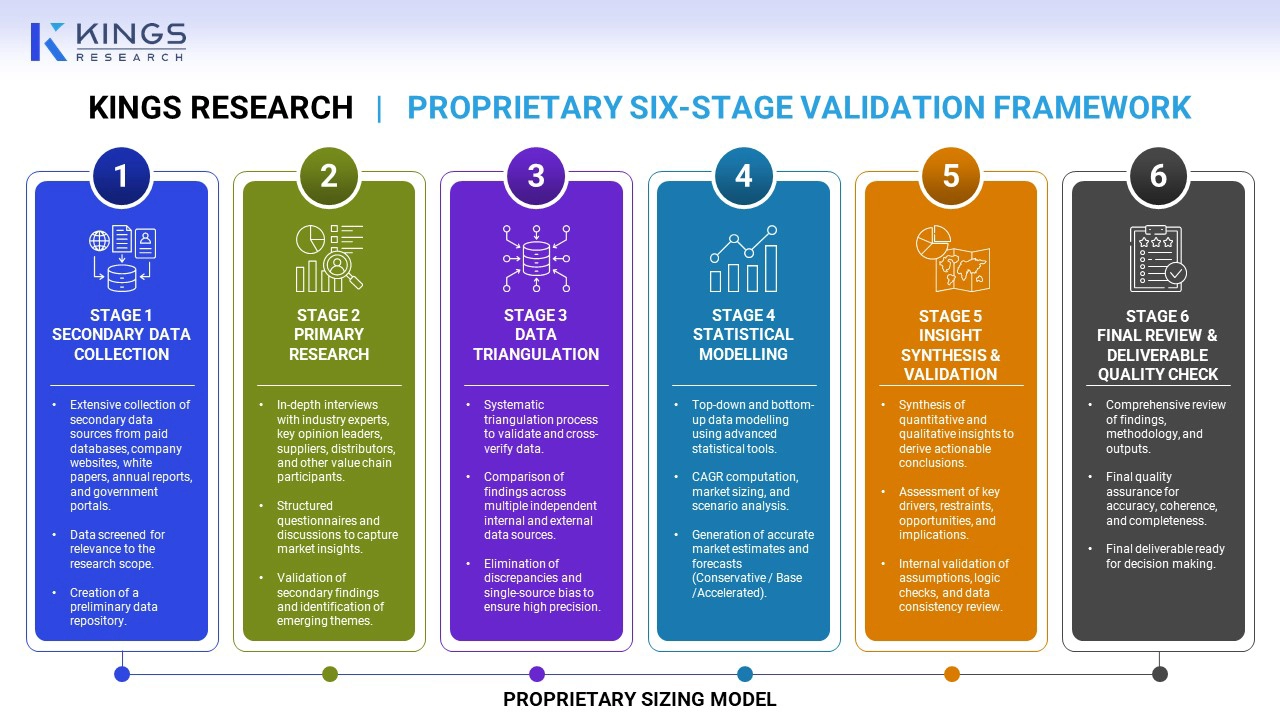
Our methodology triangulates insights from multiple independent and publicly available research databases, which are further validated against regulatory filings and public company disclosures. All estimates are cross-verified; no single-source data is presented without validation.
We deliver tailored, data-driven intelligence and strategic guidance to help organizations identify, evaluate, and capitalize on key market opportunities.
Frequently Asked Questions

Faizy brings over four years of experience in market research and consulting, with a proven ability to support strategic engagements across diverse industries and business environments. His work focuses on understanding complex market structures, identifying emerging opportunities, and translating research findings into clear, commercially relevant insights. With strong analytical capabilities and a structured approach to problem-solving, he evaluates industry trends, competitive landscapes, customer dynamics, and evolving business models. His expertise encompasses market research, competitive intelligence, market sizing and forecasting, industry assessment, company benchmarking, and strategic analysis. Faizy combines technical proficiency with a strong research orientation, enabling him to interpret both qualitative and quantitative information effectively. He has contributed to projects that help organizations assess growth potential, strengthen market positioning, and evaluate strategic priorities. His adaptable approach allows him to work across sectors while maintaining a consistent focus on accuracy, relevance, and delivering insights that support informed decision-making for clients and stakeholders.
With many years of consulting experience across global pharma, biotech, and MedTech markets, Minaz brings deep domain expertise, strategic clarity, and analytical rigor to every engagement. She has led 130+ consulting assignments spanning market entry, competitive landscaping, and portfolio prioritization, helping clients navigate complex, high-stakes decisions with confidence. Known for her ability to synthesize primary and secondary research into executive-ready recommendations, Minaz has built forecasting models and market sizing frameworks that have informed multi-million dollar investment decisions in oncology, diagnostics, and peptide therapeutics. Beyond her analytical strength, Minaz is a trusted client partner, translating complex datasets into clear, actionable insights for senior stakeholders. She currently leads a team of research analysts, driving business expansion, and shaping client engagement strategy.