



Accurate market estimates are essential for organizations that rely on evidence driven insights to plan growth strategies, evaluate investments and navigate highly competitive markets. Market research firms play an important role in delivering validated projections that reflect realistic industry developments. At Kings Research, validation and forecast accuracy form the backbone of our approach to market estimation, ensuring that every numerical estimate is grounded in fact and supported by credible sources.
This document explains the techniques and internal processes that research teams use to validate data, enhance forecast accuracy and deliver well-constructed insights that clients can depend on. For a deeper dive into the framework behind reliable forecasting, see our blog on Market Research Methodology: From Data to Decision.
Why Accurate Forecasts Matter in Market Research
Organizations use market forecasts to strengthen long term planning, identify emerging opportunities, and improve strategic outcomes. Inaccurate forecasts can lead to misallocated budgets, mistimed product launches and misguided investment decisions. Companies prioritize accuracy through rigorous validation methods that combine statistical modeling, historical assessment and industry expertise.
Reliable forecasts help companies:
- Build resilient long term strategies
- Reduce uncertainty when entering new markets
- Prioritize investment areas based on updated data
- Strengthen communication with investors
- Respond proactively to competitive changes
Core Components of Data Validation in Market Research
Data validation ensures accuracy, consistency and credibility across all sections of a market report. It includes several layers of verification that are incorporated into Kings Research’s standard workflow.
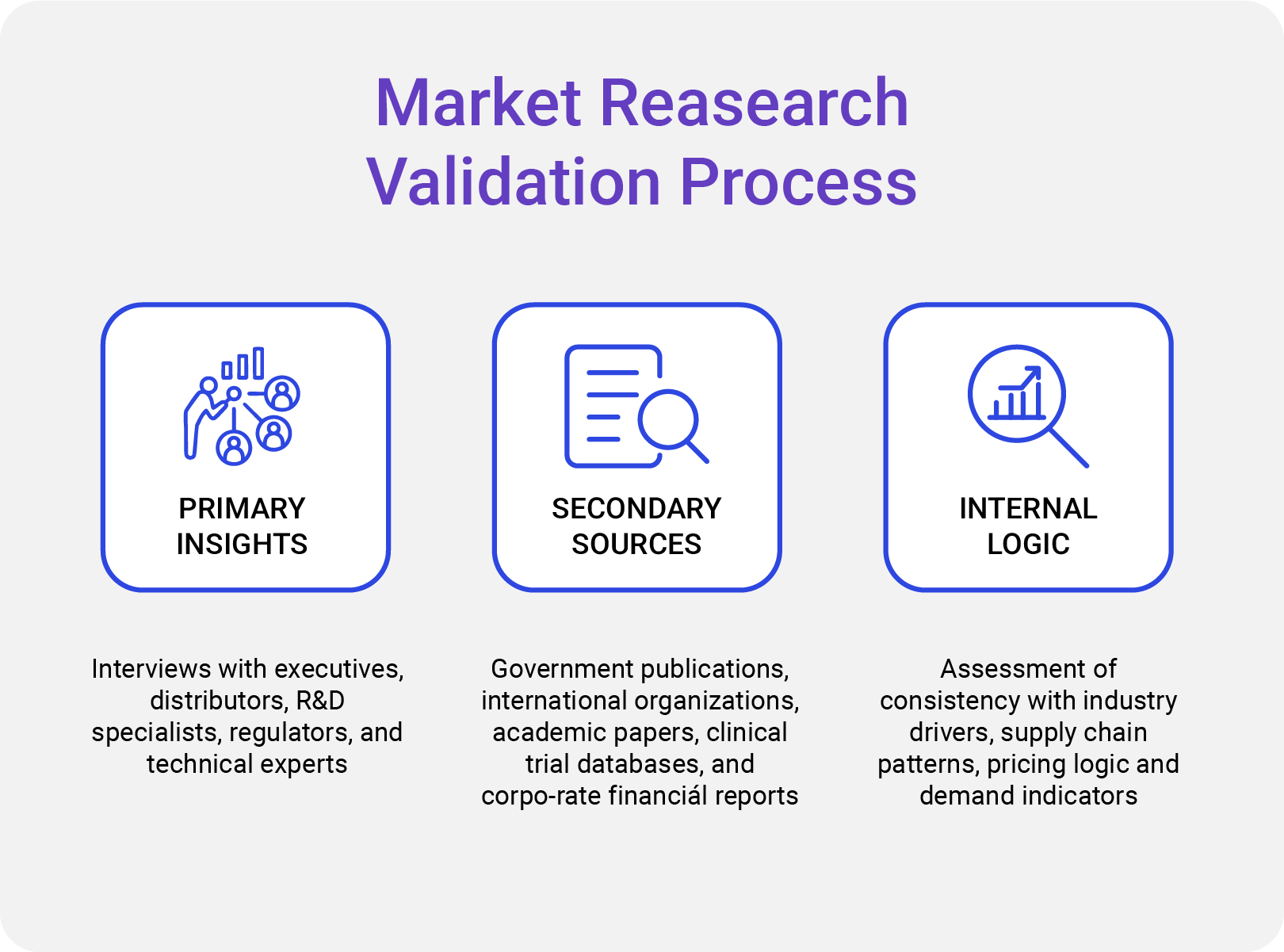
1. Triangulation of Multiple Sources
Triangulation remains one of the strongest and most widely adopted validation techniques. Research teams confirm every data point using three or more independent sources:
- Primary insights: interviews with executives, distributors, R&D specialists, regulators and technical experts
- Secondary sources: government publications, international organizations, academic papers, clinical trial databases and corporate financial reports
- Internal logic checks: assessment of consistency with industry drivers, supply chain patterns, pricing logic and demand indicators
At Kings Research, data triangulation is an explicit checkpoint during the data collection phase to reduce single source bias and to strengthen overall reliability. Read more about it in Data Triangulation in Market Research.
2. Historical Validation and Trend Comparison
Historical data provides valuable context. Analysts compare new findings to long term trends to determine whether observed changes are realistic. Unexpected deviations are investigated and must be supported by verifiable factors such as:
- New regulations
- Market expansion
- Technology breakthroughs
- Supply chain restructuring
Kings Research incorporates historical validation to ensure that market estimates align with established patterns or are explicitly justified when deviations occur. For methods that build accuracy from the ground up, explore Bottom-Up Market Analysis Framework.
3. Benchmarking with Macro Indicators
Key macroeconomic indicators influence market performance. Forecasts are evaluated against:
|
Indicator |
Validation Role |
|
GDP Growth |
Ensures overall market expansion aligns with economic conditions |
|
Industrial Output |
Tests alignment for manufacturing and equipment markets |
|
Healthcare Expenditure |
Validates projections in medical and health markets |
|
Commodity Prices |
Ensures realistic cost and pricing assumptions |
|
Population and Demographics |
Validates demand in consumer and healthcare markets |
Benchmarking prevents unrealistic overestimations or underestimations and is a standard step in Kings Research’s validation checklist.
4. Internal Logic and Consistency Checks
A report must be internally coherent. Supply dynamics must align with pricing, competitive share distribution must match company revenues and driver analysis must support the forecasted CAGR. Analysts assess whether numerical values, qualitative insights and forecast logic reinforce each other.
5. Expert Review and Quality Control
Before publication, domain experts review the entire methodology, checking assumptions, verifying calculations and ensuring data reliability. This layer of oversight is essential to professional market research and is integrated into the final editorial workflow.
Forecast Accuracy: How Research Firms Develop Precise Market Projections
Forecast accuracy depends on dependable models, verified assumptions and continuous monitoring of industry developments. Kings Research applies a combination of quantitative modeling and qualitative insight to maximize forecast reliability.
Key Techniques Used for Forecast Accuracy
1. Data Driven Forecasting Models
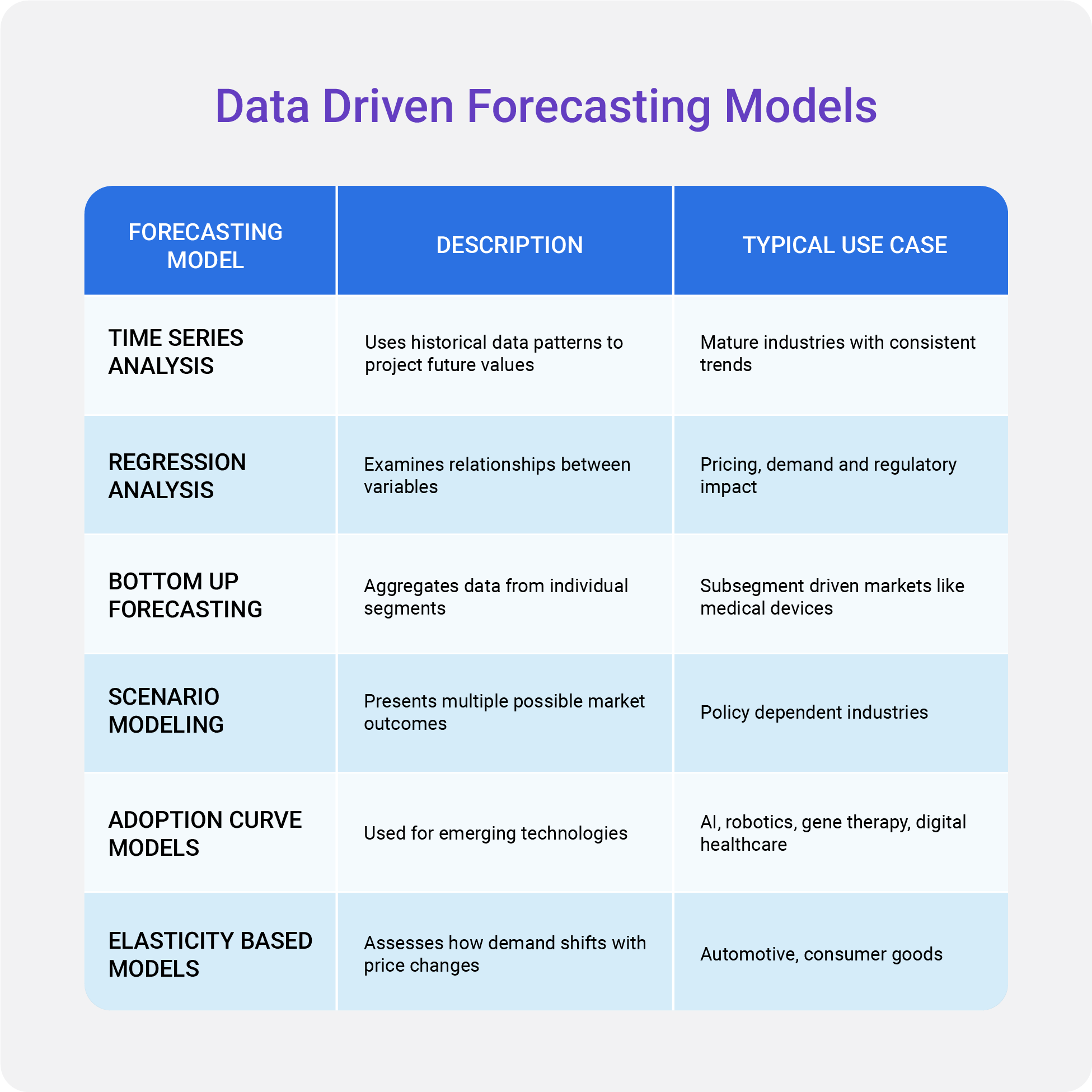
Sophisticated forecasting models are used to predict future market behavior accurately.
|
Forecasting Model |
Description |
Typical Use Case |
|
Time Series Analysis |
Uses historical data patterns to project future values |
Mature industries with consistent trends |
|
Regression Analysis |
Examines relationships between variables |
Pricing, demand and regulatory impact |
|
Bottom Up Forecasting |
Aggregates data from individual segments |
Subsegment driven markets like medical devices |
|
Scenario Modeling |
Presents multiple possible market outcomes |
Policy dependent industries |
|
Adoption Curve Models |
Used for emerging technologies |
AI, robotics, gene therapy, digital healthcare |
|
Elasticity Based Models |
Assesses how demand shifts with price changes |
Automotive, consumer goods |
Analysts select models based on market maturity, data availability and the complexity of influencing factors. Kings Research documents model selection and rationale for client transparency.
2. Strong Scenario Development
Scenario planning strengthens forecast robustness by understanding how different conditions might influence growth. Research teams typically produce:
- Base Case: Market evolves under normal and expected conditions
- Optimistic Case: Growth rises due to rapid technology adoption or favorable regulation
- Conservative Case: Growth slows due to economic volatility or regulatory restrictions
Kings Research presents scenario outputs to help clients plan for alternative futures and prioritize contingency strategies.
3. Assumption Validation
Assumptions underpin forecast accuracy. Analysts validate each assumption using reliable evidence such as:
- Government regulatory announcements
- Clinical research and scientific publications
- Verified industry investment plans
- Technological development roadmaps
- Manufacturing capacity expansions
Transparent assumptions promote credibility and client confidence. Kings Research includes a dedicated assumptions appendix in every major report.
4. Sensitivity and Stability Testing
Sensitivity analysis identifies variables that significantly influence forecasts. Analysts adjust inputs such as price, adoption rate or production capacity to evaluate projection stability. This ensures clients receive a forecast that remains robust under changing market conditions.
5. Continuous Market Monitoring
Forecast accuracy improves when analysts consistently monitor industry developments including mergers, pricing updates, supply chain changes and regulatory news. Real time updates ensure that future projections remain relevant and evidence based. Kings Research maintains market trackers to update key metrics as new information becomes available.
Case Style Examples: How Validation Strengthens Real Forecasts
To illustrate how validation improves accuracy, here are industry aligned examples based on common market events.
Example 1: Medical Device Market Forecast
The medical device market was originally expected to experience rapid growth. However, its growth outlook may need to be revisited if any of the following occur:
- Regulatory asspprovals face delays.
- Manufacturing capacity expands faster than demand.
- New competing technologies enter the market.
Triangulation with industry announcements and regulatory databases helps refine the forecast to a more realistic range.
Example 2: Electric Vehicle Battery Market
An emerging technology market often shows dramatic shifts. For electric vehicle batteries, patent filings, lithium supply fluctuations, government incentives and OEM partnerships are critical inputs. Kings Research cross checks these sources to avoid forecasts based solely on isolated announcements.
Example 3: Pharmaceutical Outsourcing Market
If a contract research organization announces a new global R&D center, analysts cross check this with hiring trends, partnership announcements, and clinical trial registry updates. This triangulated validation permits accurate adjustments to market share projections.
Validated vs Non Validated Market Research: Why It Matters
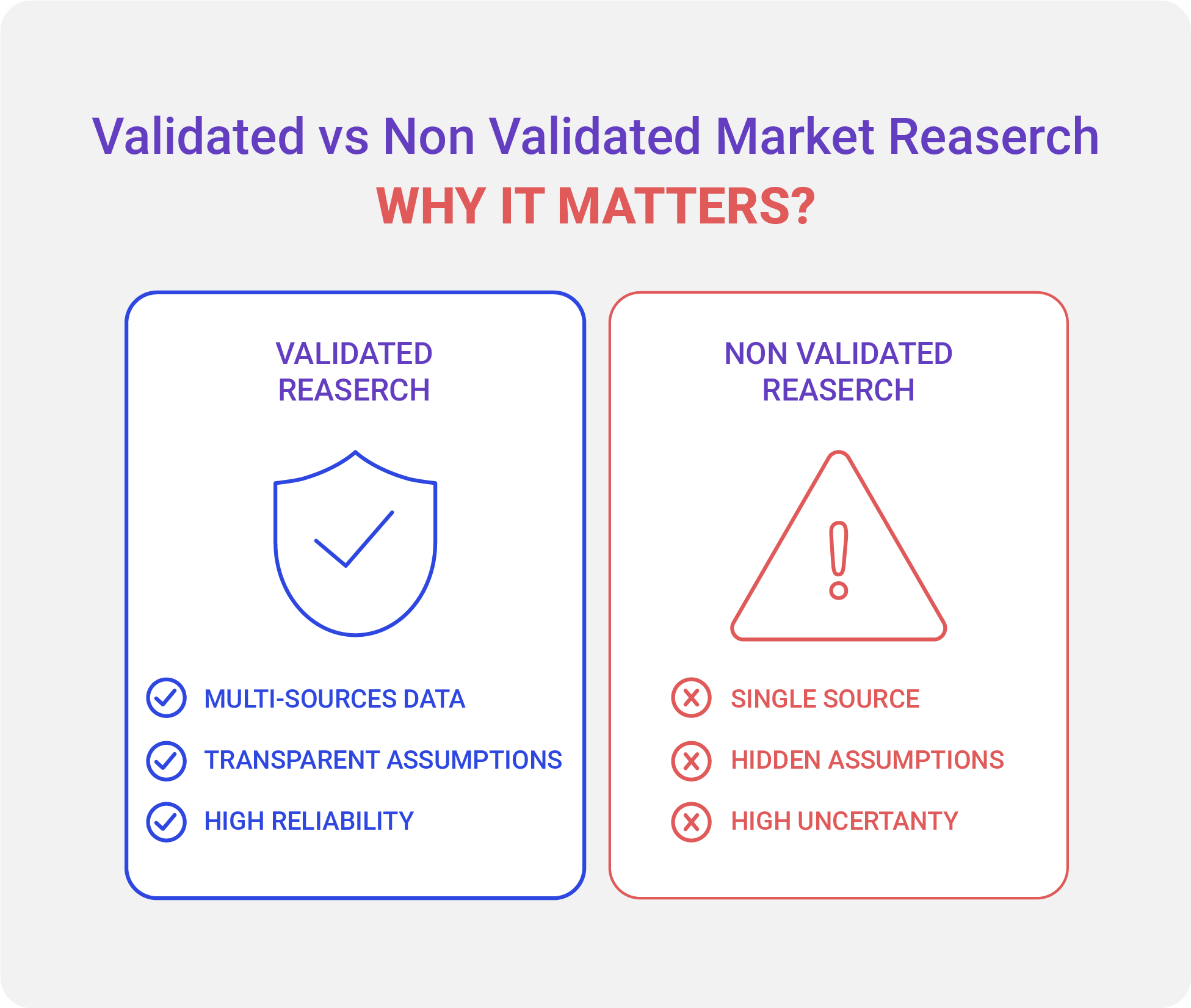
|
Aspect |
Validated Research |
Non Validated Research |
|
Data Sources |
Verified, credible, triangulated |
Unverified or limited sources |
|
Forecast Accuracy |
High reliability |
Often speculative |
|
Assumption Transparency |
Fully disclosed |
Usually unclear |
|
Decision Making Value |
Strong foundational support |
Higher risk and uncertainty |
|
Long Term Usability |
Sustainable and dependable |
Short lived and inaccurate |
Validated research provides structural and long-term advantages. For strategic applications of validated research, see Competitive Intelligence in Forecasting.
Validated research offers structural and long term advantages for organizations:
- Better alignment of budgets and resources
- Confident entry into emerging markets
- Well informed product development strategies
- Enhanced investor communication
- Lower exposure to market risks
- Stronger competitive positioning
Kings Research supports clients through consultative presentations that translate validated data into actionable strategic recommendations.
Conclusion
Validation and forecast accuracy are essential in market research. They ensure that insights are credible, actionable and aligned with real market conditions. Professional firms, including Kings Research, follow rigorous processes that include data triangulation, historical validation, macroeconomic benchmarking, scenario development, assumption verification and expert oversight.
These practices allow clients to plan confidently, seize opportunities and navigate evolving markets with clarity. As industries advance and competition intensifies, the demand for validated and accurate market intelligence will continue to grow, making these capabilities vital to successful strategic decision making.