
Inquire Now
Key Strategic Points
The market includes virtual duplicates of physical manufacturing assets, products, systems, and processes. It includes cloud-based, on-premise, and hybrid deployment models. The market serves large and small enterprises across industries like automotive, aerospace, healthcare, and consumer electronics. It focuses on improving efficiency, predictive maintenance, and product quality by using advanced digital solutions.
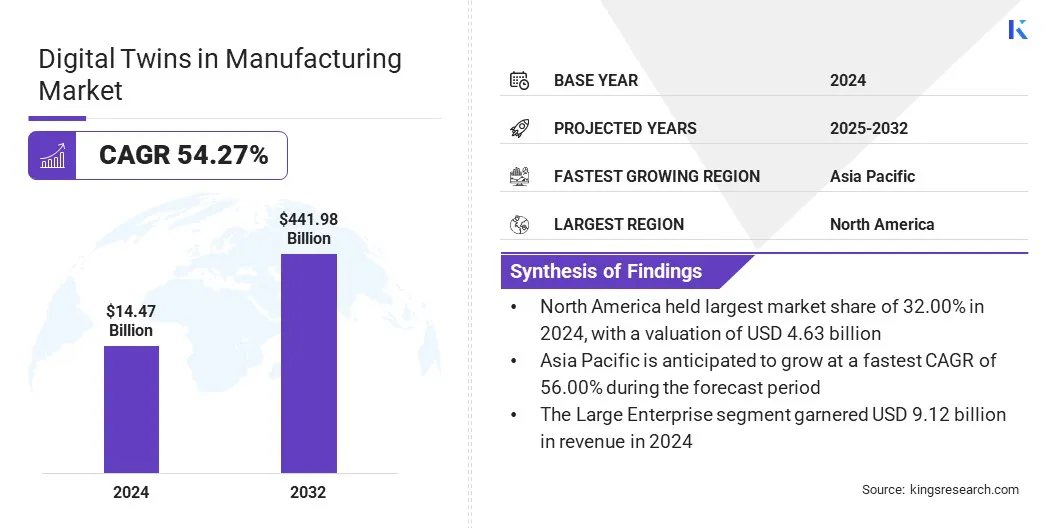
The global digital twins in manufacturing market size was valued at USD 14.47 billion in 2024 and is projected to grow from USD 21.26 billion in 2025 to USD 441.98 billion by 2032, exhibiting a CAGR of 54.27% during the forecast period. This growth is mainly driven by manufacturers using virtual models to test and increase production without affecting workflows.
This process helps them identify the bottlenecks, improve the usage of resources, cut down the downtime, and maintain quality. Increasingly, autonomous digital twins are being adopted to continuously analyze data and make real-time changes, allowing for faster responses on the production floor and enhancing overall productivity and efficiency.
Major companies operating in the global digital twins in manufacturing industry are General Electric Company, Dassault Systèmes, Siemens, Microsoft, ANSYS, Inc, AVEVA (Schneider Electric group), Oracle, Toobler Technologies, COSMO TECH, Bentley systems, Hexagon AB, NVIDIA Corporation, Hitachi Energy Ltd, ABB, and PTC.
Digital twins are being applied by companies to replicate the way new car products will fit and even work on the production lines, even before the real manufacturing commences. This will assist in resolving problems that could arise ahead of time and minimizing delays.
Online testing of assembly processes improves efficiency and ensures that the integration of new models will be less difficult. It also enables greater flexibility in changing production lines to suit various types of vehicle designs, which leads to more precise and faster product introduction.
The market is expanding with the need for greater production capacity and throughput across industries. This technology assists manufacturers in developing virtual models of their production processes, which allow them to test and optimize operations without altering their actual workflows. It enables better identification of bottlenecks and better utilization of resources.
Digital twins can also decrease downtime and ensure product quality in addition to enhancing production speed. The technology encourages scalable and flexible manufacturing, making it a major driver of contemporary industrial activity.
Implementing a digital twin system involves high investments in sensors, software, data storage, and skilled staff, which can be expensive for most small-scale manufacturers. These initial costs often slow down the adoption of digital twin solutions, even though they offer long-term benefits.
A solution to this is to offer pricing through pay-as-you-go models provided by major players. This model enables manufacturers to pay on the basis of the actual utilization of the technology, which requires lower initial investments in the initial stage and makes the operational process of the scale easier in the long run. It is also common to start with small pilot projects in many organizations or prioritize key assets first and then extend the use of digital twins over time as the results become positive.
The market is witnessing a significant trend toward the rise of autonomous digital twins that help in the real-time engineering design and automatic optimization of the processes. These digital twins collect the data from manufacturing operations and analyze it, assisting them in making adjustments on their own without any human input.
This ability helps manufacturers respond quickly to any change on the production floor, improving efficiency, and overall productivity. The move toward autonomous digital twins reflects a focus on developing more intelligent and adaptive manufacturing systems that reduce the need for manual control and improve operational outcomes.
|
Segmentation |
Details |
|
By Digital Twin Type |
Asset Twin, Product Twin, Process Twin, System Twin |
|
By Deployment Mode |
Cloud Based, On Premise, Hybrid |
|
By Organization Type |
Large Enterprise, Small and Medium Enterprise |
|
By End-User |
Automotive, Aerospace & Defense, Healthcare, Consumer Electronics, Others |
|
By Region |
North America: U.S., Canada, Mexico |
|
Europe: France, UK, Spain, Germany, Italy, Russia, Rest of Europe |
|
|
Asia-Pacific: China, Japan, India, Australia, ASEAN, South Korea, Rest of Asia-Pacific |
|
|
Middle East & Africa: Turkey, U.A.E., Saudi Arabia, South Africa, Rest of Middle East & Africa |
|
|
South America: Brazil, Argentina, Rest of South America |
Based on region, the digital twins in manufacturing market has been classified into North America, Europe, Asia Pacific, Middle East & Africa, and South America.
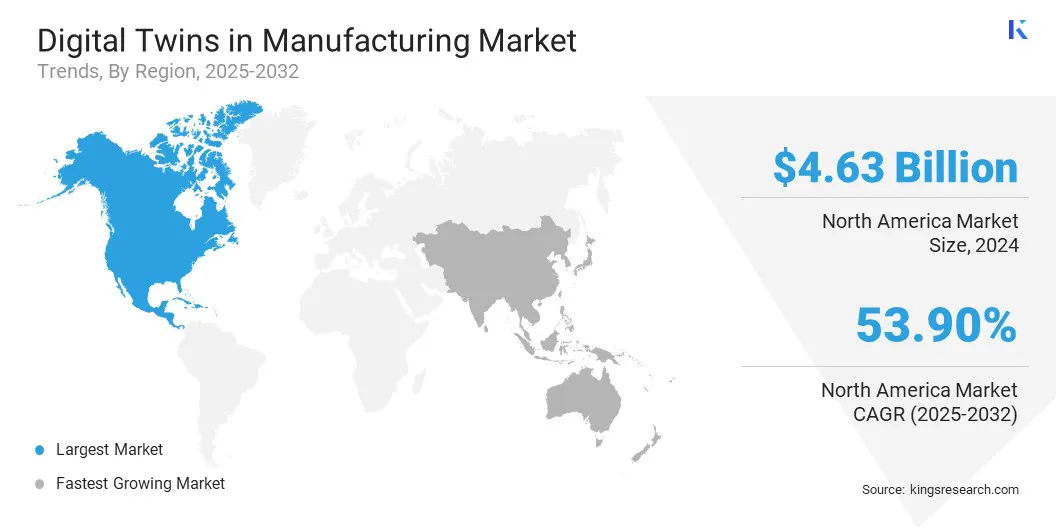
North America digital twins in manufacturing market accounted for a substantial share of 32.00% in 2024, valued at USD 4.63 billion. This dominance of the region can be explained by the fact that it embraced the Industry 4.0 technologies much earlier, that is, automation, the Internet of Things, and the use of data analytics, which allow manufacturers to improve the efficiency of operations and reduce downtime by using the digital twin technology.
Additionally, significant capital investments by companies in sophisticated manufacturing technologies have enabled the broad adoption of digital twins, thus highlighting the dominance of the regional market.
The Asia-Pacific digital twins in manufacturing industry is expected to register the fastest CAGR of 56.00% over the forecast period. This rapid growth can largely be traced to massive production activities in countries like China, Japan, India, and South Korea, which require advanced solutions in production efficiency.
In addition, the presence of favourable government policies and significant investment in Industry 4.0 infrastructure and smart-factory projects has accelerated the modernization of the manufacturing process, which in turn is generating the need to use digital twin technology in the region.
The key players in the digital twins market in the manufacturing industry are focusing on improving energy-efficiency optimization and taking control of electrical systems and power requirements. These organizations are building AI-based analytics coupled with IoT sensors to allow monitoring in real-time and anticipatory handling of the energy expenditure to minimize waste levels and enhance operational sustainability. They are also giving preference to solutions that supply control to power distribution and load management in manufacturing plants.
Companies are prioritizing platforms designed for integration into existing electrical infrastructure and for adapting energy usage based on production demands. These enterprises are also working together to expand the capacity and capability of digital twins solutions, thus responding to the growing pressure of energy-efficient manufacturing processes.
Frequently Asked Questions

Tejasv specializes in secondary research and data validation, transforming complex information into clear market insights. He supports multi-industry research initiatives by delivering reliable intelligence that informs planning and strategic direction. With a disciplined and detail-focused approach, he emphasizes analytical clarity and practical application. His interest in geopolitics and history informs his broader market perspective. This unique lens allows him to contextualize industry shifts within larger socio-political frameworks, adding depth to his analyses. He maintains rigorous documentation standards, making his findings auditable and easily reproducible. His ability to distill vast amounts of secondary data into concise, decision-ready summaries has earned him the trust of project leads across multiple verticals. Tejasv actively tracks regulatory changes and economic indicators, which he incorporates into his research to enhance its forward-looking relevance. His methodical work ethic, combined with a calm demeanor under tight deadlines, ensures that his contributions remain both timely and impactful.
Habi is a seasoned research and consulting leader with renowned experience in guiding clients on strategic growth and transformation initiatives across global markets. He has led high-performing research teams that deliver actionable insights on market expansion, M&A strategies, opportunity assessment, new business development, and product launches. His project portfolio spans large petrochemical producers, electronic device manufacturers, lubricants companies, and other leading enterprises across diverse industrial and consumer sectors. He currently heads the research department at Kings Research, where he is responsible for setting the research agenda, mentoring analysts, and ensuring client-ready deliverables that support executive decision-making. With extensive experience in market intelligence, strategic research, and consulting, Habi brings a strong understanding of evolving industry dynamics, competitive landscapes, emerging opportunities, and business growth challenges. His expertise includes developing research frameworks, translating complex market data into actionable strategic recommendations, and working closely with senior stakeholders to address critical business questions. He has also contributed to building research capabilities, strengthening analytical methodologies, and driving a culture of quality and insight-led decision-making within research teams. His cross-industry exposure enables him to connect market trends with broader business implications and provide perspectives that help organizations identify opportunities, mitigate risks, and make informed strategic decisions.