
Inquire Now
Key Strategic Points
The market is focused on the development and implementation of cryptographic algorithms that are resistant to quantum computer-enabled breaches. Unlike classical algorithms, these algorithms are immune to the computational capacity of quantum machines and can be executed on conventional hardware.
The market is aimed at the development of quantum resistant encryption schemes in order to secure digital information and communications from future quantum attacks, ensuring long term cybersecurity in the age of quantum computing. The market is undergoing rapid transformation due to the development of quantum computers, along with the adoption of international standardization models and the growing acceptance of PQC solutions.
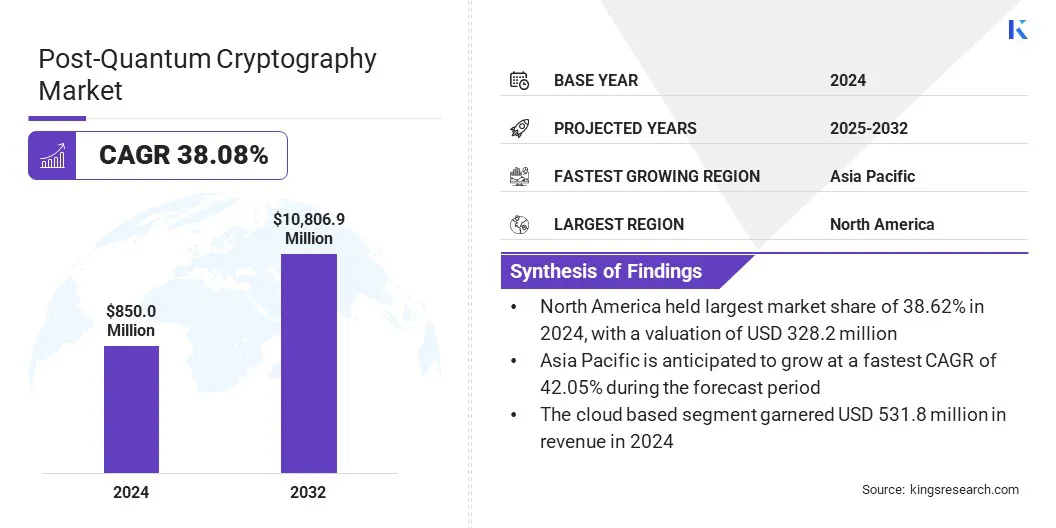
The global post-quantum cryptography market size was valued at USD 850 million in 2024 and is projected to grow from USD 1,129.2 million in 2025 to USD 10,806.9 million by 2032, exhibiting a CAGR of 38.08% during the forecast period. This rapid growth is attributed to the rising concerns about the vulnerabilities of classical cryptographic systems in the face of quantum computing threats, creating a strong demand for quantum-resistant encryption solutions.
Major companies operating in the post-quantum cryptography industry are NXP Semiconductors, Amazon Web Services, Inc., IDEMIA, Palo Alto Networks, Inc., DigiCert, Inc., Thales, Entrust Corporation, IBM, Infineon Technologies AG, KLOCH Technologies, LLC, PQShield Ltd, ISARA Corporation, Crypto4A Technologies, ID Quantique, and zeroRISC.
Governments, financial institutions, and technology providers are accelerating the shift to post-quantum cryptography to assure the protection of sensitive information and maintain long-term standards of regulatory requirements. With growing knowledge on quantum risks, the market will witness further innovation and collaboration, and more robust and future-proof cryptographic traditions will be implemented across the globe.
One of the significant forces that is fueling market expansion is the mandatory federal compliance deadlines that have generated an irreversible procurement wave. In June 2025, the U.S. Cybersecurity and Infrastructure Security Agency (CISA) established the product categories and technology standards that the federal agencies and operators of critical infrastructure should use to fulfill the post-quantum cryptography expectations.
Such binding deadlines force organizations to source and deploy quantum-resistant cryptographic solutions in a hurry to prevent future cyber-attacks that will be perpetrated by quantum computers. This regulatory pressure not only leads to adoption among government sectors, but it also cascades into the private industries that serve or interact with federal systems, creating demand across the board.
The real-time schedules and adherence requirements create certainty in the market, which stimulates faster investments and innovation in the PQC technologies as companies scramble to achieve the federal requirements before the set deadlines. This produces a long-term, irreversible, procurement-driven market stimulation.
The complexity and performance overhead of integrating the cryptographic infrastructure is a major challenge in the post-quantum cryptography market. Most of the existing systems are based on well-defined cryptographic functions that are optimized to be fast and efficient.
Substituting or supplementing them with quantum-resistant algorithms may impose added computational loads and latency, which may affect the performance of the system, particularly in resource-limited or high-throughput systems. Moreover, the incorporation of new PQC algorithms involves long testing and validation to make sure that it works with older protocols and hardware, making deployment complicated.
One of the most recent trends in the post-quantum cryptography market is the implementation of hybrid cryptography, a mixture of classical and quantum-resistant algorithms to achieve safety in the transition period. This strategy enables organizations to be compatible with their current system and transition slowly to quantum-safe solutions.
In September 2025, Sopra Steria improved its services on data-centric cybersecurity by adding the hybrid post-quantum cryptography technology. This allows clients to ensure the security of sensitive data against present and future quantum threats without compromising performance or interoperability.
Hybrid cryptography is therefore an easily applicable, versatile route by which organizations can improve their security status as quantum computing is developed, and hence is an important tactic in the changing paradigm of security in cyber space.
|
Segmentation |
Details |
|
By Component |
Hardware, Software, and Services |
|
By Deployment Mode |
Cloud Based, and On Premise |
|
By Organization Type |
Small and Medium Enterprise, and Large Enterprise |
|
By End-User |
BFSI, Healthcare, Retail and E-commerce, IT and Telecommunications, Manufacturing , and Others |
|
By Region |
North America: U.S., Canada, Mexico |
|
Europe: France, UK, Spain, Germany, Italy, Russia, Rest of Europe |
|
|
Asia-Pacific: China, Japan, India, Australia, ASEAN, South Korea, Rest of Asia-Pacific |
|
|
Middle East & Africa: Turkey, U.A.E., Saudi Arabia, South Africa, Rest of Middle East & Africa |
|
|
South America: Brazil, Argentina, Rest of South America |
Based on region, the post-quantum cryptography market has been classified into North America, Europe, Asia Pacific, Middle East & Africa, and South America.
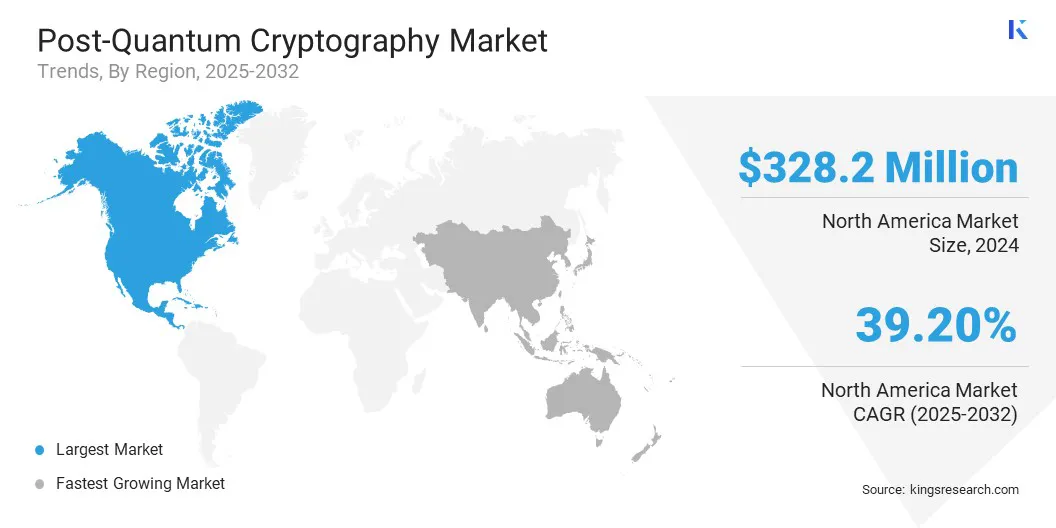
The North America post-quantum cryptography market share stood at 38.62% in 2024, valued at USD 328.2 million. The region is characterized by a developed technological base and effective government funding of cybersecurity programs. The high-level infrastructure and academic-industrial-governmental interaction in the region are increasing the rate of innovation and implementation of quantum-resistant solutions.
Moreover, the existence of various major technology firms and startups creates a competitive environment that contributes to the ongoing improvement and implementation of the state-of-the-art cryptographic technologies. The combination of these aspects is what makes North America a leading region and makes the environment conducive to the future growth of the market in the field of the post-quantum cryptography.
The Asia-Pacific post-quantum cryptography industry is set to grow at a CAGR of 42.05% over the forecast period. This market is set to grow due to the presence of strong governmental programs and the growth of investments in quantum-safe technologies.
Rapid digital transformation and modernization of telecommunications infrastructure are taking place in the region, and these activities are among the major drivers of demand for advanced cryptographic solutions. Moreover, the increasing awareness of cybersecurity, as well as the necessity to safeguard sensitive information in the context of the continuously growing digital economy, is promoting their popularity.
The post-quantum cryptography industry is characterized by continuous innovation focused on developing scalable and commercially deployable quantum-safe security solutions. Market participants are spending on new cryptographic libraries, secure software development kit (SDK), and enterprise security platforms that can serve next generation encryption needs.
Vendors are also targeting integration with enterprise applications, secure communication network, and data protection systems, so that organizations can enhance long-term data security goals.
Moreover, a lot of solution providers are broadening functionalities in cryptography administration systems, secure firmware updates, and identity-based security frameworks that uphold future ready encryption systems.
Key to accelerating the process of testing and validation of algorithms and their practical application are also strategic partnerships with academic institutions and cybersecurity research communities. With higher protection of sensitive digital assets being sought by organizations, product innovations, research and capabilities, and the capacity to provide scalable security across various digital ecosystems drive much of the competition in the market.
Frequently Asked Questions

Aswathi holds cross-domain expertise, translating market trends and competitive intelligence into decision-ready insights. Her work helps clients interpret evolving market conditions and identify growth opportunities. She brings a focused, insight-led approach to research execution. She translates these findings into clear, prioritized action plans that align with client capabilities. Her research often includes scenario modeling to test growth strategies under varying economic conditions. She maintains a rigorous validation process, cross-checking primary and secondary sources to ensure reliability. Clients value her ability to synthesize noisy data into concise executive summaries that drive board-level discussions. Her sector-specific lens, combined with a pragmatic focus on execution, consistently delivers high-impact, commercially sound recommendations. Her structured yet flexible research frameworks adapt to client timelines without compromising depth. She is known for distilling complex trade-offs into straightforward, defensible positions that facilitate confident decision-making.

Ganapathy Subramaniam Suresh
With over a decade of research leadership across global markets, Ganapathy brings sharp judgment, strategic clarity, and deep industry expertise. Known for precision and an unwavering commitment to quality, he guides teams and clients with insights that consistently drive impactful business outcomes.