
Inquire Now
Key Strategic Points
SaaS security posture management (SSPM) is a form of security tool, which aims to address the security of SaaS (software as a service) applications. SSPM constantly monitors, supervises, and examines the SaaS applications by tracking user access and determining potential risks. SPPM reduces data leakage and closes security gaps that are usually difficult to detect with conventional tools by tracking settings and third-party integrations through APIs.
The global SaaS security posture management market size was valued at USD 2,280.0 million in 2024 and is projected to grow from USD 2,602.6 million in 2025 to USD 7,461.5 million by 2032, exhibiting a CAGR of 16.24% during the forecast period.
The market is estimated to experience tremendous growth as the number of Non-Human Identities (NHIs) like service accounts, bots, and APIs expected to have extensive access to critical SaaS assets is projected to increase, potentially posing a risk of security breaches and unauthorized access. SSPM solutions solve these problems through real-time monitoring of the activities and behaviors of the NHIs to enhance security posture.
Major companies operating in the SaaS security posture management industry are Grip Security, Inc., AppOmni, Cynet, DoControl, Inc., Lumos, Netskope, Obsidian Security, Inc., Spin.AI, Varonis, Zygon Technologies, Inc., Zluri, Zscaler, Inc., Axonius, Valence Security, and CrowdStrike.
Organizations are turning to centralized discovery and AI SSPM solutions for continuous monitoring and control of SaaS security postures. They utilize AI's capabilities to improve security posture and detect security threats by analyzing machine learning and behavioral data.
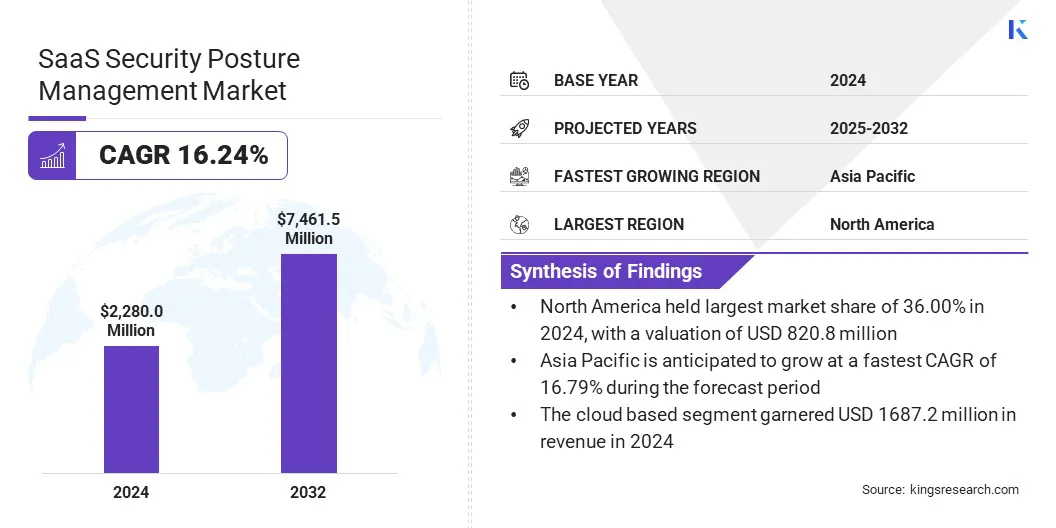
The escalating units of Non-Human Identities (NHIs) like service accounts, bots, and APIs are driving the growth of SaaS security posture management (SSPM). These NHIs often provide broad access to critical SaaS assets, which increases the vulnerability to attack surface and unauthorized access.
In addition to the adoption of OAuth integrations that allow users to access SaaS systems using third-party applications, companies are facing challenging security environments concerning authorization and usage tracking. To curb such risks, the SSPM solutions provide the real-time monitoring of the NHI behaviors, least-privilege access, and the use of OAuth authorizations in order to assist businesses in maintaining a high degree of security.
One of the major challenges is decentralized SaaS sprawl, which occurs when different departments or individuals adopt several SaaS applications independently without the centralized IT approval or oversight.
The uncontrolled proliferation leads to less visibility and complexity for the security teams, and therefore it is difficult to closely monitor and secure all the software in use. As a result, the decentralized SaaS sprawl raises the risk of security breaches, data breaches, and compliance, which poses a major challenge to SaaS security posture management solutions to uphold holistic and effective security governance.
To overcome this challenge, companies are adopting centralized SaaS discovery solutions, following stringent IT policies, and incorporating automated SSPM solutions to enhance visibility, control, and ongoing monitoring of all SaaS applications.
The market is increasingly shaped by platform convergence and security stack consolidation. In lieu of functioning as isolated solutions, SSPM capabilities are being integrated into broader cloud and enterprise security platforms. Organizations are seeking multi-environment visibility in SaaS, cloud, and identity environments to reduce the operational complexity and tool proliferation.
This transition justifies security teams matching posture results with identity and infrastructure risks in a single set of dashboards to enhance response sectors and remediation effectiveness. With the maturity of security architectures, vendors are emphasizing interoperability, ecosystem integrations, and simplified workflows to provide more integrated and complete risk management systems.
|
Segmentation |
Details |
|
By Component |
Solutions, Services |
|
By Deployment Mode |
Cloud Based, On Premises |
|
By Organization Size |
Large Enterprise, Small & Medium Enterprises |
|
By Application |
Compliance Management, Threat Detection and Response, Data Loss Prevention, Visibility & Monitoring, Others |
|
By End-user |
BFSI, Healthcare, Retail and E-commerce, IT and Telecommunications, Government, Others |
|
By Region |
North America: U.S., Canada, Mexico |
|
Europe: France, UK, Spain, Germany, Italy, Russia, Rest of Europe |
|
|
Asia-Pacific: China, Japan, India, Australia, ASEAN, South Korea, Rest of Asia-Pacific |
|
|
Middle East & Africa: Turkey, U.A.E., Saudi Arabia, South Africa, Rest of Middle East & Africa |
|
|
South America: Brazil, Argentina, Rest of South America |
Based on region, the market has been classified into North America, Europe, Asia Pacific, Middle East & Africa, and South America.
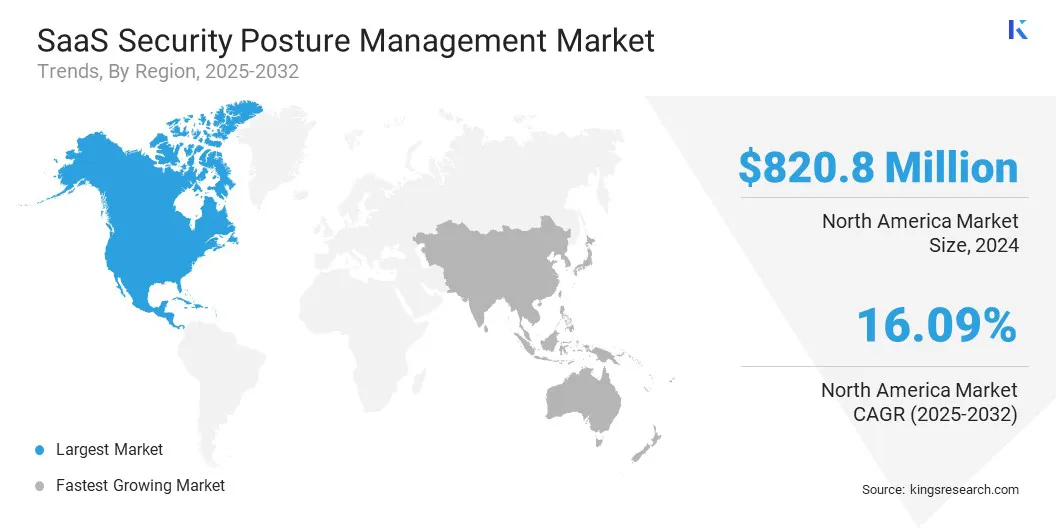
North America accounted for a substantial share of 36.00% in 2024, valued at USD 820.8 million. This is inextricably linked with the highly advanced digital ecosystem, the widespread use of cloud technologies, and the growing focus on cybersecurity.
The top companies in North America are actively building AI-native dynamic platforms to combat SaaS sprawl and shadow applications with automated threat analysis. Companies are also building identity security posture management platforms to combat shadow AI agents and unsanctioned AI tools.
Furthermore, unified security hubs are integrating cloud and partner technologies to bring unified enterprise security with simplified procurement and billing. In addition, full SaaS supply chain security protects SaaS integrations with full visibility to detect and contain breaches early. By bringing unified visibility, compliance, and enforcement to complex SaaS environments, North American companies are strengthening governance and mitigating SaaS sprawl and shadow IT risks.
The Asia-Pacific SaaS security posture management market is projected to register a CAGR of 16.79% over the forecast period. This is because the data protection and cybersecurity laws in countries such as China, including the Personal Information Protection Law (PIPL) and the Data Security Law (DSL), and the Digital Personal Data Protection Act (DPDPA) in India, the PDPA in Singapore, and the APPI in Japan, and the Notifiable Data Breaches scheme in Australia, are stricter. Such laws include breach reporting, data-transfer controls, security controls, as well as audit documentation- obligating businesses to keep an eye on SaaS settings and access management at all times.
Meanwhile, the fast rate of SaaS adoption in the BFSI and government sectors adds to the risk of misconfiguration and identity theft. Compliance Vendors are responding by integrating automated compliance dashboards, implementing least-privilege policies, local data controls, and collaborating with regional firms to enable them to create audit-ready evidence in real-time.
Key players in the SaaS security posture management are introducing AI-based applications to augment threat detection process, automate compliance, and accelerate the remediation process. These developments have enabled a better and more accurate understanding of the complex SaaS environment, allowing businesses to detect incorrect configurations and security issues in real-time.
Conversely, end-to-end SaaS supply chain protection solutions are also being created by businesses, providing end-to-end visibility on SaaS integrations, OAuth scopes, and AI agent activities. This is a holistic approach to the growing attack surface, addressing identity risks, misconfigurations, and integration vulnerabilities across the entire SaaS ecosystem.
Frequently Asked Questions

Siddhi specializes in primary and secondary research, with experience developing research frameworks and white papers that translate findings into clear business narratives. She has supported projects across diverse industries, delivering reliable insights aligned with client objectives. Her work is characterized by strong organization, clear communication, and consistent execution. Her expertise in structuring frameworks provides a solid foundation for data collection, while her white paper development translates figures into compelling executive storylines. Siddhi maintains consistency across complex, multi-phase projects, ensuring coherent, deadline-compliant deliverables. She adapts her communication to suit technical and non-technical stakeholders, bridging data and decision-making. Her disciplined workflow emphasizes error-free reporting and logical flow, earning consistent client praise. Siddhi synthesizes conflicting data, presenting balanced viewpoints that account for market uncertainties. Her portfolio reflects a track record of delivering polished, actionable documents that enhance business planning. With a pragmatic mindset, she prioritizes relevance and usability, ensuring her work addresses the strategic questions clients pose.
Habi is a seasoned research and consulting leader with renowned experience in guiding clients on strategic growth and transformation initiatives across global markets. He has led high-performing research teams that deliver actionable insights on market expansion, M&A strategies, opportunity assessment, new business development, and product launches. His project portfolio spans large petrochemical producers, electronic device manufacturers, lubricants companies, and other leading enterprises across diverse industrial and consumer sectors. He currently heads the research department at Kings Research, where he is responsible for setting the research agenda, mentoring analysts, and ensuring client-ready deliverables that support executive decision-making. With extensive experience in market intelligence, strategic research, and consulting, Habi brings a strong understanding of evolving industry dynamics, competitive landscapes, emerging opportunities, and business growth challenges. His expertise includes developing research frameworks, translating complex market data into actionable strategic recommendations, and working closely with senior stakeholders to address critical business questions. He has also contributed to building research capabilities, strengthening analytical methodologies, and driving a culture of quality and insight-led decision-making within research teams. His cross-industry exposure enables him to connect market trends with broader business implications and provide perspectives that help organizations identify opportunities, mitigate risks, and make informed strategic decisions.