
Inquire Now
Key Strategic Points
The market includes software and services designed to detect, monitor, and protect sensitive data from unauthorized access, leakage, or exfiltration across networks, endpoints, cloud environments, and storage systems. These solutions apply content inspection, contextual analysis, and policy enforcement to identify and block data transfers that violate organizational security rules or regulatory requirements.
The report covers segmentation by deployment type, component, organization size, industry vertical, and region. Data loss prevention technologies are used across enterprises and public sector organizations to maintain compliance, safeguard intellectual property, protect customer information, and reduce financial and reputational risk associated with data breaches.
The global data loss prevention market size was valued at USD 2,863.2 million in 2024 and is projected to grow from USD 3,482.0 million in 2025 to USD 16,224.6 million by 2032, exhibiting a CAGR of 24.59% over the forecast period.
The growth is primarily driven by the increasing demand for secure data handling and storage, expanding digital activities across industries, and heightened awareness regarding cybersecurity and organizational data protection.
Major companies operating in the data loss prevention market are IBM, Broadcom, Trend Micro, GTB Technologies, Cisco, Mc Afee, InfoWatch, Forta, LLC, Ekran Systems, Imperva, Palo Alto Networks, Cloudflare, Inc., CrowdStrike, Citrix Systems, Sophos Ltd. and Others.
-market.webp)
Market growth in the DLP sector is driven majorly by the rising regulatory requirements for secure data handling and storage, rising digitalization across diverse end use industries, and heightened awareness regarding cybersecurity and privacy protection.
The increase in volume of sensitive data, expanding cyber threats, and stricter regulatory requirements across end use sectors comprising banking and finance, healthcare, government, IT and telecom, and manufacturing is leading to increment in demand for efficient data loss prevention solutions.
Moreover, the surge in the adoption of remote and hybrid work environments, the adoption of cloud services, escalating insider threats, and the necessity to comply with data protection laws which include GDPR, HIPAA, and industry-specific regulations further accelerate DLP adoption.
Technical complexities of DLP implementation comprising integrating solutions across on-premises systems, cloud platforms, remote endpoints, and mobile devices act as significant challenge for many enterprises towards adopting DLP technologies. Additionally, addressing insider threats, adapting to encrypted traffic, and keeping pace with rapidly changing cyberattack patterns continue to pressure adoption of effective DLP measures.
The increasing adoption of AI and Machine Learning (ML) powered DLP systems in order to transition from conventional rule-based monitoring towards dynamic, behavior-aware, and predictive protection models acts as a significant trend in the market. AI/ML integrated DLP systems are able to analyze massive datasets, learn from user behavior and analytics, detect anomalies in real time, and automatically adapt to evolving cyber threats with minimal human involvement.
|
Segmentation |
Details |
|
By Offering |
Solutions, Services |
|
By Deployment |
On-Premise, Cloud, Hybrid |
|
By Applications |
Data Discovery & Classification, Data Monitoring, Data Encryption & Masking, Cloud Data Protection, Others |
|
By End Use |
Banking, Financial Services & Insurance (BFSI), Healthcare, IT and Telecommunications, Manufacturing, Utilities, Others |
|
By Region |
North America: U.S., Canada, Mexico |
|
Europe: France, UK, Spain, Germany, Italy, Russia, Rest of Europe |
|
|
Asia-Pacific: China, Japan, India, Australia, ASEAN, South Korea, Rest of Asia-Pacific |
|
|
Middle East & Africa: Turkey, U.A.E., Saudi Arabia, South Africa, Rest of Middle East & Africa |
|
|
South America: Brazil, Argentina, Rest of South America |
Based on region, the data loss prevention market has been classified into North America, Europe, Asia Pacific, Middle East & Africa, and South America.
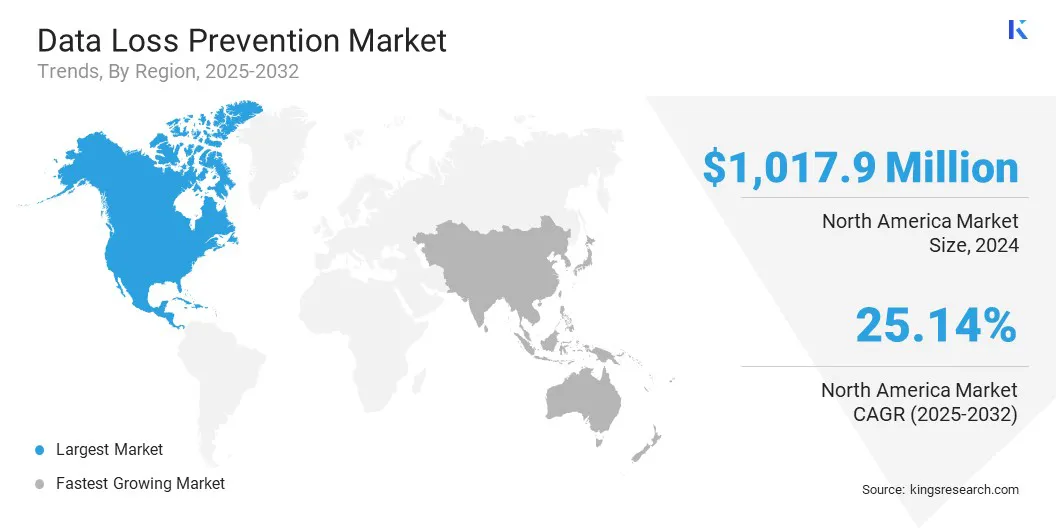
North America data loss prevention market share stood at 35.55% in 2024, valued at USD 1,017.86 million. The market is anticipated to reach USD 5,938.3 million by 2032, registering a CAGR of 25.14% over the forecast period (2025-2032). Market growth is driven by the region’s extensive commercial and digital ecosystem across the U.S. and Canada, which generates large volumes of sensitive enterprise data across cloud, endpoint, and network environments.
Strict regulatory requirements, including HIPAA, PCI DSS, SOX, CCPA, and GDPR for cross-border data flows, compel enterprises to deploy DLP solutions to ensure compliance and mitigate data breach risks. Enterprises increasingly adopt advanced DLP platforms to secure structured and unstructured data across endpoints, cloud workloads, networks, and email systems, strengthening regional demand.
The Europe data loss prevention industry is projected to grow at a robust CAGR of 25.61% over the forecast period. This growth is fuelled by rapid digital transformation, expanding cloud infrastructure and the surge in cyber threats across UK, Germany, France and other countries across the European Union.
Moreover, the surge in financial services, e-commerce, IT & telecom, healthcare, and manufacturing across the region is further driving the growth and demand for DLP solutions and services, leading to the increase in the overall market development.
Market players are investing heavily in R&D to develop advanced DLP solutions which are more adaptive, scalable, and compliant with global data protection and information security standards. Solutions like intrusion detection, threat-detection, data leakage loopholes and other allied solutions which incorporate usage of artificial intelligence to identify potential loopholes in systems is rapidly gaining pace in the market.
Additionally, market players are further refining commercialization strategies through strengthening collaborations with cloud providers, cybersecurity vendors, and managed security service partners to accelerate adoption of advanced data loss prevention solutions across diverse end use domains.
AI-driven detection engines, cloud-native DLP capabilities, behavioral analytics, and Zero-Trust-aligned architectures are being deployed to ensure regulatory compliance, operational resilience, and enhanced protection against insider threats and data exfiltration risks.
Frequently Asked Questions

Over the years, Versha brings over 15 years of experience managing consulting assignments across industries, including Food and Beverage, Consumer Goods, ICT, Aerospace, and more. Her work has spanned diverse sectors. Her cross-domain expertise and adaptability make her a versatile and dependable professional. She is known for her keen business insight and foresight. With sharp analytical skills and a curious mindset, Versha excels at transforming complex data into actionable insights. She has a proven track record of unraveling market dynamics, identifying trends, and delivering tailored solutions to meet client needs. As a skilled leader, Versha has successfully mentored research teams and directed projects with precision, ensuring high-quality outcomes. Her collaborative approach and strategic vision enable her to turn challenges into opportunities and consistently deliver impactful results. Whether analyzing markets, engaging stakeholders, or crafting strategies, Versha draws on her deep expertise and industry knowledge to drive innovation and deliver measurable value.
Habi is a seasoned research and consulting leader with renowned experience in guiding clients on strategic growth and transformation initiatives across global markets. He has led high-performing research teams that deliver actionable insights on market expansion, M&A strategies, opportunity assessment, new business development, and product launches. His project portfolio spans large petrochemical producers, electronic device manufacturers, lubricants companies, and other leading enterprises across diverse industrial and consumer sectors. He currently heads the research department at Kings Research, where he is responsible for setting the research agenda, mentoring analysts, and ensuring client-ready deliverables that support executive decision-making. With extensive experience in market intelligence, strategic research, and consulting, Habi brings a strong understanding of evolving industry dynamics, competitive landscapes, emerging opportunities, and business growth challenges. His expertise includes developing research frameworks, translating complex market data into actionable strategic recommendations, and working closely with senior stakeholders to address critical business questions. He has also contributed to building research capabilities, strengthening analytical methodologies, and driving a culture of quality and insight-led decision-making within research teams. His cross-industry exposure enables him to connect market trends with broader business implications and provide perspectives that help organizations identify opportunities, mitigate risks, and make informed strategic decisions.



.webp&w=128&q=75&dpl=dpl_DPva2LrvfsBdTJm1XZj67UTrvMHL)
