
Inquire Now
Key Strategic Points
Synthetic data is artificial data designed to mimic real-world data. It is artificially generated but retains the statistical properties of the original data from which it was generated. Synthetic data generation can happen in tabular, multimedia, or text form. Synthetic text data can be useful for natural language processing (NLP). Similarly, tabular data has applications in the creation of relational database tables.
Synthetic multimedia includes images, videos, and other unstructured data, which can be crucial for computer vision tasks such as image recognition and image classification, among others. There are growing data requirements in sectors like finance, healthcare, and retail. Synthetic data is helping such organizations by accelerating AI innovation and enabling smarter decisions.
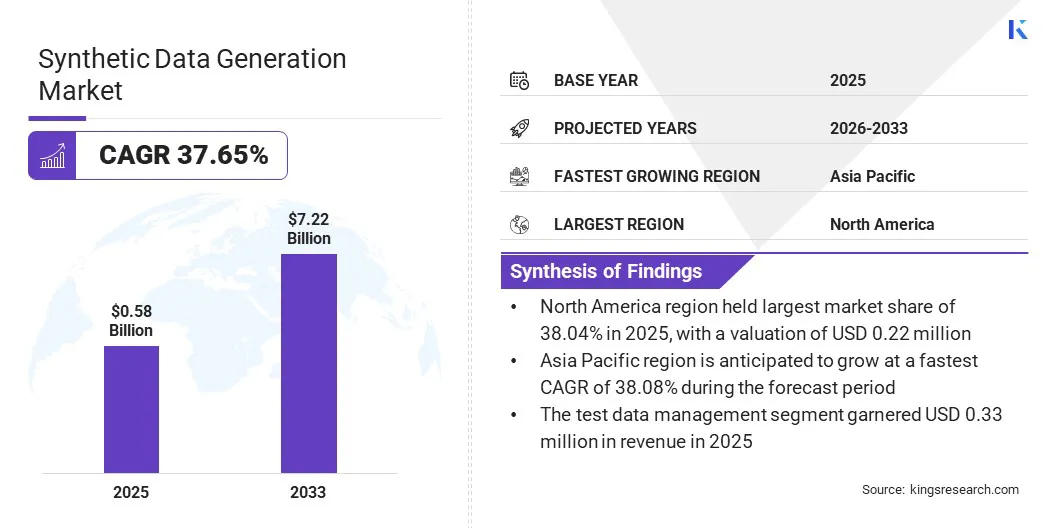
The global synthetic data generation market size was valued at USD 0.58 billion in 2025 and is projected to grow from USD 0.77 billion in 2026 to USD 7.22 billion by 2033, exhibiting a CAGR of 37.65% during the forecast period. This growth is attributed to its application for test systems, training AI models, and simulating scenarios, which is generally difficult to capture in real data.
For instance, in the healthcare sector, synthetic medical records can signify conditions such as diabetes, disease, or cancer, which can help to develop and test diagnostic tools along with predictive health models.
Major companies operating in the global synthetic data generation market are MOSTLY AI, Datagen, TonicAI, Inc., GenRocket, Inc, NVIDIA (Gretel Labs), K2view Ltd, CapGemini (Sogeti), CVEDIA Inc, Microsoft Corporation, and MDClone among others.
Synthetic data demand is expected to grow with its growing use in several sectors, including the automotive sector for the testing of autonomous vehicles, healthcare for medical imaging analysis, and patient diagnosis. In the retail sector, it is largely used for investment management and customer behavior analysis.
It can be beneficial in finance for fraud detection and risk assessment. The key advantage of synthetic data comprises cost-effectiveness, scalability, and diversity. These are largely used in training machine learning models. It offers greater control over data quality and also preserves privacy by eliminating the use of the real, sensitive data.
The recent trend indicates the integration of federated learning and differential privacy for enhancing the privacy preserving machine learning. Also, the demand for diverse and high-quality training datasets will grow with the expansion of AI in new domains, making synthetic data very crucial.
Synthetic data, when generated using robust techniques, can match or, in some cases, outperform the real data in model performance, particularly in rare-event scenarios.
While it cannot replace the real data, it is very effective when supporting the real data, particularly when team deals with limited data, unbalanced data sets, or privacy constraints. As a result, it can work as a powerful complement to real data rather than a complete replacement.
Synthetic data may lack the complexity and nuances of real-world data, which can cause AI models to perform poorly in real-world scenarios. Moreover, there is a possibility that AI models that are completely trained on synthetic data could not generalize effectively to real-world situations because of disparities between synthetic and actual data. It could also raise ethical concerns in some of the applications, such as medical diagnosis.
Real data collection is costly and slow with the association of sensor deployment, labelling, and security. But the synthetic data for online machine learning can be easily generated more cheaply and faster. Synthetic data offers controlled and scalable data sources for robust development of AI. For instance, organizations such as Nvidia and Databricks offer tools such as Unity Catalog and Omniverse Replicator for automating synthetic data pipelines. There is an estimation that around 50% to 60% of the data used for training AI platforms is synthetic. Its demand is increasing as it helps organizations to simulate new products, accelerate AI model development, and protect sensitive information.
|
Segmentation |
Details |
|
By Data |
Tabular Data, Text Data, Image & Video Data, Others |
|
By Application |
Test Data Management, AI training and Development, Enterprise Data Sharing, Data Analytics & Visualization |
|
By End user |
Financial Services, Retail, Healthcare and Others |
|
By Region |
North America: U.S., Canada, Mexico |
|
Europe: France, UK, Spain, Germany, Italy, Russia, Rest of Europe |
|
|
Asia-Pacific: China, Japan, India, Australia, ASEAN, South Korea, Rest of Asia-Pacific |
|
|
Middle East & Africa: Turkey, U.A.E., Saudi Arabia, South Africa, Rest of Middle East & Africa |
|
|
South America: Brazil, Argentina, Rest of South America |
Based on region, the global synthetic data generation market has been classified into North America, Europe, Asia Pacific, Middle East & Africa, and South America.
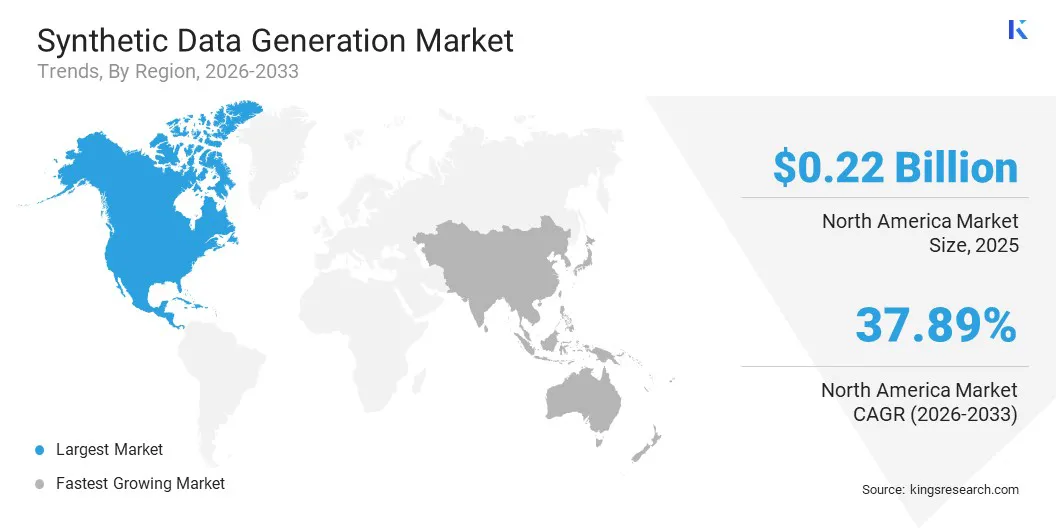
The North America synthetic data generation market accounted for a share of 38.04% in 2025, valued at USD 0.22 billion. This dominance is attributed to a combination of advanced technological infrastructure and more investment in R&D in the region. In the U.S., in particular, businesses are adopting latest technologies to decrease the risks and inefficiency.
Moreover, consumers prefer to support brands that focus on incremental innovations. In retail, synthetic data generation is helping in analyzing customer preference such as shopping habits and seasonal demand, while protecting privacy at the same time. The region has growing data privacy obligations and a strong AI ecosystem, which is creating a favorable environment for the market to grow.
The Asia-Pacific synthetic data generation market is set to grow at a CAGR of 38.08% over the forecast period. This notable growth is supported by the growing use of synthetic data in several domains in the region, such as healthcare, manufacturing, etc.
For instance, in healthcare, the synthetic data is generated for creating realistic patient records, which help research while offering anonymization and aggregation. It helps medical researchers in developing and testing algorithms for diagnosis and treatment while following the strict data protection regulations.
In manufacturing, the auto companies are using synthetic data to simulate a number of driving scenarios for the autonomous cars. It helps in training machine learning models for recognizing and responding to several conditions without the requirement for extensive real-world data collection. Companies such as Waymo and Tesla are revolutionizing the use of synthetic data for training their self-driving cars.
Key players in the synthetic data generation market are largely focusing on continuous technological innovation. There are many small players and mid-sized players that are targeting particular data types and sectors. The specialist vendors are not holding a dominant market share and are operating in niche segments.
Big cloud and AI platforms, such as Microsoft and NVIDIA, among others having a key portion in the market as synthetic data capabilities are present within broader AI and ML services. Focus is also on partnerships and acquisitions for strategic advantages.
Frequently Asked Questions

Ashim Lakhera is a market intelligence professional specializing in the Agriculture and Food & Beverage industry. His work focuses on emerging markets, competitive dynamics, industry trends, and the factors driving market growth and transformation. He has experience in market sizing, forecasting, strategic analysis, and industry research across food, FMCG, and life sciences. His research interests span the broader food and agriculture value chain, with a particular focus on how innovation, changing consumer behavior, sustainability priorities, and evolving production systems are influencing markets. He examines these developments to understand their impact on demand, competition, business models, and growth opportunities across the agri-food ecosystem. His work combines quantitative market analysis with an understanding of the broader industry forces shaping food and agriculture markets. He is particularly interested in the structural changes taking place across global food systems and how businesses are adapting to evolving consumer expectations, technological developments, and sustainability requirements.
Habi is a seasoned research and consulting leader with renowned experience in guiding clients on strategic growth and transformation initiatives across global markets. He has led high-performing research teams that deliver actionable insights on market expansion, M&A strategies, opportunity assessment, new business development, and product launches. His project portfolio spans large petrochemical producers, electronic device manufacturers, lubricants companies, and other leading enterprises across diverse industrial and consumer sectors. He currently heads the research department at Kings Research, where he is responsible for setting the research agenda, mentoring analysts, and ensuring client-ready deliverables that support executive decision-making. With extensive experience in market intelligence, strategic research, and consulting, Habi brings a strong understanding of evolving industry dynamics, competitive landscapes, emerging opportunities, and business growth challenges. His expertise includes developing research frameworks, translating complex market data into actionable strategic recommendations, and working closely with senior stakeholders to address critical business questions. He has also contributed to building research capabilities, strengthening analytical methodologies, and driving a culture of quality and insight-led decision-making within research teams. His cross-industry exposure enables him to connect market trends with broader business implications and provide perspectives that help organizations identify opportunities, mitigate risks, and make informed strategic decisions.