
Inquire Now
Key Strategic Points
The market comprises specialized platforms designed to store, manage, and index high-dimensional vector embeddings that represent unstructured data such as text, images, and audio for semantic retrieval.
The databases are critical to generative AI applications, supporting real-time natural language processing, computer vision, and personalized recommendations across BFSI, retail and e-commerce, and healthcare. As a result, the market is growing due to increased adoption of context-aware AI to extract value from large volumes of unstructured data.
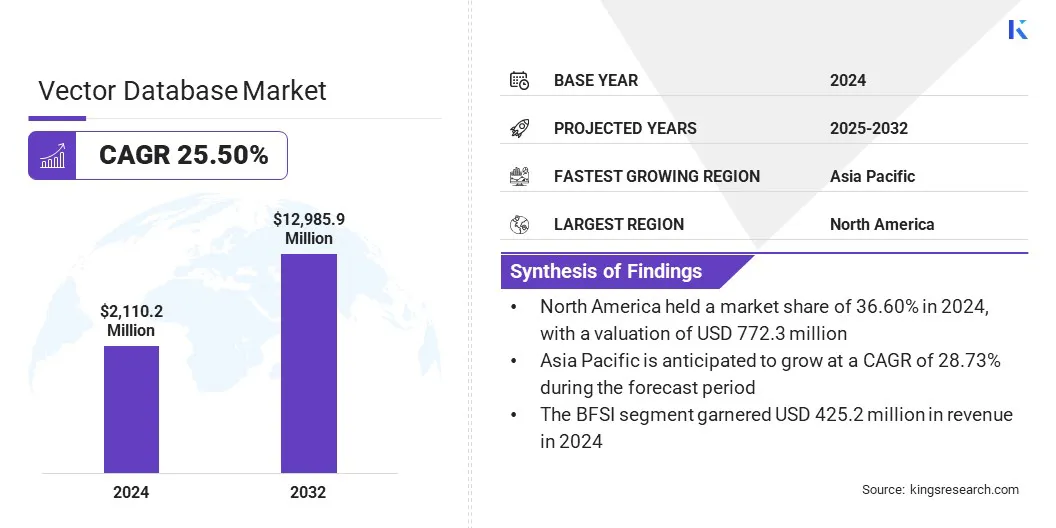
The global vector database market size was valued at USD 2,110.2 million in 2024 and is projected to grow from USD 2,648.4 million in 2025 to USD 12,986.4 million by 2032, exhibiting a CAGR of 25.5% during the forecast period.
Market growth is driven by rapid adoption of generative AI, which necessitates efficient processing of high-dimensional unstructured data. As enterprises integrate natural language processing and computer vision, vector databases are becoming essential for scaling personalized recommendation systems and delivering real-time, context-aware business intelligence.
Major companies operating in the vector database market are Microsoft, Alibaba Cloud, Elastic, MongoDB, Redis, SingleStore, DataStax, Zilliz, Pinecone, Google, AWS (Amazon Web Services), KX, Milvus, GSI Technology, and Clarifai.
The rapid adoption of generative AI and large language models (LLMs) is boosting demand for scalable, high-performance infrastructure capable of storing, processing, and querying high-dimensional vector data. As AI applications increasingly rely on embeddings for contextual understanding, traditional databases are becoming insufficient.
Moreover, industries such as BFSI and retail are experiencing growing demand for real-time, personalized recommendations that require low-latency, high-precision semantic search. These factors are accelerating the adoption of vector databases to support efficient similarity search, contextual retrieval, and advanced AI-driven decision-making at scale.
The Organizations are leveraging these databases to support advanced natural language processing, computer vision, and retrieval-augmented generation in generative AI models, enabling actionable insights from complex datasets. Furthermore, rising demand for hyper-personalized recommendations in retail and media is accelerating the deployment of vector search solutions to enhance user engagement and operational efficiency.
Enterprises, particularly in regulated sectors like BFSI and healthcare, face difficulties integrating vector search with legacy infrastructure while ensuring strict data privacy compliance. Additionally, the scarcity of skilled personnel proficient in optimizing vector algorithms and managing unstructured data pipelines limits widespread adoption. These factors create significant barriers to entry, slowing the deployment of advanced AI applications in cost-sensitive markets.
To mitigate these challenges, market players are prioritizing the development of fully managed, cloud-native solutions that reduce infrastructure complexity and operational costs.
Incorporating hybrid search capabilities allows for smoother integration with existing systems, while enhanced encryption and role-based access controls address security concerns in sensitive industries. Furthermore, vendors are investing in comprehensive developer training and automated optimization tools, democratizing access to vector technology and accelerating its deployment across retail, IT, and manufacturing sectors.
The vector database market is witnessing a strategic shift toward hybrid search, merging vector capabilities with traditional databases to refine accuracy. This convergence allows industries like BFSI and retail to optimize recommendation systems by combining semantic context with keyword precision.
Furthermore, the rapid adoption of cloud-native managed services is expanding access to infrastructure and streamlining the deployment of natural language processing solutions. Collectively, these trends are accelerating enterprise adoption of vector databases by lowering implementation complexity and cost, while broadening use cases beyond early AI adopters.
|
Segmentation |
Details |
|
By Offering |
Solutions (Vector Generation, Vector Search, Storage And Retrieval Vectors), Services (Professional Services, Managed Services) |
|
By Technology |
Natural Language Processing (Semantic Search, Document/Text Retrieval, Sentiment Analysis, Chatbots & Virtual Assistants, Others), Computer Vision (Image Retrieval, Object Detection, Face/Image Recognition, Others), Recommendation Systems (Collaborative Filtering, Content-Based Filtering, Session-Based Recommendations, Others) |
|
By Industry |
BFSI, Retail & E-commerce, Healthcare & Life Sciences, IT & ITeS, Media & Entertainment, Manufacturing, Others |
|
By Region |
North America: U.S., Canada, Mexico |
|
Europe: France, UK, Spain, Germany, Italy, Russia, Rest of Europe |
|
|
Asia-Pacific: China, Japan, India, Australia, ASEAN, South Korea, Rest of Asia-Pacific |
|
|
Middle East & Africa: Turkey, U.A.E., Saudi Arabia, South Africa, Rest of Middle East & Africa |
|
|
South America: Brazil, Argentina, Rest of South America |
Based on region, the market has been classified into North America, Europe, Asia Pacific, Middle East & Africa, and South America.
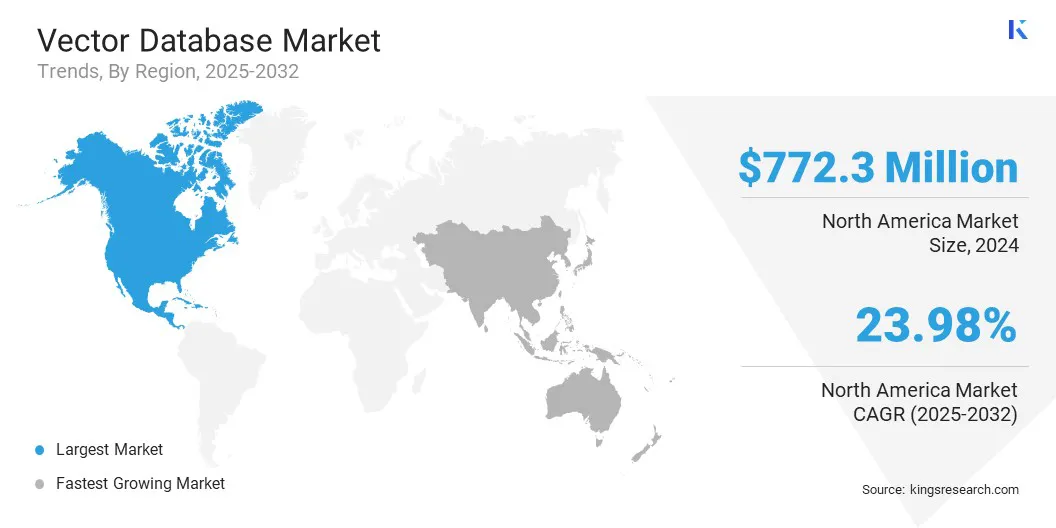
North America vector database market share stood at 36.6% in 2024, valued at USD 772.3 million. The growth of the North American market is driven by the region’s position as a leading hub for generative artificial intelligence and large language model (LLM) development.
In addition, the widespread adoption of natural language processing (NLP) and computer vision technologies across the BFSI and healthcare sectors—particularly for fraud detection, risk analytics, and drug discovery—is contributing to market expansion. Furthermore, the strong presence of major cloud hyperscalers and continued investment in scalable, low-latency search and retrieval architectures are reinforcing the region’s market leadership.
The Asia-Pacific vector database industry is set to grow at a CAGR of 28.73% over the forecast period. This notable expansion is propelled by rapid enterprise digitization across key economies such as China and India, coupled with favorable government initiatives supporting AI ecosystems.
Expanding retail and e-commerce sectors are leveraging vector search for personalized recommendations, thereby stimulating demand. Additionally, rising unstructured data volumes and modernization of IT frameworks by local technology leaders are leading to the widespread uptake of vector database solutions.
Major players operating in the vector database industry are leveraging their extensive cloud ecosystems to offer scalable vector data solutions. At the same time, specialized providers focus on high-performance similarity search and AI-native capabilities. This diverse competitive landscape is fostering rapid innovation, strategic partnerships, and continuous product advancements across the market.
Frequently Asked Questions

Ashim Lakhera is a market intelligence professional specializing in the Agriculture and Food & Beverage industry. His work focuses on emerging markets, competitive dynamics, industry trends, and the factors driving market growth and transformation. He has experience in market sizing, forecasting, strategic analysis, and industry research across food, FMCG, and life sciences. His research interests span the broader food and agriculture value chain, with a particular focus on how innovation, changing consumer behavior, sustainability priorities, and evolving production systems are influencing markets. He examines these developments to understand their impact on demand, competition, business models, and growth opportunities across the agri-food ecosystem. His work combines quantitative market analysis with an understanding of the broader industry forces shaping food and agriculture markets. He is particularly interested in the structural changes taking place across global food systems and how businesses are adapting to evolving consumer expectations, technological developments, and sustainability requirements.

Ganapathy Subramaniam Suresh
With over a decade of research leadership across global markets, Ganapathy brings sharp judgment, strategic clarity, and deep industry expertise. Known for precision and an unwavering commitment to quality, he guides teams and clients with insights that consistently drive impactful business outcomes.