
Inquire Now
Key Strategic Points
The market comprises enterprise solutions and services that allow organizations to track, govern, optimize, and monetize software licenses across on-premise and cloud environments. The market is critical for controlling IT spend, ensuring vendor compliance, and reducing operational risk. Market growth is driven by cloud adoption, subscription-based licensing, and rising audit exposure across BFSI, healthcare, IT & telecommunication, retail & e-commerce sectors.
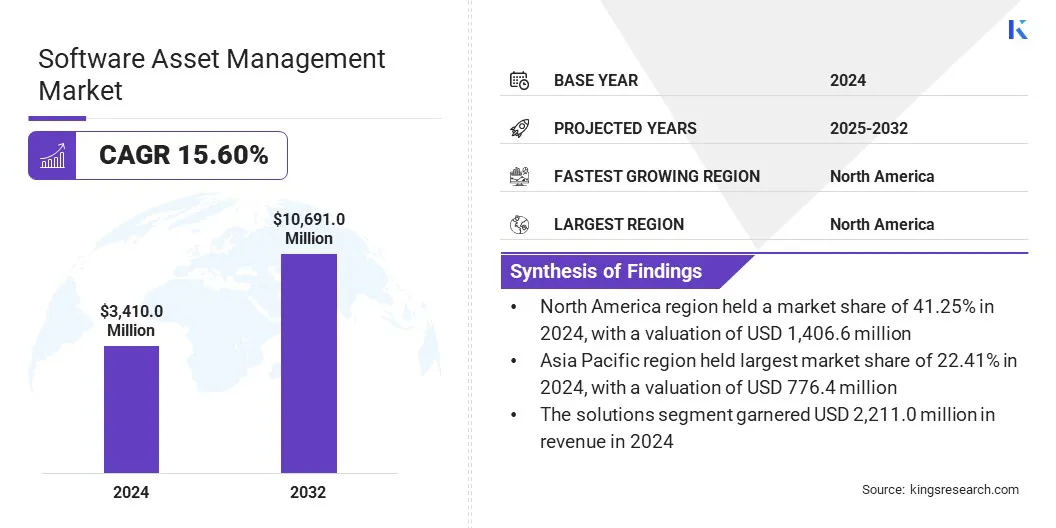
The global software asset management market size was valued at USD 3,410 million in 2024 and is projected to grow from USD 3,874.5 million in 2025 to USD 10,691.02 million by 2032, exhibiting a CAGR of 15.6% over the forecast period. This growth is fueled by the increasing complexity of software licensing, accelerated cloud adoption, and rising regulatory scrutiny. Growing usage across BFSI, healthcare, and IT enterprises enables cost optimization, compliance, and scalable governance, creating strong near-term growth opportunities globally.
Major companies operating in the software asset management industry are Flexera, Ivanti, Certero, Eracent, Snow Software, BMC Software, Matrix42, USU Software AG, ServiceNow, Broadcom, and others.
The growing complexity of software portfolios, frequent vendor audits, and the shift toward subscription-based licensing are driving global adoption of software asset management. Both SMEs and large enterprises are implementing integrated solutions to enhance cost transparency and ensure compliance across on-premise and cloud environments.
Strong demand from BFSI, healthcare, IT & telecommunications, and retail & e-commerce is further accelerating market growth. Additionally, ongoing digital transformation and cloud migration initiatives create a timely opportunity for vendors to offer scalable, analytics-driven SAM platforms.
The rising complexity of hybrid IT infrastructures is making software usage harder to track across on-premise systems, cloud platforms, and decentralized SaaS applications. As software spending grows, organizations are prioritizing cost optimization and compliance to avoid unplanned expenses and vendor audit penalties.
This is accelerating adoption of cloud-based software asset management solutions and managed services that provide centralized visibility, automated license tracking, and risk mitigation, thereby directly fueling growth in the software asset management market.
Key challenge limiting the growth of the software asset management market is the complexity of integrating SAM solutions across hybrid on premise and cloud environments. Budget constraints and limited technical expertise hinder adoption among small and medium-sized enterprises, while fragmented software inventories remain a critical barrier for large enterprises.
To address this challenge, vendors are enhancing cloud-native and hybrid-compatible SAM platforms with standardized connectors and automated discovery tools. In parallel, solution providers are expanding managed and advisory services to support SMEs with limited in-house expertise, while analytics-driven compliance engines simplify licensing intelligence and reduce audit risk across BFSI and healthcare.
The market is witnessing a strategic shift toward cloud-native solutions that integrate automated discovery with predictive analytics to optimize licensing expenditures. This trend is fueling the market by enabling organizations to gain real-time visibility into software usage while proactively controlling licensing costs.
Cloud-native platforms combined with automated discovery and predictive analytics help enterprises, particularly in BFSI and healthcare, minimize compliance gaps and audit exposure. At the same time, the growing adoption of managed services lowers operational complexity for SMEs, making advanced SAM capabilities more accessible across increasingly complex SaaS environments.
|
Segmentation |
Details |
|
By Component |
Solution, Services |
|
By Deployment |
On-Premise, Cloud |
|
By Organization Size |
Small & Medium Enterprises, Large Enterprises |
|
By Application |
BFSI, Healthcare, IT & Telecommunication, Retail & E-commerce, Others |
|
By Region |
North America: U.S., Canada, Mexico |
|
Europe: France, UK, Spain, Germany, Italy, Russia, Rest of Europe |
|
|
Asia-Pacific: China, Japan, India, Australia, ASEAN, South Korea, Rest of Asia-Pacific |
|
|
Middle East & Africa: Turkey, U.A.E., Saudi Arabia, South Africa, Rest of Middle East & Africa |
|
|
South America: Brazil, Argentina, Rest of South America |
Based on region, the software asset management market has been classified into North America, Europe, Asia Pacific, Middle East & Africa, and South America.
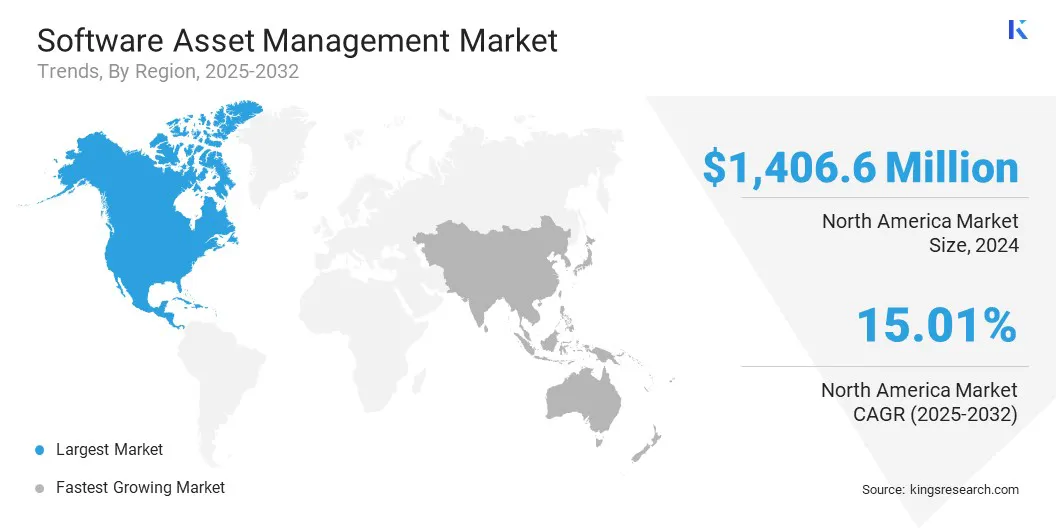
The North America software asset management market accounted for a 41.2% share in 2024, valued at USD 1,406.6 million. The market is expected to expand at a CAGR of 14.8% from 2025 to 2032. Growth is driven by widespread SAM adoption across IT ecosystems and stringent software compliance requirements in the BFSI, IT & telecommunications, and healthcare sectors to manage licensing costs and mitigate audit risks.
The Asia-Pacific software asset management industry is projected to grow at a CAGR of 16.7% during the forecast period. This expansion is driven by accelerating digital transformation across SMEs and large enterprises, particularly in retail & e-commerce and healthcare.
Increased adoption of cloud-based, solution-led offerings, valued for scalability and reduced upfront costs, along with ongoing IT modernization, rising software adoption, and heightened awareness of license governance, reinforces the region’s long-term growth potential for software asset management providers.
The global software asset management industry is moderately fragmented, comprising established enterprise software vendors and specialized service providers. Key players like Broadcom and Flexera offer integrated, scalable solutions through extensive IT management portfolios, while niche vendors concentrate on license optimization, cloud governance, and managed services. This competitive landscape fosters continuous innovation, strategic partnerships, and ongoing enhancement of compliance-focused capabilities worldwide.
Frequently Asked Questions

Ashim Lakhera is a market intelligence professional specializing in the Agriculture and Food & Beverage industry. His work focuses on emerging markets, competitive dynamics, industry trends, and the factors driving market growth and transformation. He has experience in market sizing, forecasting, strategic analysis, and industry research across food, FMCG, and life sciences. His research interests span the broader food and agriculture value chain, with a particular focus on how innovation, changing consumer behavior, sustainability priorities, and evolving production systems are influencing markets. He examines these developments to understand their impact on demand, competition, business models, and growth opportunities across the agri-food ecosystem. His work combines quantitative market analysis with an understanding of the broader industry forces shaping food and agriculture markets. He is particularly interested in the structural changes taking place across global food systems and how businesses are adapting to evolving consumer expectations, technological developments, and sustainability requirements.
Habi is a seasoned research and consulting leader with renowned experience in guiding clients on strategic growth and transformation initiatives across global markets. He has led high-performing research teams that deliver actionable insights on market expansion, M&A strategies, opportunity assessment, new business development, and product launches. His project portfolio spans large petrochemical producers, electronic device manufacturers, lubricants companies, and other leading enterprises across diverse industrial and consumer sectors. He currently heads the research department at Kings Research, where he is responsible for setting the research agenda, mentoring analysts, and ensuring client-ready deliverables that support executive decision-making. With extensive experience in market intelligence, strategic research, and consulting, Habi brings a strong understanding of evolving industry dynamics, competitive landscapes, emerging opportunities, and business growth challenges. His expertise includes developing research frameworks, translating complex market data into actionable strategic recommendations, and working closely with senior stakeholders to address critical business questions. He has also contributed to building research capabilities, strengthening analytical methodologies, and driving a culture of quality and insight-led decision-making within research teams. His cross-industry exposure enables him to connect market trends with broader business implications and provide perspectives that help organizations identify opportunities, mitigate risks, and make informed strategic decisions.