

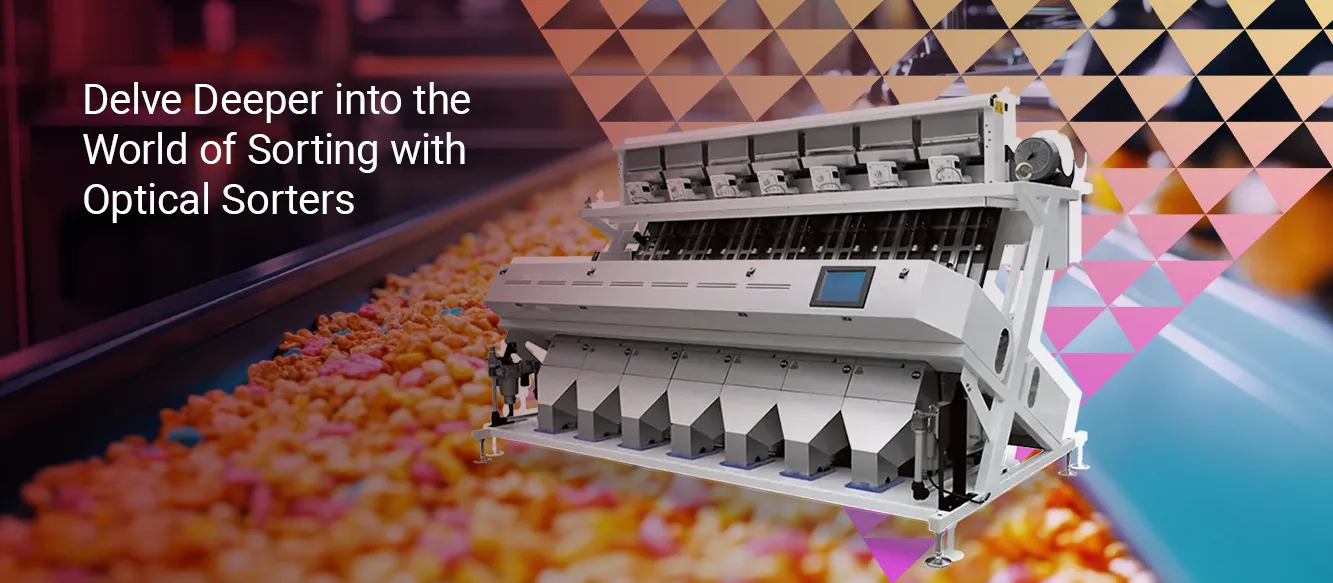
Optical sorters are machines that separate materials automatically. They utilize high-speed cameras, optical sensors, image-processing algorithms, and precision ejection mechanisms to identify and separate materials as per their physical and optical characteristics. Depending on the application, these systems can distinguish materials based on color, shape, size, composition, surface properties, and reflectivity.
The technology has become an integral part of modern automated sorting and processing operations, particularly where high throughput, consistent quality, and precise separation are required. By continuously analyzing material streams in real time, optical sorters can detect and remove unwanted materials or classify products with significantly less manual intervention.
Today, optical sorting systems are widely deployed across industries, including food processing, agriculture, plastics recycling, mining, and waste management. Their ability to process large volumes of material rapidly and accurately helps manufacturers and processors improve product purity and quality, increase operational efficiency, reduce labor requirements, and optimize resource recovery. As per Kings Research, demand for optical sorters is projected to expand at a robust 8.72% CAGR (2026-2033) and increase in value from USD 2,275.5 million in 2025 to USD 4,402.7 million in 2033.
What is an Optical Sorter?
An optical sorter is an automated sorting machine that uses optical sensors, cameras, and software to detect different materials and sort them. Unlike manual sorting, which depends heavily on human operators, an optical sorter can inspect large volumes of material continuously and make sorting decisions in fractions of a second.
Sorters may sort based on predefined characteristics such as:
- Color
- Shape
- Size
- Surface characteristics
- Transparency
- Chemical composition
- Spectral responses
A typical optical sorting machine consists of a feeding system, conveyor or chute, cameras or sensors, processing software, and an ejection mechanism.
How Does an Optical Sorter Work?
The material passes through the inspection area, where sensors capture information about individual objects. Software analyzes this information and determines whether each object meets the required sorting criteria. When an unwanted item is identified, an air jet or another mechanical mechanism removes it from the main material stream.
Stages of Sorting Process in Optical Sorters
Material Feeding
The process begins when the material enters the sorting machine. A controlled feeding system distributes the material so that individual items can be detected properly. Depending on the equipment, materials may travel on a conveyor belt or fall freely through a chute. Consistent material spacing and presentation are important because they allow sensors to inspect each item accurately.
Detection With Cameras and Sensors
Optical sorters use different types of cameras and sensors depending on the material and application. Lighting plays a crucial role in allowing cameras to detect materials, which is why it is also an essential step in the sorting process. RGB cameras can identify visible differences in color and appearance. Near-infrared (NIR) sensors can detect differences in material composition that may not be visible to the human eye. Other systems may use lasers, hyperspectral cameras, or combinations of multiple sensors.
Image and Data Processing
Information captured by sensors is processed by the machine's control system. Software analyzes the data and compares the characteristics of each object against programmed sorting parameters. Newer AI optical sorting machines can use machine learning and object-recognition techniques to identify complex patterns and material characteristics.
Material Classification
After analyzing the sensor data, the system classifies each item. For example, a recycling sorter may distinguish between different types of plastic, while a food-processing sorter may identify discolored, damaged, or foreign materials. The machine can be configured to either remove unwanted material or recover a specific target material.
Ejection
Once an item has been classified, the system determines its position and triggers the appropriate ejection mechanism. High-speed air jets are commonly used to remove unwanted items from a moving product stream. The timing of the air jet is carefully calculated based on the object's position and speed.
Collection
The sorted material ejected from an appropriate mechanism is collected in dedicated collectors. These collectors are then used to store or transport the sorted material or products. The rejected material is also separated from the sorted material at this step.
Benefits of Optical Sorting
|
Benefit |
How It Helps |
|
Higher Sorting Accuracy |
Identifies and separates materials precisely using cameras, sensors, and advanced software. |
|
Increased Throughput |
Processes large volumes of material continuously at high speed. |
|
Reduced Labor Costs |
Automates repetitive sorting tasks and reduces dependence on manual inspection. |
|
Improved Product Quality |
Removes defective, contaminated, or unwanted materials to maintain consistent quality. |
|
Reduced Waste |
Recovers valuable materials that might otherwise be discarded. |
|
Higher Material Purity |
Produces cleaner and more consistent output, particularly in recycling applications. |
|
Lower Operational Costs |
Automation can reduce labor, waste, and processing costs over time. |
|
Real-Time Monitoring |
Modern systems can provide operational data to help optimize sorting performance and maintenance. |
|
Greater Flexibility |
Advanced optical sorters can be configured for different materials, products, and sorting requirements. |
|
Improved Sustainability |
Supports recycling, resource recovery, and more efficient use of raw materials. |
Types of Optical Sorters by Sensor and Vision Technology
Optical sorters can be classified by the sensor and vision technology they use. Each type detects different material properties. The main types include color sorters, NIR sorters, laser sorters, X-ray sorters, and hyperspectral systems.
Color Sorters
Color sorters use RGB, monochromatic, or bichromatic cameras to detect color differences. These machines identify variations in color, shade, brightness, and appearance to work effectively. Their adoption is high in food processing, agriculture, and product quality control applications. Overlapping items in sorting machines can be harder to sort since they cover the color of the object below.
Near-Infrared (NIR) Sorters
NIR sorters use near-infrared light to identify materials by their chemical and molecular properties. They can distinguish materials that look similar to the human eye. NIR sorting is widely used in plastic, polymer, and waste recycling. However, it cannot see black plastic, which is a major drawback in recycling.
Laser Sorters
Laser sorters use laser light to detect surface and optical properties. They can identify differences in structure, texture, shape, and transparency. These systems are useful for applications that require precise detection of surface or structural defects.
Hyperspectral and Combined Sorters
Hyperspectral sorters slice the spectrum into many narrow bands, whereas multispectral covers a huge range in three fat bands. This provides more detailed material information than standard cameras. Combined systems may use multiple sensors, such as RGB, NIR, and laser technology. They are suitable for food processing, recycling, and other complex sorting applications.
In December 2025, BRT Hartner GmbH and RTT System GmbH launched a new AI-enabled optical sorting platform. The new solution uses a next-generation hyperspectral imaging (HSI) camera, which enables precise identification of polymer types and materials.
|
Sorter Type |
What It Spots |
Materials It Suits |
Typically Used For |
|
Color / RGB Sorter |
Differences in color, shade, brightness, and appearance |
Food products, agricultural products, and materials with visible color differences |
Food processing, agriculture, and product quality control |
|
Near-Infrared (NIR) Sorter |
Chemical and molecular differences that may not be visible to the human eye |
Plastics, polymers, and waste materials |
Plastic sorting, polymer separation, and recycling |
|
Laser Sorter |
Surface properties, structure, texture, shape, and transparency |
Materials requiring precise surface or structural detection |
Quality control, defect detection, and precision sorting |
|
Hyperspectral Sorter |
Detailed spectral differences across many narrow wavelength bands |
Food products, recyclables, and complex mixed materials |
Food processing, recycling, and applications requiring detailed material identification |
How to Choose an Optical Sorting Machine?
Choosing the right optical sorter depends on material characteristics, required throughput, accuracy, sensor technology, maintenance requirements, and total cost of ownership. Choosing a sorter without considering these factors could hurt the optimal productivity of the business.
|
Factor |
What to Evaluate |
|
Material |
Color, size, shape, composition, moisture, contamination |
|
Throughput |
Required capacity, feed rate, and operating speed |
|
Accuracy |
Purity, recovery rate, and defect-removal requirements |
|
Sensors |
RGB, NIR, laser, hyperspectral, X-ray, or multi-sensor technology |
|
Maintenance |
Cleaning, calibration, servicing, spare parts availability |
|
Cost |
Purchase price, energy, maintenance, labor, and downtime |
|
Future Needs |
Scalability, automation, and changing material streams |
In short, the best optical sorting machine is one that matches your material, throughput, accuracy requirements, and operating conditions while providing a competitive total cost of ownership.
5 Industries Where Optical Sorters Are Used
Optical sorters are used across many industries to automate sorting and quality control. These systems use cameras, sensors, and software to identify and separate materials. They can detect differences in color, size, shape, and other visible or spectral properties.
Here are the five key industries where optical sorting technology is widely used.
Food and Beverage Industry
The food industry is one of the major users of optical sorting systems. Optical sorters help inspect and sort food products at high speeds.
They are used for products such as:
- Fruits and vegetables
- Nuts and seeds
- Rice and grains
- Pulses and legumes
- Coffee
- Frozen foods
Sorting can remove discolored, damaged, or contaminated products, thereby improving quality control. Sorters can also separate foreign materials and prevent the risk of contamination and damage.
In September 2025, Tomra Food launched Tomra 4C, which it claimed to be its most advanced sorting machine upon its launch. The machine offers a simple setup for easy integration and offers a less than 1% false reject rate. The sorter is equipped with next-generation pulsed LED sensors and artificial intelligence to run the company’s proprietary deep learning platform called LUCAi.
Recycling and Waste Management
Recycling is another major application for optical sorting technology. Recycling facilities use optical sorters to separate different materials from mixed waste streams.
Common applications include:
- PET and other plastics
- Paper and cardboard
- Glass
- Mixed packaging
- Municipal solid waste
Sorting of materials based on their color, shape, and spectral properties is essential in recycling. This helps recycling plants improve material purity and recover more valuable recyclables.
In January 2025, DataBeyond Technology started operations of an AI hyperspectral optical sorter for blended fabrics at Zhangjiagang Shanhesheng Environmental Technology Co. Ltd. The novel sorter is equipped with AI and hyperspectral recognition technology to overcome long-standing challenges in sorting blended fabrics and textile recycling. The sorter is equipped with hyperspectral sensors that capture 256 spectral bands.
Mining and Mineral Processing
Optical sorting is also used in mining and mineral processing. It can help separate valuable material from waste rock before further processing. Depending on the application, sensors can identify differences in color, surface characteristics, or spectral response. The technology can be used for certain ores and industrial minerals.
By removing unwanted material early, optical sorting can reduce the amount of material sent to downstream processing. This can help lower energy, water, and processing costs.
Agriculture and Seed Processing
Agricultural processing is another important application for optical sorters. These systems are widely used to improve the quality and consistency of grains, seeds, and other agricultural products.
Typical applications include:
- Rice
- Wheat
- Corn
- Pulses
- Seeds
- Coffee
Optical sorters can identify defects such as discoloration, damage, and foreign material. They can then remove unwanted products from the processing line. This helps processors meet quality standards while reducing the need for manual inspection.
In May 2025, Bühler announced the launch of the SORTEX AI700 optical sorter in London, United Kingdom. The sorter specializes in removing gluten-containing grains from oats. This makes it a preferred product in the gluten-free industry. The equipment leverages deep learning to achieve high defect removal rates, whilst improving overall quality.
Pharmaceutical Industry
Pharmaceutical manufacturing utilizes optical sorters to help identify defects and maintain consistent product quality.
Applications can include the inspection of:
- Tablets
- Capsules
- Pharmaceutical ingredients
- Other solid-dose products
Depending on the system, sorters can detect differences in color, shape, size, and surface appearance. This supports quality control and helps manufacturers identify defective products.
Future of Optical Sorting Technology
The future of optical sorting is closely connected to advances in artificial intelligence, machine vision, sensors, and automation. AI-powered systems are becoming better at recognizing complex objects and identifying subtle differences between materials. Improved cameras and spectral sensors can provide more detailed information, while advanced software can process this information in real time.
In March 2026, Pellenc ST developed and launched the Mistral+ CONNECT optical sorter. The sorter features a high-speed conveyor belt, detection mechanism, and ejection hood to detect and separate paper and cardboard. The equipment is certified by TÜV Rheinland and features a FLOW™ Detection system, which covers an extended near-infrared and visible range with focused lighting.
Integration of optical sorters with digital monitoring systems is also gaining traction. Operators can use performance data to track sorting efficiency, identify maintenance requirements, and optimize machine settings. As recycling and resource recovery become increasingly important, optical sorting technology is expected to play a larger role in improving material recovery and supporting circular-economy initiatives.
Conclusion
An advanced optical sorter has significantly reduced the need for manual or conventional sorting processes. Advancements in vision technologies are expected to further enhance their efficacy, accuracy, and productivity in the long run. Companies are no longer competing on sorting accuracy; they are expected to focus on advancements that improve efficiency and productivity to maximize profits.
Sorters are widely used in food processing, agriculture, recycling, waste management, mining, and other industries, ensuring steady demand. With the continued development of AI, machine vision, and advanced sensors, optical sorting is becoming more intelligent and capable.
For businesses seeking higher throughput, better product quality, reduced waste, and greater automation, choosing the right optical sorting technology can provide significant operational benefits.
Looking to improve sorting accuracy, reduce waste, and increase processing efficiency? Refer to Kings Research’s optical sorter market research report to understand how fast the sorting landscape is changing.
FAQs
What materials can an optical sorter process?
An optical sorter can process many types of materials. Common examples include plastics, glass, paper, food products, grains, nuts, minerals, and recyclable waste. The right system depends on the material's size, shape, color, and composition.
How accurate is the optical sorting process?
Optical sorting can achieve high sorting accuracy when the machine is correctly configured and maintained. Accuracy depends on the material, sensor technology, feed conditions, and sorting criteria. Advanced AI and multi-sensor systems can improve results for complex materials.
How do I maintain an optical sorter?
Clean the cameras, sensors, and conveyor or chute regularly. Check the air-ejection system and remove dust or material buildup. Calibrate the sensors as recommended by the manufacturer. Regular inspections and preventive maintenance help reduce downtime and maintain sorting accuracy.
Does sorting damage delicate parts?
Optical sorting can handle delicate products when the machine is correctly configured. The use of proper ejection mechanisms and detection mechanisms can keep damage minimal, especially in the food and beverage sector.
Can optical sorters be customized to client requirements?
Yes. Optical sorters can be customized for different materials, capacities, and sorting goals. Custom options may include sensor types, conveyor or chute design, sorting programs, ejection systems, and machine configuration. The final design depends on the client's process and material requirements.