
Inquire Now
Key Strategic Points
According to Kings Research analysis, the global optical sorter market was valued at USD 2,275.5 million in 2025 and is estimated to reach USD 4,402.7 million in 2033, registering a CAGR of 8.72% over the forecast period (2026-2033).
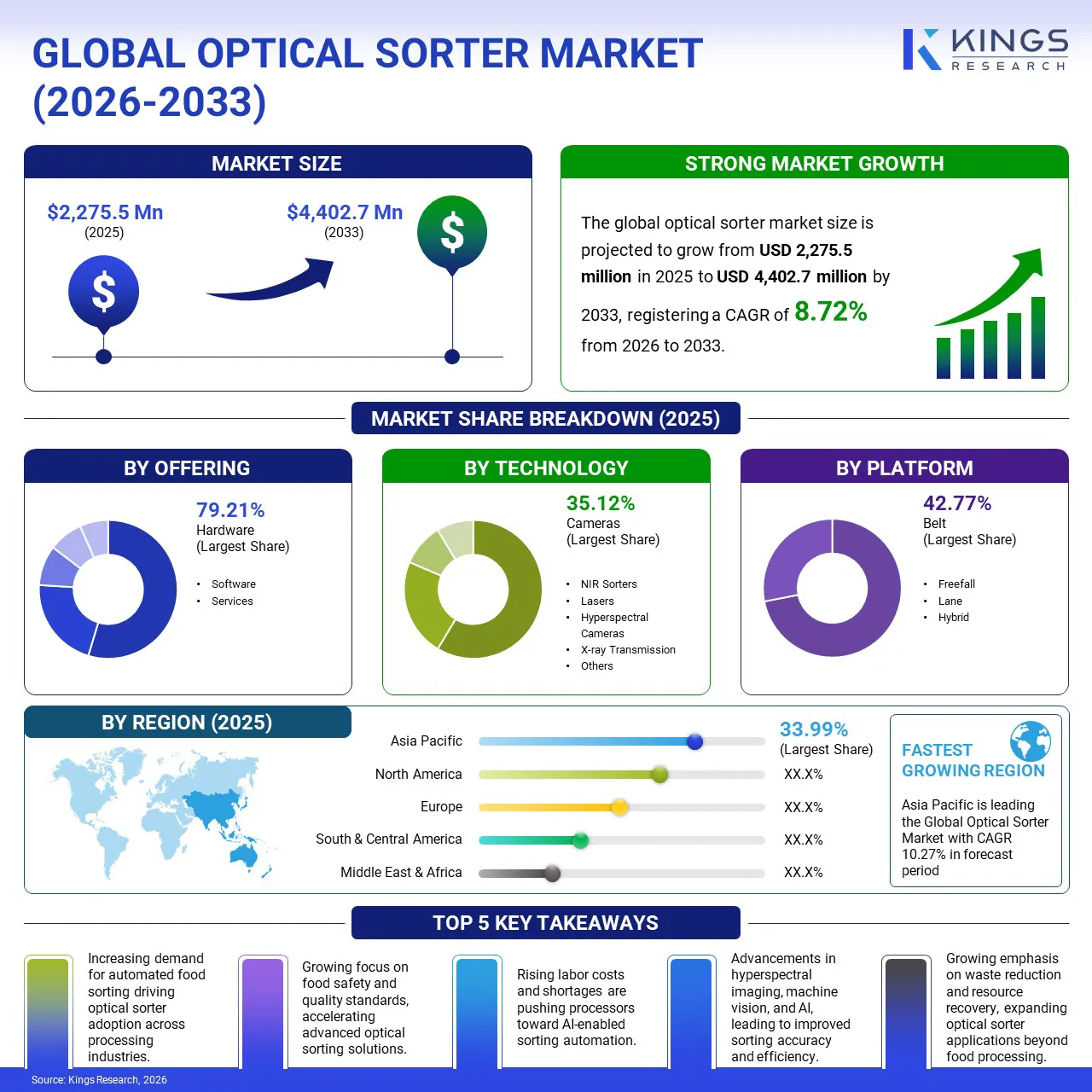
The optical sorter market is evolving from conventional sorting equipment toward advanced, automated sorting solutions, as industries increasingly prioritize higher accuracy, efficiency, yield, and consistency in product quality. Market growth is driven by the increasing adoption of automation, stricter quality and safety requirements, and surging demand for resource recovery across food processing, recycling, and mining. Advancements in optical sensing, imaging, software, and AI are expanding the capabilities and applications of optical sorting systems across diverse end-use industries.
The rising demand for faster and optimized production processes, improved quality control, and sustainable operations is fueling market expansion. Key end-use industries, including food processing, recycling, mining, pharmaceuticals, and manufacturing, are adopting optical sorters to reduce manual effort, improve production consistency, and optimize resource utilization. The machines offer high-speed and accurate defect and contaminant detection, with reported accuracy rates of up to 99.9% and foreign-material detection rates exceeding 98%. These capabilities lead to better yields and fewer contamination-related losses, which drives adoption across various end-use verticals.
Optical sorting machines require a significant initial investment, ranging from tens of thousands to millions of dollars, depending on capacity, technology, and brand. A high upfront cost restrains adoption, particularly among small- and medium-sized processors, as initial investments may outweigh the perceived short-term benefits.
The high cost of optical sorters is primarily associated with advanced cameras and optical sensors, high-speed processors, AI/ML systems, precision air-ejection systems, and integration with existing production lines. Moreover, high electricity consumption and routine maintenance of components, including air nozzles, replacement of wear-prone components, software upgrades, and calibration, further contribute to the overall operating cost of optical sorters.
To address this challenge, market players are developing energy-efficient systems, extending component lifetimes, improving predictive maintenance capabilities, and offering modular sorting solutions that allow customers to scale capacity gradually.
The inclusion of AI and machine learning is transforming the applicability of optical sorter machines across end-use industries, including recycling, food processing, and mining, leading to enhanced accuracy and efficiency. Companies are integrating AI-enabled advanced object recognition and real-time decision-making capabilities into optical sorters, thereby offering faster and more precise sorting with reduced human error. The ability of AI systems to continuously learn and adapt to new sorting materials and changing production conditions further enables them to support sustainability by reducing waste, improving material recovery, and minimizing false positives and negatives.
|
Segmentation |
Details |
|
|
By Offering |
Hardware, Software, Services |
|
|
By Technology |
Cameras, Lasers, NIR Sorters, Hyperspectral Cameras, X-ray Transmission, Others |
|
|
By Platform |
Belt, Freefall, Lane, Hybrid |
|
|
By End-User Industry |
Food Processing (Fruits and Vegetables, Grains and Cereals, Nuts and Dry Fruits, Meat and Seafood, Confectionery and Snacks), Recycling (Plastics, Metals, Glass, E-waste), Mining (Coal, Precious and Base Metals, Industrial Minerals, Others) |
|
|
By Region |
North America |
U.S., Canada, Mexico |
|
Europe |
France, UK, Spain, Germany, Italy, Russia, Rest of Europe |
|
|
Asia-Pacific |
China, Japan, India, Australia, ASEAN, South Korea, Rest of Asia-Pacific |
|
|
Middle East and Africa |
Turkey, U.A.E., Saudi Arabia, South Africa, Rest of Middle East & Africa |
|
|
South and Central America |
Brazil, Argentina, Rest of South and Central America |
|
The belt platform type captured the highest share of 42.77% in 2025, with a valuation of USD 973.1 million. The high share is attributed to its gentle handling capability, which makes belt platform optical sorters ideal for delicate or irregularly shaped products, including fresh produce, processed foods, or fragile materials. Additionally, the high accuracy of belt platform optical sorters, ranging from 97 to 99.99% range, is due to stable product presentation and controlled movement, which enable more precise imaging and sorting decisions, thereby contributing to segmental growth.
The food processing segment accounted for the highest share of 50.74% in 2025, valued at USD 1,154.6 million. This notable growth is fueled by the demand for precision weighing sensors that categorize produce by weight, ensuring uniform batches and better pricing. Additionally, optical sorters enable quality checks based on internal attributes such as sweetness and ripeness, which are important for premium markets. Moreover, enhanced defect detection and consistent quality checks help reduce contamination risks, remove unwanted material, and improve product consistency, thus fueling their adoption across the food processing industry.
The global optical sorter industry is fragmented, with competition distributed across leading global manufacturers and regional players that maintain strong positions in their respective markets. Market leadership varies by geography, technology portfolio, and end-use application, with companies differentiating themselves through advancements in artificial intelligence, machine learning, sensor technologies, and automation. Additionally, strategic partnerships, technical collaborations, acquisitions, and geographic expansion are enabling market participants to strengthen their product portfolios.
By region, the global market has been segmented into North America, Europe, Asia Pacific, the Middle East and Africa, and South and Central America.
Asia Pacific captured the largest share of 33.99% in 2025 and is estimated to register the fastest CAGR of 10.27% over the forecast period, reaching USD 1,689.3 million by 2033.
The well-established industrial ecosystem of the Asia Pacific, coupled with rapid industrialization, expanding manufacturing activities, and increasing investments in advanced sorting and recycling technologies, creates growth opportunities for the domestic market. Moreover, the rising demand for metal recycling facilities across the Asia Pacific, processing metals including gold, silver, palladium, copper, and brass, further boosts demand for optical sorters in the region.
The optical sorter market sits at the intersection of chemical safety, workplace exposure, and food-contact regulation, with the EU and U.S. currently advancing the most consequential compliance requirements shaping formulation strategy across the industry.
The market dynamics are shaped by requirements related to machinery safety, electrical safety, electromagnetic compatibility, and, increasingly, cybersecurity and digital safety concerns for connected equipment. In food-processing applications, compliance also extends to hygiene and applicable food-safety requirements, while downstream uses in recycling and waste management may bring additional environmental and regulatory considerations. The EU and U.S. remain key regulatory markets as evolving requirements in these regions shape equipment design, connectivity, and compliance strategies across the market.
Capital deployment in the global optical sorter market is increasingly focused on AI-enabled sorting technologies, strategic partnerships, application-specific product development, recycling infrastructure, and regional testing and service capabilities. Market players are shifting toward high-precision sensor technologies, including deep learning, multispectral imaging, automation, and systems capable of improving yield and material recovery. Additionally, recycling-focused investments are expanding the role of optical sorting in circular-economy and high-quality feedstock recovery applications.
Strategic partnerships are increasingly being used to expand optical sorting companies' geographic reach, strengthen customer support infrastructure, and improve access to testing and demonstration facilities.
Technology investment is increasingly centered on deep learning, AI, advanced imaging, high-efficiency ejection systems, and application-specific sorting capabilities. These investments are intended to improve defect detection, product yield, purity, throughput, and automation.
Investment in optical sorting is linked to expansion of automated recycling infrastructure, particularly for plastics and high-value secondary raw materials.
Investment activities in the market are concentrated around the development and integration of AI-driven sorting, deep learning, connectivity, modular systems, and integrated recycling solutions. The shift reflects the industry's transition from conventional optical inspection toward intelligent, data-driven sorting platforms.
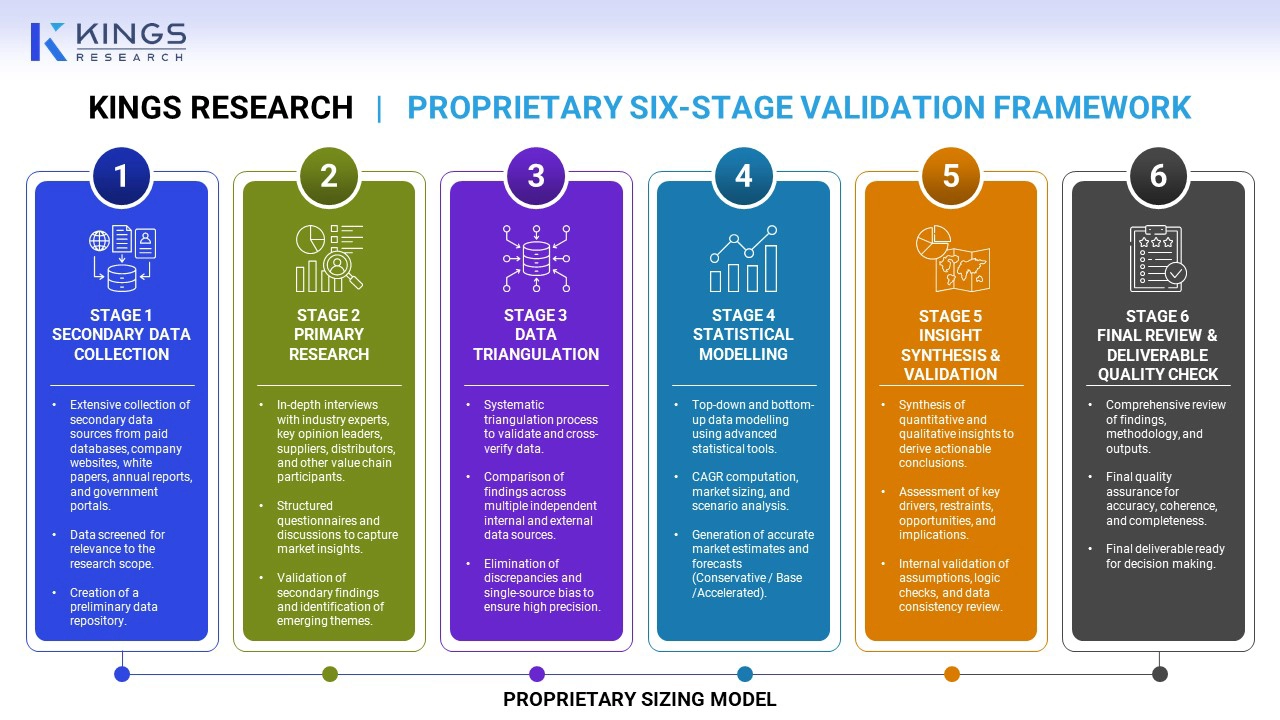
Our methodology triangulates insights from multiple independent and publicly available research databases, which is further validated against regulatory filings and public company disclosures. All estimates are cross-verified; no single-source data is presented without validation.
Our custom offerings deliver tailored, data-driven intelligence and strategic guidance to help organizations identify, evaluate, and capitalize on key market opportunities.
Frequently Asked Questions

Faizy brings over four years of experience in market research and consulting, with a proven ability to support strategic engagements across diverse industries and business environments. His work focuses on understanding complex market structures, identifying emerging opportunities, and translating research findings into clear, commercially relevant insights. With strong analytical capabilities and a structured approach to problem-solving, he evaluates industry trends, competitive landscapes, customer dynamics, and evolving business models. His expertise encompasses market research, competitive intelligence, market sizing and forecasting, industry assessment, company benchmarking, and strategic analysis. Faizy combines technical proficiency with a strong research orientation, enabling him to interpret both qualitative and quantitative information effectively. He has contributed to projects that help organizations assess growth potential, strengthen market positioning, and evaluate strategic priorities. His adaptable approach allows him to work across sectors while maintaining a consistent focus on accuracy, relevance, and delivering insights that support informed decision-making for clients and stakeholders.
Habi is a seasoned research and consulting leader with renowned experience in guiding clients on strategic growth and transformation initiatives across global markets. He has led high-performing research teams that deliver actionable insights on market expansion, M&A strategies, opportunity assessment, new business development, and product launches. His project portfolio spans large petrochemical producers, electronic device manufacturers, lubricants companies, and other leading enterprises across diverse industrial and consumer sectors. He currently heads the research department at Kings Research, where he is responsible for setting the research agenda, mentoring analysts, and ensuring client-ready deliverables that support executive decision-making. With extensive experience in market intelligence, strategic research, and consulting, Habi brings a strong understanding of evolving industry dynamics, competitive landscapes, emerging opportunities, and business growth challenges. His expertise includes developing research frameworks, translating complex market data into actionable strategic recommendations, and working closely with senior stakeholders to address critical business questions. He has also contributed to building research capabilities, strengthening analytical methodologies, and driving a culture of quality and insight-led decision-making within research teams. His cross-industry exposure enables him to connect market trends with broader business implications and provide perspectives that help organizations identify opportunities, mitigate risks, and make informed strategic decisions.