
Inquire Now
Key Strategic Points
The market involves technologies that generate electricity by recovering low- to high-temperature waste heat from industrial operations using organic rankine cycle systems. The market includes systems operating across varied capacity and temperature ranges, deployed in manufacturing facilities, refineries, petrochemical plants, and waste incineration units.
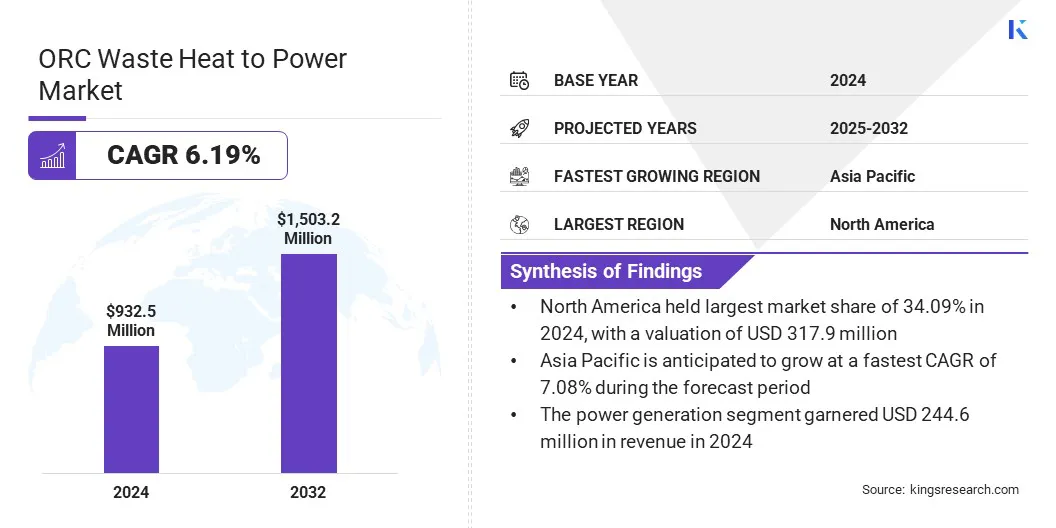
The global ORC waste heat to power market size was valued at USD 932.5 million in 2024 and is projected to grow from USD 987.3 million in 2025 to USD 1,503.2 million by 2032, exhibiting a CAGR of 6.19% over the forecast period. This growth is supported by the expansion of energy-intensive industries seeking efficient waste heat recovery solutions amid rising energy costs.
Increasing adoption of ORC systems in oil and gas processing facilities reflects rising demand for technologies that convert continuous process heat into electricity to improve operational stability. This efficiency-driven adoption gains momentum as operators pursue structured energy recovery solutions to reduce power costs and ensure uninterrupted processing.
Major companies operating in the ORC waste heat to power market are ALFA LAVAL, Mitsubishi Heavy Industries, Ltd. (Turboden S.p.A.), E.ON SE, ENOGIA, Siemens AG, BE Petrothai Group, ORCAN ENERGY AG, EXERGY INTERNATIONAL SRL, Climeon, AURA GmbH & Co. KG, Thermax Limited, Ormat, Triogen, BITZER Kühlmaschinenbau GmbH, and INTEC Engineering GmbH.
ORC units perform reliably across upstream and downstream operations where heat availability remains stable. System integration enhances performance visibility and supports compliance with energy management standards.
Rising industrial focus on waste heat utilization to reduce energy costs is driving structured recovery of unused thermal energy across energy-intensive facilities. Manufacturers are increasingly prioritizing predictable, measurable, and reliable waste heat recovery solutions to lower dependence on grid-based power and stabilize long-term energy expenditures.
ORC systems address this need by enabling scalable power generation across varied temperature ranges while delivering consistent performance. Their ability to integrate with existing industrial processes supports continuous energy recovery without disrupting operations. Ongoing advancements in ORC equipment efficiency and system control further enhance reliability, reinforcing adoption as part of long-term industrial energy optimization strategies.
High upfront capital requirements create a major financial barrier to ORC implementation in industrial facilities. Project costs include specialized equipment, engineering design, system integration, and site-specific customization, which increase initial investment levels. These constraints are more visible in capital-constrained facilities, where long payback periods affect investment priorities and slow adoption.
Industrial operators, therefore evaluate ORC projects selectively, focusing on sites with stable and predictable waste heat availability that can support long-term financial commitments.
To reduce these barriers, organizations are adopting phased investment approaches and strengthening project-financing structures. Companies are also exploring leasing and third-party ownership models to lower initial capital pressure. Pilot projects and performance-based deployments are improving financial clarity and supporting gradual, scalable ORC system adoption.
Broader integration of ORC systems across heavy industries such as cement manufacturing, steel production, glass processing, and petrochemicals is supporting market growth, as these sectors operate with continuous and high-grade thermal loads suitable for waste heat recovery. Industrial operators are deploying ORC units to convert unused process heat into electricity, improving energy efficiency and lowering dependence on grid power.
Adoption is strongest in facilities with stable heat availability that enables predictable power generation and long-term planning. Rising electricity costs and energy intensity further encourage integration of ORC systems to strengthen operational resilience and support cost control across energy-intensive production environments.
|
Segmentation |
Details |
|
By Capacity |
Below 1 MW, 1–5 MW, Above 5 MW |
|
By Temperature |
Below 150°C, 150 - 350°C, Above 350°C |
|
By Application |
Power Generation, Industrial Processes, Oil & Gas and Petrochemicals, Waste Incineration & MSW Plants, Others |
|
By Region |
North America: U.S., Canada, Mexico |
|
Europe: France, UK, Spain, Germany, Italy, Russia, Rest of Europe |
|
|
Asia-Pacific: China, Japan, India, Australia, ASEAN, South Korea, Rest of Asia-Pacific |
|
|
Middle East & Africa: Turkey, U.A.E., Saudi Arabia, South Africa, Rest of Middle East & Africa |
|
|
South America: Brazil, Argentina, Rest of South America |
Based on region, the market has been classified into North America, Europe, Asia Pacific, Middle East & Africa, and South America.
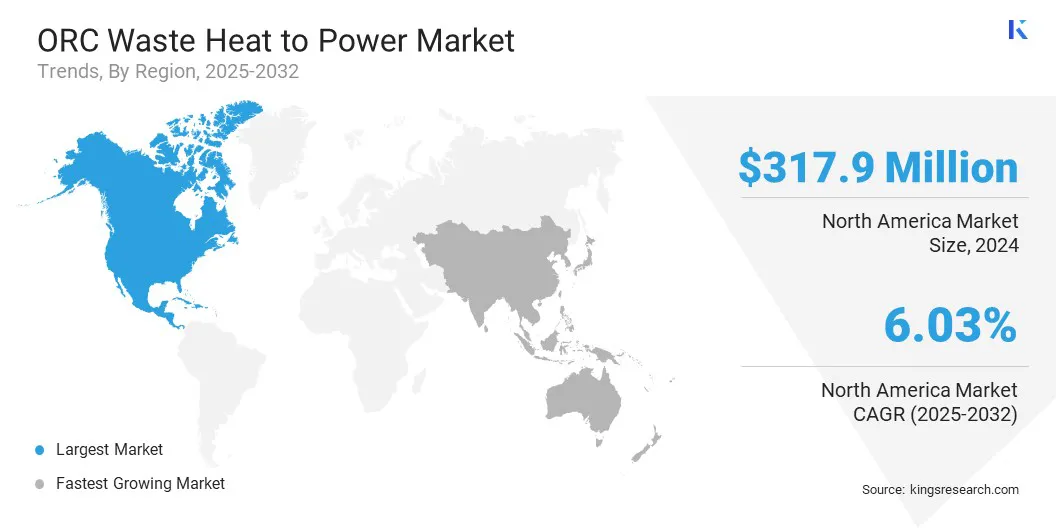
The North American ORC waste heat to power market share stood at 34.09% in 2024, valued at USD 317.9 million, supported by sustained deployment across energy-intensive industrial corridors. Market growth is driven by continuous thermal loads in industries such as cement, metals, chemicals, and refining, which enable predictable electricity generation from waste heat.
Industrial operators are increasingly implementing structured energy management programs to reduce grid dependence and manage long-term power costs, strengthening demand for ORC systems. Continued investments by manufacturers and utilities in industrial modernization and efficiency upgrades are further supporting the adoption by enabling the conversion of unused process heat into stable and measurable power output.
The Asia Pacific ORC waste heat to power industry is set to grow at a CAGR of 7.08% over the forecast period, driven by the rapid expansion of energy-intensive industries and rising interest in structured heat recovery solutions. Industrial facilities continue to scale capacity, creating stronger demand for technologies that convert surplus thermal energy into electricity.
Manufacturing clusters prioritize ORC systems for operational stability where heat availability remains consistent. Growth is also supported through increasing investments in process optimization and adoption of systems capable of operating across varied temperature conditions.
Key players in the ORC waste heat to power market are strengthening competitive positioning through strategies centered on scaling operations, expanding portfolios, and refining system performance.
Companies are developing ORC configurations suited to a wide range of temperature profiles and capacity needs, supporting deployment across diverse industrial settings. Market participants are expanding manufacturing and engineering capabilities to shorten delivery timelines and support rising demand.
Frequently Asked Questions

Antriksh is an experienced analyst specializing in cross-domain research across diverse industries. With a strong foundation in data analysis and statistical interpretation, he delivers insightful market reports that guide strategic decision-making. Antriksh excels in conducting primary research, with a focus on identifying trends and understanding consumer behavior. Thriving in dynamic and high-pressure environments, he combines analytical expertise with a commitment to delivering impactful outcomes. Beyond his professional pursuits, Antriksh's passion for travel fuels his curiosity and broadens his perspectives, enriching his ability to uncover unique insights that enhance his research capabilities. He is equally adept at synthesizing quantitative findings with qualitative context, which allows him to present holistic viewpoints to clients. His disciplined work ethic and intellectual agility make him a trusted partner in navigating market uncertainties. He consistently seeks out new methodologies to refine his analytical toolkit, and his ability to communicate complex insights clearly ensures stakeholders act confidently on his recommendations.
Habi is a seasoned research and consulting leader with renowned experience in guiding clients on strategic growth and transformation initiatives across global markets. He has led high-performing research teams that deliver actionable insights on market expansion, M&A strategies, opportunity assessment, new business development, and product launches. His project portfolio spans large petrochemical producers, electronic device manufacturers, lubricants companies, and other leading enterprises across diverse industrial and consumer sectors. He currently heads the research department at Kings Research, where he is responsible for setting the research agenda, mentoring analysts, and ensuring client-ready deliverables that support executive decision-making. With extensive experience in market intelligence, strategic research, and consulting, Habi brings a strong understanding of evolving industry dynamics, competitive landscapes, emerging opportunities, and business growth challenges. His expertise includes developing research frameworks, translating complex market data into actionable strategic recommendations, and working closely with senior stakeholders to address critical business questions. He has also contributed to building research capabilities, strengthening analytical methodologies, and driving a culture of quality and insight-led decision-making within research teams. His cross-industry exposure enables him to connect market trends with broader business implications and provide perspectives that help organizations identify opportunities, mitigate risks, and make informed strategic decisions.



.webp&w=128&q=75&dpl=dpl_DPva2LrvfsBdTJm1XZj67UTrvMHL)
