
Inquire Now
Key Strategic Points
The machine vision systems in manufacturing market refers to the industry focused on technologies that enable automated systems to visually inspect, measure, identify, and analyze objects or products within the manufacturing end-use sector. These systems integrate cameras, sensors, lenses, lighting, and image-analysis software to capture and interpret visual data for decision-making.
The technology is widely used in manufacturing facilities, factories, logistics centers, and warehouses to automate processes such as defect detection, barcode reading, object identification, measurement, and product tracking. The use of high-speed and high-accuracy inspection facilitates improved product quality, increased productivity, and reduced waste and supports data-driven operational efficiency across modern industrial automation and supply chain operations.
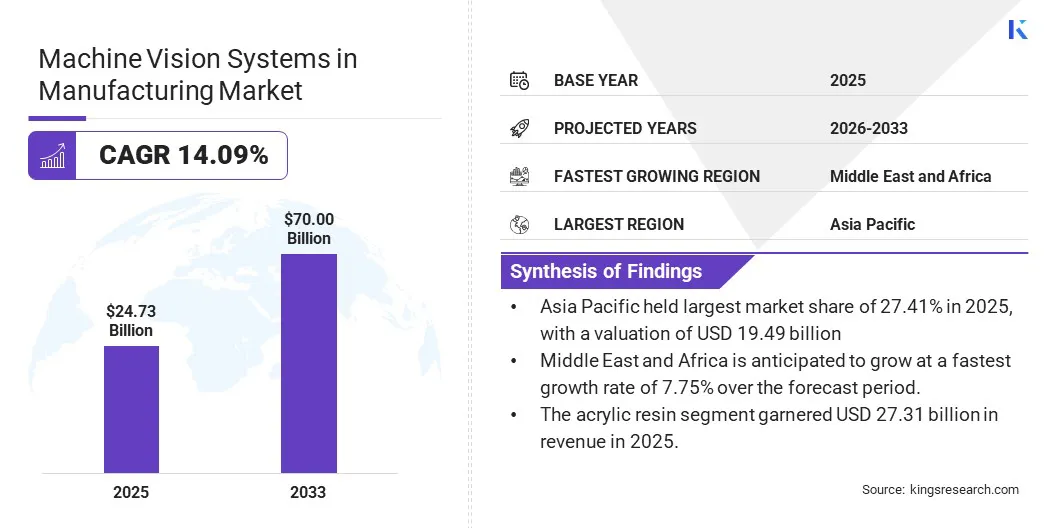
The global machine vision systems in manufacturing market was valued at USD 24.73 billion in 2025 and is projected to reach USD 70.01 billion by 2033, representing a CAGR of 14.09% over the forecast period. The rising demand for higher production, improved quality control, and reduced labor costs through automation drives the market's growth avenues for machine vision systems.
Major companies operating in the global machine vision systems in manufacturing market are Basler AG, Cognex, KEYENCE CORPORATION, Teledyne Technologies Inc., LMI Technologies, Inc., Stemmer Imaging, National Instruments Corp., OMRON Corporation, Baumer Group, SICK AG, Allied Vision Technologies GmbH, ISRA VISION, JAI, Texas Instruments Incorporated, and Banner Engineering Corp.
The market is growing rapidly owing to the capability of machine vision systems to enable real-time inspection, data-driven decisions, and process optimization through AI and IoT integration. The technology enables optimized manufacturing processes equipped with simple defect detection, continuous improvement, predictive capabilities and manufacturing enhancement.
The transition enables a data-centric approach, which enables manufacturers to move beyond simple defect detection to continuous improvement, predictive analytics and boosting manufacturing output.
Machine vision systems using AI and deep learning along with automated optical inspection (AOI), convolutional neural networks (CNN), and X-ray imaging are capable of detecting a wide range of defects. The defect type generally includes soldering issues, misplaced components, and internal faults. The inclusion of machine vision systems leads to controlled quality control and lower manufacturing defects and thus enables manufacturers to resolve production issues in real time.
Additionally, the high accuracy rate of AI-powered machine vision systems for finding defects (about 95–99.5% compared to 70–85% for human inspection in real production environments) and the ability to inspect up to 150 cm² per second, which allows for the inspection of a fully assembled PCB by finding solder joint defects smaller than 0.1 mm, act as major factors for the high demand of machine vision systems in the consumer electronics manufacturing sector.
Key challenges witnessed by machine vision systems comprise balancing accurate real-world representation with high-speed data acquisition. High-precision machine systems enable detection and localization of objects but do not ensure reflection of true spatial characteristics of the environment.
This introduces uncertainty in robotic picking tasks, where accurate positioning is essential for successful execution, such as in high-demand industrial settings that include logistics and manufacturing, where systems operate at rates comparable to or exceeding human performance to achieve acceptable returns on investment.
To address this challenge, market players are introducing high-resolution 3D sensing technologies, along with machine vision systems integrated with robotic capabilities. This fusion of artificial intelligence with 3D vision enables fast and precise object detection in complex and dynamic environments.
Market players are innovating smart camera technology, making them compact in design, lowering cost, and simplifying integration compared to traditional vision systems. Complex manufacturing operations are further deploying multi-camera machine vision systems that enable faster processing, higher throughput, and analysis of larger volumes of visual data.
The integration of AI and machine learning is further enhancing the accuracy and flexibility of machine vision in manufacturing industries, where it helps in waste reduction and product quality improvement.
|
Segmentation |
Details |
|
By Type |
1D Machine Vision System, 2D Machine Vision System, 3D Machine Vision System |
|
By Imaging |
Area Scan, Line Scan |
|
By System |
PC-Based Vision System, Smart Camera-Based System |
|
By Application |
Quality Inspection / Defect Detection, Measurement / Gauging, Identification (OCR / Barcode / Traceability), Positioning / Guidance, Sorting / Picking / Assembly, Others |
|
By End Use |
Automotive, Electronics & Semiconductor, Food & Beverage, Pharmaceutical, Consumer Electronics Others |
|
By Region |
North America: U.S., Canada, Mexico |
|
Europe: France, UK, Spain, Germany, Italy, Russia, Rest of Europe |
|
|
Asia-Pacific: China, Japan, India, Australia, ASEAN, South Korea, Rest of Asia-Pacific |
|
|
Middle East & Africa: Turkey, U.A.E., Saudi Arabia, South Africa, Rest of Middle East & Africa |
|
|
South America: Brazil, Argentina, Rest of South America |
The Asia Pacific captured the largest market share of 37.40%, valued at USD 9.25 billion in 2025. The high share is driven by Industry 4.0, automation, robotics, and extensive manufacturing hotspots across China, Japan, South Korea, India, Thailand, Malaysia and South East Asia. Countries are adopting machine vision for quality control, efficiency, smart factories, and high-precision manufacturing across automotive, pharmaceuticals, packaging, electronics, and other diverse end use verticals, leading to market expansion. This is enabling market players in the region to innovate AI-enabled vision solutions, and advanced inspection technologies to cater rising demand from manufacturing end use vertical.
For instance, in May 2025, Hikrobot introduced new product launches and upgrades across 2.5D and 3D vision, industrial cameras, smart cameras, and software platforms. The company introduced new high-speed, high-resolution cameras, improved 2.5D inspection systems, and upgraded AI and VM 5.0 capabilities. It also highlighted structured-light 3D vision, laser profile sensors, and Robot Pilot software for advanced industrial applications.
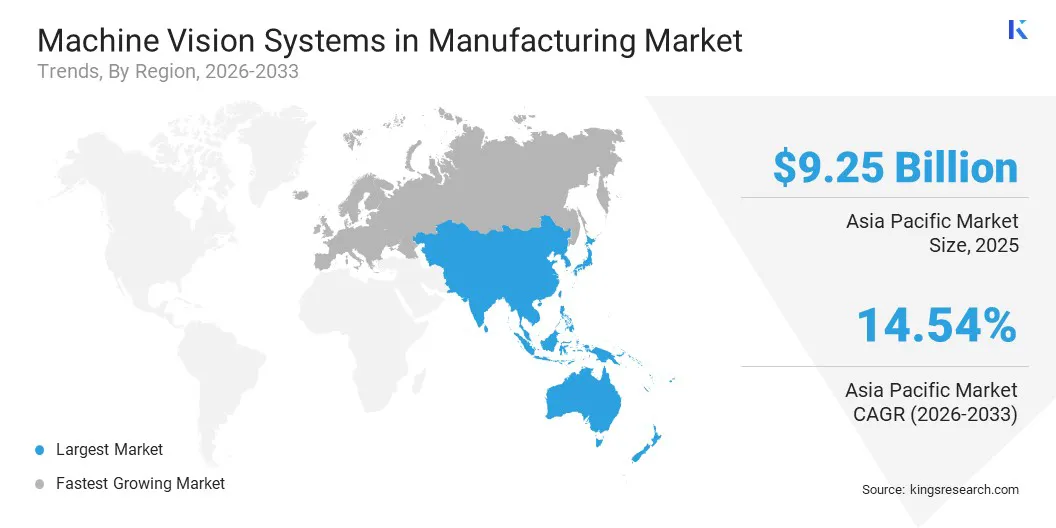
The Middle East and Africa captured the fastest CAGR of 19.38% and is forecasted to reach USD 7.12 billion in 2033. The high growth rate is attributed to the widespread adoption of machine-vision systems as part of broader industrial automation and Industry 4.0 initiatives. Major companies in the UAE and Saudi Arabia are integrating computer vision, 3D cameras, AI and robotics into manufacturing, warehousing, logistics, food processing and inspection applications. The adoption is driven by the need for greater accuracy, productivity, safety and reduced reliance on repetitive manual work, creating growth market avenues in the region.
North America is a mature market driven by the rapid adoption of AI, automation, robotics, and advanced quality-control technologies across manufacturing. The expansive automotive, electronics, pharmaceuticals, food and beverage, and packaging industries across the U.S. and Canada are increasing the deployment of machine vision to improve inspection accuracy, productivity, and operational efficiency.
Europe is witnessing steady growth in machine vision adoption, supported by Industry 4.0, industrial automation, and stringent quality and safety standards, registering a CAGR of 13.34% over the forecast interval. Economies including Germany, France, Italy, and the UK are integrating AI-enabled vision systems into automotive, electronics, pharmaceuticals, and precision manufacturing, thereby fueling market adoption.
Moreover, the increasing machine vision systems adoption across Brazil, Mexico, and other major manufacturing economies in South and Central America, driven by industrial automation and modernization of manufacturing facilities drive market growth of machine vision systems.
Key players operating in machine vision systems in the manufacturing market are increasingly focusing on integrating advanced deep learning, edge AI, and high-performance imaging technologies to cater to the emerging demand for automated quality inspection and smart manufacturing. Manufacturers are investing in AI-enabled vision systems, intelligent cameras, and high-speed sensors to improve defect detection accuracy, reduce false positives, and enable real-time decision-making on production lines.
These innovations allow manufacturing industries such as automotive, electronics, pharmaceuticals, and logistics to implement scalable visual inspection systems without complex programming, supporting the broader shift toward Industry 4.0 and autonomous factories.
Frequently Asked Questions

Faizy brings over four years of experience in market research and consulting, with a proven ability to support strategic engagements across diverse industries and business environments. His work focuses on understanding complex market structures, identifying emerging opportunities, and translating research findings into clear, commercially relevant insights. With strong analytical capabilities and a structured approach to problem-solving, he evaluates industry trends, competitive landscapes, customer dynamics, and evolving business models. His expertise encompasses market research, competitive intelligence, market sizing and forecasting, industry assessment, company benchmarking, and strategic analysis. Faizy combines technical proficiency with a strong research orientation, enabling him to interpret both qualitative and quantitative information effectively. He has contributed to projects that help organizations assess growth potential, strengthen market positioning, and evaluate strategic priorities. His adaptable approach allows him to work across sectors while maintaining a consistent focus on accuracy, relevance, and delivering insights that support informed decision-making for clients and stakeholders.
Habi is a seasoned research and consulting leader with renowned experience in guiding clients on strategic growth and transformation initiatives across global markets. He has led high-performing research teams that deliver actionable insights on market expansion, M&A strategies, opportunity assessment, new business development, and product launches. His project portfolio spans large petrochemical producers, electronic device manufacturers, lubricants companies, and other leading enterprises across diverse industrial and consumer sectors. He currently heads the research department at Kings Research, where he is responsible for setting the research agenda, mentoring analysts, and ensuring client-ready deliverables that support executive decision-making. With extensive experience in market intelligence, strategic research, and consulting, Habi brings a strong understanding of evolving industry dynamics, competitive landscapes, emerging opportunities, and business growth challenges. His expertise includes developing research frameworks, translating complex market data into actionable strategic recommendations, and working closely with senior stakeholders to address critical business questions. He has also contributed to building research capabilities, strengthening analytical methodologies, and driving a culture of quality and insight-led decision-making within research teams. His cross-industry exposure enables him to connect market trends with broader business implications and provide perspectives that help organizations identify opportunities, mitigate risks, and make informed strategic decisions.