
Inquire Now
Key Strategic Points
The heavy construction equipment market includes the sales and distribution of large and specialized construction machinery, including earthmoving, lifting, material handling, demolition and road building. It covers machines such as excavators, bulldozers, loaders, cranes, and dump trucks. Market growth is fueled by infrastructure development, rapid urbanization, and the rise in global industrial projects, as construction firms, contractors, and government agencies seek dependable and effective machinery to execute large-scale projects.
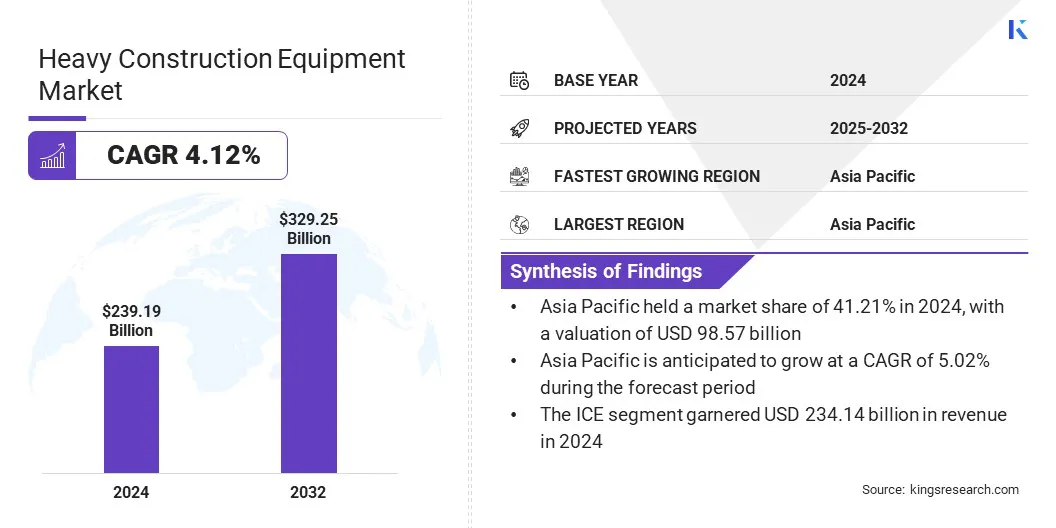
The global heavy construction equipment market size was valued at USD 239.19 billion in 2024 and is projected to grow from USD 248.13 billion in 2025 to USD 329.25 billion by 2032, exhibiting a CAGR of 4.12% during the forecast period. The growth of the market is mainly driven by growing investments in large-scale infrastructure development, accelerating urbanization, and increasing demand for sophisticated machinery that enhances operational efficiency.
Major companies operating in the global heavy construction equipment industry are Caterpillar, Komatsu Corp, XCMG Group, Deere & Company, AB Volvo, SANY Group, Hitachi Construction Machinery Co., Ltd., Liebherr Group, JC Bamford Excavators Ltd., CNH Industrial N.V., Kobelco Construction Machinery Co., Ltd., JLG Industries, Astec Industries, Inc., Kawasaki Heavy Industries, Ltd., and BAUER GROUP.
The rising integration of technologies such as automation, electrification, and telematics is significantly contributing to the growth of the market, increasing productivity and lowering the operational costs of construction and mining operations.
Heavy construction equipment market is growing substantially due to increased investments in construction and infrastructure. As governments and the private sector are focusing on enhancing urban infrastructure, transport systems, and industrial plants, they need sophisticated construction machines.
Such investments allow manufacturers to increase production capacity, develop new products, and cater to different applications such as building construction and infrastructure development. As a result, this influx of infrastructure investment leads to the growth of the market due to an increased need for durable and technologically advanced building equipment.
The market is under increased scrutiny as the government continues to impose stricter emissions and environmental laws and regulations. Stricter policies are being proposed to curb air pollution, decrease the emission of greenhouse gases, and encourage the practice of sustainability within the industry. Manufacturers and operators must now invest in cleaner technologies, meet strict reporting requirements, and adapt to emerging regulatory frameworks.
Such changes drive higher costs of operation, longer development times, and constant innovation in order to comply. To overcome this hurdle, companies are actively investing in better emission-reduction technologies and maintaining contact with policymakers so as to be proactive toward emerging rules and regulations.
Electrification of construction equipment is becoming an important trend due to the global move toward low-emission and sustainable construction practices. Manufacturers of heavy machinery are focusing on developing electric and hybrid models to meet tougher environmental standards, particularly for urban projects. This trend is further supported by collaborative initiatives aimed at accelerating this transition.
The advantages of using electrified equipment include lower noise levels, reduced operating costs, and more efficient energy consumption, making it one of the most important trends that will shape market growth in the near future.
|
Segmentation |
Details |
|
By Machinery |
Earthmoving Equipment, Material Handling Equipment, Heavy Construction Equipment, and Others |
|
By Propulsion |
ICE, and Electric |
|
By End User |
Building & Construction, Forestry & Agriculture, Infrastructure, Mining, and Others |
|
By Region |
North America: U.S., Canada, Mexico |
|
Europe: France, UK, Spain, Germany, Italy, Russia, Rest of Europe |
|
|
Asia-Pacific: China, Japan, India, Australia, ASEAN, South Korea, Rest of Asia-Pacific |
|
|
Middle East & Africa: Turkey, U.A.E., Saudi Arabia, South Africa, Rest of Middle East & Africa |
|
|
South America: Brazil, Argentina, Rest of South America |
Based on region, the global market has been classified into North America, Europe, Asia Pacific, Middle East & Africa, and South America.
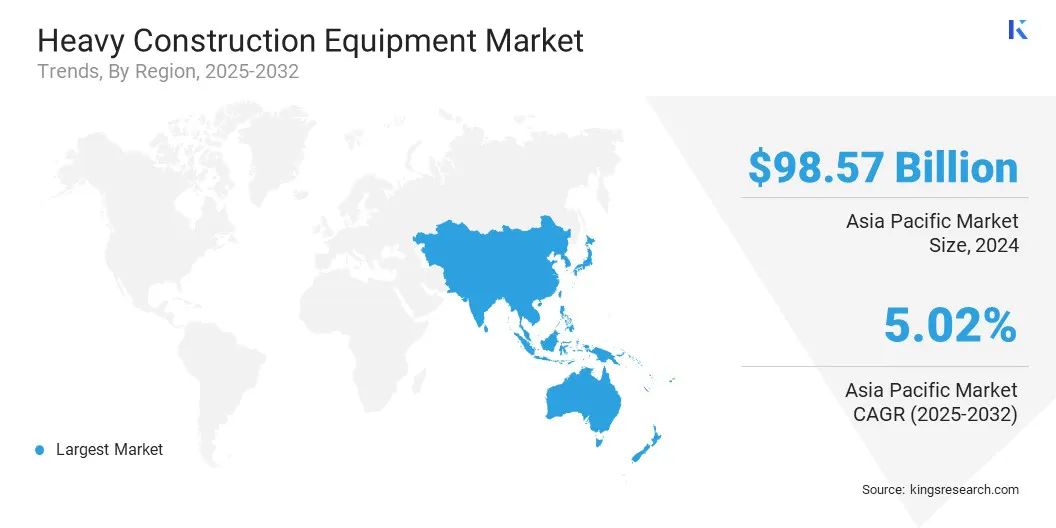
Asia-Pacific heavy construction equipment market share stood at 41.21% in 2024, valued at USD 98.57 billion. The leadership of the region is driven by massive infrastructure development, high urban population growth rates, and the rising industrial activities in the region. To facilitate economic growth, governments are making huge investments in transportation corridors, metro rail projects, and energy infrastructure.
Moreover, the increasing number of local and international equipment producers and the rising use of technologically advanced equipment are contributing to the development of the regional market. The high demand for heavy equipment in the region is expected to be maintained by favorable government programs and the ongoing development of the construction and mining industries.
The North America heavy construction equipment market is set to grow at a CAGR of 4.01% over the forecast period. This expansion is propelled by the rising investment in rehabilitation infrastructure, especially in transport, energy, and public utility systems in the U.S. and Canada. The need to modernize infrastructure and the age of some of the structures are creating a strong demand for better and more efficient construction machinery.
Moreover, automated and low-emission machinery is actively being adopted in the region to facilitate efficient operations and meet environmental requirements. The existence of leading equipment manufacturers and the well-established market of renting the equipment further creates sustained demand.
The construction equipment industry is highly competitive, characterized by the ongoing development of technology, as well as the evolving nature of customer needs. Firms are competing in terms of product innovation, equipment, efficiency, sustainability, and optimizing lifecycle costs. The market is also experiencing a shift toward digital capabilities, such as telematics, automation, and predictive maintenance, which are becoming a major point of differentiation.
Moreover, there is a high focus on the development of service networks, aftermarket services, and adaptable financing solutions to increase customer retention. Regional manufacturers are also gaining momentum in enhancing their presence by providing affordable solutions to address local needs. The presence of strategic initiatives like capacity expansion, localized production, and the creation of environmentally compliant machinery is further increasing competition throughout the market.
Frequently Asked Questions

Aswathi holds cross-domain expertise, translating market trends and competitive intelligence into decision-ready insights. Her work helps clients interpret evolving market conditions and identify growth opportunities. She brings a focused, insight-led approach to research execution. She translates these findings into clear, prioritized action plans that align with client capabilities. Her research often includes scenario modeling to test growth strategies under varying economic conditions. She maintains a rigorous validation process, cross-checking primary and secondary sources to ensure reliability. Clients value her ability to synthesize noisy data into concise executive summaries that drive board-level discussions. Her sector-specific lens, combined with a pragmatic focus on execution, consistently delivers high-impact, commercially sound recommendations. Her structured yet flexible research frameworks adapt to client timelines without compromising depth. She is known for distilling complex trade-offs into straightforward, defensible positions that facilitate confident decision-making.
Habi is a seasoned research and consulting leader with renowned experience in guiding clients on strategic growth and transformation initiatives across global markets. He has led high-performing research teams that deliver actionable insights on market expansion, M&A strategies, opportunity assessment, new business development, and product launches. His project portfolio spans large petrochemical producers, electronic device manufacturers, lubricants companies, and other leading enterprises across diverse industrial and consumer sectors. He currently heads the research department at Kings Research, where he is responsible for setting the research agenda, mentoring analysts, and ensuring client-ready deliverables that support executive decision-making. With extensive experience in market intelligence, strategic research, and consulting, Habi brings a strong understanding of evolving industry dynamics, competitive landscapes, emerging opportunities, and business growth challenges. His expertise includes developing research frameworks, translating complex market data into actionable strategic recommendations, and working closely with senior stakeholders to address critical business questions. He has also contributed to building research capabilities, strengthening analytical methodologies, and driving a culture of quality and insight-led decision-making within research teams. His cross-industry exposure enables him to connect market trends with broader business implications and provide perspectives that help organizations identify opportunities, mitigate risks, and make informed strategic decisions.