


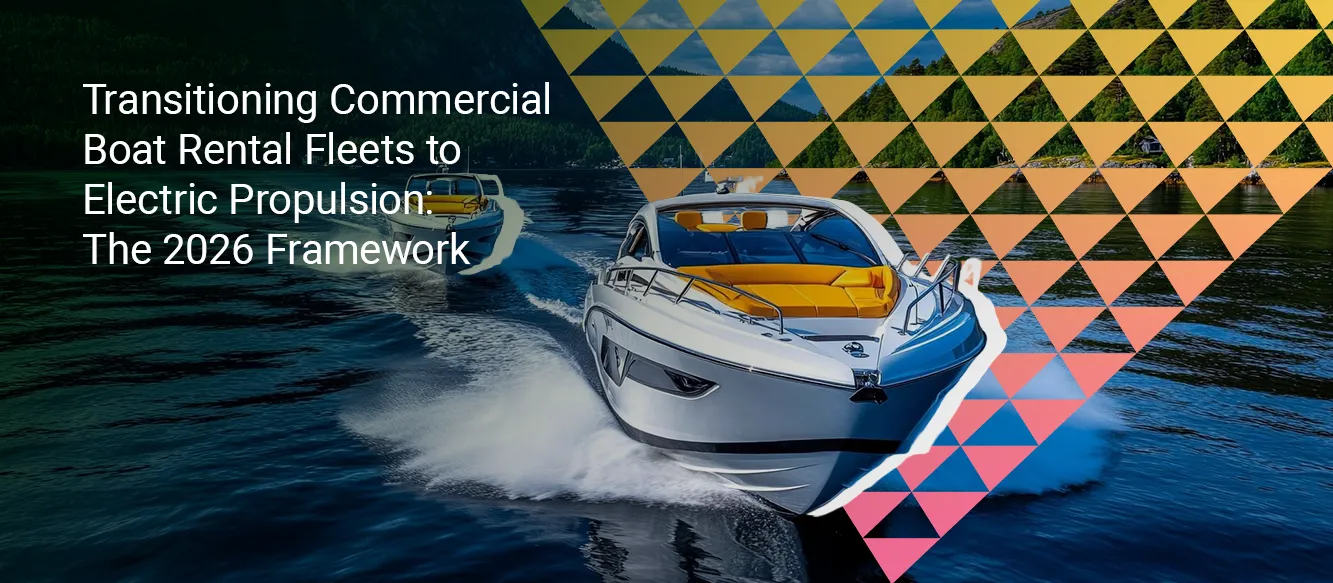
The commercial boat rental industry is at an inflection point. Across Europe's canal networks, North America's coastal waterways, and Asia-Pacific's emerging tourist destinations, fleet operators are confronting a fundamental question: how to transition from internal combustion engine (ICE) propulsion to electric drivetrains without compromising operational viability or the customer experience.
The macroeconomic context is clear. While the traditional macroscopic boat rental market stands at an audited USD 27.23 billion as of 2025, forward-looking asset projections indicate an expansion to USD 42.35 billion by 2033, driven entirely by fleet turnover in emission-controlled zones, as per Kings Research. This represents a CAGR of 5.77%, but beneath this headline figure lies a more significant story: the accelerating replacement of ICE vessels with electric and hybrid alternatives in response to municipal clean-water mandates, shifts in consumer preferences, and the compelling economics of reduced operational overhead.
The transition is already underway. In July 2024, ePropulsion partnered with a French boat rental business to introduce electric propulsion solutions to French waterways, aiming to decrease environmental impact and facilitate the adoption of environmentally friendly technologies. In July 2024, Groupe Beneteau and Le Boat signed a 10-year partnership to modernize Le Boat’s fleet with more sustainable vessels. The agreement covers 400 new DELPHIA boats over the decade, alongside new premium models and a broader fleet renewal strategy.
As such, this blog explores the 2026 framework for transitioning commercial boat rental fleets to electric propulsion, highlighting the market drivers, industry initiatives, and strategic considerations shaping a successful shift to sustainable operations.
The Strategic Case for Fleet Electrification
AI Overview Snippet: The transition to electric craft is a consequence of municipal carbon-free mandates, collapsing operational maintenance overhead, and premium eco-tourism yields. Fleet operators adopting electric propulsion gain regulatory compliance, reduced fuel and maintenance costs, and access to environmentally conscious customer segments willing to pay premium rates for silent, emission-free experiences.
The strategic case for fleet electrification rests on three pillars:
Regulatory drivers
Municipalities and national governments are increasingly restricting the operation of internal combustion engines in sensitive waterways. The EU's Recreational Craft Directive (2013/53/EU) sets stringent emissions and noise standards for boats offered for rent. In the United States, the U.S. Coast Guard enforces detailed safety and operator requirements under the Recreational Boating Regulations. These frameworks are not static—they are tightening.
Operational economics
The total cost of ownership for electric vessels is increasingly favorable. While upfront capital expenditure remains higher, the deletion of fuel lines, oil filters, water pump impellers, and seasonal winterization labor produces meaningful line-item savings over a vessel's lifecycle.
Market differentiation
Eco-tourism has become a growth engine. Consumers seek sustainable experiences, and operators offering silent, emission-free electric craft command premium pricing and higher occupancy rates.
The National Marine Manufacturers Association (NMMA) reports that in 2025, the U.S. recreational boat market recorded 220,397 new powerboats sold, with fishing boats leading all categories at 77,434 units, followed by watersports boats including personal watercraft (PWC) at 71,461 units. While electric penetration remains low in absolute terms, the trajectory is clear: new powerboat sales are shifting toward alternative propulsion as consumer preferences evolve.
The Regulatory Trigger: USCG Plan Review Frameworks (46 CFR § 182.220)
Converting commercial watercraft from internal combustion to electric propulsion triggers mandatory compliance hurdles under U.S. Coast Guard regulations. The critical regulatory reference is 46 CFR § 182.220, which governs machinery installations on small passenger vessels.
Under traditional internal combustion setups, many machinery installations are exempt from detailed plan review. However, all-electric architectures are subject to mandatory plan checks because they fall under the category of "unusual" propulsion systems that require separate consideration. As the Coast Guard explicitly states: "Propulsion machinery of an unusual type for small passenger vessels must be given separate consideration and is subject to such requirements as determined necessary by the cognizant OCMI".
The requirements for machinery for electrically propelled vessels are contained in applicable regulations in Subchapter F (Marine Engineering) and Subchapter J (Electrical Engineering) of 46 CFR. For vessels certificated under 46 CFR Subchapter T that use all-electric propulsion, compliance with 46 CFR 182.220 is mandatory, and the cognizant Officer in Charge, Marine Inspection (OCMI) may require plan submission for approval.
Step-by-step plan submission protocols
The Coast Guard Marine Safety Center (MSC) has established detailed procedures for electrical plan review under Procedure Number E2-23. This Plan Review Guideline (PRG) provides guidance regarding the information required to be submitted to the MSC for review of electrical plans for small passenger vessels on U.S. flag inspected vessels.
The submission must include sufficient documentation and plans to indicate compliance with applicable requirements. Required documents include:
- Elementary one-line diagrams showing the complete electrical distribution system
- Cable lists detailing all wiring specifications
- Bills of materials for all electrical components
- Type and size of generators and prime movers
- Power, lighting, and interior communication panelboards
The cost of non-compliance
A single plan-check rejection from the MSC can freeze fleet deployment for months, wiping out an entire high-yield summer rental season. Operators must engage qualified marine engineers and naval architects early in the conversion process to avoid costly revision delays.
Fleet Operating Economics: Upfront CapEx vs. Lifecycle OpEx
The financial case for electric fleet transition requires careful analysis of upfront capital expenditure against long-term operational savings.
Amortization windows for marine-grade lithium-ion batteries. High-capacity marine-grade lithium-ion power blocks are projected to last over 1,000 cycles—equivalent to approximately 5–8 years of commercial rental operation, depending on usage intensity. While the upfront cost remains higher than equivalent ICE installations, the economics improve as battery technology matures and production scales.
Electric propulsion eliminates:
- Fuel lines and fuel storage systems — removing fire hazards and spill risks
- Oil filters and engine oil — eliminating regular oil changes and disposal costs
- Water pump impellers — removing cooling system maintenance
- Seasonal winterization labor — electric systems require minimal cold-weather preparation
Energy Cost-stability
The U.S. Energy Information Administration (EIA) provides real industrial regional utility kilowatt-hour cost vectors that demonstrate energy cost stability profiles relative to volatile marine fuel index averages. According to the EIA's Electric Power Monthly for April 2026, commercial electricity rates across U.S. regions ranged from approximately 13.68 cents/kWh (Pennsylvania) to 24.02 cents/kWh (Massachusetts). By contrast, marine diesel prices remain subject to global oil market volatility.
The industrial sector—which includes marina and commercial fleet operations—enjoyed even lower rates, with Pennsylvania at 9.82 cents/kWh, Michigan at 8.95 cents/kWh, and New York at 8.62 cents/kWh.
The Propulsion Matrix
Traditional ICE propulsion typically operates at 20–25% thermal efficiency, with most of the energy lost as heat. Electric propulsion systems achieve 85–95% efficiency from battery to propeller, representing a fundamental thermodynamic advantage that translates directly to lower per-hour operating costs.
|
Propulsion Type |
Efficiency |
Fuel/Energy Cost (per hour) |
Maintenance Cost (annual) |
Noise Level |
|
Internal Combustion Engine |
20–30% |
High (volatile fuel prices) |
High (oil, filters, cooling) |
High (70–90 dB) |
|
Electric Motor |
85–95% |
Low (stable electricity rates) |
Low (minimal moving parts) |
Low (<50 dB) |
Financial Blueprint of an 8-Vessel Rental Fleet Transition
To understand the real-world economics of fleet electrification, consider the financial blueprint of an 8-vessel commercial rental transition.
Capital Expenditure Allocation
Retrofitting standard hulls with alternative powertrains requires significant upfront investment. Based on industry data from commercial rental operators who have undertaken similar transitions, the capital allocation typically breaks down as:
- Propulsion system (motors, controllers, cabling): 35–40% of total conversion cost
- Battery storage (lithium-ion packs, BMS): 40–45% of total conversion cost
- Charging infrastructure (shore power, pedestals, transformers): 15–20% of total conversion cost
- Engineering and plan review: 5–10% of total conversion cost
Real-world Operational Data
MIT Sea Grant researchers demonstrated that wedge-shaped vortex generators attached to a ship’s hull can reduce drag by up to 7.5%, cutting fuel use and emissions and potentially saving large commercial vessels hundreds of thousands of dollars annually.
Engineering Safe Charging Infrastructure: Mitigating Electric Shock Drowning (ESD)
One of the most critical, and most frequently overlooked aspects of electric fleet transition is the engineering of safe shore-power charging infrastructure.
The Physics of ESD
Electric Shock Drowning (ESD) occurs when low-level AC current escapes into fresh or brackish waterways from a compromised hull grounding system. The current passes through the body with sufficient force to cause skeletal muscular paralysis, rendering the victim unable to help themselves while immersed in freshwater, eventually resulting in drowning.
As the NFPA notes, more than 50 deaths and over 30 injuries have been documented due to leakage current in or around marinas. The National Electrical Code (NEC), Article 555 Marinas, Boatyards, Floating Buildings, and Commercial and Noncommercial Docking Facilities, has seen significant changes around marina ground-fault protection requirements.
Ground-fault Protection Requirements
The NEC requires the main overcurrent protective device that feeds the marina to have ground-fault protection set to open at 100 milliamps (mA) for feeder and branch circuit conductors, and 30 mA for receptacles feeding shore power.
The execution of isolating onboard neutral connections. During active charging sequences, neutral connections must be properly isolated to prevent stray parallel return paths. The American Boat and Yacht Council (ABYC) E-11 Standard for AC and DC Electrical Systems addresses the design, construction, and installation of AC and DC electrical systems on boats.
Battery Room Isolation and Thermal Runaway Safety Codes
Physical storage compartments for marine-grade lithium-ion batteries requires strict adherence to federal safety codes.
Class I, Division 1 Electrical Component Boundaries
Battery rooms and lockers containing large battery installations must be treated as hazardous locations. The Code of Federal Regulations mandates that electric motors must be outside the duct and compartment and must have an explosion-proof motor for a Class I, Division 1, Group B location, or its IEC equivalent designation of Zone 1, IIB + H2 location.
Physical layout standards. Key requirements for battery rooms include:
- Fire-retardant barriers: Compartmentalizing battery storage to contain potential fires
- Automatic emergency isolation switches: Enabling rapid disconnection in fault conditions
- Structural blast routes: Providing pressure relief pathways in the event of thermal runaway
The ventilation formula. The eCFR (46 CFR § 111.15-10) enforces strict volumetric air-exchange requirements. For large battery installations, each battery room must have a power exhaust ventilation system with openings for intake air near the floor. The quantity of air expelled must be at least:
q = 3.89 × i × n
where:
- q = quantity of expelled air in cubic feet per hour
- i = Maximum charging current during gas formation, or one-fourth of the maximum obtainable charging current of the charging facility, whichever is greater
- n = Number of cells
The power ventilation system must be separate from ventilation systems for other spaces and must be interlocked with the battery charger so that the battery cannot be charged without ventilation. Each blower must have a non-sparking fan.
Mandatory Electrical Safety: Propulsion Ground Detection
Integrating constant warning systems is essential for clearing Coast Guard safety inspections before putting paying customers on the water.
A Subchapter J-compliant insulation monitoring device continuously measures the insulation resistance between the propulsion system's ungrounded DC bus and the vessel's ground. When resistance drops below a predetermined threshold, the device triggers audible and visual alarms at the helm, alerting the operator to a potential ground fault before it becomes a safety hazard.
The federal requirement. Under 46 CFR § 111.05-21(a), continuous line ground fault detection is required for electrical systems aboard inspected vessels. The Coast Guard's Marine Safety Center has established specific procedures for reviewing ground detection systems as part of the electrical plan review process.
Designing Alert Arrays
Audible and visual alert arrays must be installed at the primary helm control panel to provide immediate notification of ground faults. The system must:
- Continuously monitor insulation resistance
- Trigger audible alarms when resistance drops below threshold
- Illuminate visual indicators at the helm
- Provide clear indication of which circuit is affected
NFPA 70 / NEC Section 555 applies the specific milliamp trip-setting limits required for ground-fault protection on electrical distribution feeders serving commercial boat slips.
Frequently Asked Questions About Battery Safety and Fleet Logistics
What are the primary safety concerns with marine lithium-ion batteries?
Thermal runaway, off-gassing of flammable gases during charging, and the risk of electric shock drowning from faulty grounding are the primary safety concerns. Compliance with 46 CFR § 111.15-10 ventilation requirements and ABYC E-11 electrical standards is mandatory.
How often must battery rooms be ventilated?
Battery rooms must have power exhaust ventilation systems interlocked with chargers so that batteries cannot be charged without ventilation. The ventilation rate is calculated using the formula q = 3.89 × i × n (cubic feet per hour).
What is the typical lifespan of marine-grade lithium-ion batteries in rental service?
Commercial marine-grade lithium-ion batteries are typically rated for 1,000–2,000 cycles, equivalent to approximately 5–8 years of rental operation depending on daily usage intensity and depth of discharge.
What ground-fault protection is required for marina charging infrastructure?
NEC Article 555 requires ground-fault protection set to open at 100 mA for feeder and branch circuit conductors, and 30 mA for receptacles feeding shore power.
Can existing ICE vessels be converted to electric propulsion?
Yes, but conversions trigger mandatory USCG plan review under 46 CFR § 182.220, as all-electric propulsion is classified as "unusual" propulsion requiring separate consideration.
What documentation is required for USCG plan review?
Elementary one-line diagrams, cable lists, bills of materials, generator specifications, and panelboard details must be submitted to the Marine Safety Center for review.
Access the Complete Blueprint
Electric propulsion is becoming a strategic requirement for commercial boat rental fleets, driven by evolving regulations, lower operating costs, and growing demand for sustainable experiences. Operators that combine sound engineering, regulatory compliance, and long-term fleet planning will be best positioned to reduce lifecycle costs and remain competitive as the market continues to evolve.
Download the Boat Rental Market Report to explore propulsion transition trends, competitive developments, regional opportunities, and future market forecasts shaping the global boat rental industry.
Speak with a Maritime Industry Analyst to discuss how your fleet can capitalize on emerging opportunities in electric propulsion.