
Inquire Now
Key Strategic Points
According to Kings Research, the global cleaning services market size is projected to grow from USD 395.23 billion in 2025 to USD 579 billion by 2033, registering a CAGR of 4.6% from 2026 to 2033.
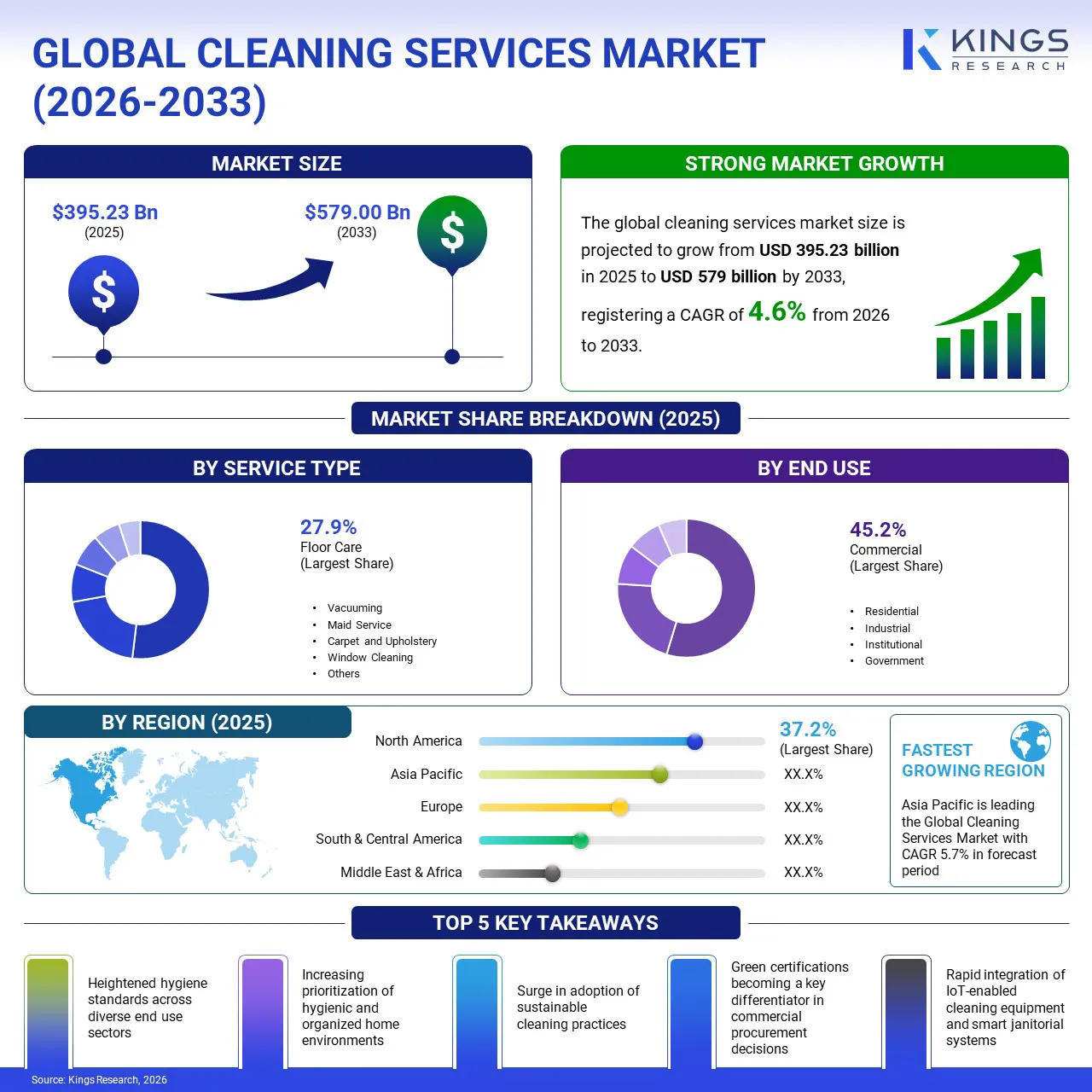
The global cleaning services industry is transforming into a technology-enabled, outsourced facility management function, propelled primarily by heightened hygiene standards and the growing adoption of automation. The market exhibits long-term growth potential underpinned by expanding commercial infrastructure, rapid urbanization, and the rising penetration of professional cleaning services across emerging economies.
|
Segmentation |
Details |
|
|
By Service Type |
Floor Care, Vacuuming, Maid Services, Carpet & Upholstery, Window Cleaning, Others |
|
|
By End Use |
Commercial, Residential, Industrial, Institutional, Government |
|
|
By Region |
North America |
U.S., Canada, Mexico |
|
Europe |
France, UK, Spain, Germany, Italy, Russia, Rest of Europe |
|
|
Asia-Pacific |
China, Japan, India, Australia, ASEAN, South Korea, Rest of Asia-Pacific |
|
|
Middle East and Africa |
Turkey, U.A.E., Saudi Arabia, South Africa, Rest of Middle East & Africa |
|
|
South and Central America |
Brazil, Argentina, Rest of South and Central America |
|
Heightened hygiene standards across commercial office premises, healthcare establishments, industrial facilities, and public spaces are creating a strong demand for professional cleaning services. Professional cleaning service providers utilize advanced equipment, specialized techniques, and eco-friendly products. This enables them to offer customized solutions for specific needs, including allergy reduction, specialized odor remediation, and sustainable cleaning.
Additionally, the higher revenue yield of commercial cleaning contracts on a per-hour or per-square-foot basis, compared to residential work, further boosts the overall profitability of professional cleaning services, thereby creating lucrative growth avenues for cleaning services industry expansion. Moreover, the transition to remote work is further transforming the market dynamics owing to the rise in demand for clean and organized living spaces, which are becoming vital for maintaining productivity and focus.
Key Insight: Rising hygiene awareness and the increasing adoption of outsourced commercial cleaning, fueled by evolving workplace trends, are accelerating the demand for professional cleaning services.
Staffing challenges driven by labor shortages, characterized by turnover rates exceeding 200% annually and an aging workforce nearing retirement, are constraining the growth of the cleaning services market. According to the Bureau of Labor Statistics (BLS) Occupational Outlook Handbook, employment of janitors and building cleaners is projected to grow by 2% from 2024 to 2034. The BLS estimates approximately 351,300 annual job openings, primarily driven by the demand to replace workers exiting the workforce rather than net expansion.
This replacement-driven demand highlights the industry's ongoing workforce constraints despite modest employment growth. Consequently, the shortage of professional cleaning personnel leads to inconsistent service quality, rising labor costs, and reduced customer satisfaction. This dynamic is accelerating the adoption of automated cleaning technologies, including autonomous floor cleaning robots and AI-enabled cleaning management solutions.
Key Insight: Labor scarcity has evolved from a cyclical challenge into a structural constraint, influencing capital allocation decisions and driving increased investment in robotics and workforce augmentation technologies to maintain service consistency and safeguard margins.
The rising emphasis on sustainable cleaning products and practices is shaping the cleaning services market. This shift is targeted at minimizing environmental impact while enhancing occupant health and safety. Market players are prioritizing solutions that reduce exposure to hazardous chemicals, improve indoor air quality, and minimize waste and packaging. Consequently, this shift is accelerating demand for cleaning service providers that utilize environmentally friendly practices and hold recognized green certifications. Sustainability credentials are emerging as a key competitive differentiator and a critical procurement criterion for end users when shortlisting cleaning service providers.
Furthermore, regulatory initiatives are reinforcing this shift by promoting safety standards designed to boost the adoption of safer, environmentally responsible cleaning products.
For instance, in June 2026, U.S. Senators introduced the Safer Choice Program Authorization Act of 2026 to formally authorize and preserve the EPA’s Safer Choice program. The legislation has received strong support from the American Cleaning Institute and is aimed at strengthening science-based standards for safer cleaning products.
Key Insight: Green certifications have become a primary competitive advantage in the cleaning services market, with sustainability credentials increasingly influencing corporate procurement decisions and contract awards.
The global cleaning services market is highly fragmented, characterized by intense competition among major global players, regional janitorial contractors, franchise-based operators, and specialized hygiene service providers.
Market leadership is differentiated by service model and geography, while ongoing investments in robotics, workforce management technology, and sustainability credentials are rapidly transforming the competitive landscape. Additionally, an emphasis on strategic acquisitions and targeted mergers to broaden service portfolios, strengthen market presence, and expand revenue is further intensifying competition.
Key Insight: Competitive differentiation is shifting toward technology-driven service delivery, with M&A activities increasingly targeted at closing capability gaps in mission-critical and specialized cleaning verticals.
North America is the dominant region in the global cleaning services market, accounting for a share of 37.24%, valued at USD 147.18 billion in 2025. The presence of diverse commercial and industrial facilities, coupled with stringent workplace hygiene standards, contributes to regional dominance. The increasing demand for integrated workplace services through long-term facility management contracts with large corporate customers in countries such as the U.S. and Canada is propelling domestic market development.
The Asia-Pacific cleaning services market is anticipated to register the fastest CAGR of 5.7% during the forecast period (2026-2033). Rapid urbanization, expansion of organized commercial real estate, and industrial hubs across China, India, and Southeast Asia are creating significant growth opportunities. This growth is further supported by increasing focus on technological innovations and the rising commercialization of AI-powered cleaning solutions.
Key Insight: North America continues to establish the benchmark in professional cleaning, supported by a well-developed outsourcing infrastructure and well-defined workplace hygiene standards. In contrast, Asia-Pacific is witnessing accelerated growth, driven by rapid commercialization and the increasing formalization of hygiene standards across corporate and industrial end-user segments.
The regulatory framework governing the cleaning services market is evolving globally as governments strengthen requirements around workplace sanitation, chemical safety, and worker protection. In the U.S., the Occupational Safety and Health Administration (OSHA) maintains general industry sanitation standards under 29 CFR 1910. These standards cover hazard communication, personal protective equipment, and walking-working surfaces and remain applicable whether cleaning is performed by in-house staff or an outside vendor.
Furthermore, the U.S. Environmental Protection Agency (EPA) Safer Choice program provides a science-based benchmark for the inclusion of safer ingredients in cleaning products.
Key Insight: Regulatory authorities are increasingly emphasizing chemical safety certification and documented sanitation compliance as critical indicators of preparedness for cleaning service providers. Consequently, green chemistry credentials and audit-ready service documentation are emerging as essential differentiators for both new entrants and established participants.
A resilient, digitally connected service delivery chain ensures consistent sourcing of cleaning chemicals and equipment, reliable workforce deployment, and verifiable hygiene outcomes from suppliers to end clients.
An integrated, technology-enabled service delivery chain improves workforce reliability, chemical safety compliance, and client-facing transparency, enabling cleaning service providers to meet evolving hygiene expectations while managing structural labor constraints.
Key Insight: The market is shifting toward workforce augmentation through robotics, standardized chemical safety sourcing, and digital compliance documentation to improve service resilience and ensure consistent hygiene outcomes across multi-site contracts.
How We Gather This Information
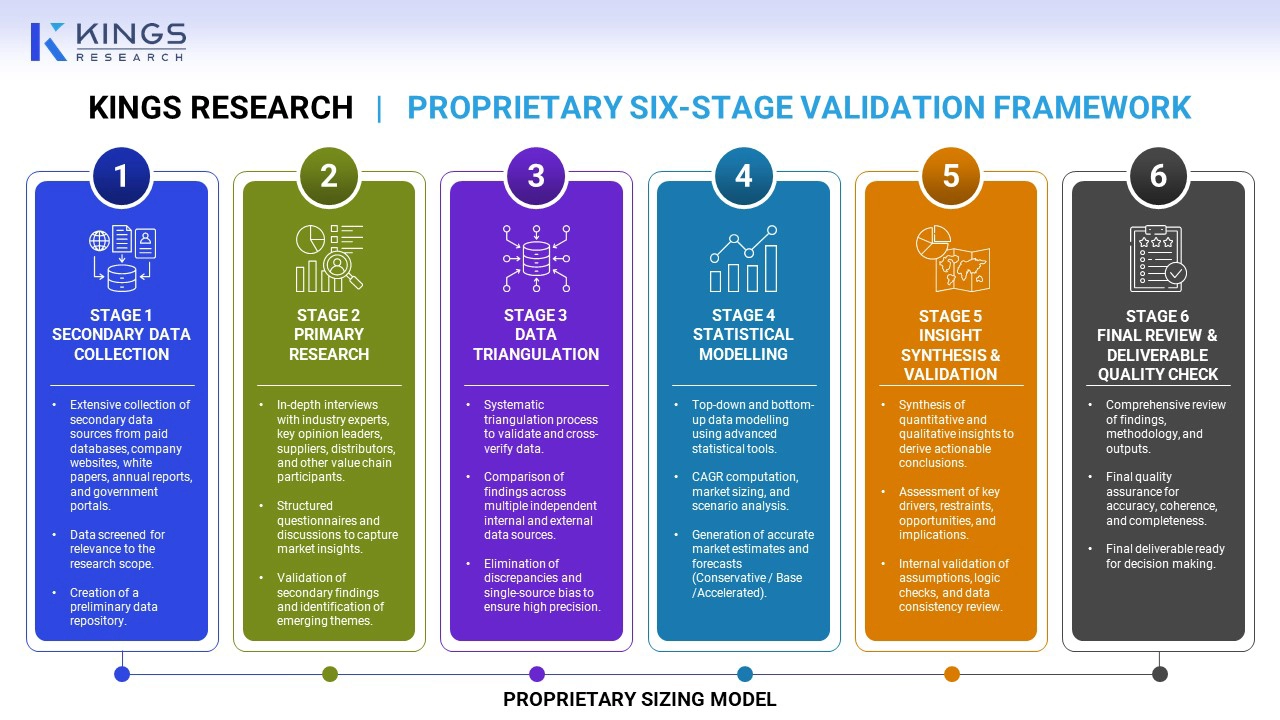
Our methodology triangulates insights from multiple independent and publicly available research databases, which is further validated against regulatory filings and public company disclosures. All estimates are cross-verified; no single-source data is presented without validation.
Our custom offerings deliver tailored, data-driven intelligence and strategic guidance to help organizations identify, evaluate, and capitalize on key market opportunities.
Frequently Asked Questions

Faizy brings over four years of experience in market research and consulting, with a proven ability to support strategic engagements across diverse industries and business environments. His work focuses on understanding complex market structures, identifying emerging opportunities, and translating research findings into clear, commercially relevant insights. With strong analytical capabilities and a structured approach to problem-solving, he evaluates industry trends, competitive landscapes, customer dynamics, and evolving business models. His expertise encompasses market research, competitive intelligence, market sizing and forecasting, industry assessment, company benchmarking, and strategic analysis. Faizy combines technical proficiency with a strong research orientation, enabling him to interpret both qualitative and quantitative information effectively. He has contributed to projects that help organizations assess growth potential, strengthen market positioning, and evaluate strategic priorities. His adaptable approach allows him to work across sectors while maintaining a consistent focus on accuracy, relevance, and delivering insights that support informed decision-making for clients and stakeholders.
Smriti Vinodia is a market research and consumer insights professional with expertise in qualitative research, consumer behavior, and strategic market intelligence across the FMCG and FMCD industries. She has experience supporting leading brands by transforming complex consumer and market insights into actionable strategies that inform product development, innovation, positioning, and business growth. Her expertise spans qualitative consumer research, market and competitive intelligence, consumer trend analysis, and AI-enabled insight generation. She has worked across diverse research engagements, helping organizations understand evolving consumer needs, identify emerging market opportunities, and strengthen customer-centric decision-making. Combining analytical rigor with a strong understanding of consumer psychology and market dynamics, Smriti brings a strategic perspective to research and insights. She focuses on connecting consumer behavior with commercial priorities, enabling organizations to make informed decisions, develop relevant products and experiences, and build sustainable growth strategies in rapidly evolving and competitive markets.