
Inquire Now
Key Strategic Points
The market includes materials and solutions designed to protect, contain, and transport products safely across supply chains and end-use applications. These packaging solutions offer strength, durability, and barrier protection to prevent damage, contamination, or product loss during storage and transportation.
The report covers segmentation by packaging type, material, end-use industry, and region. Paper and paperboard packaging solutions are widely used across consumer goods, food and beverage, e-commerce, industrial, and public sector applications. These solutions ensure product safety, meet regulatory standards, support sustainability goals, and reduce operational and environmental risks.
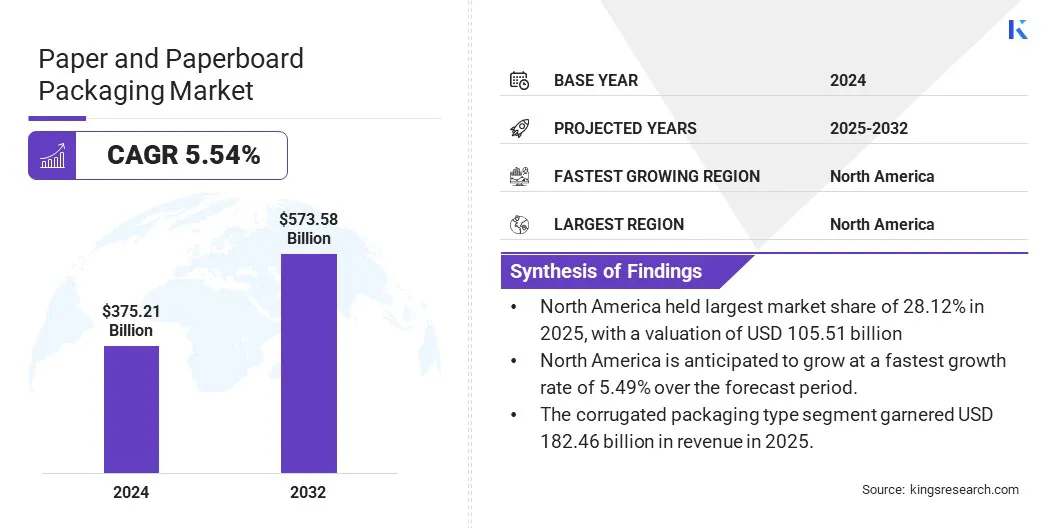
The global paper and paperboard packaging market size was valued at USD 375.21 billion in 2025 and is projected to grow from USD 393.26 billion in 2026 to USD 573.58 billion by 2032, exhibiting a CAGR of 5.54 % over the forecast period (2026-2033).
Market growth is primarily driven by the rising demand for sustainable and recyclable packaging, increased usage across food & beverage, e-commerce, and consumer goods sectors, and growing regulatory and consumer emphasis on eco-friendly, lightweight, and circular packaging solutions.
Major companies operating in the paper and paperboard packaging industry are Mondi, International Paper, Smurfit Westrock, DS Smith, Packaging Corporation of America, Stora Enso, Georgia-Pacific LLC, Oji Holdings Corporation, Rengo Co., Ltd., Saica, Mayr-Melnhof Karton AG, Cascades Inc., Novolex, Amcor plc, and YFY Inc.
The market is experiencing notable growth, mainly due to the increasing adoption of paper mailers, corrugated boxes, and paper fillers across large-scale logistics and fulfillment operations in order to structurally reduce plastic usage while improving packaging efficiency.
Regulatory restrictions on single-use plastics are accelerating the transition to paper and paperboard packaging by limiting or banning plastic-based formats across key markets. As governments promote recyclable, biodegradable, and renewable materials, brands are increasingly adopting paper-based alternatives to ensure regulatory compliance and sustain consumer acceptance.
This regulatory push, combined with rising demand for sustainable packaging, is boosting adoption across end-use industries such as food and beverage, e-commerce, pharmaceuticals, consumer goods, and industrial packaging. Growth in e-commerce, demand for lightweight and cost-efficient materials, and advancements in paperboard strength, barrier properties, and printing technologies are further supporting this shift.
Raw material prices are highly sensitive to changes in forestry regulations, energy and logistics costs, recycling rates, and global supply–demand dynamics, creating cost uncertainty for manufacturers. This volatility pressures margins and complicates long-term pricing strategies, particularly for high-volume and price-sensitive end-use industries such as food, e-commerce, and consumer goods.
To mitigate this challenge, market players are securing long-term supply agreements, increasing the use of recycled fiber, optimizing material usage through light weighting and process efficiency improvements, and investing in automation and energy-efficient technologies. Some companies are prioritizing vertical integration and supplier diversification to reduce exposure to raw material price fluctuations.
The increasing adoption of sustainable, recyclable, and smart packaging solutions is a key trend propelling the market, as it aligns with evolving regulatory requirements and changing consumer preferences. The rising use of sustainable coatings, biodegradable inks, and higher recycled fiber content is further supporting this trend, enabling manufacturers to meet environmental regulations while maintaining performance standards.
At the same time, the integration of smart and functional features such as QR codes, digital watermarks, and NFC tags is enhancing product traceability, strengthening anti-counterfeiting measures, and improving consumer engagement. These innovations add value for brand owners, support transparency across supply chains, and expand the application scope of paper and paperboard packaging, thereby reinforcing long-term market growth.
|
Segmentation |
Details |
|
By Packaging Type |
Folding Cartons & Boxes, Corrugated Packaging, Sleeves and Wraps, Others |
|
By Material |
Virgin Paper/ Paperboard, Recycled Paper / Paperboard, Others |
|
By End-Use Industry |
Food and Beverage, Consumer Goods, Healthcare, E-Commerce & Retail, Others |
|
By Region |
North America: U.S., Canada, Mexico |
|
Europe: France, UK, Spain, Germany, Italy, Russia, Rest of Europe |
|
|
Asia-Pacific: China, Japan, India, Australia, ASEAN, South Korea, Rest of Asia-Pacific |
|
|
Middle East & Africa: Turkey, UAE, Saudi Arabia, South Africa, Rest of Middle East & Africa |
|
|
South America: Brazil, Argentina, Rest of South America |
Based on region, the market has been classified into North America, Europe, Asia Pacific, Middle East & Africa, and South America.
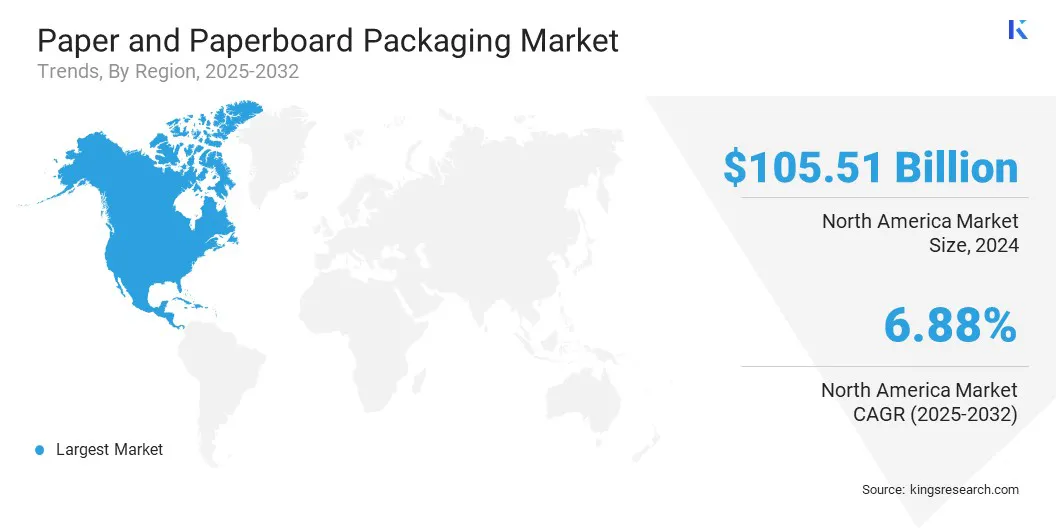
The North America paper and paperboard packaging market share stood at 28.12% in 2025 and is anticipated to grow at a CAGR of 6.88% over the forecast period. This growth is mainly propelled by strong demand for sustainable packaging solutions from the food and beverage, e-commerce, retail, and consumer goods sectors.
This rising demand is further boosted by high disposable incomes, expanding retail and e-commerce infrastructure, and increasing consumer preference for sustainable and recyclable packaging solutions. Additionally, rising environmental awareness and regulatory initiatives promoting eco-friendly packaging practices are further boosting the adoption of paper and paperboard materials across industries in North America.
The Europe paper and paperboard packaging industry is projected to grow at a CAGR of 5.49% over the forecast period. This growth is fostered by rapid urbanization, rising disposable incomes, expanding e-commerce and logistics activities, and stricter regulations on plastic packaging across the UK, Germany, France, and other European countries.
The surge in consumer awareness regarding sustainable and recyclable packaging solutions, along with government initiatives promoting eco-friendly materials, and the growing manufacturing base are contributing to higher adoption of durable, cost-effective paper and paperboard packaging.
Companies operating in the paper and paperboard packaging industry are investing heavily in research and development to create advanced packaging solutions that are more sustainable, lightweight, and compliant with global environmental regulations. They are focusing on innovations such as high-barrier paper structures, eco-friendly coatings, biodegradable inks, and higher recycled fiber content to improve performance while reducing environmental impact.
Additionally, players are incorporating digital and smart packaging technologies, including QR codes, digital watermarks, and NFC-enabled features into paperboard packaging to improve traceability, ensure regulatory compliance, increase operational efficiency, and boost consumer engagement.
Frequently Asked Questions

Ashim Lakhera is a market intelligence professional specializing in the Agriculture and Food & Beverage industry. His work focuses on emerging markets, competitive dynamics, industry trends, and the factors driving market growth and transformation. He has experience in market sizing, forecasting, strategic analysis, and industry research across food, FMCG, and life sciences. His research interests span the broader food and agriculture value chain, with a particular focus on how innovation, changing consumer behavior, sustainability priorities, and evolving production systems are influencing markets. He examines these developments to understand their impact on demand, competition, business models, and growth opportunities across the agri-food ecosystem. His work combines quantitative market analysis with an understanding of the broader industry forces shaping food and agriculture markets. He is particularly interested in the structural changes taking place across global food systems and how businesses are adapting to evolving consumer expectations, technological developments, and sustainability requirements.
Habi is a seasoned research and consulting leader with renowned experience in guiding clients on strategic growth and transformation initiatives across global markets. He has led high-performing research teams that deliver actionable insights on market expansion, M&A strategies, opportunity assessment, new business development, and product launches. His project portfolio spans large petrochemical producers, electronic device manufacturers, lubricants companies, and other leading enterprises across diverse industrial and consumer sectors. He currently heads the research department at Kings Research, where he is responsible for setting the research agenda, mentoring analysts, and ensuring client-ready deliverables that support executive decision-making. With extensive experience in market intelligence, strategic research, and consulting, Habi brings a strong understanding of evolving industry dynamics, competitive landscapes, emerging opportunities, and business growth challenges. His expertise includes developing research frameworks, translating complex market data into actionable strategic recommendations, and working closely with senior stakeholders to address critical business questions. He has also contributed to building research capabilities, strengthening analytical methodologies, and driving a culture of quality and insight-led decision-making within research teams. His cross-industry exposure enables him to connect market trends with broader business implications and provide perspectives that help organizations identify opportunities, mitigate risks, and make informed strategic decisions.