
Inquire Now
Key Strategic Points
The compostable packaging market focuses on the development, production, and sale of packaging materials that can decompose biologically into natural elements under composting conditions. These materials decompose over a certain period of time without leaving any toxic residues and are generally made from natural resources such as plant starches, cellulose or bioplastics. The market includes a wide range of applications such as food & beverage packaging, retail, healthcare and consumer products.
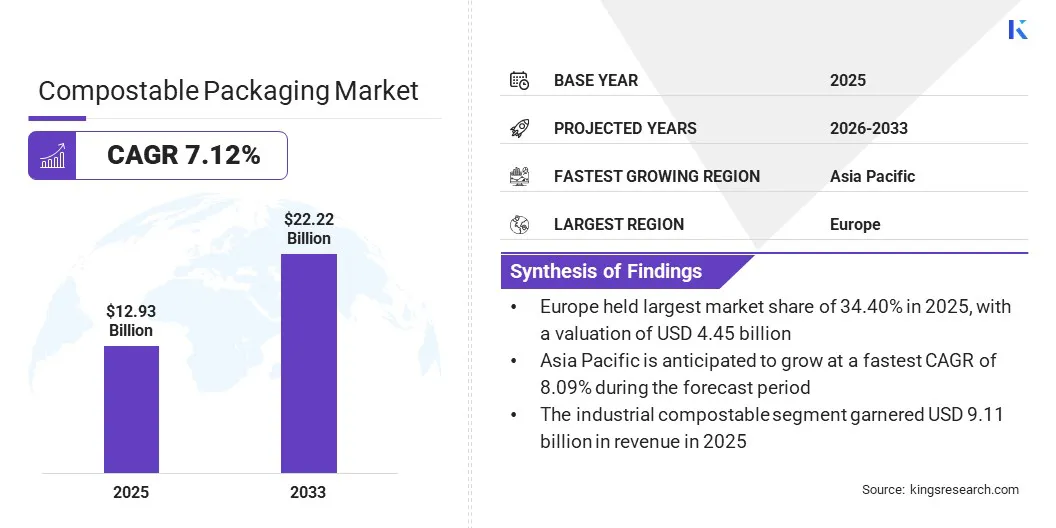
The global compostable packaging market size was valued at USD 12.93 billion in 2025 and is projected to grow from USD 13.73 billion in 2026 to USD 22.22 billion by 2033, exhibiting a CAGR of 7.12% during the forecast period. This growth reflects increasing demand for sustainable packaging solutions across various industries, driven by heightened environmental awareness and regulatory initiatives.
Major companies operating in the global compostable packaging market are Amcor plc, Mondi, WestRock Company, Sealed Air Corporation, Huhtamäki Oyj, Stora Enso, Futamura Group, TIPA LTD, BIOBAG, Vegware Ltd, SmartSolve, Genpak, noissue, BioPak, and Ecoware.
Technological development in bio-packaging materials and the increasing consumer preference for eco-friendly packaging are also driving the adoption of compostable packaging. The market is expected to grow significantly as more companies adopt sustainable packaging solutions, with compostable packaging serving as a key component of the sustainability revolution.
The shift in consumer preferences toward sustainability represents a key driver for the compostable packaging market. Increasing environmental awareness has led to a public consensus to prioritize products and packaging materials that factor in sustainable packaging and reduce ecological footprint. Consumers are increasingly considering sustainable packaging features in their purchasing decisions.
This shift is reinforced by consumer awareness, which is prompting a preference for compostable and biodegradable packaging solutions over conventional plastics. As a result, companies across various industries are being compelled to integrate sustainable packaging solutions into their product offerings to align with evolving consumer expectations and compete within the market.
One of the significant challenges with the compostable packaging market is the lack of adequate infrastructure for collecting, segregating, and treating compostable materials. In numerous areas, municipal waste management systems are not sufficiently designed to have compostable packaging sorted from conventional waste. Consequently, compostable materials are frequently disposed of in landfills, where they fail to decompose as intended.
To address this issue, companies are partnering with waste management services and are pursuing pilot projects focusing on the enhancement of composting facilities. Moreover, companies are educating people about waste disposal and promoting good labeling practices to improve waste segregation.
One of the most important trends in the compostable packaging market is the increased adoption of bio-based materials. Advances in material science have enabled the development of packaging derived from renewable sources such as corn starch, sugarcane, and cellulose. These materials offer performance characteristics similar to conventional plastics with the added advantages of being compostable under suitable conditions.
The diversification and expansion of bio-based polymers, such as polylactic acid (PLA) and polyhydroxyalkanoates (PHA), provide packaging manufacturers with new ways to broaden their portfolio of solutions that meet industry needs. Further, bio-based polymers are reducing reliance on fossil-based fuels and are contributing effectively in worldwide sustainability efforts.
|
Segmentation |
Details |
|
By Material |
PLA, PHA, Starch Blends, PBAT/PBS, Fiber-Based Materials, and Others |
|
By Packaging Format |
Flexible Packaging and Rigid Packaging |
|
By Compostability Type |
Industrial Compostable and Home Compostable |
|
By End-use Industry |
Food & Beverages, Hospitality, Healthcare & Pharmaceuticals, Personal Care & Cosmetics, Consumer Goods, E-commerce & Retail, Agriculture & Horticulture, and Others |
|
By Region |
North America: U.S., Canada, Mexico |
|
Europe: France, UK, Spain, Germany, Italy, Russia, Rest of Europe |
|
|
Asia-Pacific: China, Japan, India, Australia, ASEAN, South Korea, Rest of Asia-Pacific |
|
|
Middle East & Africa: Turkey, U.A.E., Saudi Arabia, South Africa, Rest of Middle East & Africa |
|
|
South America: Brazil, Argentina, Rest of South America |
Based on region, the global compostable packaging market has been classified into North America, Europe, Asia Pacific, Middle East & Africa, and South America.
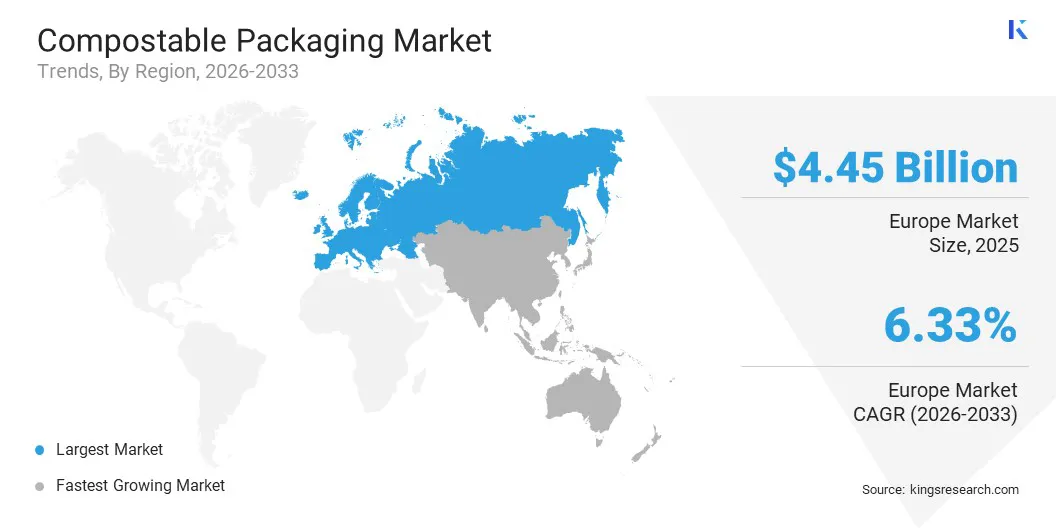
Europe's compostable packaging market share stood at 34.40% in 2025, valued at USD 4.45 billion. This strong position is supported by stringent environmental regulations, proactive policy measures, and the widespread adoption of sustainable packaging practices across member countries. European consumers exhibit high environmental awareness, leading to increased demand for compostable packaging in sectors such as food, retail, and personal care.
The region also benefits from robust investments in research and development, fostering innovation in new materials and packaging formats. Collaboration between governments, industry players, and research institutions continues to drive advancements, positioning Europe as a leader in the global transition toward sustainable packaging solutions.
The Asia Pacific compostable packaging market is set to grow at a CAGR of 8.09% over the forecast period, driven by rising environmental awareness and government initiatives to curb plastic waste. The fast-paced retail market, urbanization, and the growth of e-commerce have resulted in an increased need for sustainable packaging solutions in the region.
In response, manufacturers are adjusting their production capacities to increase their output and are creating innovative compostable solutions to meet different consumer needs. Industry associations and regulatory bodies also have an important role in promoting sustainability and market development. This sustainable momentum will push Asia Pacific to be a major contributor to the growth of the compostable packaging market.
The compostable packaging competitive landscape is characterized by rapid growth and emerging innovation driven by growing sustainability pressures and evolving regulations. Companies are innovating a range of new materials, such as cellulose films and biopolymer coatings that can deliver high-performance properties and certified compostability. The focus is growing on the requirements of domestic and industrial composting, together with solutions that provide high barrier properties for different applications.
Strategic partnerships, innovations, increasing R&D investments, and compliance with stringent environmental regulations are driving product development and market expansion. As consumers are focusing more on sustainability, manufacturers are creating a niche for themselves with technology advancement, certification success, and scalability of solutions that meet consumers’ environmental impact and functional packaging requirements.
Frequently Asked Questions

Aswathi holds cross-domain expertise, translating market trends and competitive intelligence into decision-ready insights. Her work helps clients interpret evolving market conditions and identify growth opportunities. She brings a focused, insight-led approach to research execution. She translates these findings into clear, prioritized action plans that align with client capabilities. Her research often includes scenario modeling to test growth strategies under varying economic conditions. She maintains a rigorous validation process, cross-checking primary and secondary sources to ensure reliability. Clients value her ability to synthesize noisy data into concise executive summaries that drive board-level discussions. Her sector-specific lens, combined with a pragmatic focus on execution, consistently delivers high-impact, commercially sound recommendations. Her structured yet flexible research frameworks adapt to client timelines without compromising depth. She is known for distilling complex trade-offs into straightforward, defensible positions that facilitate confident decision-making.
Habi is a seasoned research and consulting leader with renowned experience in guiding clients on strategic growth and transformation initiatives across global markets. He has led high-performing research teams that deliver actionable insights on market expansion, M&A strategies, opportunity assessment, new business development, and product launches. His project portfolio spans large petrochemical producers, electronic device manufacturers, lubricants companies, and other leading enterprises across diverse industrial and consumer sectors. He currently heads the research department at Kings Research, where he is responsible for setting the research agenda, mentoring analysts, and ensuring client-ready deliverables that support executive decision-making. With extensive experience in market intelligence, strategic research, and consulting, Habi brings a strong understanding of evolving industry dynamics, competitive landscapes, emerging opportunities, and business growth challenges. His expertise includes developing research frameworks, translating complex market data into actionable strategic recommendations, and working closely with senior stakeholders to address critical business questions. He has also contributed to building research capabilities, strengthening analytical methodologies, and driving a culture of quality and insight-led decision-making within research teams. His cross-industry exposure enables him to connect market trends with broader business implications and provide perspectives that help organizations identify opportunities, mitigate risks, and make informed strategic decisions.