
Inquire Now
Key Strategic Points
The market encompasses garments and accessories embedded with sensors, actuators, and electronic components that monitor physiological, environmental, or performance-related data. These products integrate textile engineering with advanced technologies to deliver functional capabilities such as biometric tracking, temperature regulation, posture correction, and interactive feedback.
The report includes segmentation by product type, technology, end use, and region. Smart clothing solutions are applied across healthcare, sports and fitness, military and defense, and consumer lifestyle segments to enhance user experience, support real-time monitoring, and enable data-driven insights in everyday and specialized applications.
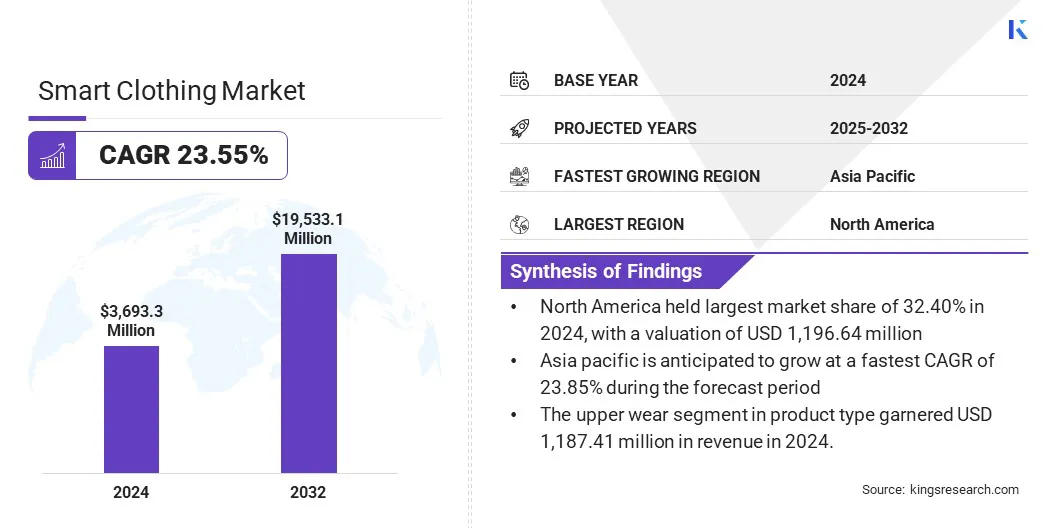
The global smart clothing market size was valued at USD 3,693.33 million in 2024 and is projected to grow from USD 4,450.16 million in 2025 to USD 19,533.17 million by 2032, exhibiting a CAGR of 23.55% over the forecast period.
This growth is driven by increasing adoption of smart apparel by hospitals, fitness centers, professional sports organizations, and consumers to enable continuous physiological monitoring, activity tracking, and performance optimization.
Major companies operating in the smart clothing market are AiQ Smart Clothing, DuPont, Myontec, Myzone, Owlet UK, Sensoria, Siren, TORAY INDUSTRIES, INC., Vulpes Electronics GmbH, Wearable X, Athos Therapeutics, Hexoskin, Under Armour, Inc., Hexoskin (Carré Technologies Inc.), and OMsignal Ltd.
Advancements in smart materials, textile-integrated sensing technologies, and the integration of AI-driven clothing systems are accelerating the development and adoption of flexible smart clothing capable of capturing complex body movements, posture, and biomechanical forces in real time
The demand for smart clothing is driven by the growing use of wearable health monitoring solutions by healthcare providers and consumers, along with increased focus on fitness, performance optimization, and preventive care among individuals. Adoption is further supported by employers deploying sensor-enabled garments to improve worker safety and ergonomics across industrial and occupational environments.
Additionally, advancements in textile-integrated sensors, AI-enabled analytics, and connected wearable platforms are enabling real-time health and activity monitoring, supporting adoption across healthcare, sports and fitness, military and defense, and consumer lifestyle segments.
The rising adoption of connected AI-enabled systems in clothing and apparels is expanding the market growth of smart clothing. Advancements in wearable sensors and real-time data analytics are enabling continuous health monitoring, performance tracking, and worker safety across healthcare, fitness, and industrial environments.
Additionally, the integration of smart clothing with digital platforms and IoT ecosystems further improves usability, scalability, and data-driven decision-making for consumers using smart clothing and apparel.
|
Segmentation |
Details |
|
By Product Type |
Upper Wear, Lower Wear, Inner Wear, Footwear, Others |
|
By Gender |
Male, Female, Unisex |
|
By Distribution Channel |
Online, Offline |
|
By End User |
Defense and Military, Sports and Fitness, Apparel & Fashion, Healthcare, Industrial, Others |
|
By Region |
North America: U.S., Canada, Mexico |
|
Europe: France, UK, Spain, Germany, Italy, Russia, Rest of Europe |
|
|
Asia-Pacific: China, Japan, India, Australia, ASEAN, South Korea, Rest of Asia-Pacific |
|
|
Middle East & Africa: Turkey, U.A.E., Saudi Arabia, South Africa, Rest of Middle East & Africa |
|
|
South America: Brazil, Argentina, Rest of South America |
The North America smart clothing market share stood at 32.40% in 2024, valued at USD 1,196.64 million. This dominant share of North America is attributed to the high adoption of wearable health and fitness monitoring solutions, strong consumer demand for connected apparel, and advanced digital health and IoT ecosystems primarily across the U.S. and Canada.
The dominant position of North America is attributed to the high adoption of wearable health and fitness monitoring solutions, robust consumer demand for connected and tech-integrated apparel in addition with a mature digital health and IoT ecosystem, particularly in the U.S. and Canada.
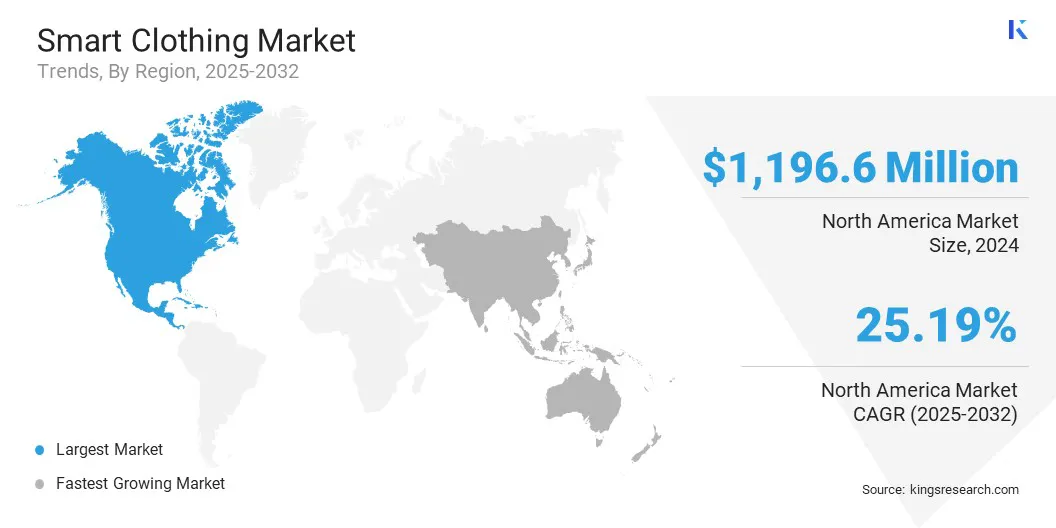
The Asia-Pacific smart clothing industry is set to grow at a CAGR of 23.85% over the forecast period. This growth is driven by rapid urbanization, increasing health awareness, and strong regional expertise in advanced textiles and electronics manufacturing.
In addition, government initiatives promoting digital health, smart wearables, and Industry 4.0 are accelerating the integration of technology into clothing and apparel across major economies such as China, Japan, South Korea, and India.
Major players operating in the smart clothing industry are undertaking extensive research and development initiatives, along with strategic partnerships and acquisitions, to expand their technological capabilities and business reach.
Companies are emphasizing integration of advanced digital technologies into conventional apparel designs, while ensuring washability and long-term wear durability. They are also focusing on real-time data capture and seamless connectivity with mobile applications and cloud-based analytics platforms to enhance user experience and drive broader adoption of smart clothing.
Frequently Asked Questions

Over the years, Versha brings over 15 years of experience managing consulting assignments across industries, including Food and Beverage, Consumer Goods, ICT, Aerospace, and more. Her work has spanned diverse sectors. Her cross-domain expertise and adaptability make her a versatile and dependable professional. She is known for her keen business insight and foresight. With sharp analytical skills and a curious mindset, Versha excels at transforming complex data into actionable insights. She has a proven track record of unraveling market dynamics, identifying trends, and delivering tailored solutions to meet client needs. As a skilled leader, Versha has successfully mentored research teams and directed projects with precision, ensuring high-quality outcomes. Her collaborative approach and strategic vision enable her to turn challenges into opportunities and consistently deliver impactful results. Whether analyzing markets, engaging stakeholders, or crafting strategies, Versha draws on her deep expertise and industry knowledge to drive innovation and deliver measurable value.

Ganapathy Subramaniam Suresh
With over a decade of research leadership across global markets, Ganapathy brings sharp judgment, strategic clarity, and deep industry expertise. Known for precision and an unwavering commitment to quality, he guides teams and clients with insights that consistently drive impactful business outcomes.



.webp&w=128&q=75&dpl=dpl_DPva2LrvfsBdTJm1XZj67UTrvMHL)