

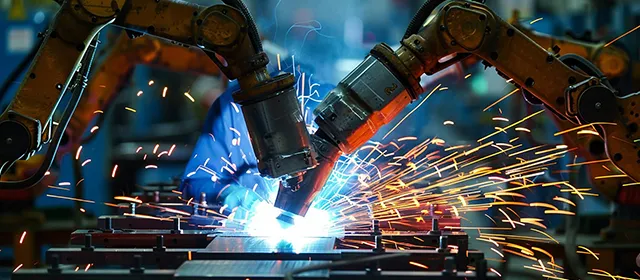
Robotic welding has entered a new phase of global expansion. What once began as a solution for high-volume automotive manufacturers has now evolved into a mainstream requirement across industries, geographies, and production scales. From the surge in electric vehicle (EV) manufacturing to the growth of mixed-model production lines, robotic welding has become a foundational technology in modern industrial automation. As per Kings Research, the global robotic welding market is set to generate a value of $20.78 billion by 2032.
Manufacturers worldwide are now integrating robotic welding systems to keep pace with global competition and to meet the heightened expectations for product quality and production consistency. The rapid increase in industrial robot installations reflects a deeper structural change taking place across global manufacturing, one where welding automation has become indispensable.
This blog examines how robotic welding is transforming industries worldwide, highlighting real-world developments and adoption trends.
The Global Surge in Welding Automation
The worldwide shift toward automation has set the stage for the explosive growth of robotic welding. Across all regions, North America, Europe, and Asia-Pacific, manufacturers are embracing welding robots to meet the demand for higher precision, repeatability, and speed. This movement is strongly supported by the significant rise in industrial robot deployments across global factories.
By the end of 2023, there were approximately 4,281,585 industrial robots operating worldwide, representing one of the most significant expansions of automation in industrial history (Source: https://www.therobotreport.com/). This massive installed base underscores how deeply integrated robotics has become across essential operations such as welding, assembly, cutting, and material handling. The increasing dependence on robotics is not confined to large manufacturers alone. Small and mid-sized fabricators are also investing in robotic welding solutions due to the growing affordability of cobots, modular welding cells, and simplified programming environments.
In regions such as East Asia, the acceleration is even more dramatic. Manufacturers in China, South Korea, and Japan continue to dominate robot adoption, with welding cells forming a critical component of automotive and electronics production lines.
Europe, meanwhile, is expanding its use of welding automation across machinery, metals, rail, aerospace, and energy infrastructure. The United States is also experiencing a notable rise in welding automation, driven by reshoring initiatives, workforce shortages, and growing capital investments across manufacturing sectors.
Rising Robot Density and Its Influence on Welding Operations
One of the clearest indicators of global automation advancement is robot density—the number of robots operating per 10,000 manufacturing workers. The rapid increase in this metric reflects not only the global scale of automation but also the increasing reliance on robotic welding to manage complex or repetitive processes.
According to the International Federation of Robotics (IFR), global average robot density reached 162 robots per 10,000 employees in 2023, doubling from about 74 robots per 10,000 employees in 2016 (Source: ifr.org). This growth highlights how manufacturers across multiple regions have shifted from traditional manual welding to automated systems capable of handling high-precision tasks at industrial speed. As factories become more digitized, the integration of robotic welding is no longer considered a premium investment but rather a necessity for meeting modern production demands.
This doubling of robot density also aligns with the rise in mixed-model production and the requirement for manufacturers to maintain flexibility while managing a wider variety of product types. Welding robots now support everything from low-volume custom fabrication to high-volume EV component production, reinforcing their expanding role in global manufacturing.
Automotive and EV Manufacturing: The Epicenter of Robotic Welding Growth
The automotive sector continues to be the single largest adopter of robotic welding. Robotic welding systems are now central to vehicle body fabrication, exhaust assembly, structural welding, battery enclosure joining, and the high-strength steel operations needed for vehicle safety.
In the United States, adoption trends clearly indicate the strength of demand. IFR data shows that 44,303 industrial robots were installed in U.S. manufacturing in 2023, reflecting a 12% annual increase.
Among these, 14,678 robots were installed in the automotive sector alone, representing nearly one-third of the total installations in U.S. factories (Source: ifr.org). Globally, automotive manufacturers remain the biggest users of industrial robots, driven by the push toward EV production, lightweight material welding, and high-speed body-in-white automation.
EVs, in particular, are reshaping welding requirements. Battery pack structures, aluminum components, and lightweight frames require advanced welding methods such as laser welding, hybrid welding, and high-precision MIG systems, all of which benefit significantly from automation. Major automotive and EV manufacturers across Europe and Asia-Pacific have expanded their automated welding lines to maintain consistency across thousands of weld points per vehicle while meeting strict safety and durability standards.
Labor Shortages and Safety Regulations Accelerating Adoption
Worldwide labor shortages, especially among skilled welders, have significantly influenced the rise of welding automation. Many countries are experiencing an aging workforce, limited availability of skilled welders, and increased production pressure. As a result, robotic welding is filling critical gaps by performing tasks that are difficult, hazardous, or increasingly hard to staff.
According to NIOSH (CDC), the number of industrial robots in U.S. factories rose by 10% in 2022, driven largely by worker shortages and the need to prevent injuries associated with high-heat welding and repetitive tasks. The CDC also highlights that robots are increasingly used to perform “dangerous or repetitive tasks,” reducing worker exposure to harmful fumes, burns, and repetitive motion strain. (Source: www.cdc.gov)
These safety-driven shifts are especially important in regions where workplace safety regulations have become more stringent. Europe has intensified its focus on occupational safety standards, prompting manufacturers to transition hazardous welding processes to robotic systems. In Asia, where high-volume industrial hubs operate continuously, 24/7 robotic welding ensures both productivity and worker safety while reducing operational fatigue.
Round-the-Clock Production and the Economics of Continuous Welding
One of the most compelling global trends in robotic welding is the move toward continuous operation. As manufacturing demands grow, companies are increasingly turning to automation to run production lines without interruption. Robotic welding systems can operate 24 hours a day, ensuring consistent output, lower defect rates, and improved cost efficiency over long durations.
Reports from Robotics & Automation News and The Robot Report emphasize that manufacturers adopting robotic welding benefit significantly from the ability to maintain uninterrupted production cycles. This capability is particularly crucial in industries where downtime can result in substantial financial losses, such as automotive, shipbuilding, heavy machinery, and energy.
Continuous robotic welding also plays a major role in addressing global supply chain pressures. As demand for faster lead times grows, manufacturers across North America, Europe, and Asia-Pacific rely on automated welding to maintain competitiveness without compromising quality.
Advancements in Robotic Welding Technologies Across Global Factories
The global spread of robotic welding is supported by rapid advancements in technology. AI-driven welding path optimization, real-time quality monitoring, and multimodal sensing have transformed how welding robots respond to complex manufacturing environments.
In Asia, manufacturers are investing heavily in AI-based welding robots that can adapt to variations in material thickness, reduce porosity, and ensure uniform penetration. European factories are deploying laser welding robots for aerospace components, precision machinery, and lightweight aluminum structures. In the U.S., the rise of collaborative welding robots (cobot welders) is reshaping small and mid-sized fabrication shops by offering safer, more flexible, and easily programmable welding automation solutions.
Digitalization also plays a major role in this evolution. Modern welding robots integrate with digital twins, MES systems, and IoT platforms, enabling predictive maintenance, remote diagnostics, and automated quality checks. These advancements support a global shift toward smart factories where robotic welding becomes seamlessly integrated into broader production ecosystems.
Adoption Trends Across Major Industries Worldwide
Robotic welding is spreading beyond automotive and heavy manufacturing into sectors such as construction, agriculture, healthcare, renewable energy, oil and gas, and consumer appliances. In Europe, robotic welding cells are increasingly used for wind turbine components, powertrain systems, and railway structures. Asia-Pacific has seen rapid adoption in shipbuilding, electronics welding, and industrial machinery. North America continues to expand automation in agricultural equipment, metal furniture, and material handling system fabrication.
This cross-industry adoption is driven by the global need for consistent quality, lower production defects, and the ability to meet customized orders without compromising speed. Manufacturers now expect welding robots to handle diverse materials, complex assemblies, and smaller lot sizes, capabilities supported by modern multi-axis robotic arms and advanced seam-tracking technologies.
Challenges Slowing Adoption in Some Markets
Despite its worldwide growth, certain markets still face challenges in fully adopting robotic welding. High initial investment remains a barrier for smaller manufacturers, particularly in developing regions. Skilled automation engineers are still in short supply, slowing the integration process for factories that lack internal expertise. Additionally, industries dealing with highly custom products or inconsistent part positioning may hesitate to adopt robotic welding due to the complexity of programming and fixture design.
However, these barriers are steadily diminishing as technology becomes more affordable, programming becomes easier, and cobot welders gain traction among small and medium enterprises.
The Global Future of Robotic Welding
The next decade will see robotic welding become even more intelligent, autonomous, and accessible. Global manufacturers are moving toward fully automated welding cells capable of self-adjusting parameters, identifying defects in real time, and optimizing weld paths with minimal human intervention. AI-driven weld monitoring systems will continue to reduce rework and improve consistency across high-precision applications.
The rapid expansion of EV and battery manufacturing will further elevate demand for robotic welding worldwide, particularly for aluminum structures and critical safety components. At the same time, digital manufacturing initiatives across Europe, the United States, and APAC will accelerate the adoption of robotic welding within smart factories built on real-time data and advanced automation technologies.
As nations invest in large-scale infrastructure, renewable energy, heavy machinery, and defense equipment, robotic welding will remain a core technology enabling quality, efficiency, and long-term reliability.
Conclusion
Robotic welding is experiencing one of the most significant global expansions of any manufacturing technology. With rapidly increasing robot density and strong adoption across automotive, EV, metal fabrication, aerospace, and industrial machinery, the welding automation landscape is undergoing a transformative shift.
Manufacturers across every major industrial region are embracing robotic welding to cope with labor shortages, enhance safety, accelerate production, and maintain the consistency required by modern global supply chains. As technological advancements continue and the costs of automation become more accessible, robotic welding will play an even more central role in shaping the factories of the future.