
Inquire Now
Key Strategic Points
The market involves analytical methods and tools designed to measure cellular and biochemical metabolic activities. This enables the quantification of processes such as energy production, nutrient utilization, mitochondrial function, and metabolite generation.
Metabolism assays evaluate dynamic metabolic interactions and convert biochemical changes into measurable optical, fluorescent, luminescent, or electrochemical signals for precise and real-time analysis. They play a vital role in advancing drug discovery, disease modeling, cell health assessment, and functional genomics across biotechnology, clinical studies, and pharmaceutical research.
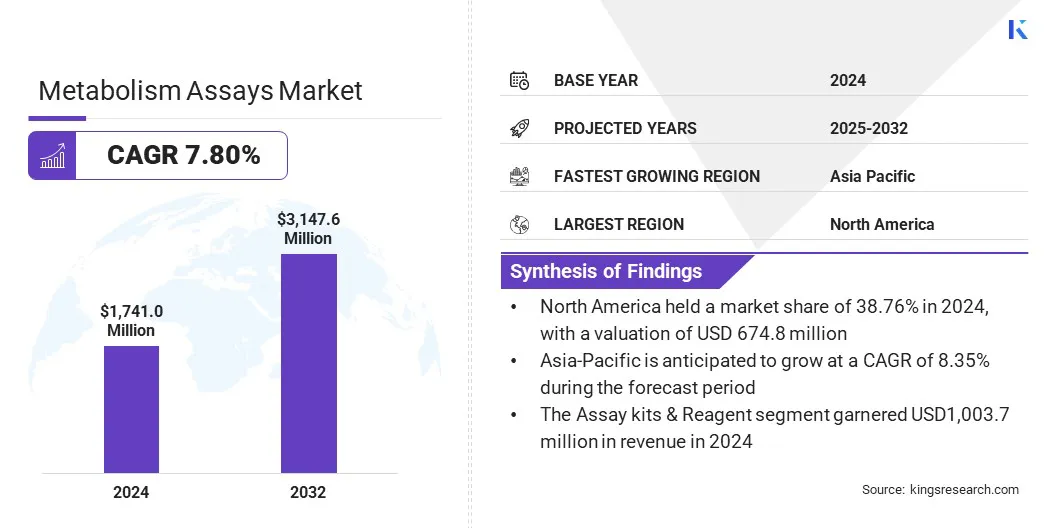
The global metabolism assays market size was valued at USD 1,741.0 million in 2024 and is projected to grow from USD 1,860.9 million in 2025 to USD 3,147.6 million by 2032, exhibiting a CAGR of 7.80% over the forecast period.
The market is expanding due to the rising demand for advanced tools that measure cellular energy pathways, mitochondrial activity, and metabolic health. The market growth is supported by increased drug discovery workflows, broader use of cell-based assays in academic and industrial research, and rapid adoption of high-throughput analytical technologies across research settings.
Major companies operating in the metabolism assays market are Agilent Technologies, Inc., Thermo Fisher Scientific Inc., DH Life Sciences, LLC., Bruker, Shimadzu Corporation, PerkinElmer, LECO Corporation, Merck KGaA, Promega Corporation, Abcam Limited, Bio-Rad Laboratories, Inc., Cayman Chemical, Enzo Biochem Inc., Human Metabolome Technologies, and Sartorius AG.
Market growth in the metabolism assay sector is driven by the growing focus on mitochondrial dysfunction research, as abnormalities in mitochondrial activity are increasingly linked to neurodegenerative, metabolic, and rare diseases. This rising scientific emphasis is creating strong demand for highly sensitive assays that measure oxidative phosphorylation, ATP production, glycolytic shifts, and cellular stress responses.
Leading players are increasing R&D efforts to develop next-generation mitochondrial assay platforms, thereby enhancing real-time metabolic analyzers and expanding high-content screening capabilities.
A key factor driving the growth of the metabolism assays market is the rising demand for advanced cell-based analysis in drug discovery. Pharmaceutical developers are increasingly prioritizing real-time evaluation of metabolic pathways to better understand compound efficacy, toxicity, and mechanism of action.
This shift is driven by the growing complexity of therapeutic pipelines, where early identification of metabolic dysfunction reduces late-stage failures and accelerates candidate selection. Research teams across biotechnology firms, pharmaceutical companies, and academic laboratories are adopting metabolism assays to monitor parameters such as mitochondrial activity, glycolysis rates, and ATP production.
The expanding reliance on precise metabolic profiling is strengthening the use of high-content, high-throughput assay platforms, supporting more accurate decision-making and enhancing overall drug development efficiency.
A key challenge restraining the growth of the metabolism assays market is the high cost and technical complexity of advanced assay platforms and instrumentation. Developing, manufacturing, and maintaining high-performance metabolic analyzers, 3D cell culture systems, and organoid-compatible assays requires substantial investment.
In addition, the need for skilled personnel and robust data analysis capabilities further increases overall operational expenses. These factors may limit adoption, particularly among smaller research laboratories, academic institutions, and emerging markets.
To address this challenge, market players are focusing on developing cost-effective, user-friendly, and scalable assay kits and instruments, providing training and technical support programs, and forming strategic partnerships to enhance accessibility and drive broader adoption across pharmaceutical, biotechnology, and academic research settings.
A key trend influencing the metabolism assays market is the accelerating shift toward 3D cell culture and organoid-based analytical systems. Research teams and pharmaceutical developers are increasingly adopting these advanced models to replicate human tissue architecture and capture metabolic activity with greater accuracy.
Organoid-based assays enable more realistic evaluation of mitochondrial function, nutrient utilization, and drug-induced metabolic changes compared to traditional 2D cultures. These improvements strengthen predictive insights, reduce translational gaps, and support more effective screening and toxicity assessment across drug discovery and preclinical research, thereby driving market demand.
|
Segmentation |
Details |
|
By Product |
Assay Kits & Reagents, Instruments & Analyzers, Software & Services |
|
By Technology |
Colorimetry, Fluorimetry, Spectrometry, Others |
|
By Application |
Diagnostics, Research |
|
By End-User |
Hospitals, Diagnostic Laboratories, Pharma & Biotech Companies & CROs |
|
By Region |
North America: U.S., Canada, Mexico |
|
Europe: France, UK, Spain, Germany, Italy, Russia, Rest of Europe |
|
|
Asia-Pacific: China, Japan, India, Australia, ASEAN, South Korea, Rest of Asia-Pacific |
|
|
Middle East & Africa: Turkey, U.A.E., Saudi Arabia, South Africa, Rest of Middle East & Africa |
|
|
South America: Brazil, Argentina, Rest of South America |
Based on region, the global metabolism assays market has been classified into North America, Europe, Asia Pacific, Middle East & Africa, and South America.
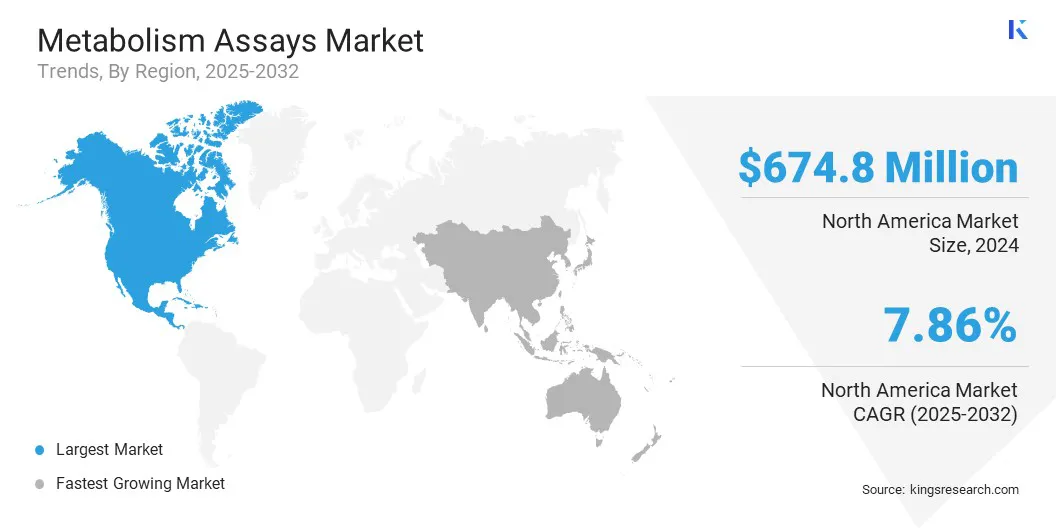
The North America metabolism assays market accounted for approximately 38.76 percent of the global market in 2024, with a valuation of USD 674.8 million. This dominance is driven by the region’s strong concentration of pharmaceutical and biotechnology companies and a high volume of drug discovery and biomedical research activities.
The region’s growth is further driven by investments in personalized medicine, functional genomics, and 3D organoid-based cell culture models. Rising prevalence of metabolic and neurodegenerative diseases, including diabetes, obesity, and Alzheimer’s disease, is increasing demand for high-throughput and sensitive metabolic assays in drug discovery and disease modeling. This trend is contributing to sustained market demand across the region.
Asia-Pacific is poised for significant growth at a robust CAGR of 8.35% over the forecast period, driven by expanding biotechnology and pharmaceutical research, increasing government support for life sciences, and rising investments in advanced laboratory infrastructure.
Countries such as China, India, Japan, and South Korea are adopting high-throughput and real-time metabolic assay platforms across academic, clinical, and industrial research environments to support drug discovery and disease research.
Research institutions and pharmaceutical companies in the region are increasingly focusing on translational research aligned with local population needs. Moreover, the rising incidence of lifestyle-related metabolic disorders is increasing demand for metabolic assays, supporting sustained market growth across Asia-Pacific.
Leading players in the metabolism assays industry are emphasizing technological innovation, portfolio expansion, and strategic collaborations to address growing demand for high-sensitivity, real-time metabolic analysis.
Companies are launching advanced platforms, including 4D-metabolomics mass spectrometers, XF analyzers, and organoid-compatible assay kits, to improve accuracy, throughput, and physiological relevance. These companies are conducting validation studies, pilot programs, and application testing to demonstrate performance, reliability, and reproducibility, facilitating regulatory acceptance and adoption in pharmaceutical, biotech, and academic research.
Frequently Asked Questions

Swati is a committed research analyst with a passion for optimizing systems and processes across industries, specializing in healthcare but also bringing valuable expertise to sectors such as consumer goods, life sciences, and more. Her cross-domain research approach allows her to generate clear, actionable reports that inform strategic decisions in a variety of fields. Swati is committed to staying ahead of evolving trends, leveraging her broad understanding of different sectors to provide insights that are relevant to a range of industries. In her personal time, she enjoys music and spending quality time with her family, which inspires her creativity and enriches her professional approach. Her systematic methodology ensures that every report is both thorough and practical. Swati's ability to bridge regulatory frameworks with market realities gives her recommendations a distinct edge. She collaborates seamlessly with cross-functional teams, distilling complex data into straightforward narratives. Her proactive monitoring of policy and technological shifts keeps her analysis forward-looking.

With over a decade of research leadership across global markets, Ganapathy brings sharp judgment, strategic clarity, and deep industry expertise. Known for precision and an unwavering commitment to quality, he guides teams and clients with insights that consistently drive impactful business outcomes.