
Inquire Now
Key Strategic Points
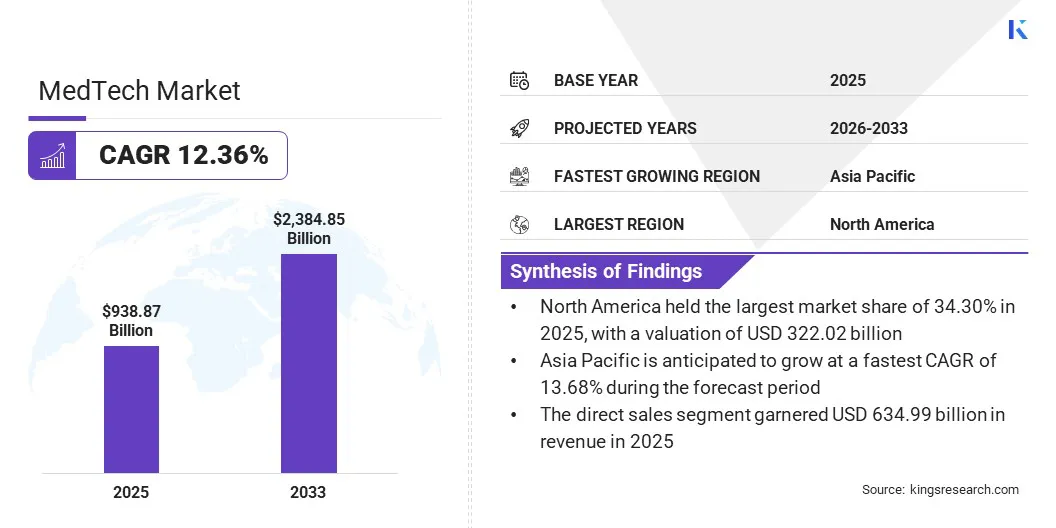
The global medtech industry size was valued at USD 938.87 billion in 2025 and is projected to reach USD 2,384.85 billion by 2033, exhibiting a CAGR of 12.36% during the forecast period. This growth is driven by advancements in medical technology, an increase in healthcare expenditures, rising prevalence of chronic diseases, and adoption of digital health solutions worldwide.
Major companies operating in the global medtech market are Medtronic, Johnson & Johnson, Abbott, Medline, Siemens Healthineers AG, Stryker, Becton, Dickinson and Company (BD), GE Healthcare, Baxter International Inc., Boston Scientific, B.Braun SE, Koninklijke Philips NV, Olympus Corp., OMRON Corp., and Roche Diagnostics.
Additionally, supportive government policies and investment in healthcare infrastructure are accelerating market expansion. The integration of artificial intelligence and robotics is further transforming diagnostics and treatment workflows, while ongoing innovation continues to enhance patient outcomes and operational efficiency across healthcare systems.
The worldwide prevalence of non-communicable diseases (NCDs) such as cardiovascular disease, cancer, chronic respiratory disease, and diabetes remains a fundamental driver of the global medtech industry. In September 2025, the World Health Organization stated that 75% of all people died from non-communicable diseases in 2021, underscoring the scale of the global disease burden that healthcare systems must address.
This widespread and sustained burden is prompting simultaneous investment in medical technologies across both mature and emerging markets. These investments range from advanced diagnostic imaging and cardiac devices in developed nations to essential screening and monitoring equipment in resource-constrained settings. NCDs affect populations across every region and income level, resulting in consistent global demand for diagnostics, therapeutics, monitoring devices, and preventive care technologies.
Despite international harmonization efforts, significant disparities persist between major regulatory bodies like the U.S. FDA, the EU’s MDR, and authorities in Asia-Pacific and Latin America. Variations in clinical evidence requirements, approval timelines, and post-market surveillance force manufacturers to develop separate compliance strategies for each market, raising complexity and costs. This patchwork of regulations can slow product launches, impede global market access, and disproportionately impact smaller companies.
To address this challenge, companies are investing in specialized regulatory affairs teams and leveraging local regulatory expertise in each target market. Industry players are also participating in global harmonization initiatives and forming strategic partnerships to streamline compliance and accelerate product approvals across regions.
The adoption of artificial intelligence across diagnostic and imaging applications is emerging as the most influential trend in the global medtech industry. Manufacturers are embedding machine learning capabilities directly into diagnostic devices to assist clinicians in identifying abnormalities, prioritizing urgent cases, and reducing diagnostic variability across practitioners and regions.
This momentum is being reinforced by regulatory bodies in multiple countries establishing dedicated approval pathways for AI-based software as a medical device. As healthcare systems across both developed and emerging markets face growing patient volumes alongside limited specialist availability, AI-assisted diagnostics are positioned as a central tool for improving efficiency and diagnostic accuracy on a global scale.
|
Segmentation |
Details |
|
By Product Type |
Medical Devices, Digital Health & Healthcare IT, and Healthcare Robotics |
|
By Distribution Channel |
Direct Sales and Indirect Sales |
|
By Region |
North America: U.S., Canada, Mexico |
|
Europe: France, UK, Spain, Germany, Italy, Russia, Rest of Europe |
|
|
Asia-Pacific: China, Japan, India, Australia, ASEAN, South Korea, Rest of Asia-Pacific |
|
|
Middle East & Africa: Turkey, U.A.E., Saudi Arabia, South Africa, Rest of Middle East & Africa |
|
|
South America: Brazil, Argentina, Rest of South America |
Based on region, the global medtech market has been classified into North America, Europe, Asia Pacific, Middle East & Africa, and South America.
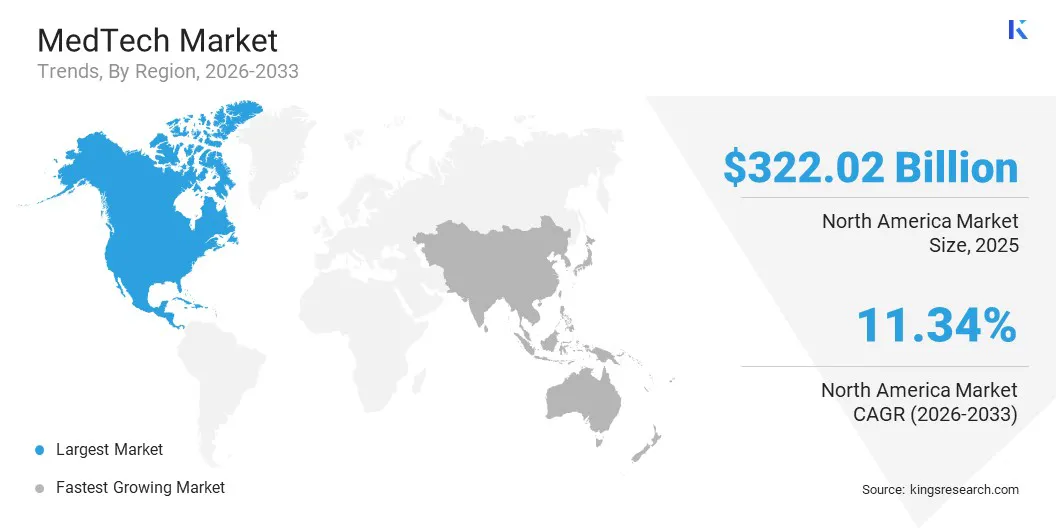
The North America market share stood at around 34.30% in 2025, valued at USD 322.02 billion. The dominant share is supported by a mature healthcare infrastructure, technological innovations, and significant investments in research and development across the region. The region benefits from well-established public and private reimbursement systems, which help accelerate the adoption of new medical technologies.
Strong institutional research capacity, extensive collaboration between academic medical centers and industry, and a robust venture capital ecosystem continue to fuel product innovation and commercialization. Canada complements this position through steady public healthcare investment and growing adoption of digital health tools, reinforcing the region's status as the largest revenue-generating medtech market globally.
The Asia Pacific medtech industry is set to grow at a 13.68% CAGR over the forecast period, driven by an aging population, expanding healthcare infrastructure, and rising disposable incomes across regions. This demographic shift is prompting governments to increase public healthcare expenditure and expand national health insurance schemes, improving medical technology access across both urban and rural settings. The region has also emerged as a major manufacturing hub, with countries like China and India scaling domestic device production to reduce import dependence. Rapid urbanization and a growing base of private healthcare providers further support the region's accelerated market expansion.
The global medtech market is moderately consolidated, comprising both leading international corporations and specialized regional companies that compete across a diverse array of product categories. Leading companies maintain strong positions through extensive product portfolios, global distribution networks, and continuous investment in research and development. These companies compete based on technological innovation, regulatory approvals, and strategic partnerships with healthcare providers.
Mergers, acquisitions, and collaborations remain common strategies for expanding therapeutic coverage and entering emerging markets. Meanwhile, smaller and mid-sized companies are carving out niches in specialized segments such as digital health, minimally invasive devices, and AI-enabled diagnostics, increasing competition and accelerating the pace of innovation across the industry.
Frequently Asked Questions

Aswathi holds cross-domain expertise, translating market trends and competitive intelligence into decision-ready insights. Her work helps clients interpret evolving market conditions and identify growth opportunities. She brings a focused, insight-led approach to research execution. She translates these findings into clear, prioritized action plans that align with client capabilities. Her research often includes scenario modeling to test growth strategies under varying economic conditions. She maintains a rigorous validation process, cross-checking primary and secondary sources to ensure reliability. Clients value her ability to synthesize noisy data into concise executive summaries that drive board-level discussions. Her sector-specific lens, combined with a pragmatic focus on execution, consistently delivers high-impact, commercially sound recommendations. Her structured yet flexible research frameworks adapt to client timelines without compromising depth. She is known for distilling complex trade-offs into straightforward, defensible positions that facilitate confident decision-making.
With many years of consulting experience across global pharma, biotech, and MedTech markets, Minaz brings deep domain expertise, strategic clarity, and analytical rigor to every engagement. She has led 130+ consulting assignments spanning market entry, competitive landscaping, and portfolio prioritization, helping clients navigate complex, high-stakes decisions with confidence. Known for her ability to synthesize primary and secondary research into executive-ready recommendations, Minaz has built forecasting models and market sizing frameworks that have informed multi-million dollar investment decisions in oncology, diagnostics, and peptide therapeutics. Beyond her analytical strength, Minaz is a trusted client partner, translating complex datasets into clear, actionable insights for senior stakeholders. She currently leads a team of research analysts, driving business expansion, and shaping client engagement strategy.