
Inquire Now
Key Strategic Points
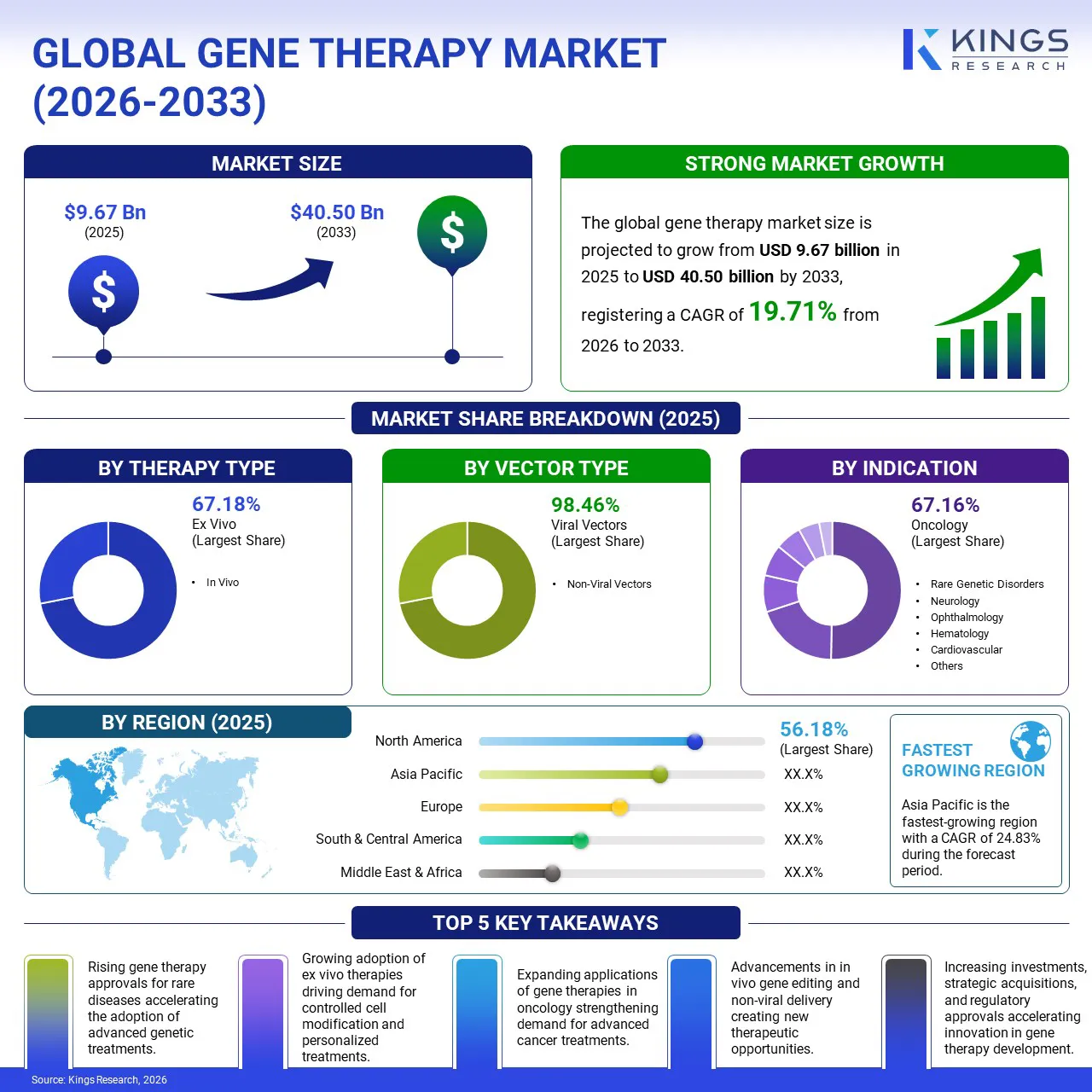
According to Kings Research, the global gene therapy market size was USD 9.67 billion in 2025 and is projected to grow from USD 11.50 billion in 2026 to USD 40.50 billion by the end of 2033, exhibiting a CAGR of 19.71% during the forecast period (2026-2033).
The gene therapy market is primarily driven by increasing investments in research and development, a growing pipeline of gene-based treatments, rising prevalence of rare genetic and chronic diseases, and advancements in gene-editing and delivery technologies. Market growth is further supported by evolving regulatory approvals, expanding treatment indications, improved access to innovative therapies, and the adoption of one-time, potentially curative treatment approaches. Wider use of chimeric antigen receptor T-cell (CAR-T) therapies in blood cancers is expanding the commercially addressable patient base.
The evolution of the gene therapy industry toward in vivo editing, non-viral delivery, and individualized treatments is transforming development and deployment of therapies. Large pharmaceutical companies are acquiring specialist developers, while regulators are introducing faster pathways for therapies that target rare conditions with a known genetic cause. Established commercial adoption of CAR-T therapies for blood cancers and gene therapies for inherited blood disorders acts as a critical driver of ex vivo adoption in the overall gene therapy market.
Gene therapies replace or modify genetic material within a patient's cells to correct or compensate for underlying genetic defects. They are predominantly administered as one-time interventions, alongside an emerging subset of repeat-dosing modalities; these therapies offer the potential for durable clinical benefits, reducing or eliminating the need for lifelong treatment and addressing conditions with limited or no existing therapeutic options.
Rare genetic disorders represent a key target segment for the gene therapy market, as their well-defined genetic causes provide opportunities for targeted gene replacement and genome editing approaches. Furthermore, increasing regulatory approvals and the commercialization of novel gene therapy products are expanding market opportunities, strengthening investor confidence, and supporting the growth of the industry's development pipeline.
According to the Alliance for Regenerative Medicine (ARM) March 2026 report, 10 gene therapies for rare diseases were approved in the U.S. from 2023 to 2025, compared with 5, between 2017 and 2022. This doubling of approvals reflects a maturing regulatory pathway and a growing base of commercial products. Recent regulatory approvals have expanded the eligible patient populations for existing gene therapies.
In November 2025, Novartis Pharmaceutical Corporation (Novartis AG) received U.S. Food and Drug Administration (FDA) approval for Itvisma, a gene replacement therapy for children two years and older, teens, and adults with spinal muscular atrophy (SMA), given as a one-time fixed intrathecal dose that does not need to be adjusted based on patient age or body weight. The approval extends gene therapy to older SMA patients who were not eligible for earlier treatment options.
The high upfront cost of gene therapies, driven by one-time administration and complex manufacturing requirements, poses a significant restraint. Reimbursement challenges require payers to absorb substantial upfront treatment costs despite the potential for long-term clinical benefits. This creates budget pressure for public and private insurers, especially Medicaid programs, and leads to long coverage reviews, prior authorization requirements, and limited access.
In July 2025, the U.S. Department of Health and Human Services (HHS) announced that 33 states, the District of Columbia, and Puerto Rico were participating in the Cell and Gene Therapy Access Model, under which CMS negotiated outcomes-based agreements with manufacturers that provide guaranteed discounts and rebates if therapies do not deliver their promised benefits. This shows how payers are adapting reimbursement to high upfront costs, although budget pressure remains significant. To address the challenge, manufacturers are testing new pricing and access approaches.
In April 2026, Regeneron Pharmaceuticals, Inc. received FDA accelerated approval for Otarmeni, the first in vivo gene therapy for genetic hearing loss caused by OTOF variants. Regeneron provides Otarmeni at no cost to clinically eligible patients in the U.S.
In vivo gene editing delivers editing tools directly into the body, often to the liver using lipid nanoparticles (LNPs), rather than modifying cells outside the body. This approach avoids the complex cell collection and manufacturing steps of ex vivo therapies and is anticipated to make treatment simpler and affordable. The emergence of individualized therapies, designed for very small groups of patients with a specific mutation, is further creating market development opportunities. Evolving regulatory frameworks that recognize strong biological rationale alongside clinical evidence are further positioned to improve the commercial viability of these therapies and facilitate broader market adoption.
In February 2026, the U.S. Food and Drug Administration (FDA) issued draft guidance titled "Considerations for the use of the Plausible Mechanism Framework to Develop Individualized Therapies that Target Specific Genetic Conditions with Known Biological Cause." The guidance describes how developers can generate evidence of effectiveness, safety, and manufacturing quality for such therapies, opening a path to approval for treatments that are unlikely to suit large clinical trials. Clinical results from in vivo editing programs show the potential of this approach beyond rare diseases.
In June 2025, CRISPR Therapeutics AG reported Phase 1 data for CTX310, an in vivo CRISPR/Cas9 therapy delivered by lipid nanoparticles to the liver, exhibiting peak reductions of up to 82% in triglycerides and up to 86% in low-density lipoprotein (LDL) at the highest dose tested. These results point to future use of gene editing in common cardiovascular conditions, which would greatly expand the addressable patient population.
|
Segmentation |
Details |
|
|
By Therapy Type |
Ex Vivo and In Vivo |
|
|
By Vector Type |
Viral Vectors (Adeno-Associated Virus (AAV), Lentivirus, Adenovirus, Retrovirus & γ-Retrovirus, and Other Viral) and Non-Viral Vectors |
|
|
By Indication |
Oncology, Rare Genetic Disorders, Neurology, Ophthalmology, Hematology, Cardiovascular, and Others |
|
|
By Delivery Method |
Systemic and Localized |
|
|
By End User |
Hospitals & Specialty Clinics, Academic & Research Institutes, and Others |
|
|
By Region |
North America |
U.S., Canada, and Mexico |
|
Europe |
France, UK, Spain, Germany, Italy, Russia, and Rest of Europe |
|
|
Asia Pacific |
China, Japan, India, Australia, ASEAN, South Korea, and Rest of Asia Pacific |
|
|
Middle East & Africa |
Turkey, U.A.E., Saudi Arabia, South Africa, and Rest of Middle East & Africa |
|
|
South & Central America |
Brazil, Argentina, and Rest of South & Central America |
|
The ex vivo segment held the majority share of 67.18% in 2025. This is attributed to the ability of ex vivo gene therapy to modify patient cells outside the body, allowing cell modification and quality assessment before administration, rigorous pre-infusion quality screening, and a more predictable safety profile with lower immune risks. Furthermore, its transformative clinical success in high-demand areas such as cancer immunotherapy and inherited blood disorders (using hematopoietic stem cells) further contributes to its market position.
In December 2025, Fondazione Telethon ETS received FDA approval for Waskyra (etuvetidigene autotemcel), which is an ex vivo gene therapy for pediatric and adult patients with Wiskott-Aldrich syndrome (WAS). The approval follows a positive opinion from the European Medicines Agency (EMA), marking a significant advancement in the treatment of this rare genetic immunodeficiency, particularly for patients lacking a suitable HLA-matched related stem cell donor.
The neurology segment is expected to register a CAGR of 24.63% during the forecast period. This growth is driven by developments in next-generation DNA sequencing, CRISPR/Cas9 gene-editing technology, antisense oligonucleotides, and adeno-associated viral vectors, fostering translation of genetic discoveries into clinical applications.
Furthermore, ongoing investigations into various neurological disorders demonstrate the expanding therapeutic potential of gene-based interventions. Advancements in delivery methods, including intrathecal injection and direct delivery into the brain, enable therapies to reach target cells effectively in the central nervous system, thereby creating market development avenues in the forthcoming years.
In September 2026, Ultragenyx Pharmaceutical Inc. received FDA approval for FAYUVI (rebisufligene etisparvovec-hopf), an AAV9-based gene therapy for treating Sanfilippo Syndrome Type A (MPS IIIA). This marks the company's second gene therapy approval and represents a significant development in the rare disease gene therapy market, supporting market expansion and commercialization.
The oncology segment held the largest share of 67.16% in 2025, supported by the wide use of CAR-T therapies in multiple myeloma, lymphoma, and leukemia, and by gene-based treatments for bladder cancer and melanoma. According to the American Cancer Society (ACS) July 2026 report, an estimated 2,114,850 new cancer cases and 626,140 cancer deaths are expected in the U.S. in 2026. This large patient population underscores the sustained demand for advanced oncology treatments, including CAR-T and other gene-based therapies.
The global gene therapy market is segmented into North America, Europe, Asia Pacific, Middle East & Africa, and South & Central America.
North America
North America held the largest share of 56.18% in 2025. The U.S. is the major market, supported by FDA-approved products and treatment infrastructure, thereby aiding commercial momentum. A large network of authorized treatment centers, specialist hospitals, and academic medical centers supports the delivery of complex one-time therapies. According to the Q1 2026 Gene, Cell, & RNA Therapy Landscape Report, jointly published by the American Society of Gene & Cell Therapy (ASGCT) and Citeline (a Norstella company), the global market currently encompasses 40 approved gene therapies, including 25 products authorized for clinical use in the U.S., indicating the high market growth for gene therapies.
Moreover, expedited FDA programs such as Regenerative Medicine Advanced Therapy (RMAT) designation and accelerated approval have shortened development timelines for many gene therapies. Strong venture and pharmaceutical investment, along with a deep base of contract manufacturers, further supports the region's position.
Additionally, public payers in the U.S. are developing models to improve access to these high-cost treatments. In 2026, the Centers for Medicare & Medicaid Services (CMS) published its first evaluation of the Cell and Gene Therapy Access Model, which found that both participating manufacturers signed agreements on schedule and that 34 state or territory Medicaid agencies joined, covering 84% of Medicaid beneficiaries with sickle cell disease.
Asia Pacific
Asia Pacific is expected to register the highest CAGR of 24.83% over the forecast period. China leads regional growth with a large pipeline of CAR-T and gene therapy candidates, faster domestic approvals, and lower local manufacturing expenditure. Japan supports early access through its conditional approval system, while India and South Korea are building local capacity for affordable cell and gene therapies. Rising cancer and rare disease diagnoses, wider hospital adoption of advanced therapies, and government support for biotechnology are expected to drive demand for gene therapies in the region.
Regional biotechnology companies are achieving significant clinical and regulatory milestones, reflecting the growing maturity of the gene therapy ecosystem. Progress in regulatory approvals, particularly for advanced therapies targeting previously underserved indications, is strengthening the position of Asia Pacific in the global gene therapy market.
In June 2026, the National Medical Products Administration (NMPA) of China approved satricabtagene autoleucel (satri-cel), the world’s first CAR T-cell therapy for solid tumors, for CLDN18.2-positive, HER2-negative advanced gastric/GEJ adenocarcinoma. The approval demonstrates the growing clinical acceptance and commercial potential of ex vivo CAR T-cell therapies in oncology.
Europe, Middle East & Africa, and South & Central America
Germany, France, and the UK lead demand in Europe, supported by established centers for CAR-T and rare disease treatment and by national health systems that have adopted managed access and outcomes-based agreements. The centralized approval process in Europe enables a single authorization covering all EU member states. European regulatory authorities continue to expand gene therapy availability across oncology and rare disease indications, supported by an evolving regulatory framework and adoption of advanced treatment modalities.
In June 2026, the European Medicines Agency (EMA) reported that the European Commission had authorized Adstiladrin (nadofaragene firadenovec) for BCG-unresponsive non-muscle invasive bladder cancer on May 28, 2026, and that Itvisma had received a positive opinion for spinal muscular atrophy in patients aged 2 and older. These decisions broaden the range of gene therapies available to European patients.
The Middle East & Africa is witnessing growing investment in advanced cell and gene therapy infrastructure, driven by rising focus on treating inherited blood disorders, expanding oncology care, and strengthening local healthcare capabilities. Countries across the region are advancing strategic collaborations, regulatory approvals, and investments in specialized manufacturing facilities to support the development, commercialization, and local production of gene therapies. These developments, alongside efforts to establish clinical research and biomanufacturing capabilities, are positioning the Middle East & Africa as an emerging market for advanced therapies and improving access to innovative treatments.
In June 2026, Genetix Biotherapeutics entered into an exclusive strategic collaboration with SPIMACO and its subsidiary SPIMACO Bio to develop, commercialize, and locally manufacture LYFGENIA and ZYNTEGLO across Saudi Arabia and the broader Middle East. The initiative supports market expansion and improved access to gene therapies for sickle cell disease and beta-thalassemia.
In August 2025, the Saudi Food and Drug Authority (SFDA) approved a Phase I clinical trial of the first gene therapy developed in Saudi Arabia using CAR T-cell technology for adults with relapsed/refractory CD19-positive acute lymphoblastic leukemia (ALL). The initiative highlights growing capabilities of Saudi Arabia in advanced cell and gene therapy research and supports its ambition to become a regional hub for healthcare innovation.
In June 2025, King Faisal Specialist Hospital & Research Centre (KFSHRC) partnered with Germfree Laboratories to establish the first fully integrated, modular Advanced Therapy Medicinal Product (ATMP) manufacturing campus in Riyadh (Saudi Arabia). The facility will feature 16 cGMP-compliant production suites to support clinical and commercial-scale cell and gene therapy development, strengthening local biomanufacturing capabilities and advancing Saudi Arabia’s ambition to become a global biotechnology hub by 2040.
The South and Central America gene therapy market is gradually evolving, supported by increasing clinical research activity, regulatory advancements, and growing interest in cell and gene therapies. Brazil leads the regional landscape, supported by a relatively well-established regulatory framework and approvals for gene therapies such as Zolgensma and Luxturna. Argentina is also strengthening its position through regulatory optimizations and ongoing stem cell research, although commercial cell therapy approvals remain limited. However, fragmented regulatory frameworks, inadequate infrastructure, lengthy approval timelines, and limited technical expertise continue to restrict market penetration and commercialization.
Recent developments in clinical research, GMP manufacturing infrastructure, and regional collaborations are expected to create opportunities for market growth, while investment in technical capabilities and enhanced patient access remain key priorities. In April 2026, Brazil’s Health Regulatory Agency (ANVISA) reported exploration of flexible regulatory pathways, including conditional approvals and early regulatory consultations, to accelerate advanced therapy development and market access. The agency further reported considering real-world evidence, long-term safety monitoring, and international regulatory harmonization to reduce approval uncertainties and improve patient access.
The global gene therapy market is moderately consolidated, with major pharmaceutical companies accounting for most commercial sales, alongside biotechnology firms developing advanced delivery platforms, gene-editing technologies, and differentiated therapies. Competition focuses on clinical efficacy, safety, manufacturing scalability, treatment center access, and reimbursement. Companies are strengthening their positions through investments in next-generation technologies, strategic collaborations, acquisitions, label expansions, and regulatory approvals across new markets.
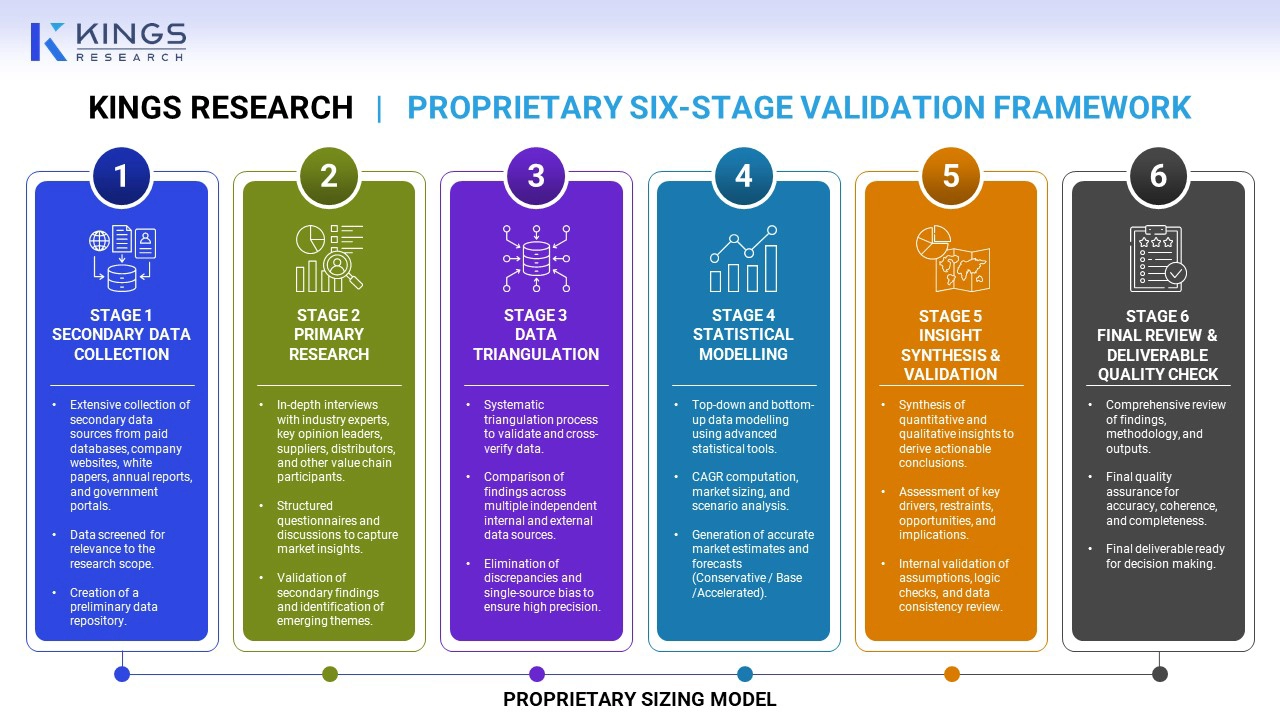
Our methodology triangulates insights from multiple independent and publicly available research databases, which are further validated against regulatory filings and public company disclosures. All estimates are cross-verified; no single-source data is presented without validation.
We deliver tailored, data-driven intelligence and strategic guidance to help organizations identify, evaluate, and capitalize on key market opportunities.
Frequently Asked Questions

Faizy brings over four years of experience in market research and consulting, with a proven ability to support strategic engagements across diverse industries and business environments. His work focuses on understanding complex market structures, identifying emerging opportunities, and translating research findings into clear, commercially relevant insights. With strong analytical capabilities and a structured approach to problem-solving, he evaluates industry trends, competitive landscapes, customer dynamics, and evolving business models. His expertise encompasses market research, competitive intelligence, market sizing and forecasting, industry assessment, company benchmarking, and strategic analysis. Faizy combines technical proficiency with a strong research orientation, enabling him to interpret both qualitative and quantitative information effectively. He has contributed to projects that help organizations assess growth potential, strengthen market positioning, and evaluate strategic priorities. His adaptable approach allows him to work across sectors while maintaining a consistent focus on accuracy, relevance, and delivering insights that support informed decision-making for clients and stakeholders.
With many years of consulting experience across global pharma, biotech, and MedTech markets, Minaz brings deep domain expertise, strategic clarity, and analytical rigor to every engagement. She has led 130+ consulting assignments spanning market entry, competitive landscaping, and portfolio prioritization, helping clients navigate complex, high-stakes decisions with confidence. Known for her ability to synthesize primary and secondary research into executive-ready recommendations, Minaz has built forecasting models and market sizing frameworks that have informed multi-million dollar investment decisions in oncology, diagnostics, and peptide therapeutics. Beyond her analytical strength, Minaz is a trusted client partner, translating complex datasets into clear, actionable insights for senior stakeholders. She currently leads a team of research analysts, driving business expansion, and shaping client engagement strategy.