
Inquire Now
Key Strategic Points
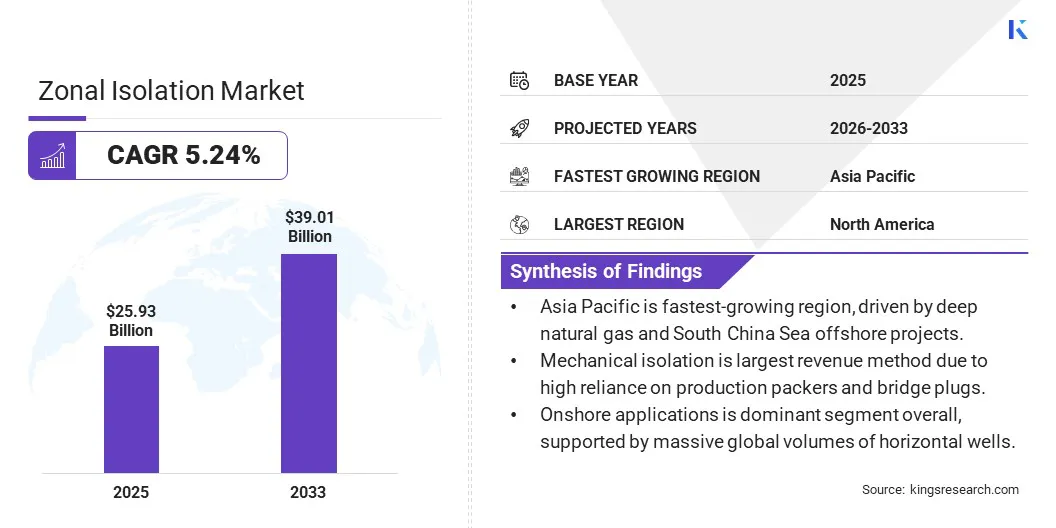
According to Kings Research, the global zonal isolation market size was valued at USD 25.93 billion in 2025 and is projected to grow to USD 39.01 billion by 2033, exhibiting a CAGR of 5.24% during the forecast period. Increased energy demand, technological advancements in drilling, environmental protection regulations, and unconventional oil and gas exploration are some of the factors driving the growth of the market.
In the scope of work, the report includes solutions offered by companies such as Baker Hughes Company, Helix Energy, Halliburton, National Oilwell Varco (NOV Inc.), Hydra Well Intervention AS, AltaRock Energy, Inc., Schlumberger Limited, TAM International, Inc., Weatherford International, Welltec A/S, and others.
The growth of the market is primarily attributed to the rising energy demand and constant search for new reserves of oil and gas. The technological advancements in drilling technologies such as hydraulic fracturing and horizontal drilling are also playing a significant role in the growth of the market. Moreover, strict government regulations on environmental protection and the need for efficient resource management are driving the adoption of zonal isolation techniques.
The need to prevent cross-contamination between different geological zones and to enhance the production efficiency of oil and gas wells further boost market progress. Moreover, rising investments in offshore drilling projects and the development of unconventional oil and gas resources are playing an important role.
The zonal isolation market is experiencing steady growth due to the increasing complexity of oil and gas extraction processes. Technological advancements and the development of new materials for zonal isolation, such as swellable packers and mechanical isolation tools, are creating potential opportunities for market growth.
Geographically, North America holds a significant market share, attributed to the booming shale gas industry, while regions such as the Middle East and Africa exhibit considerable potential due to their vast oil reserves.
Zonal isolation is a key process in the oil and gas industry, which prevents fluid flow between different geological zones during drilling, completion, and production phases. It isolates specific zones, thus preserving wellbore integrity and increasing hydrocarbon extraction efficiency.
Techniques employed for zonal isolation include cementing, the application of mechanical packers, and the use of chemical sealants. Effective zonal isolation is essential for preventing contamination of water sources, ensuring the stability of the wellbore, and optimizing production rates. It plays a vital role in maintaining environmental safety and regulatory compliance in the oil and gas industry.
Manufacturers in the zonal isolation market are prioritizing innovation and sustainability. These efforts include the development of advanced materials, such as biodegradable sealants and high-performance mechanical packers, which aim to enhance efficiency and ensure environmental compliance. Furthermore, companies are investing in digital technologies to improve real-time monitoring and control of isolation processes. New products, such as self-healing sealants and low-toxicity chemicals, are gaining significant traction as they address both performance and regulatory requirements.
Companies should continue to focus on research and development to create cost-effective, high-efficiency solutions. Collaboration with technology providers and adherence to stringent environmental standards are likely to play a crucial role in sustaining growth and maintaining competitive advantage in this evolving market.
A prominent factor supporting the growth of the zonal isolation market is the increasing adoption of advanced drilling techniques. Hydraulic fracturing, horizontal drilling, and multizone completions are enhancing oil and gas recovery, making reliable zonal isolation essential for maintaining well integrity and optimizing production. These techniques require precise isolation of different geological zones to prevent unwanted fluid migration, crossflow, and contamination while enabling selective production and stimulation.
As the energy industry explores unconventional oil and gas reserves and more complex reservoirs, demand for effective zonal isolation solutions is anticipated to increase. Increased focus on well integrity and life-of-well management is also driving adoption, with operators requiring reliable barriers for production, intervention, workover and abandonment activities. The market is expanding on the back of the development of zonal isolation systems, whose reliability and effectiveness are being enhanced by technological innovations in the areas of advanced packers, expandable barriers, and high-performance materials.
One of the major challenges hampering the growth of the market is the high cost involved with the advanced zonal isolation technologies. The cost of incorporating these technologies is often prohibitive for smaller companies and projects with limited budgets. To address this challenge, firms are striving to come up with cost-effective solutions without compromising on quality. One of the main strategies is to invest in standard order to conceive innovative materials and tools that provide high performance at lower costs.
Additionally, collaborative efforts among industry stakeholders, including technology providers and oil and gas companies, lead to shared advancements and cost reductions. This approach makes advanced zonal isolation technologies more accessible and promotes industry-wide efficiency and sustainability.
The adoption of digital technologies is a significant trend impacting the zonal isolation market. Companies are increasingly using advanced software and analytics to improve the precision and efficiency of zonal isolation processes. These digital tools enable real-time monitoring and control, allowing operators to make data-driven decisions and optimize well performance.
The integration of sensors and IoT devices in drilling equipment enhances the effectiveness of zonal isolation techniques by providing real-time insights into well conditions. This is leading to improved operational efficiency, reduced costs, and minimized environmental risks, making digital transformation a key focus area for companies operating in the market.
Another prominent trend in the zonal isolation market is the rising shift toward sustainable and environmentally friendly practices. There is a growing emphasis on using eco-friendly materials and methods to minimize the environmental impact of drilling activities. Biodegradable sealants and low-toxicity chemicals are being developed and adopted to ensure safe and sustainable zonal isolation.
Furthermore, companies are focusing on reducing greenhouse gas emissions and minimizing the ecological footprint of their operations. This trend is further fueled by increasing regulatory pressures and a global transition to sustainability. Moreover, the market is witnessing a rise in innovative, green technologies that align with environmental standards and regulations.
|
Segmentation |
Details |
|
By Application Type |
Onshore, Offshore |
|
By Method Type |
Mechanical, Chemical |
|
By Region |
North America: U.S., Canada, Mexico |
|
Europe: France, UK, Spain, Germany, Italy, Russia, Rest of Europe |
|
|
Asia-Pacific: China, Japan, India, Australia, ASEAN, South Korea, Rest of Asia Pacific |
|
|
Middle East & Africa: Turkey, UAE, Saudi Arabia, South Africa, Rest of Middle East & Africa |
|
|
South & Central America: Brazil, Argentina, Rest of South & Central America |
The global market is segmented by application type, method type, and geography.
Based on application type, the market is categorized into onshore and offshore. The onshore segment led the zonal isolation market in 2025. This considerable growth is propelled by the extensive exploration and production activities occurring on land. Onshore drilling projects are generally more cost-effective compared to offshore operations, thereby attracting significant investments.
The availability of advanced drilling technologies and the development of unconventional oil and gas resources such as shale and tight oil have spurred onshore drilling activities. Moreover, the onshore segment has better infrastructure and logistics, which results in more efficient operations and lower costs. Government policies and incentives that encourage exploration for oil and gas onshore are also supporting the growth of the segment.
Based on method type, the market is classified into mechanical and chemical. According to Kings Research, the mechanical segment is poised to witness significant growth through the forecast period (2026-2033), owing to growing emphasis on well integrity, dependable pressure containment, and effective zonal isolation in complex well settings. Key oilfield service companies such as Halliburton, SLB and Baker Hughes continue to develop and provide mechanical packer technologies for openhole and cased-hole applications, hydraulic fracturing, selective stimulation, production management and multizone isolation. Halliburton’s ZoneGuard mechanical isolation systems are designed for multizone isolation and fracturing applications and provide immediate sealing. Baker Hughes provides mechanical-set packers that provide reliable sealing and are set, released, and reset during well operations. SLB’s expandable annular zonal isolation packers are also engineered to deliver fast isolation in irregular and challenging wellbore conditions.
Based on region, the global market is classified into North America, Europe, Asia-Pacific, MEA, and South & Central America.
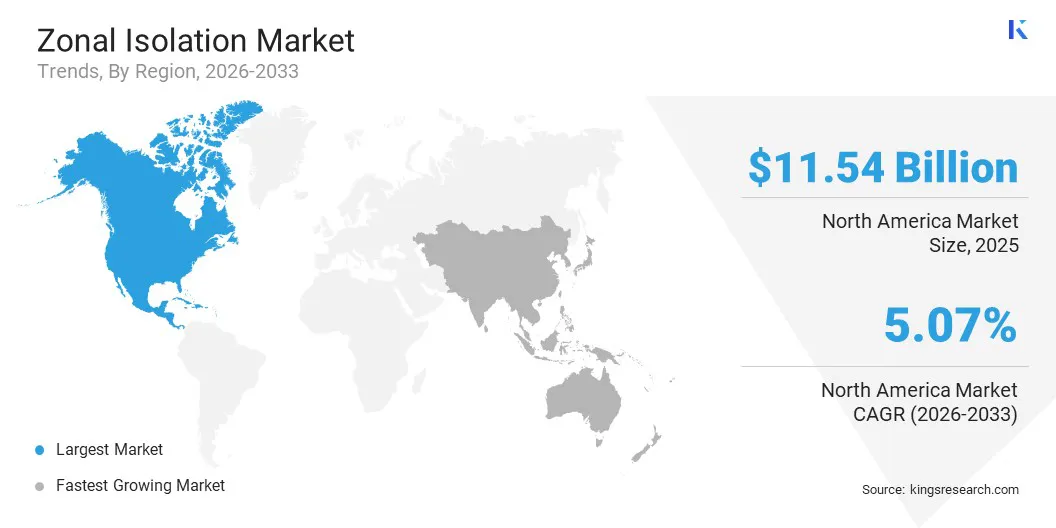
According to Kings Research, the North America region has the largest market share in the global zonal isolation market in 2025. This strong growth is primarily attributed to its extensive oil and gas exploration and production activities, especially in the U.S. and Canada. The area is abundant in shale gas and tight oil, which is driving a strong demand for advanced zonal isolation techniques to improve production efficiency and environmental safety.
Furthermore, increased investments in research and development and technological advancements are other factors that are driving the regional market growth. Also, the expansion is backed by the presence of major industry players and a well-developed infrastructure. Government policies and incentives are also conducive to the development of the regional industry.
Asia-Pacific is poised to experience considerable growth over the forecast period. This expansion is bolstered by the increasing energy demand from rapidly developing economies such as China and India. The region is witnessing significant investments in oil and gas exploration and production to meet this demand.
Advancements in drilling technologies and the discovery of new oil and gas reserves are enhancing market prospects. Additionally, supportive government policies and the expansion of infrastructure are facilitating regional market growth. The focus on sustainable energy practices and the adoption of advanced zonal isolation techniques are further supporting domestic market expansion.
This report provides valuable insight into the fragmented nature of the zonal isolation market. Prominent players are focusing on several key business strategies such as partnerships, mergers and acquisitions, product innovations, and joint ventures to expand their product portfolio and increase their market shares across different regions.
Manufacturers are adopting a range of strategic initiatives, including investments in R&D activities, the establishment of new manufacturing facilities, and supply chain optimization, to strengthen their market standing.
How We Gather This Information
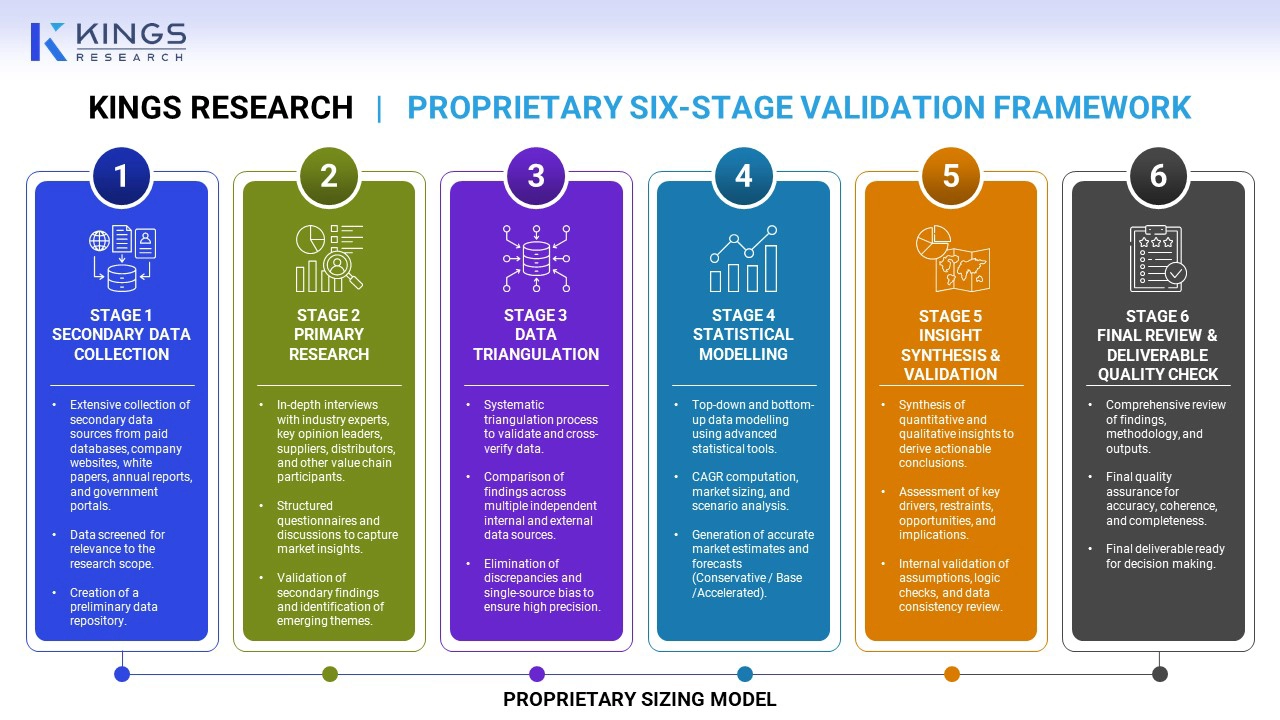
Our methodology triangulates insights from multiple independent and publicly available research databases and is further validated against regulatory filings and public company disclosures. All estimates are cross-verified; no single-source data is presented without validation.
Frequently Asked Questions

Ashim Lakhera is a market intelligence professional specializing in the Agriculture and Food & Beverage industry. His work focuses on emerging markets, competitive dynamics, industry trends, and the factors driving market growth and transformation. He has experience in market sizing, forecasting, strategic analysis, and industry research across food, FMCG, and life sciences. His research interests span the broader food and agriculture value chain, with a particular focus on how innovation, changing consumer behavior, sustainability priorities, and evolving production systems are influencing markets. He examines these developments to understand their impact on demand, competition, business models, and growth opportunities across the agri-food ecosystem. His work combines quantitative market analysis with an understanding of the broader industry forces shaping food and agriculture markets. He is particularly interested in the structural changes taking place across global food systems and how businesses are adapting to evolving consumer expectations, technological developments, and sustainability requirements.
Habi is a seasoned research and consulting leader with renowned experience in guiding clients on strategic growth and transformation initiatives across global markets. He has led high-performing research teams that deliver actionable insights on market expansion, M&A strategies, opportunity assessment, new business development, and product launches. His project portfolio spans large petrochemical producers, electronic device manufacturers, lubricants companies, and other leading enterprises across diverse industrial and consumer sectors. He currently heads the research department at Kings Research, where he is responsible for setting the research agenda, mentoring analysts, and ensuring client-ready deliverables that support executive decision-making. With extensive experience in market intelligence, strategic research, and consulting, Habi brings a strong understanding of evolving industry dynamics, competitive landscapes, emerging opportunities, and business growth challenges. His expertise includes developing research frameworks, translating complex market data into actionable strategic recommendations, and working closely with senior stakeholders to address critical business questions. He has also contributed to building research capabilities, strengthening analytical methodologies, and driving a culture of quality and insight-led decision-making within research teams. His cross-industry exposure enables him to connect market trends with broader business implications and provide perspectives that help organizations identify opportunities, mitigate risks, and make informed strategic decisions.