
Inquire Now
Key Strategic Points
Vehicle to grid (V2G) technology is a smart energy management solution that enables electric vehicles (EVs) to exchange electricity bidirectionally with the power grid.
It allows EVs to draw energy for charging and supply stored energy to the grid, optimizing energy utilization and enabling efficient interaction between transportation and electricity networks. The V2G market encompasses technology providers, automakers, utility companies and charging infrastructure developers
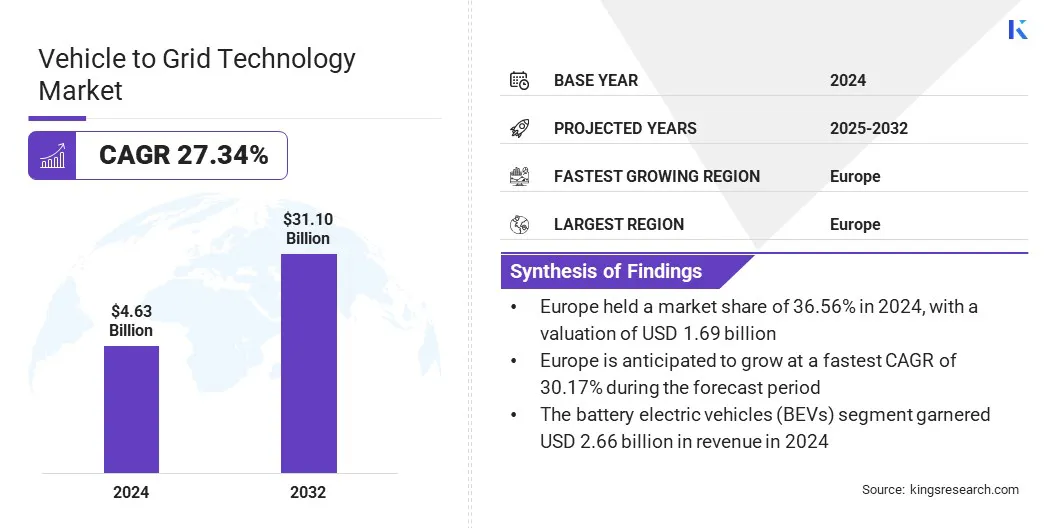
The global vehicle to grid technology market size was valued at USD 4.63 billion in 2024 and is projected to grow from USD 5.73 billion in 2025 to USD 31.1 billion by 2032, exhibiting a CAGR of 27.34% during the forecast period.
Rising adoption of electric vehicles (EVs) is enhancing distributed energy storage, allowing EVs to store and supply electricity back to the grid and support peak load management. Additionally, the growing focus on renewable energy integration and reducing carbon emissions is boosting V2G adoption, enabling EVs to complement intermittent renewable sources and support a sustainable energy system.
Major companies operating in the vehicle to grid technology market are NUVVE HOLDING CORP, GENERAL MOTORS, Hyundai Motor Company, Toyota Motor North America, Inc, Nissan Motor Co., LTD, Renault SAS, Honda Motor Co., Ltd, The Mobility House GmbH, Fermata Energy, LLC, ABB Ltd, Dreev, IoTecha, EDF Group, E.ON SE, and OVO Group Ltd.
Increasing partnerships between government, research institutes, and utilities are fueling market expansion by demonstrating EVs as decentralized energy storage, thereby supporting broader adoption of V2G technologies.These partnerships combine policy initiatives, technological advancements, and infrastructure investment to facilitate the broader adoption and commercialization of V2G technologies
Rapid Growth in Electric Vehicle Adoption
The growth of vehicle to grid technology market is propelled by the rapid global adoption of electric vehicles (EVs). The expanding fleet of EVs allows consumers, utilities, and companies to adopt V2G technologies for energy storage and bidirectional electricity flow.
This expansion supports smart energy management, facilitates renewable energy integration, enhances grid stability, and promotes peak load management. It also accelerates the deployment of V2G infrastructure and contributes to sustained market growth.
High Cost of Bidirectional Chargers and V2G-Compatible Infrastructure
A key challenge hindering the expansion of the vehicle to grid technology market is the high cost of bidirectional chargers and V2G-compatible infrastructure. The deployment of advanced hardware requires significant investment in technology, installation, and integration with existing grid systems.
These substantial upfront expenses increase the cost of V2G solutions and limit adoption among consumers, fleet operators, and utility companies. This, in turn, slows the large-scale implementation of V2G technologies.
To address this challenge, market players are investing in research and development to produce more efficient and cost-effective charging solutions. Companies are collaborating with automakers, utilities, and technology providers to standardize components, reduce manufacturing costs, and streamline installation processes of bidirectional chargers and V2G-compatible infrastructure. Some manufacturers are adopting scalable deployment models and offering incentives and leasing options to lower upfront expenses for consumers and fleet operators.
Advancement of Bidirectional Charging Technologies
A notable trend influencing the vehicle to grid technology market is the advancement of bidirectional charging technologies that enable electric vehicles to both draw power from and supply energy back to the grid.
Companies are investing in hardware optimization, smart software integration, and predictive energy management to improve efficiency and reliability. These developments enhance grid stability, support peak load management, facilitate renewable energy integration, and offer scalable, cost-effective V2G solutions.
|
Segmentation |
Details |
|
By Component |
Smart Meters, Electric Vehicle Supply Equipment, Home Energy Management (HEM) Systems, Power Converters and Transformers, Others |
|
By Vehicle Type |
Battery Electric Vehicles (BEVs), Plug-in Hybrid Electric Vehicles (PHEVs), Fuel Cell Electric Vehicles (FCEVs) |
|
By End User |
Residential, Commercial, Others |
|
By Region |
North America: U.S., Canada, Mexico |
|
Europe: France, UK, Spain, Germany, Italy, Russia, Rest of Europe |
|
|
Asia-Pacific: China, Japan, India, Australia, ASEAN, South Korea, Rest of Asia-Pacific |
|
|
Middle East & Africa: Turkey, U.A.E., Saudi Arabia, South Africa, Rest of Middle East & Africa |
|
|
South America: Brazil, Argentina, Rest of South America |
Based on region, the Market has been classified into North America, Europe, Asia Pacific, Middle East & Africa, and South America.
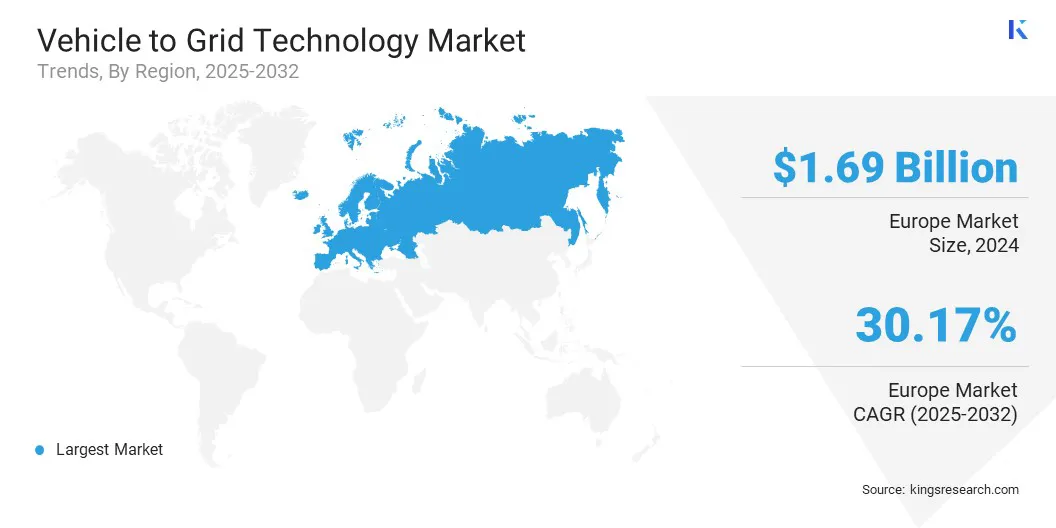
Europe vehicle to grid technology market share stood at 36.56% in 2024, valued at USD 1.69 billion. This dominance is primarily reinforced by strong government policies and initiatives, such as the European Green Deal and the Fit for 55 package, which promote renewable energy integration, EV adoption, and decarbonization.
Increasing adoption of electric vehicles creates a strong demand for distributed energy storage, allowing EVs to support peak load management and enable efficient integration of renewable energy sources.
The region's advanced smart charging infrastructure and energy management systems improve operational efficiency and enable seamless bidirectional energy flow. Additionally, increasing investment from energy companies and technology startups in V2G is accelerating the commercialization and large-scale deployment of vehicle to grid solutions across the region.
The North America vehicle to grid technology industry is set to grow at a robust CAGR of 26.81% over the forecast period. This growth is attributed to the rising adoption of electric vehicles (EVs), which is expanding the potential for distributed energy storage and grid integration.
Supportive government initiatives such as the U.S. Inflation Reduction Act and federal funding for smart grid and energy storage projects are fostering a favorable regulatory environment for the adoption and expansion of vehicle to grid technologies.
Technological advancements in areas such as smart charging infrastructure and energy management systems are improving operational efficiency, enabling bidirectional energy flow, and enhancing the scalability of vehicle to grid solutions. Additionally, strategic mergers and acquisitions among V2G technology providers are consolidating expertise and accelerating the deployment of advanced V2G solutions across the region.
Key players operating in the vehicle to grid technology industry are forging strategic partnerships with automakers and technology providers to integrate V2G systems into existing grid infrastructures, enhancing energy management and grid stability. They are investing heavily in research and development to advance bidirectional charging technologies and improve the efficiency, reliability, and scalability of vehicle to grid system.
Additionally, market participants are deploying smart charging infrastructure and sophisticated energy management platforms that enable seamless communication between electric vehicles and the grid while supporting peak load management and renewable energy integration.
Frequently Asked Questions

Over the years, Versha brings over 15 years of experience managing consulting assignments across industries, including Food and Beverage, Consumer Goods, ICT, Aerospace, and more. Her work has spanned diverse sectors. Her cross-domain expertise and adaptability make her a versatile and dependable professional. She is known for her keen business insight and foresight. With sharp analytical skills and a curious mindset, Versha excels at transforming complex data into actionable insights. She has a proven track record of unraveling market dynamics, identifying trends, and delivering tailored solutions to meet client needs. As a skilled leader, Versha has successfully mentored research teams and directed projects with precision, ensuring high-quality outcomes. Her collaborative approach and strategic vision enable her to turn challenges into opportunities and consistently deliver impactful results. Whether analyzing markets, engaging stakeholders, or crafting strategies, Versha draws on her deep expertise and industry knowledge to drive innovation and deliver measurable value.
Habi is a seasoned research and consulting leader with renowned experience in guiding clients on strategic growth and transformation initiatives across global markets. He has led high-performing research teams that deliver actionable insights on market expansion, M&A strategies, opportunity assessment, new business development, and product launches. His project portfolio spans large petrochemical producers, electronic device manufacturers, lubricants companies, and other leading enterprises across diverse industrial and consumer sectors. He currently heads the research department at Kings Research, where he is responsible for setting the research agenda, mentoring analysts, and ensuring client-ready deliverables that support executive decision-making. With extensive experience in market intelligence, strategic research, and consulting, Habi brings a strong understanding of evolving industry dynamics, competitive landscapes, emerging opportunities, and business growth challenges. His expertise includes developing research frameworks, translating complex market data into actionable strategic recommendations, and working closely with senior stakeholders to address critical business questions. He has also contributed to building research capabilities, strengthening analytical methodologies, and driving a culture of quality and insight-led decision-making within research teams. His cross-industry exposure enables him to connect market trends with broader business implications and provide perspectives that help organizations identify opportunities, mitigate risks, and make informed strategic decisions.



.webp&w=128&q=75&dpl=dpl_DPva2LrvfsBdTJm1XZj67UTrvMHL)
