
Inquire Now
Key Strategic Points
According to Kings Research, the global data center energy storage market size was recorded at USD 5.04 billion in 2025 and is projected to reach USD 8.13 billion by 2033, growing at a CAGR of 6.16% from 2026 to 2033.
Data center energy storage refers to systems designed to store electrical energy for use in data centers to ensure operational continuity and efficiency, especially during power outages or fluctuating energy demand. Common technologies include uninterruptible power supplies, lithium-ion batteries, lead-acid batteries, flywheels, and emerging solutions such as hydrogen fuel cells.
The report covers companies such as ABB, Delta Electronics, Inc., Eaton, GE Vernova Inc., Huawei Digital Power, Legrand, Mitsubishi Electric Corporation, Saft, Schneider Electric, Vertiv Group Corp., and others.
Kings Research finds that increasing investments in energy storage solutions for data centers, coupled with the growing adoption of lithium-ion batteries, are driving the growth of the market. Data centers are increasingly shifting toward solar and wind power in response to sustainability commitments and regulatory pressure, including EU Green Deal compliance requirements and corporate carbon-neutral targets, but these sources are intermittent and require reliable storage to ensure uninterrupted operations.
Energy storage systems connect clean energy generation with steady power use in data centers, especially during peak hours or when renewable output is limited. This role in load balancing and grid-dependency reduction is central to why storage has become essential infrastructure rather than an optional add-on for modern data center operators.
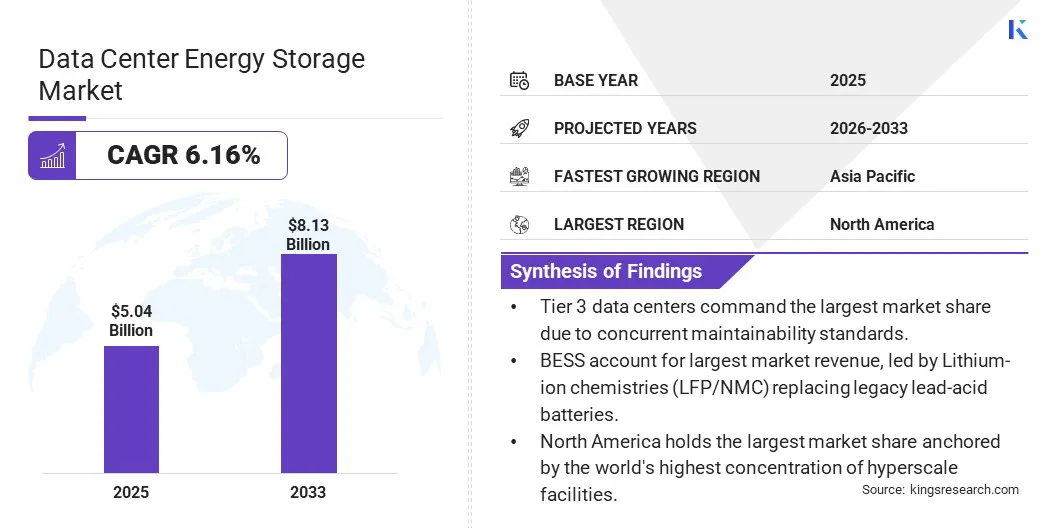
The growing shift toward solar and wind power in data centers is a primary driver of storage demand, since these sources are intermittent and require reliable backup to ensure uninterrupted operations. For instance, in August 2026, Equinix signed its fourth renewable-energy Power Purchase Agreement (PPA) in Singapore with Flo Energy Singapore, strengthening its efforts to power data-center operations with renewable electricity. The agreement highlights the growing use of renewable power by data-center operators and supports demand for energy-storage solutions to manage intermittency and ensure reliable power supply.
On the other hand, in June 2026, Energy Dome partnered with NUAI to evaluate its CO₂ Battery Plus long-duration energy storage technology at NUAI’s Texas AI data center site. The collaboration aims to support time-to-power, improve operational flexibility, and reduce emissions associated with AI and data-center workloads, highlighting the growing adoption of advanced energy-storage technologies for high-demand data centers.
The high upfront cost of installing advanced energy storage systems presents a significant challenge for the market. Costs include the purchase and installation of storage systems, infrastructure upgrades, and ongoing maintenance, a burden that is often prohibitive for small- to mid-sized data center operators specifically, even as large hyperscale operators continue to invest at scale.
This challenge is compounded by rapid technological change, since operators may hesitate to commit to large upfront investments when future innovations could offer more cost-effective alternatives. These costs are often offset over time by operational efficiency gains and energy savings, and mitigation strategies include modular and scalable system adoption, government incentives for sustainable technologies, and financing options that spread costs over time.
AI-driven energy management systems are helping data centers optimize energy storage utilization. AI algorithms, along with machine learning and predictive analytics, help data centers manage energy consumption more efficiently by predicting demand patterns, optimizing usage in real time, monitoring storage performance, and adjusting energy distribution for maximum efficiency.
For instance, in June 2026, Fluence, NVIDIA, and nVent Electric announced a collaboration to develop a reference electrical and power architecture for AI data centers. Fluence’s battery storage and energy-management capabilities are designed to help manage the dynamic power requirements of high-density AI workloads, improve grid flexibility, and enhance data-center power reliability.
|
Segmentation |
Details |
|
By Type |
Tier 1, Tier 2, Tier 3, and Tier 4 |
|
By Technology |
Battery Energy Storage, Flywheel Energy Storage, Fuel Cell Energy Storage, Thermal Energy Storage, Others |
|
By End User |
IT & Telecommunications, BFSI, Healthcare, Government, Others |
|
By Region |
North America: U.S., Canada, Mexico |
|
Europe: France, UK, Spain, Germany, Italy, Russia, Rest of Europe |
|
|
Asia-Pacific: China, Japan, India, Australia, ASEAN, South Korea, Rest of Asia-Pacific |
|
|
Middle East & Africa: Turkey, UAE, Saudi Arabia, South Africa, and the Rest of Middle East & Africa |
|
|
South & Central America: Brazil, Argentina, Rest of South & Central America |
The global market has been segmented on the basis of type, technology, end user, and geography.
Based on type, the market is classified into Tier 1, Tier 2, Tier 3, and Tier 4. The Tier 3 segment held the largest share in 2025, primarily due to its balance between high availability, operational reliability, and infrastructure cost. Tier 3 facilities are concurrently maintainable, allowing individual power and cooling components to be maintained or replaced without disrupting IT operations. This makes them well suited to enterprises, colocation providers, and AI-intensive workloads that require high uptime without the substantially higher infrastructure complexity and cost associated with Tier 4 facilities.
Based on technology, the market is divided into battery energy storage, flywheel energy storage, fuel cell energy storage, thermal energy storage, and others. The battery energy storage segment held the largest market share, driven by the high reliability, scalability, energy density, and rapid response capabilities of battery-based systems. Data centers particularly suit lithium-ion batteries because they can provide backup power and support load management within a compact footprint.
Rising deployment of AI, cloud computing, and hyperscale data centers is increasing electricity demand and creating a greater need for flexible energy storage. Battery systems enable data centers to store electricity from renewable sources, manage peak loads, and maintain power continuity during grid disruptions, supporting operational reliability and cost optimization.
Technological advancements are further strengthening battery adoption. Improvements in cycle life, energy density, charging efficiency, and battery-management systems, combined with declining technology costs, are improving the economic viability of energy storage. In parallel, stricter carbon-reduction targets are encouraging data-center operators to integrate battery storage with renewable power systems as part of their decarbonization strategies.
Based on end users, the market has been segmented into IT & telecommunications, BFSI, healthcare, government, and others. The IT & telecommunications segment held the largest share in 2025, driven by the rapid expansion of cloud computing, 5G networks, artificial intelligence, and data-intensive digital services. The growing volume of data generated by connected devices and digital applications is encouraging IT and telecom companies to expand data-center capacity and invest in supporting power infrastructure.
The increasing dependence on mission-critical digital services is also creating strong demand for reliable and uninterrupted power. Energy storage systems provide backup power during grid disruptions, support peak-load management, and improve power quality, helping data centers maintain continuous operations and minimize downtime.
Furthermore, the growing adoption of renewable energy within data-center operations is strengthening demand for energy storage. Battery systems allow operators to store excess renewable electricity and use it during periods of high demand or limited generation, while also helping to reduce grid dependence, energy costs, and carbon emissions.
Based on region, the global market has been segmented into North America, Europe, Asia-Pacific, MEA, and South & Central America.
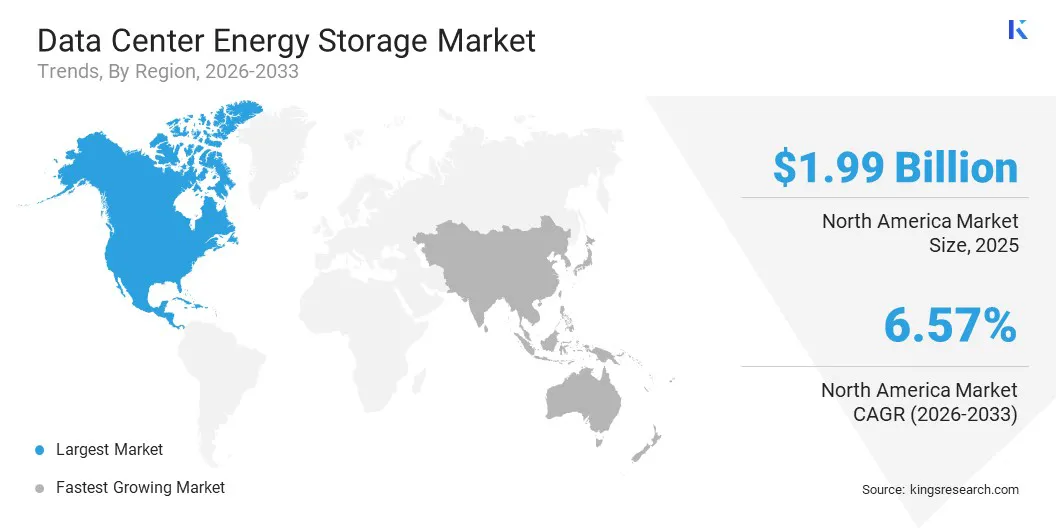
North America accounted for a 39.46 percent share of the global market in 2025, valued at USD 1.99 billion. This dominance reflects the region's concentration of hyperscale data centers, especially in the United States, home to major technology and cloud service providers driving surging energy demand from digitalization, cloud services, and AI applications. The region's regulatory framework aimed at reducing carbon emissions has further prompted operators to invest in sustainable storage systems, alongside growing demand from edge computing and 5G network expansion.
Asia-Pacific is projected to grow at the fastest CAGR over the forecast period, propelled by rapid digital transformation and the expansion of cloud computing and IT infrastructure across China, India, and Southeast Asian countries. Growing internet penetration, mobile connectivity, and smart city initiatives are driving demand for data centers and energy storage solutions, supported by government investment in renewable energy projects across the region.
In June 2026, IFC partnered with Sify Infinit Spaces to support the development of two AI-ready, energy-efficient data centers in Navi Mumbai and Chennai, with a combined capacity of 103 MW. The facilities are designed to support growing demand for cloud computing and AI while incorporating energy-efficient cooling and renewable energy, reinforcing India's rapidly expanding digital infrastructure and the increasing need for reliable and sustainable power solutions.
Europe represents a significant and maturing market for energy storage in data centers, supported by the region's aggressive carbon-reduction targets under the EU Green Deal and a well-established base of colocation and hyperscale facilities across Germany, France, Ireland, and the Nordics. Regulatory pressure to phase out diesel backup generation is a particularly strong driver in this region, pushing operators toward battery and hybrid storage systems as a compliant alternative.
The MEA region is witnessing increasing demand for data center energy storage as Saudi Arabia and the UAE accelerate data center development alongside large-scale investments in renewable power and battery energy storage. Saudi Arabia's data center capacity exceeded 440 MW in 2025, while the UAE is developing a 5.2 GW solar project integrated with 19 GWh of battery storage, supporting the region's shift toward reliable, sustainable power for digital infrastructure.
The global data center energy storage market report provides valuable insights, highlighting the fragmented nature of the industry. Companies are implementing impactful strategic initiatives, such as expansion of services, investments in research and development (R&D), establishment of new service delivery centers, and optimization of their service delivery processes, which are likely to create new opportunities for market growth.
How We Gather This Information
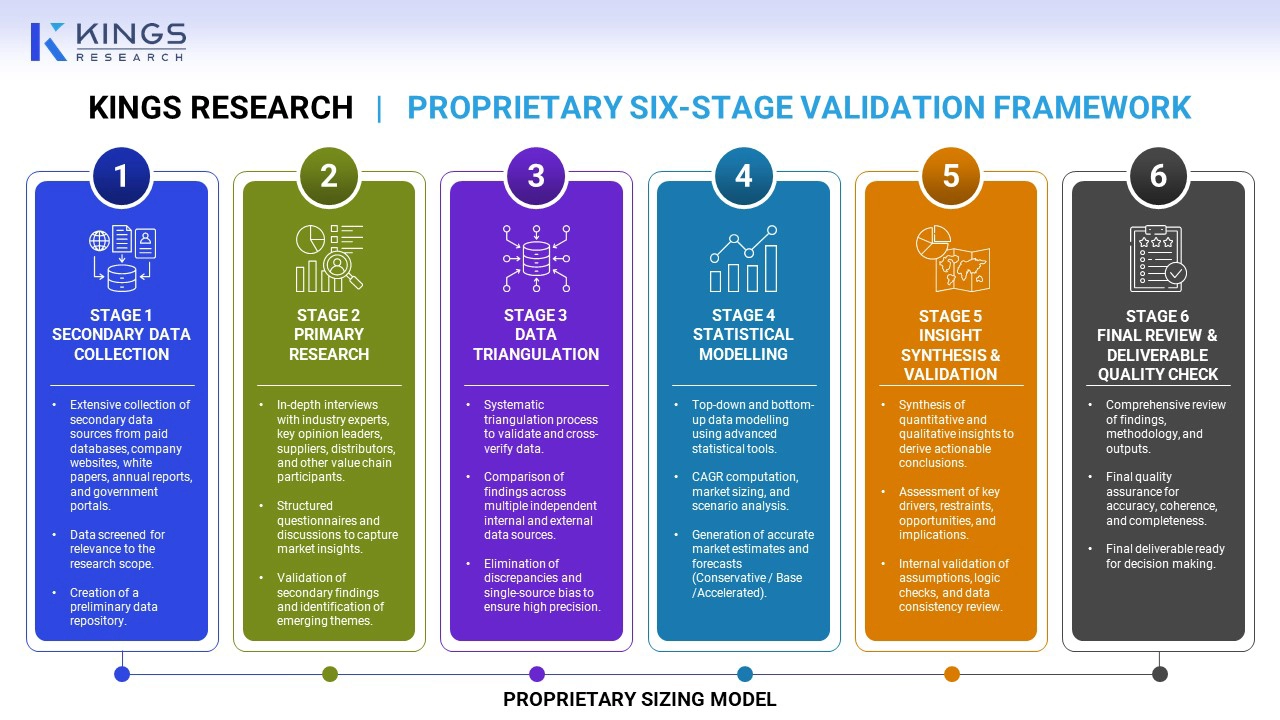
Our methodology combines insights from multiple independent and publicly available research databases, and we further validate this information against regulatory filings and public company disclosures. All estimates are cross-verified; no single-source data is presented without validation.
Our custom offerings deliver tailored, data-driven intelligence and strategic guidance to help organizations identify, evaluate, and capitalize on key market opportunities.
Frequently Asked Questions

Swati is a committed research analyst with a passion for optimizing systems and processes across industries, specializing in healthcare but also bringing valuable expertise to sectors such as consumer goods, life sciences, and more. Her cross-domain research approach allows her to generate clear, actionable reports that inform strategic decisions in a variety of fields. Swati is committed to staying ahead of evolving trends, leveraging her broad understanding of different sectors to provide insights that are relevant to a range of industries. In her personal time, she enjoys music and spending quality time with her family, which inspires her creativity and enriches her professional approach. Her systematic methodology ensures that every report is both thorough and practical. Swati's ability to bridge regulatory frameworks with market realities gives her recommendations a distinct edge. She collaborates seamlessly with cross-functional teams, distilling complex data into straightforward narratives. Her proactive monitoring of policy and technological shifts keeps her analysis forward-looking.
Habi is a seasoned research and consulting leader with renowned experience in guiding clients on strategic growth and transformation initiatives across global markets. He has led high-performing research teams that deliver actionable insights on market expansion, M&A strategies, opportunity assessment, new business development, and product launches. His project portfolio spans large petrochemical producers, electronic device manufacturers, lubricants companies, and other leading enterprises across diverse industrial and consumer sectors. He currently heads the research department at Kings Research, where he is responsible for setting the research agenda, mentoring analysts, and ensuring client-ready deliverables that support executive decision-making. With extensive experience in market intelligence, strategic research, and consulting, Habi brings a strong understanding of evolving industry dynamics, competitive landscapes, emerging opportunities, and business growth challenges. His expertise includes developing research frameworks, translating complex market data into actionable strategic recommendations, and working closely with senior stakeholders to address critical business questions. He has also contributed to building research capabilities, strengthening analytical methodologies, and driving a culture of quality and insight-led decision-making within research teams. His cross-industry exposure enables him to connect market trends with broader business implications and provide perspectives that help organizations identify opportunities, mitigate risks, and make informed strategic decisions.