
Inquire Now
Key Strategic Points
Artificial intelligence (AI) in healthcare involves the use of advanced computational algorithms and machine learning techniques to mimic human intelligence in medical applications. AI systems analyze complex medical data, support disease diagnosis, personalize treatment plans, predict health outcomes, and optimize healthcare operations.
Global artificial intelligence in healthcare market size was valued at USD 10.34 billion in 2023 and is projected to grow from USD 13.50 billion in 2024 to USD 110.98 billion by 2031, growing at a staggering CAGR of 35.12% from 2024 to 2031.
The market is experiencing robust growth, driven by technological advancements in machine learning, data analytics, and healthcare innovation. It covers a broad spectrum of applications, including diagnostics, personalized medicine, drug discovery, patient monitoring, and operational automation.
The expansion of the market is further fueled by factors such as the increasing volume of healthcare data, the need for cost-efficiency, and the demand for enhanced patient outcomes.
Major companies operating in the global AI in healthcare market are IBM Corporation, Koninklijke Philips N.V., NVIDIA Corporation, Medtronic, Siemens AG, Microsoft Corporation, Intel Corporation, General Electric Company, Pfizer Inc., Eli Lilly and Company, Epic Systems Corporation., Oracle, Johnson & Johnson Services, Inc., Amazon.com, Inc., Hoffmann-La Roche AG, and others.
As AI technologies are increasingly integrated into healthcare systems, they offer opportunities to streamline processes, improve accuracy, and drive operational efficiencies. This shift is expected to foster innovation, improve healthcare delivery, and enhance overall patient care across various medical specialties.
Market Driver
"Adoption of Synthetic Data and Advancement in Real Time Analysis"
The growing volume of healthcare data from sources such as electronic health records and wearable devices is boosting the growth os the artificial intelligence in healthcare market, creating a significant opportunity for AI to process and analyze this information, improving efficiencies and enabling more tailored healthcare solutions.
The use of synthetic data, including synthetic control arms for clinical trials, addresses data scarcity and privacy concerns, enhancing model training and improving the accuracy of diagnostics and personalized treatments.
Additionally, AI technologies enable real-time insights during surgeries, enhancing decision-making and improving patient outcomes by providing actionable recommendations and identifying potential complications. These factors are boosting the adoption of AI in healthcare, fostering innovation, improving care delivery, and enhancing operational performance.
Market Challenge
Bias in AI Algorithm and Model Interpretability
As AI systems rely on large datasets to drive insights, protecting sensitive patient data from breaches and unauthorized access remains a top priority, particularly with increasing data volume. This presents a major challenge to the expansion of the artificial intelligence in healthcare market.
Additionally, AI algorithms may inherit biases from unrepresentative training data, leading to inequitable healthcare outcomes for underrepresented groups, which highlights the need for diverse datasets and ongoing monitoring.
Moreover, the "black box" nature of many AI models hinders their adoption in clinical settings, as healthcare professionals require clear explanations of AI decision-making processes. Improving model transparency through explainable AI is essential to building trust, enhancing clinical decision-making, and ensuring accountability in patient care.
Market Trend
"Generative AI and Predictive Analytics"
Growing adoption of generative AI and predictive analysis is emerging as a key trend influencing the artificial intelligence in healthcare market. Generative AI is streamlining clinical processes by generating synthetic data and medical images, enhancing diagnostic precision, and enabling personalized treatment strategies.
Simultaneously, predictive analytics is empowering healthcare providers to proactively manage patient care by analyzing historical and real-time data to predict health risks, facilitating early interventions and improved preventive care.
In the drug discovery sector, AI accelerates the identification and optimization of drug candidates, reducies development timelines, minimizes costs, and supports drug repurposing. These advancements improve patient outcomes, drive operational efficiencies, and position AI as a key factor for innovation and competitiveness in healthcare.
| Segmentation | Details |
| By Component | Hardware, Software, Services, Medical Imaging and Diagnostics |
| By Application | Drug Discovery and Development, Personalized Medicine, Robotic Surgery, Others |
| By Technology | Machine Learning, Natural Language Processing, Context-aware Computing, Computer Vision, Hospital & Healthcare Providers, Patients |
| By End User | Pharmaceuticals & Biotechnology Companies, Healthcare Payers |
| By Region | North America: U.S., Canada, Mexico |
| Europe: France, U.K., Spain, Germany, Italy, Russia, Rest of Europe | |
| Asia-Pacific: China, Japan, India, Australia, ASEAN, South Korea, Rest of Asia-Pacific | |
| Middle East & Africa: Turkey, UAE, Saudi Arabia, South Africa, Rest of Middle East & Africa | |
| South America: Brazil, Argentina, Rest of South America |
Market Segmentation:
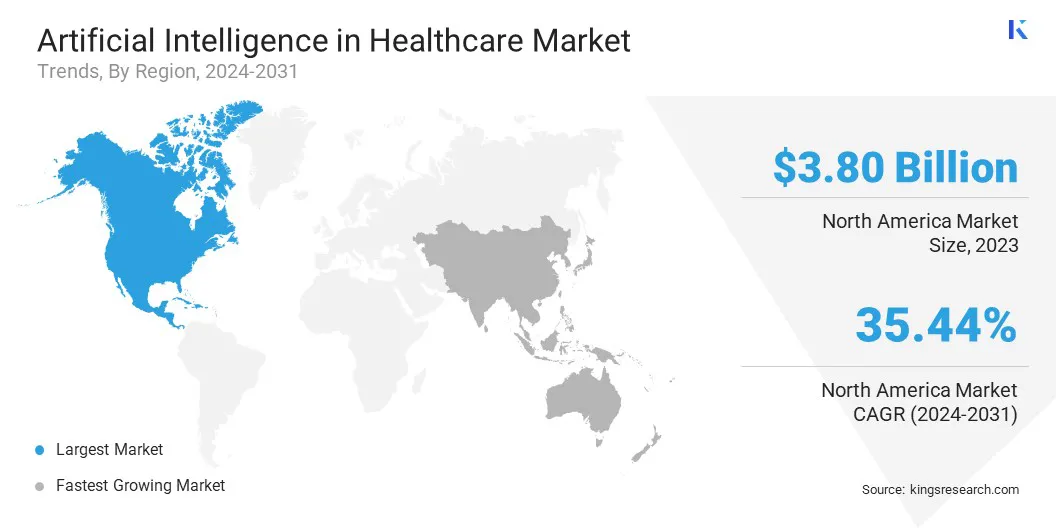
North America artificial intelligence in healthcare market accounted for a substantial share of 36.74% and was valued at USD 3.80 billion in 2023. This dominance is reinforced by a strong technological infrastructure, significant investments in research and development, and the presence of leading healthcare providers and technology companies.
The regional market benefits from extensive collaborations between academic institutions, healthcare providers, and technology firms, creating a dynamic ecosystem for AI innovations.
The United States contributes significantly to this growth, supported by favorable regulatory frameworks, including FDA guidelines for AI-powered medical devices, and the expnading use of AI in diagnostics, personalized medicine, and drug discovery.
Additionally, the growing demand for efficient healthcare solutions, improved patient outcomes, and cost reductions propel the adoption of AI technologies across North America. This growth is further supported by ongoing investments, digital transformation initiatives, and collaborative ecosystem.

Asia-Pacific AI in healthcare market is expected to grow at the fastest CAGR of 36.16% through the projection period. This rapid expansion is fostered by large-scale investments in healthcare infrastructure, advancements in AI technology, and growing healthcare needs due to a rising population and increasing prevalence of chronic diseases.
Governments across the region are actively promoting AI adoption through strategic policies, funding initiatives, and partnerships with technology companies.
The artificial intelligence in healthcare industry is characterized by a number of participants, including both established corporations and rising organizations.
Startups are rapidly growing, focusing on niche applications such as early disease detection, personalized medicine, and AI-assisted remote monitoring. These startups are gaining traction through significant investments and strategic partnerships with larger healthcare organizations, enabling switf scaling of their innovations.
Recent Developments:
Frequently Asked Questions

Over the years, Versha brings over 15 years of experience managing consulting assignments across industries, including Food and Beverage, Consumer Goods, ICT, Aerospace, and more. Her work has spanned diverse sectors. Her cross-domain expertise and adaptability make her a versatile and dependable professional. She is known for her keen business insight and foresight. With sharp analytical skills and a curious mindset, Versha excels at transforming complex data into actionable insights. She has a proven track record of unraveling market dynamics, identifying trends, and delivering tailored solutions to meet client needs. As a skilled leader, Versha has successfully mentored research teams and directed projects with precision, ensuring high-quality outcomes. Her collaborative approach and strategic vision enable her to turn challenges into opportunities and consistently deliver impactful results. Whether analyzing markets, engaging stakeholders, or crafting strategies, Versha draws on her deep expertise and industry knowledge to drive innovation and deliver measurable value.

With over a decade of research leadership across global markets, Ganapathy brings sharp judgment, strategic clarity, and deep industry expertise. Known for precision and an unwavering commitment to quality, he guides teams and clients with insights that consistently drive impactful business outcomes.



.webp&w=128&q=75&dpl=dpl_9cT76VEyqA3GYX2gzuuRZBM2Vb4x)