
Inquire Now
Key Strategic Points
Sustainable packaging refers to the use of materials that are environmentally friendly such as paper, recycled plastics, and metal to reduce environmental harm. It is an amalgamation of hard and soft formats in the primary, secondary, and tertiary layers across food, healthcare, and retail sectors. The market includes recyclable, reusable, and biodegradable processes in order to spur resource efficiency and support the global circular economy.
The global sustainable packaging market size was valued at USD 292.56 billion in 2024 and is projected to grow from USD 312.31 billion in 2025 to USD 525.51 billion by 2032, exhibiting a CAGR of 7.72% during the forecast period. This expansion is fueled by the fact that packaging producers and brand owners are compelled to fulfill stringent compliance demands imposed by global environmental regulations and single-use plastic prohibitions.
Meanwhile, the market is experiencing a major trend in the development of barrier designs for humidity-sensitive goods, as high-performance mono-materials are substituting laminates.
Major companies operating in the global sustainable packaging market are Huhtamaki, 3M, Nampak Ltd., ITC Limited, Stora Enso, Smurfit Westrock, Crown Holdings, Inc., Packmile Pvt. Ltd., Ball Corporation, Tetra Pak International S.A., Elopak AS, NaturTrust, UPM Global, Amcor Group, and Mondi.
There is an uptake of more complex manufacturing methods by companies to manufacture ultra-thin high-strength packaging steel. These improvements aim at decreasing the weight of the steel packages without compromising high standards of structural strength and product barrier properties required for food and aerosol applications. They contrast with traditional steel production techniques, which in many cases led to heavier packaging and increased carbon footprints at the time of transportation.
Hydrogen-based steelmaking and electric arc furnace technologies are being embraced by the sustainable packaging sector, as producers strive to provide low-carbon steel technology, making this a widely used initiative in metal packaging.
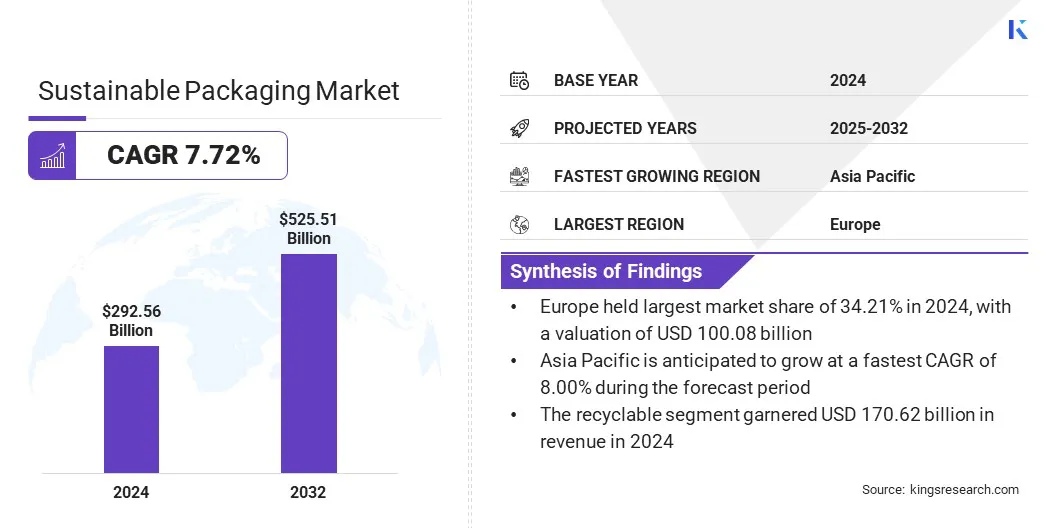
The sustainable packaging market is expanding steadily to fulfill the demand for compliance with global environmental mandates and single-use plastic bans. This demand helps businesses mitigate financial risks, including non-compliance penalties, plastic taxes, and waste management costs. To meet increasing regulatory pressure, companies are launching innovative offerings that prioritize material circularity and standardized recycling benchmarks. These developments improve efficiency across the supply chain and serve as the foundation for national zero-waste initiatives and advanced manufacturing.
The market is facing major challenges due to the high cost of post-consumer recycled (PCR) resins and bio-based feedstock. Because such materials need specialized collection and sophisticated chemical treatment, they are more likely to be priced at a premium compared to traditional virgin plastics. The scarcity of food-grade recycled content also poses bottlenecks in the supply chain, thus making it hard to scale production.
To address these issues, manufacturers are relying on long-term sourcing contracts and investing in vertically integrated recycling facilities to ensure the stable supply of raw materials. They are also adopting advanced technologies in recycling low-quality waste into high-quality resins using light-weighting techniques to decrease material usage. Companies are reducing price barriers and making sustainable solutions more economically viable by designing their packaging to be more material-efficient and collaborating on circular collection systems.
One of the trends in the sustainable packaging industry is the growing popularity of high-performance mono materials and bio-coating to shield delicate products. These superior designs are designed to protect commodities like food and pharmaceuticals against moisture and environmental degradation. They do not resemble conventional multi-layer laminates that are hard to separate and recycle because of their complicated chemical structure.
The market is increasingly relying on the use of new barrier technologies, as they provide global brands with alternatives to non-recyclable foils, namely compostable or fiber-based solutions. These solutions are also becoming a universally adopted innovation in the industry to guarantee the shelf life of products and achieve the goals of the circular economy.
|
Segmentation |
Details |
|
By Material |
Paper & Paperboard, Plastics, Glass, Metal |
|
By Type |
Rigid, Flexible |
|
By Packaging |
Primary Packaging, Secondary Packaging, Tertiary Packaging |
|
By Process |
Recyclable, Reusable, Biodegradable |
|
By Application |
Food & Beverages, Personal Care & Cosmetics, Healthcare, Others |
|
By Region |
North America: U.S., Canada, Mexico |
|
Europe: France, UK, Spain, Germany, Italy, Russia, Rest of Europe |
|
|
Asia-Pacific: China, Japan, India, Australia, ASEAN, South Korea, Rest of Asia-Pacific |
|
|
Middle East & Africa: Turkey, U.A.E., Saudi Arabia, South Africa, Rest of Middle East & Africa |
|
|
South America: Brazil, Argentina, Rest of South America |
Based on region, the market has been classified into North America, Europe, Asia Pacific, Middle East & Africa, and South America.
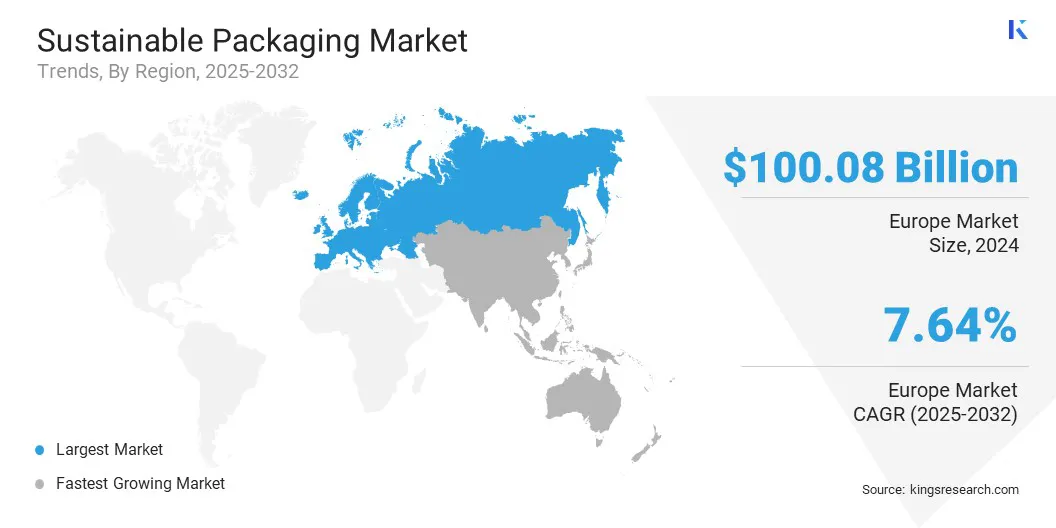
The Europe sustainable packaging market accounted for a substantial share of 34.21% in 2024, with a valuation of USD 100.08 billion. This dominance is reinforced by the high concentration of key industry players who are strategically adopting circular economy practices to comply with strict regional environmental requirements. These companies are at the forefront of the shift to incorporate closed loop systems and modern recycling into their business models.
The leadership in the region is also driven by the existence of a well-established network of producers and brand owners that focus on material recovery and the reduction of single-use plastics to gain a competitive edge in the global market.
The Asia-Pacific sustainable packaging market is expected to register the fastest CAGR of 8.00% over the forecast period. This growth is attributed to the high concentration on localized innovation and the rapid expansion of manufacturing plants that focus on sustainable packaging production.
Emerging economies are increasing their industrial potential to generate biodegradable substitutes and high-grade recycled resins in order to achieve growing domestic and foreign demand. Moreover, conversion plants are being upgraded on a large scale, positioning the region as a global center of cost-effective and environmentally friendly solutions in the e-commerce and consumer goods industries.
Major players operating in the sustainable packaging sector are actively establishing international contacts and increasing investments in capital and material science to achieve a competitive edge. Large-scale producers are working with biopolymer producers to incorporate renewable feedstock, which allows the creation of high-performance carbon-neutral substitutes for conventional plastics.
Simultaneously, the providers of packaging solutions are commercializing sophisticated recycling infrastructure, automated sortation systems, and closed-loop logistics to fast-track the shift to a fully circular economy. Such investments and expansion of global footprints assist in strengthening supply chains, moving to zero-waste requirements, and accelerating the implementation of plastic-free solutions in the global markets.
Frequently Asked Questions

Tejasv specializes in secondary research and data validation, transforming complex information into clear market insights. He supports multi-industry research initiatives by delivering reliable intelligence that informs planning and strategic direction. With a disciplined and detail-focused approach, he emphasizes analytical clarity and practical application. His interest in geopolitics and history informs his broader market perspective. This unique lens allows him to contextualize industry shifts within larger socio-political frameworks, adding depth to his analyses. He maintains rigorous documentation standards, making his findings auditable and easily reproducible. His ability to distill vast amounts of secondary data into concise, decision-ready summaries has earned him the trust of project leads across multiple verticals. Tejasv actively tracks regulatory changes and economic indicators, which he incorporates into his research to enhance its forward-looking relevance. His methodical work ethic, combined with a calm demeanor under tight deadlines, ensures that his contributions remain both timely and impactful.
Habi is a seasoned research and consulting leader with renowned experience in guiding clients on strategic growth and transformation initiatives across global markets. He has led high-performing research teams that deliver actionable insights on market expansion, M&A strategies, opportunity assessment, new business development, and product launches. His project portfolio spans large petrochemical producers, electronic device manufacturers, lubricants companies, and other leading enterprises across diverse industrial and consumer sectors. He currently heads the research department at Kings Research, where he is responsible for setting the research agenda, mentoring analysts, and ensuring client-ready deliverables that support executive decision-making. With extensive experience in market intelligence, strategic research, and consulting, Habi brings a strong understanding of evolving industry dynamics, competitive landscapes, emerging opportunities, and business growth challenges. His expertise includes developing research frameworks, translating complex market data into actionable strategic recommendations, and working closely with senior stakeholders to address critical business questions. He has also contributed to building research capabilities, strengthening analytical methodologies, and driving a culture of quality and insight-led decision-making within research teams. His cross-industry exposure enables him to connect market trends with broader business implications and provide perspectives that help organizations identify opportunities, mitigate risks, and make informed strategic decisions.