Inquire Now
Key Strategic Points
The sodium silicate market includes chemical compounds made from sodium oxide and silica, known for their adhesive, binding, and water-resistant qualities, used in various industrial processes. These compounds provide reliable chemical stability and durability, making them important in applications such as detergents, water treatment, construction, pulp and paper, adhesives, paints, and food preservation.
The market is segmented by form and application, with attention to production methods, demand trends, and regulatory factors. Sodium silicate supports a wide range of industries by improving product performance and process efficiency, contributing to steady market growth.
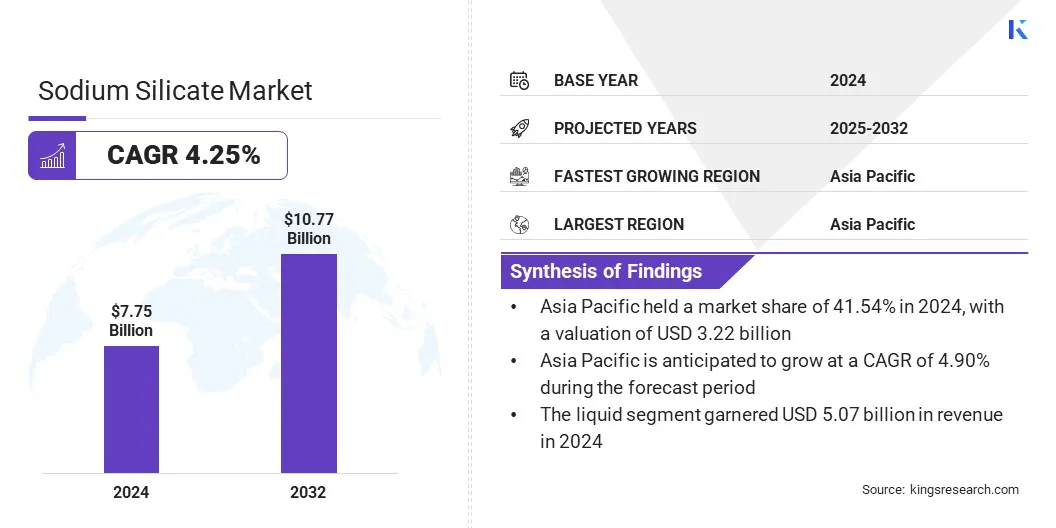
The global sodium silicate market size was valued at USD 7.75 billion in 2024 and is projected to grow from USD 8.05 billion in 2025 to USD 10.77 billion by 2032, exhibiting a CAGR of 4.25% during the forecast period. This growth is largely driven by the rising adoption in the water treatment and construction industries, where the bonding and strengthening qualities of sodium silicate increase the durability of products and assist in making them environmentally friendly.
With the increased industrialization of many countries and stricter environmental regulations, the pressure to utilize green materials such as sodium silicate across a broad range of applications is rising.
Major companies operating in the global sodium silicate industry are PQ Corporation, Nippon Chemical Industrial CO., LTD., Tokuyama Corporation, Occidental Chemical Corporation, Evonik Industries AG, QEMETICA, BASF SE, Oriental Silicas Corporation, Metro Chem Industries, Hindcon Chemicals Ltd., Merck KGaA, Sinchem Europe, Adwan Chemical Industries Co. Ltd. (ACIC), Kiran Global Chem Limited., and FUJI CHEMICAL Co., Ltd.
Market players are striving to innovate and diversify their products to align with the new opportunities and regulations. Through research and development, they are developing specialized solutions of sodium silicate that can cater to various industries, enhance performance, and ensure compliance. Most companies are also collaborating with other companies to increase their production potential and expand their market share.
Sodium silicate has significant applications in water treatment, primarily as a corrosion inhibitor and pH stabilizer. Its ability to inhibit corrosion in water systems can help avert corrosion in pipes and machinery, extending their life and reducing the cost of maintenance. This makes it applicable in the treatment of water across municipal and industrial environments. Additionally, sodium silicate plays a key role in eliminating impurities and stabilizing water quality through stabilization of alkalinity.
The use of sodium silicate is significant, since it is not used as a raw material to produce other chemicals in water treatment, unlike many other chemicals. The growing attention to clean and safe water, along with stricter environmental policies, increases the demand for effective water treatments, thereby contributing to the use of sodium silicate. Its adaptability and success in enhancing the durability and quality of water systems make it a preferred choice, which contributes to the consistent market development.
Unpredictability in the price of raw materials is a significant market challenge. Silica and soda ash are the most significant inputs, which can vary in price due to the lack of balance between supply and demand, geopolitical disputes, and energy costs. These fluctuations increase the cost of production and destabilize pricing structures. When costs vary erratically, manufacturers find it difficult to maintain constant profit levels and an efficient supply chain.
The ensuing recurrent price volatility may reduce customer demand and slow the growth of the market.To address these issues, firms are diversifying raw material, streamlining production, and employing flexible pricing mechanisms to deal with the high and low costs and remain growth-oriented.
The growing focus on turning bio-based sodium silicate from rice husk ash is supporting innovation in the sustainable production of materials through the use of agricultural waste as a renewable raw material. This focus reduces the use of traditional sources of silica that affect the environment and promotes the practices of circular economy. A silica-based rice husk ash is a more economical and eco-friendly option that enhances waste valorization and lowers carbon emission levels in conventional production processes.
Moreover, switching to RHA-based sodium silicate is in line with growing regulatory demands and consumer preferences for eco-friendlier products. The trend encourages manufacturers to emphasize cleaner technologies and simplify production processes to encourage sustainability without sacrificing the performance of the products. In general, the shift to bio-based sodium silicate of RHA is transforming the sector by combining both environmental safety and economic sustainability to facilitate future development and innovation.
|
Segmentation |
Details |
|
By Form |
Liquid, and Solid |
|
By Application |
Water Treatment, Detergents & Cleaning Agents, Construction, Precipitated Silica, Pulp & Paper, Adhesives & Paints, Food Preservation, and Other Applications |
|
By Region |
North America: U.S., Canada, Mexico |
|
Europe: France, UK, Spain, Germany, Italy, Russia, Rest of Europe |
|
|
Asia-Pacific: China, Japan, India, Australia, ASEAN, South Korea, Rest of Asia-Pacific |
|
|
Middle East & Africa: Turkey, U.A.E., Saudi Arabia, South Africa, Rest of Middle East & Africa |
|
|
South America: Brazil, Argentina, Rest of South America |
Based on region, the global market has been classified into North America, Europe, Asia Pacific, Middle East & Africa, and South America.
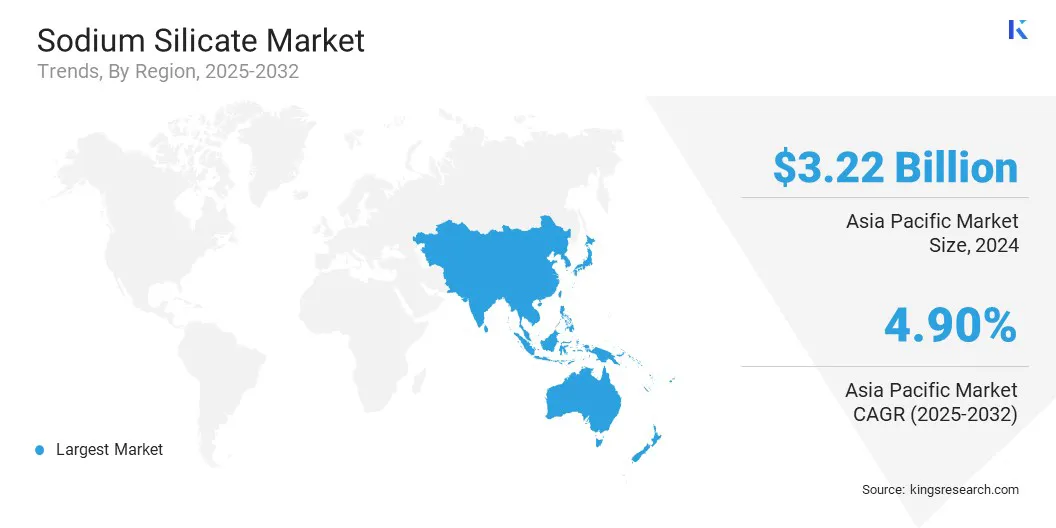
Asia Pacific sodium silicate market share stood at 41.54% in 2024, valued at USD 3.22 billion. This dominance is reinforced by the strong demand within sectors such as chemicals, pulp and paper, detergents, and construction, especially in countries such as China and India. Growing manufacturing activities throughout the region, continuous infrastructure projects, and rapid industrial growth have all contributed significantly to the increase in demand.
The easy access to raw materials and low-cost manufacturing, and increasing investments in the chemical industry have also strengthened the market position of the region. Stable growth in the upcoming years is also anticipated to be supported by the expanding use of sodium silicate in water treatment and eco-friendly cleaning products.
The North America sodium silicate market is set to grow at a CAGR of 3.96% over the forecast period, driven by both the stable demand from developed end-use industries and replenishment consumption, rather than capacity augmentations. Growth in the region is supported by strict environmental regulations that encourage the use of sodium silicate in wastewater treatment and emission-control applications.
Also, regular product innovations, a focus on specialty and high-purity products, and the presence of mature manufacturers will help ensure steady market development in the U.S and Canada.
Companies in the sodium silicate market are improving their production processes and increasing the efficiency of their operations to gain a competitive edge. Besides the legal and environmental requirements of significant uses such as water treatment, building, and laundry, most players are also focusing on maintaining quality products and constant supply.
To meet consumer demands and stay competitive, manufacturers are also introducing customized and application specific grades into their products. They are also broadening their presence by increasing their capacity, forming strategic alliances, and working in close coordination with the downstream industries so that they can have long-term supply agreements with other industries.
Frequently Asked Questions

Aswathi holds cross-domain expertise, translating market trends and competitive intelligence into decision-ready insights. Her work helps clients interpret evolving market conditions and identify growth opportunities. She brings a focused, insight-led approach to research execution. She translates these findings into clear, prioritized action plans that align with client capabilities. Her research often includes scenario modeling to test growth strategies under varying economic conditions. She maintains a rigorous validation process, cross-checking primary and secondary sources to ensure reliability. Clients value her ability to synthesize noisy data into concise executive summaries that drive board-level discussions. Her sector-specific lens, combined with a pragmatic focus on execution, consistently delivers high-impact, commercially sound recommendations. Her structured yet flexible research frameworks adapt to client timelines without compromising depth. She is known for distilling complex trade-offs into straightforward, defensible positions that facilitate confident decision-making.
Habi is a seasoned research and consulting leader with renowned experience in guiding clients on strategic growth and transformation initiatives across global markets. He has led high-performing research teams that deliver actionable insights on market expansion, M&A strategies, opportunity assessment, new business development, and product launches. His project portfolio spans large petrochemical producers, electronic device manufacturers, lubricants companies, and other leading enterprises across diverse industrial and consumer sectors. He currently heads the research department at Kings Research, where he is responsible for setting the research agenda, mentoring analysts, and ensuring client-ready deliverables that support executive decision-making. With extensive experience in market intelligence, strategic research, and consulting, Habi brings a strong understanding of evolving industry dynamics, competitive landscapes, emerging opportunities, and business growth challenges. His expertise includes developing research frameworks, translating complex market data into actionable strategic recommendations, and working closely with senior stakeholders to address critical business questions. He has also contributed to building research capabilities, strengthening analytical methodologies, and driving a culture of quality and insight-led decision-making within research teams. His cross-industry exposure enables him to connect market trends with broader business implications and provide perspectives that help organizations identify opportunities, mitigate risks, and make informed strategic decisions.