
Inquire Now
Key Strategic Points
Zero Trust Security refers to a paradigm of cybersecurity that presupposes no implicit trust on any user, device, or network, both within or outside the perimeter. It has a constant verification of identities and a strict access control with principles of least privilege, real-time monitoring and segmentation. This reduces the attack surfaces and minimizes the movement within the systems laterally, making it more resilient to advanced cyber threats.
The market comprises a variety of integrated cybersecurity solutions like identity and access management (IAM) to regulate user and device authentication, multi-factor authentication (MFA) to enhance identity verification, and micro-segmentation to separate segments of the network and limit access without authorization.
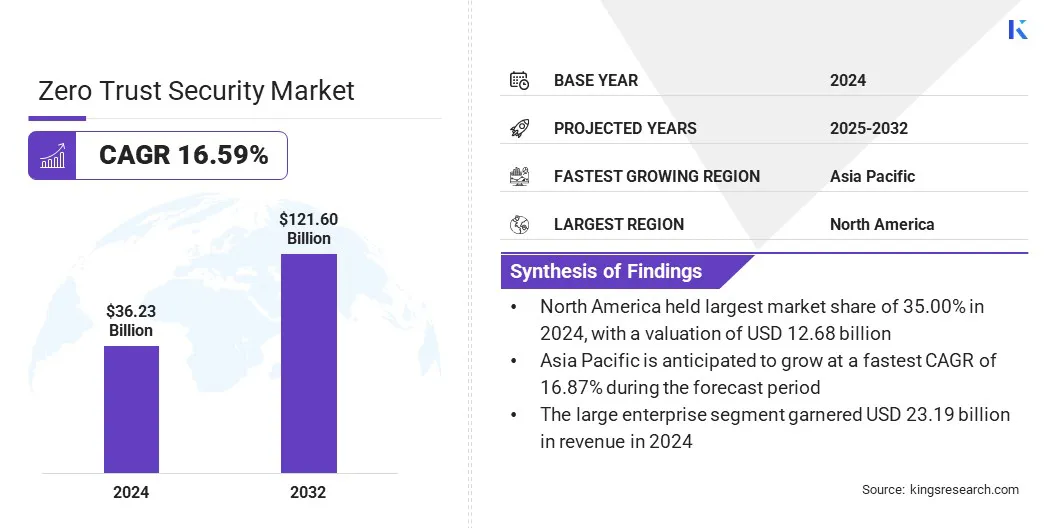
The global zero trust security market size was valued at USD 36.23 billion in 2024 and is projected to grow from USD 41.52 billion in 2025 to USD 121.60 billion by 2032, exhibiting a CAGR of 16.59% during the forecast period.
The market is experiencing a major transformation as organizations are shifting off the old, perimeter-based defenses and adopting a more holistic, identity-based approach. This development is directly connected to the increasing cyber threats, remote working, adoption of cloud technologies, and the burst of IoT devices. All of these factors have broadened the attack surface, making traditional security models less effective.
Major companies operating in the zero trust security industry are Palo Alto Networks, Zscaler, Inc., Cloudflare, Microsoft, Akamai Technologies, CrowdStrike, Cisco Systems, Inc., Netskope, Check Point Software Technologies Ltd., IBM, Delinea, Ivanti, Fortinet, Inc., Broadcom, and Nord Security.
As generative AI becomes more common, organizations are adopting strong security measures to ensure the safe and compliant use of AI technologies. Implementing zero trust architecture offers advanced security features, including real-time AI security posture, dynamic policy enforcement on the network edge, and central monitoring of AI model interactions.
These integrated security layers allow organizations to keep their data secure and compliant, facilitating the confident innovation of AI technology. The increasing advancements in AI technology have led to rapid investment in Zero Trust architecture, making it a necessity for AI security.
The increase in regulatory demands and the changing standards in cyber insurance are making zero trust a strategic decision and a non-negotiable operational imperative. In critical infrastructure industries, governments are enforcing stringent micro-segmentation and identity-based access control, making any operational failures in this area tantamount to legal liabilities.
Simultaneously, insurers employ zero trust adoption as a key underwriting criterion, either refusing coverage or imposing elevated premiums on businesses that do not demonstrate comprehensive, explicit oversight of all users and devices. Such regulations create a constant cycle of growth where organizations adopt these frameworks to maintain legal eligibility and financial protection, accelerating market expansion through mandatory compliance.
Comprehensive user and device verification is a challenge in the zero trust model as it demands a change in mindset from a one-time verification to a continuous model that never assumes trust. But achieving this state is technically challenging because organizations have to monitor various real-time factors like device health, location, and behavioral anomalies in highly distributed environments. In addition, there can be legacy environments that do not have modern API or MFA capabilities. Moreover, security teams have to deal with a friction paradox in which higher verification frequencies can negatively impact the user experience.
To mitigate this challenge of implementing zero trust, organizations are adopting integrated and adaptive security solutions that are equipped with continuous user and device verification and seamless authentication systems. Many organizations are now seeking to integrate their current systems with Zero Trust architectures. The goal is to ensure compliance and facilitate agile threat response, all while keeping productivity and user experience intact.
Zero trust Network Access (ZTNA) passwordless is gaining momentum in the market of zero trust security, as most vendors now seek superior and more convenient ways to authenticate users. This shift has brought an end to the use of traditional passwords which can be easily decrypted by cybercriminals.
It has also provided the use of other forms of more secure authenticators. This passwordless approach applies the fundamental concept of zero trust that requires every user to be continuously authenticated prior to accessing any resource since it requires constant validation instead of a single initial login.
|
Segmentation |
Details |
|
By Offering |
Network Security, Data Security, Endpoint Security, Cloud Security, API Security, IoT Security |
|
By Deployment Mode |
Cloud Based, On Premise |
|
By Authentication Type |
Single Factor Authentication, Multi-Factor Authentication |
|
By Organization Type |
Large Enterprise, Small and Medium Enterprise |
|
By End-user |
BFSI, IT and Telecommunications, Healthcare, Retail and E-commerce, Utilities, Others |
|
By Region |
North America: U.S., Canada, Mexico |
|
Europe: France, UK, Spain, Germany, Italy, Russia, Rest of Europe |
|
|
Asia-Pacific: China, Japan, India, Australia, ASEAN, South Korea, Rest of Asia-Pacific |
|
|
Middle East & Africa: Turkey, U.A.E., Saudi Arabia, South Africa, Rest of Middle East & Africa |
|
|
South America: Brazil, Argentina, Rest of South America |
Based on region, the zero trust security market has been classified into North America, Europe, Asia Pacific, Middle East & Africa, and South America.
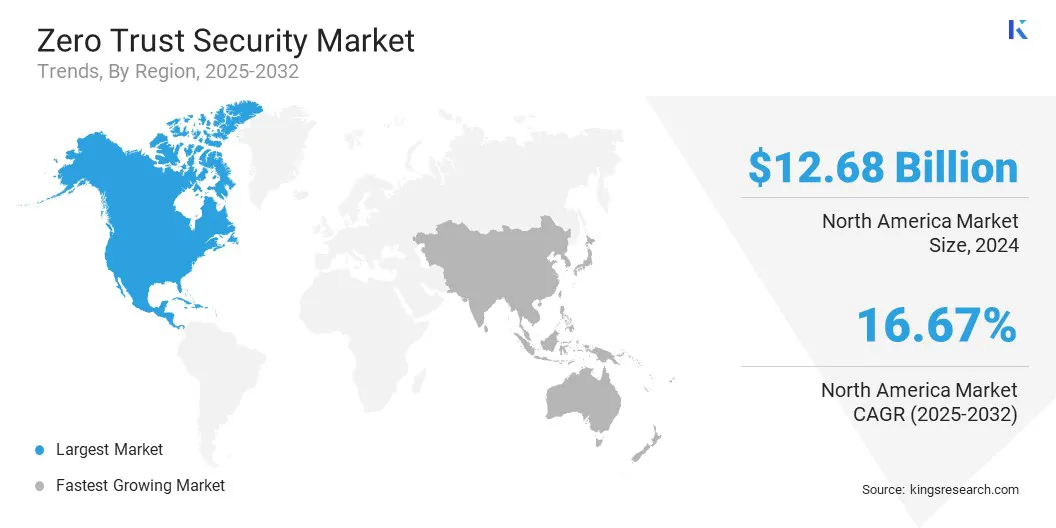
North America zero trust security market share of 35.00% in 2024 in the global market, with a valuation of USD 12.68 billion. The region has been witnessing growth due to strategic innovation in the form of simplifying the deployment process and increasing the level of automation to improve efficiency in operations.
The major players in the region are moving away from fragmented security systems to unified and cloud-delivered bundles that incorporate adaptive authentication, dark web credential monitoring, and endpoint security into one single interface.
Additionally, advanced real-time intelligence and patch management tools improve incident response efficiency. These strategies are designed for sectors in the region that are tightly regulated, such as finance and government, reinforcing North America’s leadership in delivering scalable, integrated zero trust frameworks.
The Asia Pacific zero trust security industry is expected to register the fastest growth in the market, with a projected CAGR of 16.87% over the forecast period. This growth is sustained by strategic partnerships that bring together superior zero trust security, cellular IoT, and operational technology networks to address critical weaknesses in distributed environments across Southeast Asia.
These partnerships combine expertise in connectivity management and AI-driven threat protection, which is critical for the continuous monitoring and response required for securing growing smart infrastructure. Additionally, there is a large-scale investment driving digital transformation by improving cloud infrastructure, artificial intelligence, and secure hybrid environments.
Both public and private investments are aimed at creating strong cloud services and digital ecosystems that are imperative to the fast development of connected devices and the growth of zero trust schemes in complicated and large-scale settings.
Key players are shifting from isolated security tools towards unified platforms that incorporate identity, device intelligence, and cloud access. Companies have also focused on AI-driven automation as a way to deliver proactive threat detection and remediation, which will ultimately reduce the overall IT workload.
There has been a major focus placed on the critical infrastructure's security, with providers using agentless and hardware-accelerated solutions to protect legacy infrastructure without impacting performance. The market has also witnessed the rise of Gen AI governance, with many tools monitoring AI engagements. By providing these services as simple packages, the companies have made them scalable for diverse industries.
Frequently Asked Questions

Siddhi specializes in primary and secondary research, with experience developing research frameworks and white papers that translate findings into clear business narratives. She has supported projects across diverse industries, delivering reliable insights aligned with client objectives. Her work is characterized by strong organization, clear communication, and consistent execution. Her expertise in structuring frameworks provides a solid foundation for data collection, while her white paper development translates figures into compelling executive storylines. Siddhi maintains consistency across complex, multi-phase projects, ensuring coherent, deadline-compliant deliverables. She adapts her communication to suit technical and non-technical stakeholders, bridging data and decision-making. Her disciplined workflow emphasizes error-free reporting and logical flow, earning consistent client praise. Siddhi synthesizes conflicting data, presenting balanced viewpoints that account for market uncertainties. Her portfolio reflects a track record of delivering polished, actionable documents that enhance business planning. With a pragmatic mindset, she prioritizes relevance and usability, ensuring her work addresses the strategic questions clients pose.

Ganapathy Subramaniam Suresh
With over a decade of research leadership across global markets, Ganapathy brings sharp judgment, strategic clarity, and deep industry expertise. Known for precision and an unwavering commitment to quality, he guides teams and clients with insights that consistently drive impactful business outcomes.