
Inquire Now
Key Strategic Points
The optometry equipment comprises devices used for diagnosing, monitoring, and treating vision-related disorders. It includes autorefractors, slit lamps, fundus cameras, optical coherence tomography scanners, and tonometers. These instruments support optometrists in assessing refractive errors, detecting ocular diseases, and ensuring effective eye care across hospitals, clinics, and specialized diagnostic centers.
The global optometry equipment market size was valued at USD 4.78 billion in 2024 and is projected to grow from USD 5.16 billion in 2025 to USD 9.09 billion by 2032, exhibiting a CAGR of 8.28% over the forecast period.
This growth is driven by the increasing demand for remote consultations, improved access to eye care, and technological advancements such as AI, virtual reality (VR), telemedicine, and computer simulations enabling accurate virtual diagnostics. The tele-optometry is further supporting early disease detection, reduces patient travel, and strengthens healthcare delivery efficiency worldwide.
Major companies operating in the optometry equipment market are ZEISS Group, Alcon Vision LLC, Topcon Corporation, NIDEK CO., LTD., EssilorLuxottica, Haag-Streit Group, Bausch + Lomb Incorporated, Johnson & Johnson, Revenio Group Oyj, Canon Medical Systems, Kowa Company, Ltd., OCULUS Optikgeräte GmbH, Visionix Ltd., Reichert Technologies, and Ziemer Ophthalmic Systems AG.
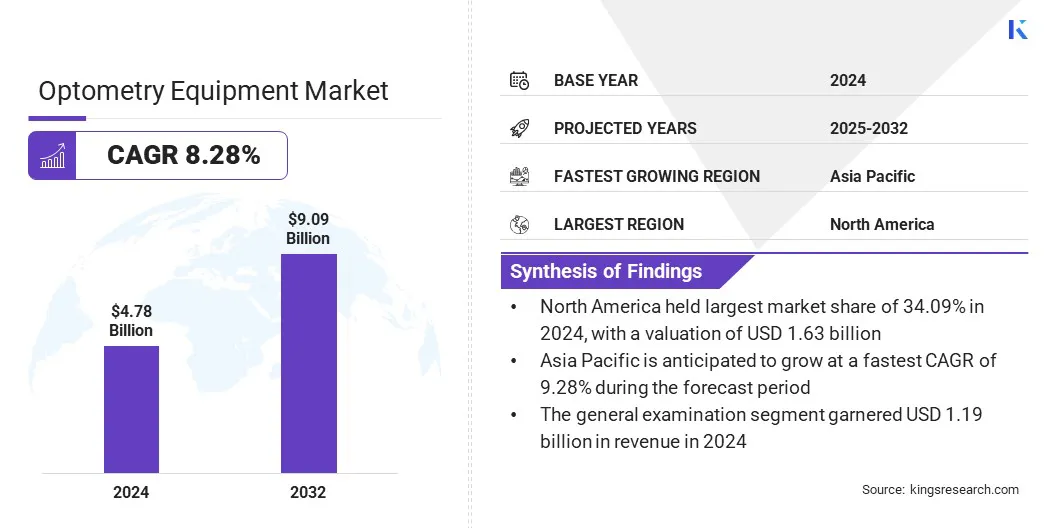
The expansion of telehealth and remote eye testing is propelling the growth in the market. The increasing deployment of digital platforms in hospitals and clinics allows accurate vision assessments and consultations in remote and underserved areas.
Furthermore, the development of portable diagnostic devices and mobile-based instruments is facilitating early detection of ocular diseases, while integration with telemedicine platforms is enhancing workflow efficiency. These factors are improving accessibility to eye care services and addressing the growing demand for cost-effective, advanced diagnostic solutions across hospitals, clinics, and specialized care centers.
Growing Prevalence of Eye Disorders
The growing prevalence of eye disorders is driving the expansion of the optometry equipment market. The rising incidence of cataracts, glaucoma, diabetic retinopathy, and myopia is increasing the demand for advanced diagnostic and monitoring devices. The aging population and lifestyle changes are further contributing to higher rates of vision impairment.
Clinics and hospitals are adopting advanced optometry equipment, including fundus cameras, OCT scanners, and tonometers, to support accurate diagnosis and effective treatment. Additionally, early detection and continuous monitoring have become critical in managing chronic ocular conditions, fostering innovations in precise optometry solutions globally.
High Cost of Advanced Diagnostic Equipment
The high cost of advanced diagnostic equipment poses a significant challenge to the expansion the optometry equipment market. Premium devices, including OCT scanners, fundus cameras, and autorefractors, require substantial capital investment, limiting adoption among smaller clinics and practices.
Moreover, ongoing maintenance, software updates, and training add to the financial expense. Price sensitivity in emerging markets further constrains widespread deployment, restricting access to advanced diagnostic capabilities and impacting market growth.
To address this challenge, companies are offering flexible financing options, leasing programs, and modular equipment designs. Manufacturers are reducing entry barriers through cost-effective and scalable solutions, enabling broader adoption of advanced diagnostic tools in diverse clinical settings.
Integration of AI in Diagnostic Imaging
A key trend influencing the optometry equipment market is the integration of artificial intelligence (AI) in diagnostic imaging. AI-enabled devices are improving accuracy in detecting ocular conditions, including diabetic retinopathy, glaucoma, and macular degeneration.
Additionally, these devices are able to streamline image analysis, reduce diagnostic time, and enhance decision-making for clinicians. Furthermore, the adoption of AI-integrated imaging platforms increased efficiency in clinics and hospitals by optimizing patient workflow and reinforcing diagnostic capabilities.
|
Segmentation |
Details |
|
By Type |
Refraction & Vision Testing, Diagnostic & Imaging, Surgical & Treatment |
|
By Application |
General Examination, Cataract, Glaucoma, Refractive Errors, Age related macular degeneration, Others |
|
By End User |
Hospital, Specialty clinics, Others |
|
By Region |
North America: U.S., Canada, Mexico |
|
Europe: France, UK, Spain, Germany, Italy, Russia, Rest of Europe |
|
|
Asia-Pacific: China, Japan, India, Australia, ASEAN, South Korea, Rest of Asia-Pacific |
|
|
Middle East & Africa: Turkey, U.A.E., Saudi Arabia, South Africa, Rest of Middle East & Africa |
|
|
South America: Brazil, Argentina, Rest of South America |
Based on region, the market has been classified into North America, Europe, Asia Pacific, Middle East & Africa, and South America.
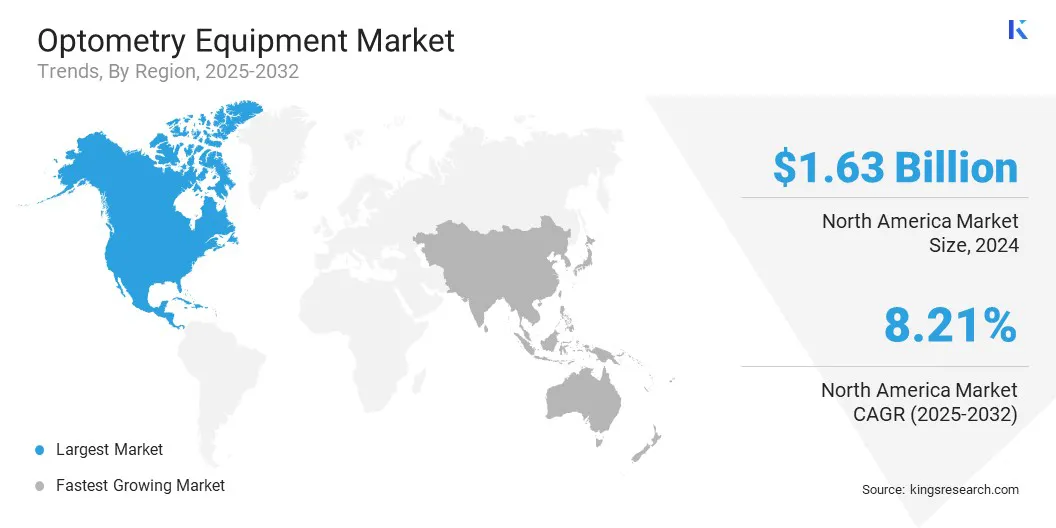
North America optometry equipment market share stood at 34.09% in 2024, with a valuation of USD 1.63 billion. This dominance is reinforced by the adoption of advanced diagnostic and imaging devices, driven by a well-established healthcare infrastructure and high awareness of eye care.
Increasing prevalence of ocular disorders and rising geriatric population in the region are further contributing to this growth. Moreover, market players in the region are focusing on technologically advanced optometry solutions and integrating them with digital platforms. These efforts are improving service efficiency and contributing to regional market growth.
Asia Pacific is set to grow at a robust CAGR of 9.28% over the forecast period. This growth is attributed with the expansion of healthcare access, rising awareness of eye care, and government as well as private sector initiatives to strengthen diagnostic infrastructure.
Additionally, the adoption of portable and tele-optometry devices in hospitals are improving accessibility in urban and rural areas. Moreover, technological advancements in imaging and AI-based diagnostics are further supporting domestic market expansion.
Key players in the market are focusing on strategic initiatives to sustain growth and maintain competitive advantage. Companies are actively investing in research and development to enhance diagnostic accuracy and expand product portfolios.
They are further adopting digital integration, AI-enabled imaging, and tele-optometry solutions, while also engaging in collaborations, mergers, and acquisitions to expand market presence and gain access to advanced technologies.
Frequently Asked Questions

Antriksh is an experienced analyst specializing in cross-domain research across diverse industries. With a strong foundation in data analysis and statistical interpretation, he delivers insightful market reports that guide strategic decision-making. Antriksh excels in conducting primary research, with a focus on identifying trends and understanding consumer behavior. Thriving in dynamic and high-pressure environments, he combines analytical expertise with a commitment to delivering impactful outcomes. Beyond his professional pursuits, Antriksh's passion for travel fuels his curiosity and broadens his perspectives, enriching his ability to uncover unique insights that enhance his research capabilities. He is equally adept at synthesizing quantitative findings with qualitative context, which allows him to present holistic viewpoints to clients. His disciplined work ethic and intellectual agility make him a trusted partner in navigating market uncertainties. He consistently seeks out new methodologies to refine his analytical toolkit, and his ability to communicate complex insights clearly ensures stakeholders act confidently on his recommendations.
With many years of consulting experience across global pharma, biotech, and MedTech markets, Minaz brings deep domain expertise, strategic clarity, and analytical rigor to every engagement. She has led 130+ consulting assignments spanning market entry, competitive landscaping, and portfolio prioritization, helping clients navigate complex, high-stakes decisions with confidence. Known for her ability to synthesize primary and secondary research into executive-ready recommendations, Minaz has built forecasting models and market sizing frameworks that have informed multi-million dollar investment decisions in oncology, diagnostics, and peptide therapeutics. Beyond her analytical strength, Minaz is a trusted client partner, translating complex datasets into clear, actionable insights for senior stakeholders. She currently leads a team of research analysts, driving business expansion, and shaping client engagement strategy.



.webp&w=128&q=75&dpl=dpl_CJzjB6WVUAT19Reax6v8xwinTPW6)
