
Inquire Now
Key Strategic Points
The omnichannel customer engagement solutions market refers to the different services and software that enable organizations to interact with customers across multiple communication channels such as email, SMS, push notifications, live chat, and messaging apps through a unified system. The platforms leverage real-time data, which is generally enhanced by AI/ML frameworks to identify customer preferences, behaviors, and optimal engagement times.
The platforms enhance customer experience, strengthen brand loyalty, and support long-term retention by ensuring the delivery of personalized and timely messaging, content, and product recommendations tailored to users.
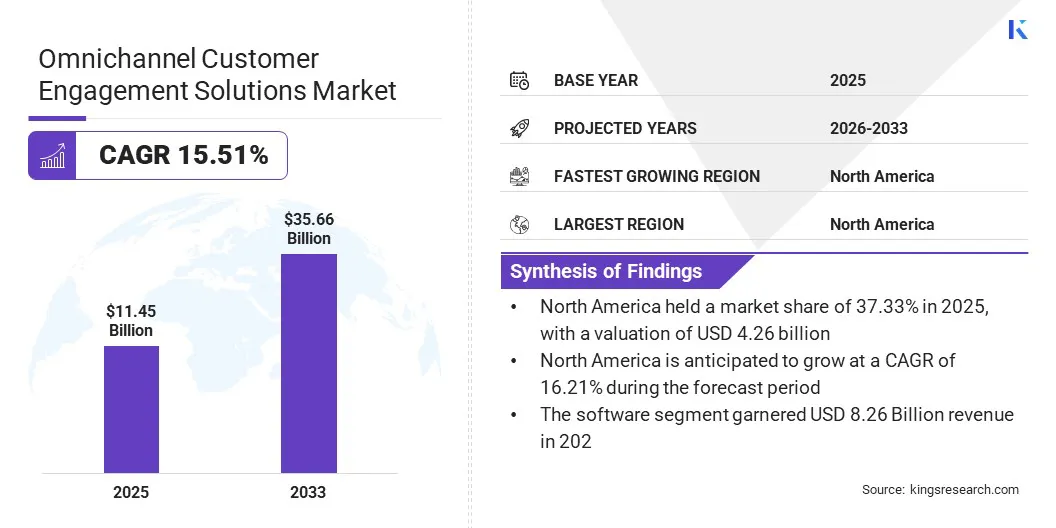
The global omnichannel customer engagement solutions market size was valued at USD 11.45 billion in 2025 and is projected to grow from USD 12.99 billion in 2026 to USD 35.66 billion by 2033, exhibiting a CAGR of 15.51% during the forecast period (2026 – 2033). This growth is driven by accelerated digitalization, which is transforming customer behavior owing to increased engagement across a fragmented mix of content channels.
This trend drives the demand for cohesive engagement strategies that integrate interactions across marketing and sales and thus aid businesses in gaining deeper insights and responding effectively to evolving consumer preferences.
Major companies operating in the global omnichannel customer engagement solutions industry are Adobe, Avaya LLC, eGain Corporation, Genesys, HubSpot, Inc., IBM Corporation, Microsoft, NICE, Oracle, Pegasystems Inc., Salesforce, Inc., SAP SE, Verint Systems Inc., Zendesk, Inc., and Zoho Corporation Pvt. Ltd.
Market players are restructuring their product offerings through the introduction of solutions incorporating agentic AI, which involves autonomous agents to interpret goals, coordinate actions across channels, and deliver seamless, end-to-end customer journeys. Additionally, the ability of agentic AI systems to enable seamless, connected experiences across multiple platforms, while simultaneously maintaining context, personalizing interactions, and proactively resolving issues, further acts as a major factor supporting industry expansion.
AI agents unify voice, chat, SMS, and other customer engagement channels into a single, continuous, context-aware experience while maintaining conversation history and intent across touchpoints, instead of treating each interaction separately. This enables customers to switch channels without repeating information. AI agents act as an intelligent interface by handling real-time conversations while preserving context and delivering human-like responses.
The systems are powered by natural language processing (NLP), machine learning (ML), and speech recognition to transform data into different formats, detect intent, interpret meaning, and execute tasks such as record updates, scheduling, or request resolution. This, in turn, enables the management of multi-turn conversations, automates workflows, and integrates directly with enterprise tools like CRMs and backend systems in omnichannel customer engagement platforms.
Delivering a consistent and seamless experience across all customer touchpoints, due to the presence of fragmented customer data, poses a major challenge. This leads to inconsistent customer experiences across channels, legacy technology limitations, inventory synchronization difficulties, and staff training gaps, which negatively impact customer satisfaction and operational efficiency.
To address these challenges, market players are introducing AI-powered omnichannel platforms to unify communication channels, automate workflows, improve real-time data management, and deliver seamless customer engagement experiences.
The rising demand for seamless, data-driven, and personalized experiences across all customer touchpoints is emerging as a notable market trend. The inclusion of data-driven personalized services enables enterprises to integrate online and offline channels to facilitate smooth movement for customers between digital platforms and physical stores. The trend is further accelerating the adoption of AI-powered automation and real-time analytics to improve personalization and respond faster to customer behavior.
Additionally, the adoption of mobile-first design and digital wallets to simplify transactions, along with the inclusion of voice assistants, immersive technologies like AR/VR, and gamification, is enhancing consumer engagement and creating market development avenues.
|
Segmentation |
Details |
|
By Component |
Software, Services |
|
By Organization Size |
Large Enterprises, Small and Medium Enterprises (SMEs) |
|
By Deployment Mode |
Cloud-based, On-Premises |
|
By Application |
Customer Data & CRM Platforms, Marketing Campaign Orchestration, Conversational Engagement (chatbots, messaging), Social Media Engagement, Others |
|
By End-User Industry |
Banking, Financial Services, and Insurance (BFSI), Commercial, Manufacturing, Food & Beverage, Pharmaceutical, Others |
|
By Region |
North America: U.S., Canada, Mexico |
|
Europe: France, UK, Spain, Germany, Italy, Russia, Rest of Europe |
|
|
Asia-Pacific: China, Japan, India, Australia, ASEAN, South Korea, Rest of Asia-Pacific |
|
|
Middle East & Africa: Turkey, U.A.E., Saudi Arabia, South Africa, Rest of Middle East & Africa |
|
|
South America: Brazil, Argentina, Rest of South America |
Based on region, the omnichannel customer engagement solutions market has been classified into North America, Europe, Asia Pacific, Middle East & Africa, and South America.
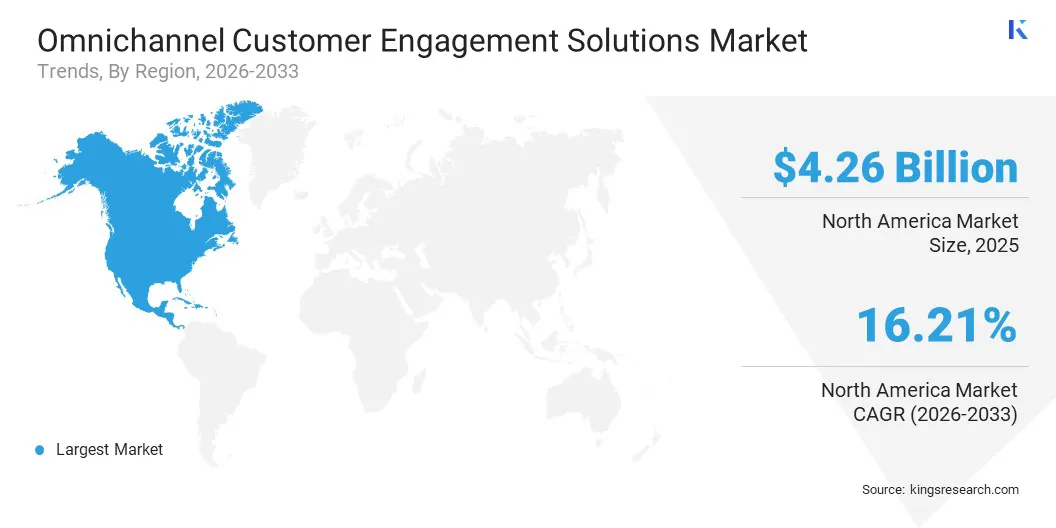
North America accounted for a substantial share of 37.33% in 2025, with a valuation of USD 4.26 billion. The high share is fueled by advanced digital infrastructure, technology leadership, and an extensive customer base, which drive innovation, adoption, and implementation of personalized products and service recommendations for consumers, thus refining the products and solutions associated with the omnichannel customer engagement solutions. The U.S. accounts for the majority of the share, due to its extensive retail and e-commerce ecosystem, leading to the widespread adoption of omnichannel customer engagement solutions.
In January 2026, Vonage launched Vonage Conversations for Agentforce Marketing, which integrates its Communications APIs directly into Salesforce’s Agentforce Marketing platform. The solution enables enterprises to manage two-way customer interactions across channels such as SMS, WhatsApp, and RCS within a single interface. The product combines live agents with agentic AI to support real-time insights, workflow automation, and hyper-personalized, omnichannel customer journey.
Europe is anticipated to grow at a CAGR of 16.21% over the forecast period. The growth rate is attributable to the rapid digital transformation and widespread adoption of AI-driven technologies. Enterprises are adopting unified omnichannel customer engagement solutions to facilitate seamless data interactions across digital platforms, contact centers, messaging apps, and in-person touchpoints. Additionally, strong regulatory frameworks associated with data privacy and customer protection are enabling organizations to implement integrated omnichannel customer engagement solutions that ensure secure and compliant data usage.
In February 2026, Worldline launched One Commerce platform at EuroShp 2026, which is a unified omnichannel retail vision designed to integrate payments, data, and technology to deliver seamless customer experiences across online and in-store channels. The platform improves operational efficiency, enables faster adoption of payment methods, and supports advanced analytics and real-time reporting.
Major players operating in the omnichannel customer engagement market are engaging in strategic mergers and acquisitions and launching innovative solutions to strengthen their market presence. The acquisitions reflect a broader industry transition to AI-driven, data-unified customer engagement ecosystems. Market players are emphasizing the consolidation of fragmented communication channels into unified platforms to improve customer experience, thus driving market development.
Frequently Asked Questions

Faizy brings over four years of experience in market research and consulting, with a proven ability to support strategic engagements across diverse industries and business environments. His work focuses on understanding complex market structures, identifying emerging opportunities, and translating research findings into clear, commercially relevant insights. With strong analytical capabilities and a structured approach to problem-solving, he evaluates industry trends, competitive landscapes, customer dynamics, and evolving business models. His expertise encompasses market research, competitive intelligence, market sizing and forecasting, industry assessment, company benchmarking, and strategic analysis. Faizy combines technical proficiency with a strong research orientation, enabling him to interpret both qualitative and quantitative information effectively. He has contributed to projects that help organizations assess growth potential, strengthen market positioning, and evaluate strategic priorities. His adaptable approach allows him to work across sectors while maintaining a consistent focus on accuracy, relevance, and delivering insights that support informed decision-making for clients and stakeholders.
Habi is a seasoned research and consulting leader with renowned experience in guiding clients on strategic growth and transformation initiatives across global markets. He has led high-performing research teams that deliver actionable insights on market expansion, M&A strategies, opportunity assessment, new business development, and product launches. His project portfolio spans large petrochemical producers, electronic device manufacturers, lubricants companies, and other leading enterprises across diverse industrial and consumer sectors. He currently heads the research department at Kings Research, where he is responsible for setting the research agenda, mentoring analysts, and ensuring client-ready deliverables that support executive decision-making. With extensive experience in market intelligence, strategic research, and consulting, Habi brings a strong understanding of evolving industry dynamics, competitive landscapes, emerging opportunities, and business growth challenges. His expertise includes developing research frameworks, translating complex market data into actionable strategic recommendations, and working closely with senior stakeholders to address critical business questions. He has also contributed to building research capabilities, strengthening analytical methodologies, and driving a culture of quality and insight-led decision-making within research teams. His cross-industry exposure enables him to connect market trends with broader business implications and provide perspectives that help organizations identify opportunities, mitigate risks, and make informed strategic decisions.