
Inquire Now
Key Strategic Points
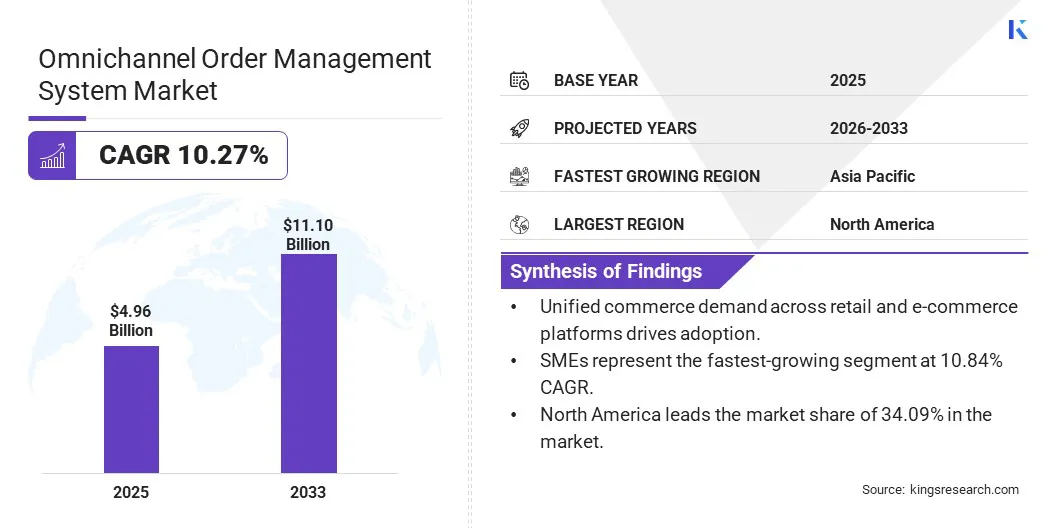
According to Kings Research, the global omnichannel order management system market size was recorded at USD 4.96 billion in 2025 and is projected to reach USD 11.10 billion by 2033, growing at a CAGR of 10.27% from 2026 to 2033. The market is expanding as retailers and e-commerce businesses seek to synchronize orders, inventory, fulfillment, and customer interactions across online and offline sales channels.
Growing consumer expectations for real-time inventory visibility, flexible delivery options, and seamless returns are encouraging businesses to adopt integrated order management platforms.
The increasing adoption of unified commerce is strengthening demand for omnichannel order management systems across retail and e-commerce operations. These platforms enable businesses to centralize order processing, coordinate inventory across multiple locations, optimize order routing, and support fulfillment models such as ship-from-store, buy online, pick up in-store (BOPIS), and same-day delivery. Advancements in cloud computing, artificial intelligence, automation, and API-based integration are further improving system scalability and operational efficiency.
The migration toward cloud-based and SaaS-based order management platforms is also reshaping the market landscape. Cloud-native architectures allow enterprises to integrate order management systems with enterprise resource planning (ERP), warehouse management systems (WMS), customer relationship management (CRM), e-commerce platforms, and logistics networks. This integration enables real-time data exchange and provides businesses with greater flexibility to respond to changing customer demand.
Major companies operating in the omnichannel order management system industry are Deck Commerce, IBM, Aptean, Manhattan Associates, SkuNexus LLC, Kibo Software, Inc., Veeqo Ltd, Fluent Commerce, Oracle, Cart.com, Inc., Blue Yonder Group, Inc., Baozun Inc., Deposco, Inc., SAP SE, and Salesforce.com, Inc.
The rapid expansion of e-commerce and direct-to-consumer commerce is increasing the need for centralized systems that can manage orders across websites, mobile applications, physical stores, marketplaces, and other digital channels. As retailers expand their presence across multiple sales touchpoints, managing different order flows and customer interactions becomes increasingly complex. Omnichannel order management platforms help businesses centralize order processing and coordinate transactions across channels, enabling more consistent customer experiences and supporting continued digital commerce expansion.
Growing demand for real-time inventory visibility is encouraging retailers to adopt omnichannel order management systems that connect inventory data across stores, distribution centers, warehouses, and fulfillment locations. Accurate inventory information enables businesses to display reliable product availability, reduce order cancellations, and make informed fulfillment decisions. By evaluating inventory proximity, customer location, delivery costs, and fulfillment capacity, these systems can support distributed order routing and improve inventory utilization while reducing fulfillment inefficiencies.
The increasing adoption of buy online, pick up in-store (BOPIS), curbside pickup, ship-from-store, and same-day delivery is creating additional demand for centralized order orchestration. These fulfillment models require retailers to coordinate digital orders with store-level inventory, labor capacity, order preparation, and pickup operations. By using physical stores as localized fulfillment hubs, retailers can reduce delivery distances and improve customer convenience, while integrated returns and reverse-logistics capabilities further strengthen the value of omnichannel order management platforms.
Integration complexity across legacy ERP, WMS, CRM, e-commerce, payment, and logistics systems remains a major barrier to omnichannel OMS adoption. Many enterprises operate multiple systems with different data structures, APIs, and operational processes. Connecting these environments can increase implementation time, integration costs, and migration risk.
System incompatibilities can also result in inventory discrepancies, delayed order updates, inconsistent customer information, and fragmented fulfillment workflows. Vendors are responding through API-based connectors, middleware platforms, microservices architectures, and modular deployment models that simplify integration with existing enterprise technology stacks.
Cloud-based and Software-as-a-Service (SaaS) platforms are reshaping omnichannel order management by providing scalable infrastructure, faster deployment, simplified maintenance, and subscription-based access. Cloud deployment reduces dependence on extensive on-premises infrastructure while enabling real-time access to order, inventory, and customer information.
Cloud-native architectures also facilitate integration with third-party e-commerce, logistics, payment, and analytics platforms. As businesses increasingly prioritize flexibility and faster time-to-value, cloud-based OMS platforms are expected to gain market share throughout the forecast period.
|
Segmentation |
Details |
|
By Component |
Solution and Services |
|
By Deployment |
On-premises and Cloud-based |
|
By Organization |
Small and Medium Enterprises, and Large Enterprises |
|
By Vertical |
Healthcare, Manufacturing, Food & Beverages, Automotive, Retail & E-commerce, and Others |
|
By Region |
North America: U.S., Canada, Mexico |
|
Europe: France, UK, Spain, Germany, Italy, Russia, Rest of Europe |
|
|
Asia-Pacific: China, Japan, India, Australia, ASEAN, South Korea, Rest of Asia-Pacific |
|
|
Middle East & Africa: Turkey, U.A.E., Saudi Arabia, South Africa, Rest of Middle East & Africa |
|
|
South and Central America: Brazil, Argentina, Rest of South and Central America |
Based on component, the market is categorized into solutions and services. The solution segment accounted for the largest market share in 2025, supported by growing demand for centralized platforms that manage order processing, inventory visibility, order routing, fulfillment orchestration, and returns across multiple sales channels.
The services segment is expected to register the fastest growth over the forecast period. Increasing system complexity and the need to integrate OMS platforms with ERP, WMS, CRM, e-commerce, logistics, and payment systems are encouraging enterprises to invest in consulting, implementation, integration, and managed services.
Based on deployment, the market is segmented into on-premises and cloud-based platforms. The on-premises segment accounted for the larger share, supported by demand among large enterprises for greater control over data, system customization, security, and integration with existing enterprise infrastructure.
Cloud-based OMS platforms are gaining adoption due to their scalability, lower infrastructure requirements, flexible subscription models, and faster deployment. Cloud platforms also facilitate integration with third-party applications and support real-time information sharing across geographically distributed operations. The growing preference for SaaS-based enterprise applications is expected to accelerate cloud-based OMS adoption.
Based on organization size, the market is divided into large enterprises and small and medium enterprises. Large enterprises accounted for the largest share in 2025, driven by complex supply chains, high order volumes, extensive store networks, multiple sales channels, and greater investment in enterprise technology infrastructure. Large retailers increasingly require centralized platforms capable of coordinating inventory and fulfillment across distribution centers, stores, online channels, marketplaces, and third-party logistics providers.
The small and medium enterprises segment is projected to register the fastest CAGR of 10.84% over the forecast period. Growing availability of cloud-based OMS platforms is reducing implementation barriers for SMEs by providing scalable functionality without requiring extensive upfront infrastructure investment.
The expansion of e-commerce marketplaces, direct-to-consumer business models, and digital payment infrastructure is further encouraging SMEs to adopt automated order management and fulfillment solutions.
By vertical, the market is segmented into healthcare, manufacturing, food & beverages, automotive, retail & e-commerce, and others. Retail & e-commerce represents a major application segment, supported by rapid digital commerce adoption and increasing demand for seamless shopping experiences across physical and digital channels.
Retailers are increasingly using OMS platforms to synchronize store and warehouse inventory, support BOPIS and ship-from-store fulfillment, automate distributed order routing, and manage returns across channels.
Based on region, the global omnichannel order management system market is classified into North America, Europe, Asia-Pacific, Middle East & Africa, and South & Central America.
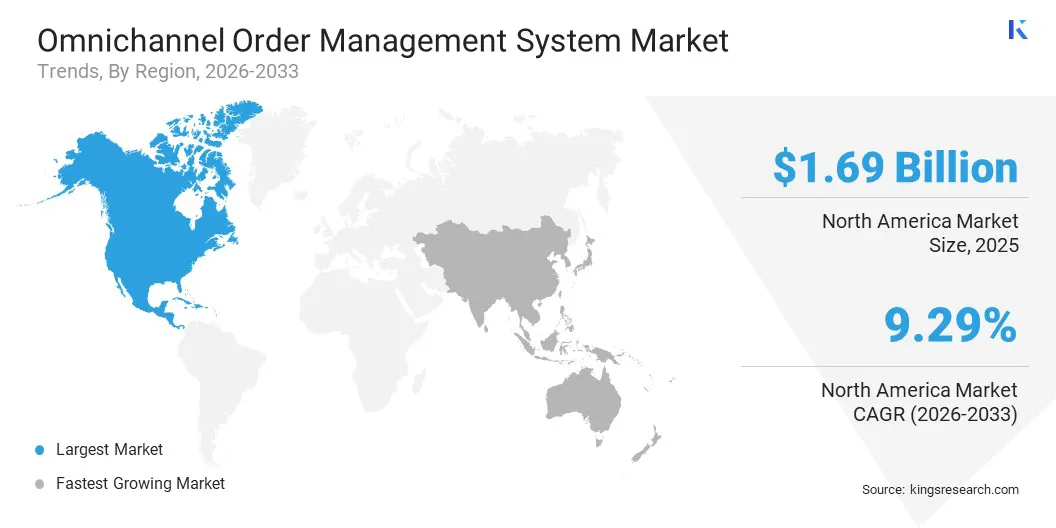
North America held the largest market share of 34.09% in 2025, with a market value of approximately USD 1.69 billion. According to Kings Research, the region's leading position is supported by its mature retail ecosystem, high e-commerce penetration, established technology infrastructure, and early adoption of advanced retail technology solutions.
Asia-Pacific is projected to be the fastest-growing regional market, supported by rapid e-commerce expansion, increasing smartphone and internet penetration, digital payment adoption, and growing investments in retail technology infrastructure. China, India, Japan, Australia, and Southeast Asian economies represent important markets for omnichannel order management adoption.
Europe, the Middle East & Africa, and South & Central America are witnessing growing adoption of omnichannel order management systems as retailers modernize digital commerce and fulfillment operations. Europe is supported by unified commerce, cross-border e-commerce, legacy system modernization, and growing demand for real-time inventory visibility. The Middle East & Africa is benefiting from digital transformation, retail modernization, e-commerce expansion, and investments in cloud infrastructure, particularly in the UAE and Saudi Arabia. South & Central America is experiencing increasing demand as retailers expand digital sales channels and modernize fulfillment and supply chain infrastructure, led by Brazil and Argentina. Overall, rising e-commerce penetration, flexible fulfillment models, and investments in digital supply chain technologies are expected to support market growth across these regions
The omnichannel order management system industry is characterized by the presence of several well-established technology providers and emerging vendors competing on the basis of platform scalability, integration capabilities, and user experience.
Key market participants are focusing on strategies such as enhancing real-time order visibility, incorporating artificial intelligence for demand forecasting, and streamlining multi-channel fulfillment processes. Companies are also investing in research and development to offer modular, cloud-native solutions that cater to specific industry verticals and enterprise sizes.
Furthermore, strategic partnerships with e-commerce platforms, logistics providers, and cloud service companies, along with mergers and acquisitions, are being pursued to expand global reach, improve implementation services, and deliver end-to-end order management solutions tailored to evolving business needs.
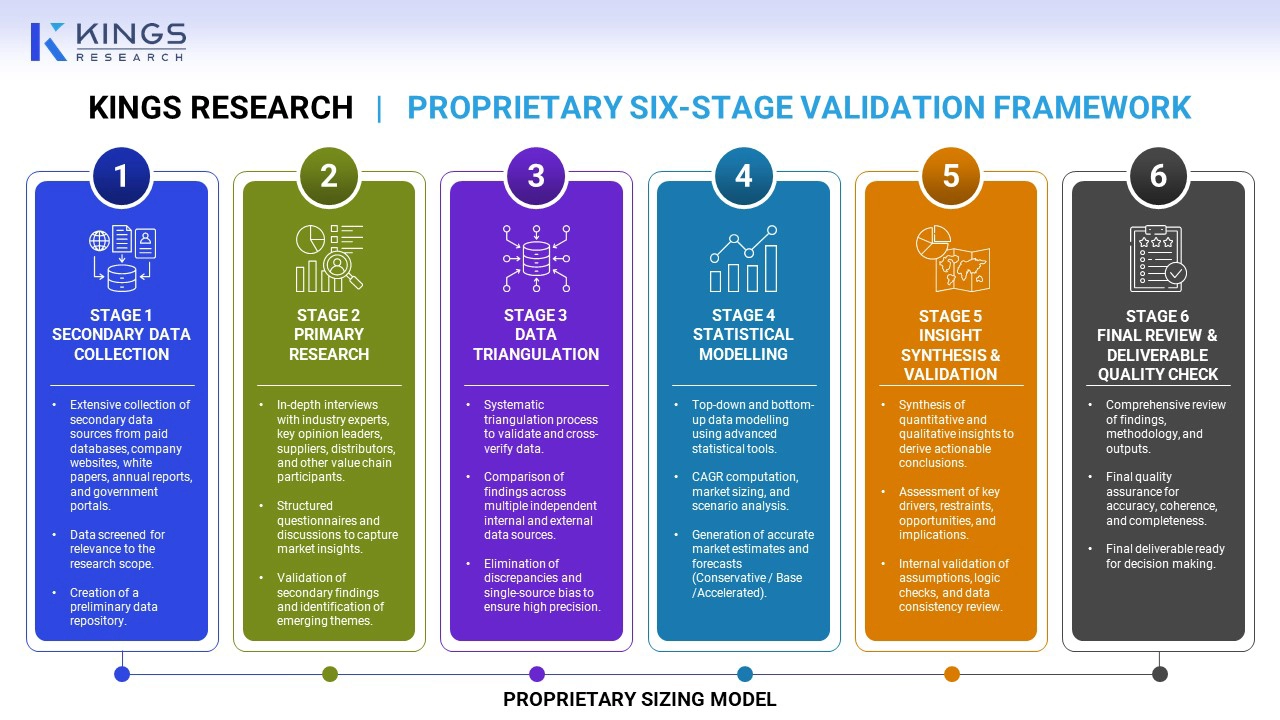
Our methodology triangulates insights from multiple independent and publicly available research databases and is further validated against regulatory filings and public company disclosures. All estimates are cross-verified; no single-source data is presented without validation.
Our custom offerings deliver tailored, data-driven intelligence and strategic guidance to help organizations identify, evaluate, and capitalize on key market opportunities.
Frequently Asked Questions

Over the years, Versha brings over 15 years of experience managing consulting assignments across industries, including Food and Beverage, Consumer Goods, ICT, Aerospace, and more. Her work has spanned diverse sectors. Her cross-domain expertise and adaptability make her a versatile and dependable professional. She is known for her keen business insight and foresight. With sharp analytical skills and a curious mindset, Versha excels at transforming complex data into actionable insights. She has a proven track record of unraveling market dynamics, identifying trends, and delivering tailored solutions to meet client needs. As a skilled leader, Versha has successfully mentored research teams and directed projects with precision, ensuring high-quality outcomes. Her collaborative approach and strategic vision enable her to turn challenges into opportunities and consistently deliver impactful results. Whether analyzing markets, engaging stakeholders, or crafting strategies, Versha draws on her deep expertise and industry knowledge to drive innovation and deliver measurable value.
Habi is a seasoned research and consulting leader with renowned experience in guiding clients on strategic growth and transformation initiatives across global markets. He has led high-performing research teams that deliver actionable insights on market expansion, M&A strategies, opportunity assessment, new business development, and product launches. His project portfolio spans large petrochemical producers, electronic device manufacturers, lubricants companies, and other leading enterprises across diverse industrial and consumer sectors. He currently heads the research department at Kings Research, where he is responsible for setting the research agenda, mentoring analysts, and ensuring client-ready deliverables that support executive decision-making. With extensive experience in market intelligence, strategic research, and consulting, Habi brings a strong understanding of evolving industry dynamics, competitive landscapes, emerging opportunities, and business growth challenges. His expertise includes developing research frameworks, translating complex market data into actionable strategic recommendations, and working closely with senior stakeholders to address critical business questions. He has also contributed to building research capabilities, strengthening analytical methodologies, and driving a culture of quality and insight-led decision-making within research teams. His cross-industry exposure enables him to connect market trends with broader business implications and provide perspectives that help organizations identify opportunities, mitigate risks, and make informed strategic decisions.



.webp&w=128&q=75&dpl=dpl_DPva2LrvfsBdTJm1XZj67UTrvMHL)
