
Inquire Now
Key Strategic Points
Natural fiber composites (NFCs) are materials combining a polymer matrix with natural fibers such as jute, flax, hemp, sisal, coir, or bamboo. They offer the strength and stiffness of natural fibers alongside the durability and processability of polymers. The NFCs market encompasses the production, processing, and application of these composites across industries such as automotive, construction, consumer goods, and aerospace.
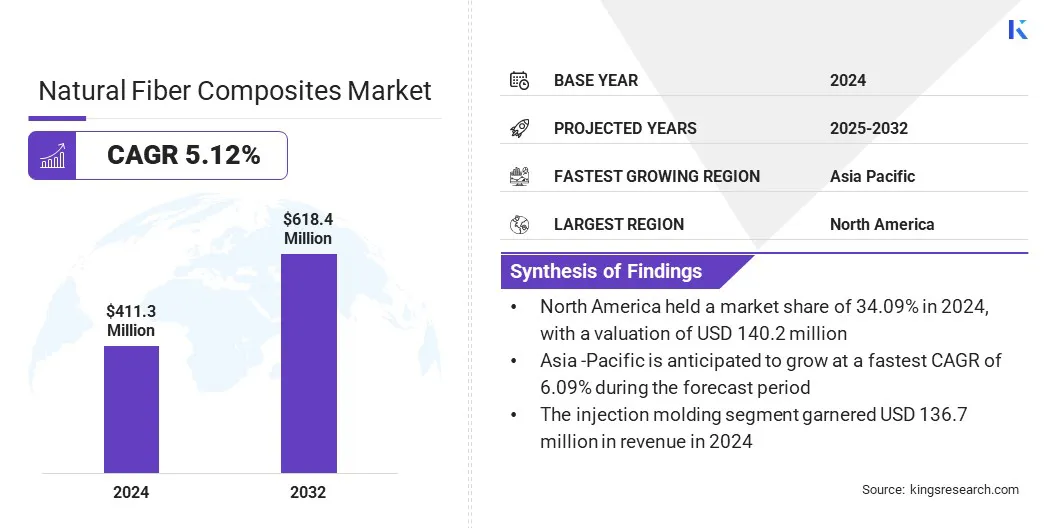
The global natural fiber composites market size was valued at USD 411.3 million in 2024 and is projected to grow from USD 430.5 million in 2025 to USD 618.4 million by 2032, exhibiting a CAGR of 5.12% over the forecast period.
This growth is driven by the growing emphasis on sustainable and biodegradable materials, fueled by stricter environmental regulations and increased consumer demand for eco-friendly products. Additionally, the expansion of the construction and packaging sectors is fueling the adoption of natural fiber composites across industrial and commercial applications.
Major companies operating in the natural fiber composites market are Bcomp Ltd, Tecnaro GmbH, UPM-Kymmene Oyj, FlexForm Technologies, Green Dot Bioplastics Inc, Polyvlies Franz Beyer GmbH, Procotex Corporation nv, NPSP BV, Lingrove, Inc, JELU-WERK J. Ehrler GmbH & Co. KG, GODAVARI BIOREFINERIES LTD, Plasthill Oy, Weifang Yunding Holding Group Co., Ltd, BUSS AG, and Procotex.
Rising light vehicle production is boosting demand for lightweight and sustainable materials in the automotive sector. Automakers are increasingly adopting natural fiber composites to reduce vehicle weight, improve fuel efficiency, and meet stricter environmental regulations. This shift toward eco-friendly materials is accelerating the adoption of bio-based composites, fostering market expansion.
Rising Consumer Preference for Eco-Friendly Products
A key factor propelling the growth of the natural fiber composites market is the rising consumer preference for eco-friendly products that reduce environmental impact and dependence on non-renewable materials.
Consumers are increasingly favoring products that incorporate bio-based fibers such as flax, jute, hemp, and kenaf, valued for their strength, lightweight properties, and recyclability. This shift is driving industries including automotive, construction, and packaging to adopt natural fiber composites. The growing awareness of carbon footprint reduction is further creating demand for sustainable materials that support regulatory compliance and corporate sustainability goals.
Inconsistent Quality and Variability of Natural Fibers
A key challenge impeding the growth of the natural fiber composites market is the inconsistent quality and variability of natural fibers. Their properties are highly dependent on environmental factors such as soil conditions, climate, and cultivation practices, resulting in fluctuations in strength, moisture absorption, and fiber length. These inconsistencies make it difficult for manufacturers to achieve uniform performance in the large-scale production of composite components.
To address this challenge, market players are increasingly investing in advanced fiber treatment and surface modification techniques to improve strength, durability, and moisture resistance.
They are also collaborating with agricultural partners to establish standardized cultivation practices and ensure a more uniform raw material supply. Additionally, integrating hybrid composites with synthetic reinforcements is improving performance consistency while maintaining sustainability benefits.
Expansion of NFC in Electric Vehicles
A key trend influencing the natural fiber composites market is their expanding use in electric vehicles. Automakers are integrating NFCs into interiors, body panels, and structural components to reduce weight, improve energy efficiency, and lower carbon emissions. This integration is enhancing vehicle range, supporting compliance with environmental regulations, and driving broader adoption of bio-based composites across the automotive sector.
|
Segmentation |
Details |
|
By Type |
Wood, Hemp, Flax, Jute, Others |
|
By Process |
Injection Molding, Compression Molding, Pultrusion, Others |
|
By End Use |
Automotive, Construction, Consumer Goods, Aerospace, Others |
|
By Region |
North America: U.S., Canada, Mexico |
|
Europe: France, UK, Spain, Germany, Italy, Russia, Rest of Europe |
|
|
Asia-Pacific: China, Japan, India, Australia, ASEAN, South Korea, Rest of Asia-Pacific |
|
|
Middle East & Africa: Turkey, U.A.E., Saudi Arabia, South Africa, Rest of Middle East & Africa |
|
|
South America: Brazil, Argentina, Rest of South America |
Based on region, the market has been classified into North America, Europe, Asia Pacific, Middle East & Africa, and South America.
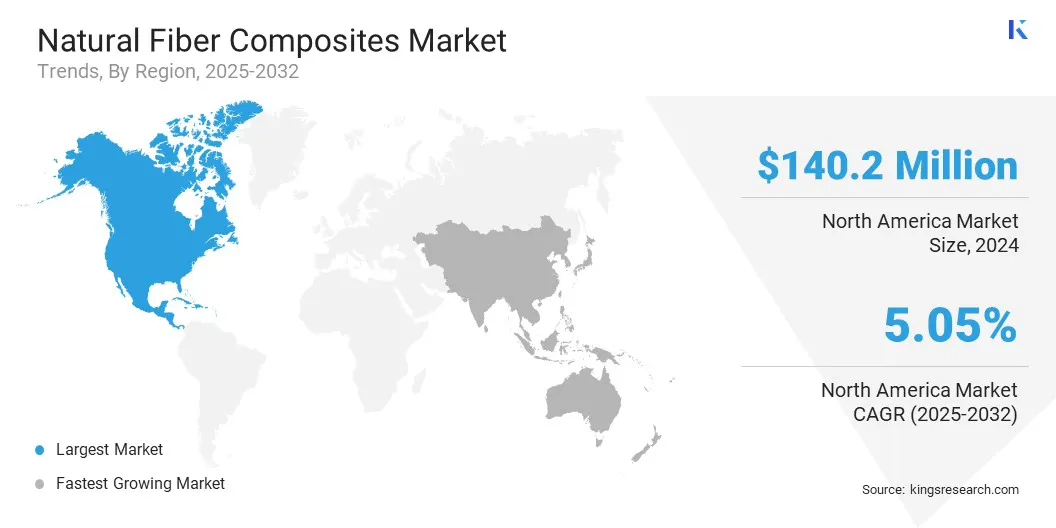
North America natural fiber composites market share stood at 34.09% in 2024, valued at USD 140.2 million. This dominance is reinforced by the increasing demand for lightweight materials in the automotive and transportation sectors across the region.
Stringent environmental regulations, including the U.S. Corporate Average Fuel Economy (CAFE) standards and California's Low-Emission Vehicle (LEV) regulations, are compelling manufacturers to adopt sustainable materials to meet fuel efficiency and emission targets. Rising consumer awareness and preference for eco-friendly products are prompting industries to replace conventional plastics with bio-based alternatives.
Technological advancements by regional players in fiber treatment and composite processing are enhancing material performance and consistency of natural fiber composite components. Additionally, the growth of electric and alternative energy vehicles is creating a strong demand for sustainable, high-performance components that reduce vehicle weight, thus aiding regional market expansion.
The Asia-Pacific natural fiber composites industry is set to grow at a robust CAGR of 6.09% over the forecast period. This growth is propelled by the increasing automotive production and rapid urbanization, generating demand for lightweight and sustainable materials.
Government initiatives, including China’s green building codes and India’s sustainable manufacturing incentives, are fostering the adoption of natural fiber composites in the automotive and construction sectors. The region’s abundant natural fibers, including jute, hemp, and coir, provide cost-effective raw materials. Additionally, rising investments by local manufacturers in advanced fiber processing are enhancing material quality and expanding industrial applications.
Competitive Landscape
Major players operating in the natural fiber composites industry are expanding production capabilities to meet growing demand for lightweight and sustainable materials.
They are focusing on strategic partnerships to scale the manufacturing of natural fiber composite components for automotive and specialty vehicles to enable efficient integration of eco-friendly materials. Additionally, players are investing in advanced fiber processing and surface treatment techniques to improve the strength, durability, and consistency of composite panels.
Frequently Asked Questions

Swati is a committed research analyst with a passion for optimizing systems and processes across industries, specializing in healthcare but also bringing valuable expertise to sectors such as consumer goods, life sciences, and more. Her cross-domain research approach allows her to generate clear, actionable reports that inform strategic decisions in a variety of fields. Swati is committed to staying ahead of evolving trends, leveraging her broad understanding of different sectors to provide insights that are relevant to a range of industries. In her personal time, she enjoys music and spending quality time with her family, which inspires her creativity and enriches her professional approach. Her systematic methodology ensures that every report is both thorough and practical. Swati's ability to bridge regulatory frameworks with market realities gives her recommendations a distinct edge. She collaborates seamlessly with cross-functional teams, distilling complex data into straightforward narratives. Her proactive monitoring of policy and technological shifts keeps her analysis forward-looking.

With over a decade of research leadership across global markets, Ganapathy brings sharp judgment, strategic clarity, and deep industry expertise. Known for precision and an unwavering commitment to quality, he guides teams and clients with insights that consistently drive impactful business outcomes.