
Inquire Now
Key strategic points
According to Kings Research, the global natural fiber market size was valued at USD 72.75 billion in 2025 and is projected to reach USD 106.94 billion by 2033, growing at a CAGR of 4.93% from 2026 to 2033.
The report covers products offered by companies such as Vardhaman Textiles Limited, Grasim Industries Limited, Bcomp, The Natural Fibre Company, Procotex, FlexForm Technologies, Bast Fibre Technologies Inc., Lenzing AG, Barnhardt Natural Fibers, Südwolle Group, The Schneider Group, HempFlax Group B.V., EcoTechnilin, Ludlow Jute & Specialities Limited, and Cheviot Company Limited. Natural fibers, sourced from plants, animals, and minerals, are gaining ground as a lower-impact alternative to synthetic materials across textiles, automotive, construction, and packaging applications. Kings Research finds that this shift is driven less by general consumer sentiment than by two concrete forces: brand-level sustainability commitments from major manufacturers and tightening regulatory requirements on material sourcing and end-of-life handling in key markets.
The Global Organic Textile Standard (GOTS) has played a measurable role in this shift by certifying organic-fiber products against defined environmental and social criteria, giving buyers a verifiable standard to specify against rather than relying on unverified sustainability claims.
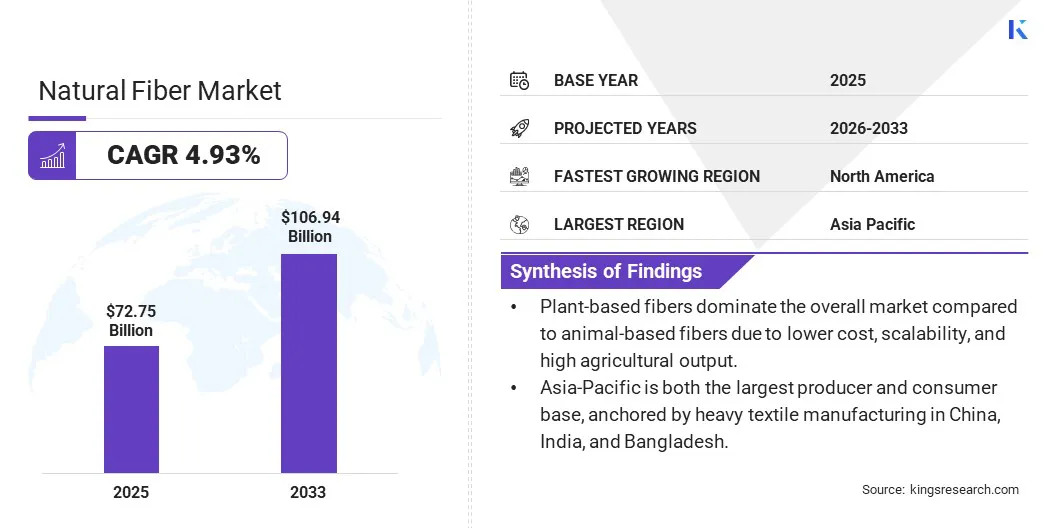
Rising brand-level commitments to sustainable sourcing are a primary driver of natural fiber demand. Natural fibers are biodegradable and renewable, making them an increasingly specified alternative to synthetic materials in textile, automotive, and packaging applications where manufacturers face growing pressure to document material provenance.
Automotive lightweighting mandates are pulling natural fiber composites into structural and visible vehicle components. In June 2025, Bcomp and the BMW Group confirmed series-production maturity for flax-based natural fiber composites, developed over several years through motorsport testing in BMW M programs. The companies report that replacing carbon fiber composites with natural fiber composites in a vehicle roof application reduces production carbon dioxide emissions by approximately 40%, thus illustrating a concrete performance and sustainability case scenario associated with natural fiber usage.
High production costs remain a significant restraint on the natural fiber market, particularly by reducing producer profitability and limiting incentives to expand acreage. According to the University of Georgia’s College of Agricultural and Environmental Sciences, U.S. cotton producers continue to face pressure from high input costs, elevated interest rates, weak cotton prices, and limited demand. U.S. cotton production generated positive returns in only 4 of the 28 years from 1997 to 2024, with average annual losses of approximately USD 113 per acre, and cotton prices are forecasted to remain relatively weak in 2026, with a working range of 64–70 cents per pound. These conditions constrain production expansion and encourage producers to focus on cost control, financial management, and proactive marketing strategies.
Automotive-grade biocomposite adoption is accelerating the integration of natural fibers into mainstream vehicle production, expanding their use beyond motorsport and niche applications. The adoption of natural fiber composites in series-production vehicles, including the BMW Group’s Neue Klasse platform featuring Bcomp’s flax-fiber-based solutions, highlights growing OEM acceptance of these materials for interior and exterior components. This trend is expected to strengthen demand for high-performance natural fibers, particularly flax, while encouraging investments in material engineering, lightweighting, and sustainable composite technologies.
|
Segmentation |
Details |
|
By Type |
Plant-based (Cotton, Linen, Jute, Hemp, Others), Animal-based Fiber (Wool, Silk, Others) |
|
By Application |
Apparel & Fashion Textiles, Home & Interior Textiles, Industrial Textiles, Others |
|
By Region |
North America (U.S., Canada, Mexico) Europe (France, U.K., Spain, Germany, Italy, Russia, Rest of Europe) Asia-Pacific (China, Japan, India, South Korea, Rest of Asia-Pacific) Middle East & Africa (Turkey, U.A.E., Saudi Arabia, South Africa, Rest of Middle East & Africa) South and Central America (Brazil, Argentina, Rest of South and Central America) |
The market is segmented based on type, application, and geography.
Plant-based fibers, including cotton, linen, jute, and hemp, account for the largest type share, at 67.41% in 2025, reflecting their established use in textiles alongside expanding applications in packaging and biocomposites. Advancements in processing technologies are extending plant-based natural fibers into higher-value applications beyond commodity textiles. Rising demand for sustainable natural fibers, aimed at reducing reliance on synthetic materials and lowering environmental impact, further strengthens the market growth of plant-based natural fibers across diverse end-use industry verticals.
The apparel & fashion textiles segment led end-use demand with a 49.32% share in 2025, driven by sustained demand for natural-fiber apparel and home textiles valued for comfort, breathability, and durability. The rising preference for breathable, comfortable, and sustainable apparel materials comprising cotton, wool, and hemp fuels the adoption of natural fibers in the apparel, fashion, and textile industries.
Based on region, the market is classified into North America, Europe, Asia-Pacific, Middle East & Africa, and South and Central America.
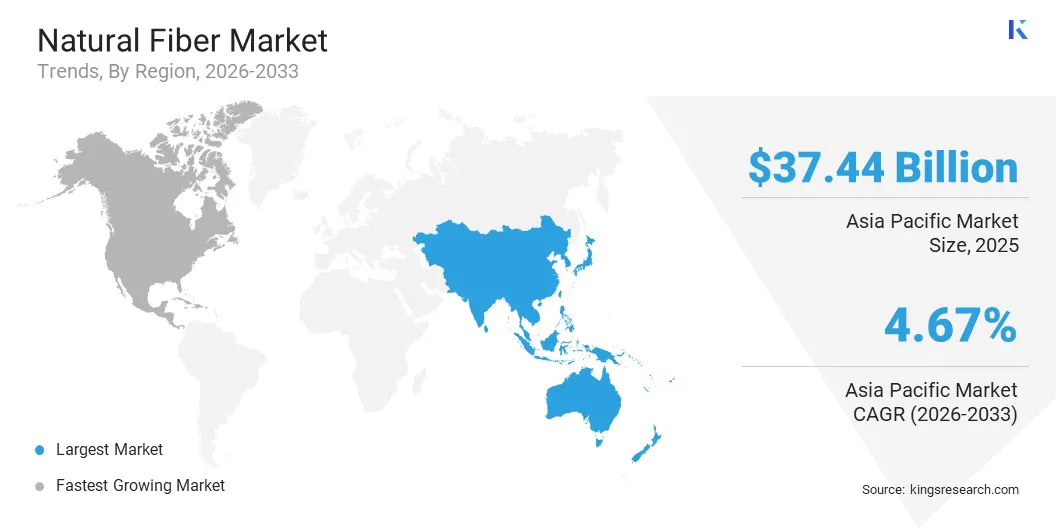
Asia-Pacific held the largest regional share, at 51.46% in 2025, valued at USD 37.44 billion, supported by the region's vast agricultural resource base, skilled processing labor force, and established manufacturing infrastructure across major fiber-producing countries, including China and India. The region is also anticipated to register the fastest regional CAGR, at 4.67%, over 2026 to 2033. The large textile and apparel manufacturing base of Asia-Pacific, particularly in countries comprising China, India, Bangladesh, and Vietnam, contributes towards the high demand for natural fibers. Additionally, rising consumer preference for sustainable materials, with increasing adoption of eco-friendly textiles, is poised to drive the demand for natural fibers in Asia-Pacific over the forecast interval.
The global natural fibers market is fragmented, with prominent players focusing on capacity expansion, strategic partnerships, product innovation, acquisitions, and the development of higher-value natural fiber applications to strengthen their market positions across regions. Competition is particularly evident across cotton, flax, hemp, jute, bamboo, regenerated cellulosic fibers, and natural-fiber composites, with companies increasingly targeting sustainable textiles, automotive interiors, construction materials, packaging, and other industrial applications.
Market players are investing in new production capacity, processing technologies, R&D, and supply-chain development to address rising demand for renewable and lower-impact materials. The market is also witnessing increasing commercialization of natural fibers in automotive and industrial applications, supporting the transition from conventional synthetic materials toward bio-based alternatives.
How We Gather This Information
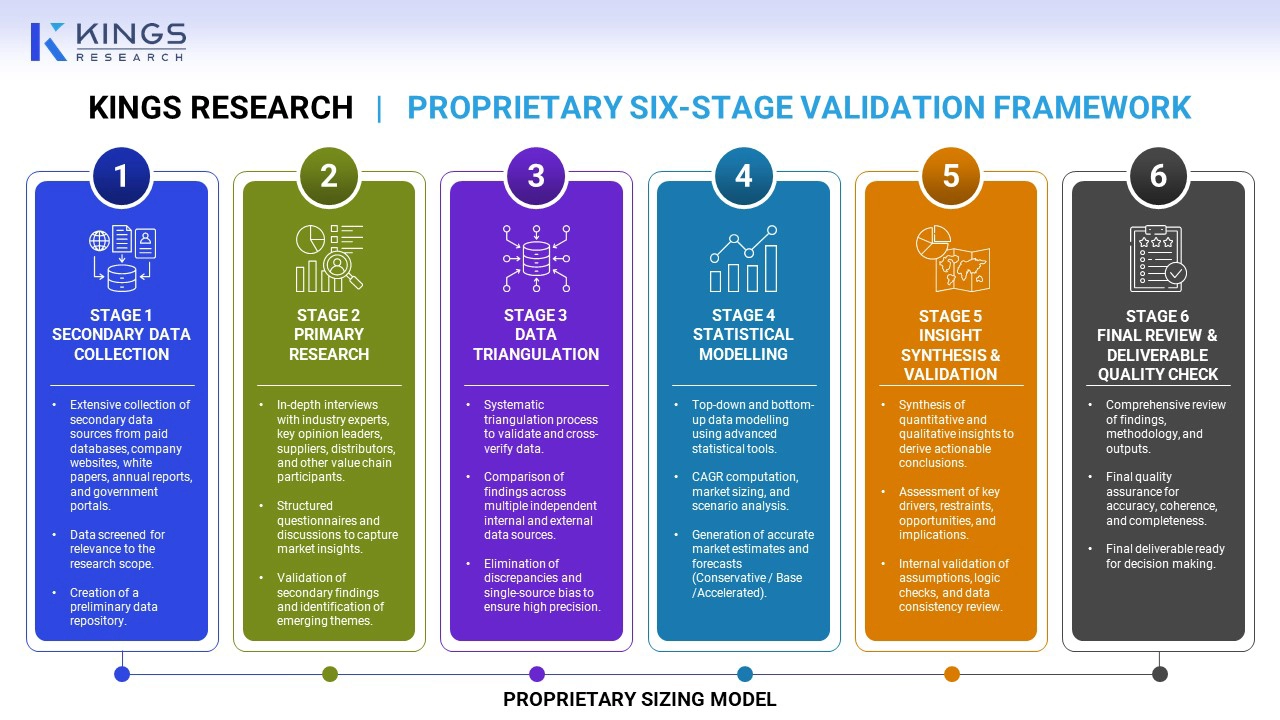
Our methodology triangulates insights from multiple independent and publicly available research databases, which is further validated against regulatory filings and public company disclosures. All estimates are cross-verified; no single-source data is presented without validation.
Our custom offerings deliver tailored, data-driven intelligence and strategic guidance to help organizations identify, evaluate, and capitalize on key market opportunities.
Frequently Asked Questions

Swati is a committed research analyst with a passion for optimizing systems and processes across industries, specializing in healthcare but also bringing valuable expertise to sectors such as consumer goods, life sciences, and more. Her cross-domain research approach allows her to generate clear, actionable reports that inform strategic decisions in a variety of fields. Swati is committed to staying ahead of evolving trends, leveraging her broad understanding of different sectors to provide insights that are relevant to a range of industries. In her personal time, she enjoys music and spending quality time with her family, which inspires her creativity and enriches her professional approach. Her systematic methodology ensures that every report is both thorough and practical. Swati's ability to bridge regulatory frameworks with market realities gives her recommendations a distinct edge. She collaborates seamlessly with cross-functional teams, distilling complex data into straightforward narratives. Her proactive monitoring of policy and technological shifts keeps her analysis forward-looking.
Habi is a seasoned research and consulting leader with renowned experience in guiding clients on strategic growth and transformation initiatives across global markets. He has led high-performing research teams that deliver actionable insights on market expansion, M&A strategies, opportunity assessment, new business development, and product launches. His project portfolio spans large petrochemical producers, electronic device manufacturers, lubricants companies, and other leading enterprises across diverse industrial and consumer sectors. He currently heads the research department at Kings Research, where he is responsible for setting the research agenda, mentoring analysts, and ensuring client-ready deliverables that support executive decision-making. With extensive experience in market intelligence, strategic research, and consulting, Habi brings a strong understanding of evolving industry dynamics, competitive landscapes, emerging opportunities, and business growth challenges. His expertise includes developing research frameworks, translating complex market data into actionable strategic recommendations, and working closely with senior stakeholders to address critical business questions. He has also contributed to building research capabilities, strengthening analytical methodologies, and driving a culture of quality and insight-led decision-making within research teams. His cross-industry exposure enables him to connect market trends with broader business implications and provide perspectives that help organizations identify opportunities, mitigate risks, and make informed strategic decisions.