
Inquire Now
Key Strategic Points
The market comprises technologies and software solutions that use statistical modeling, machine learning, and data mining techniques to forecast future outcomes based on historical data. These tools enable organizations to anticipate trends, identify risks, and make informed decisions that improve business performance.
The report covers segmentation by component, deployment type, enterprise type, vertical, and region, offering insights into adoption patterns, growth drivers, and emerging technologies. Predictive analytics is used across sectors such as finance, healthcare, retail, manufacturing, and transportation to enhance demand forecasting, fraud detection, and operational efficiency.
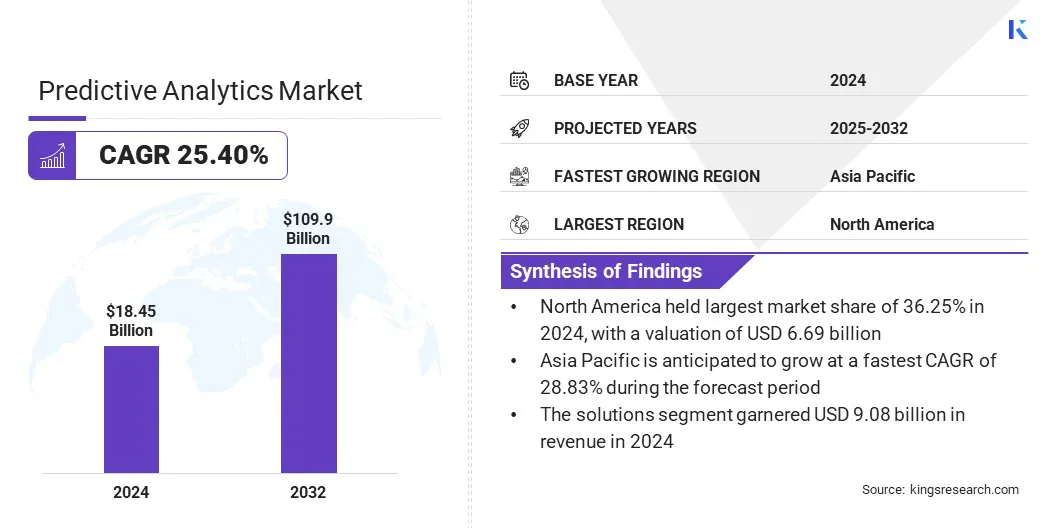
The global predictive analytics market size was valued at USD 18.45 billion in 2024 and is projected to grow from USD 22.54 billion in 2025 to USD 109.90 billion by 2032, exhibiting a CAGR of 25.40% during the forecast period.
Market growth is primarily driven by the rising adoption of artificial intelligence and machine learning technologies that enable accurate forecasting, trend analysis, and decision-making. The shift from traditional analytics tools to advanced predictive platforms is improving business intelligence, enhancing efficiency, and supporting proactive risk management.
Major companies operating in the predictive analytics market are IBM, SAP SE, Microsoft, SAS Institute Inc., Oracle, H2O.ai, Cloud Software Group, Inc., FICO, Alteryx, Salesforce, Inc., Verisk Analytics, Inc., Palantir Technologies Inc., Dataiku, LexisNexis, and Altair Engineering Inc.
Expanding digital transformation initiatives across industries such as finance, healthcare, manufacturing, and retail are further accelerating market adoption. Additionally, continuous advancements in big data processing, cloud-based analytics, and automation capabilities by technology providers are further supporting market growth.
The growth of the predictive analytics market is driven by the increasing emphasis on data-driven decision-making across industries seeking to improve operational efficiency and strategic outcomes. Enterprises are adopting predictive models to analyze historical and real-time data, enabling accurate forecasting, performance optimization, and proactive risk management.
Organizations in sectors such as finance, healthcare, retail, and manufacturing are leveraging these insights to enhance productivity and competitiveness. This shift toward evidence-based decision-making is further supported by expanding digital transformation initiatives and the growing availability of advanced analytics tools, thereby driving market growth.
Data quality and integration issues pose a major challenge to the growth of the predictive analytics market. Enterprises collect data from multiple internal and external sources, often leading to inconsistencies, duplication, and incomplete records that reduce the accuracy of analytical outcomes.
Ensuring data uniformity across structured and unstructured formats requires robust governance frameworks, and advanced data management tools. Integration is further complicated by legacy systems, disparate databases, and incompatible software environments that hinder seamless data flow.
To address these challenges, organizations are investing in data cleansing technologies, standardized integration platforms, and improved data governance practices to enhance the reliability and effectiveness of predictive analytics solutions.
The growing adoption of cloud-based predictive analytics is transforming how organizations manage and analyze data to improve decision-making and operational efficiency. Enterprises are shifting from traditional on premise systems to cloud platforms that offer scalability, flexibility, and cost efficiency while supporting faster deployment and real-time analytics.
This transition enables seamless integration with machine learning frameworks and big data tools, and enterprise applications, enhancing predictive accuracy and collaboration across business functions. As leading technology providers expand their cloud offerings, enterprises of all sizes are gaining access to advanced analytics capabilities, driving innovation, agility, and competitive advantage in increasingly data-driven business environments.
|
Segmentation |
Details |
|
By Component |
Solutions and Services |
|
By Deployment Type |
Cloud and On-premise |
|
By Enterprise Type |
Large Enterprises, and Small and Medium-sized Enterprises (SMEs) |
|
By Vertical |
Banking, Financial Services & Insurance (BFSI), Retail & E-commerce, Government & Defense, Healthcare & Life Sciences, Energy & Utilities, IT & Telecommunications, Transportation & Logistics, and Others |
|
By Region |
North America: U.S., Canada, Mexico |
|
Europe: France, UK, Spain, Germany, Italy, Russia, Rest of Europe |
|
|
Asia-Pacific: China, Japan, India, Australia, ASEAN, South Korea, Rest of Asia-Pacific |
|
|
Middle East & Africa: Turkey, U.A.E., Saudi Arabia, South Africa, Rest of Middle East & Africa |
|
|
South America: Brazil, Argentina, Rest of South America |
Based on region, the market has been classified into North America, Europe, Asia Pacific, Middle East & Africa, and South America.
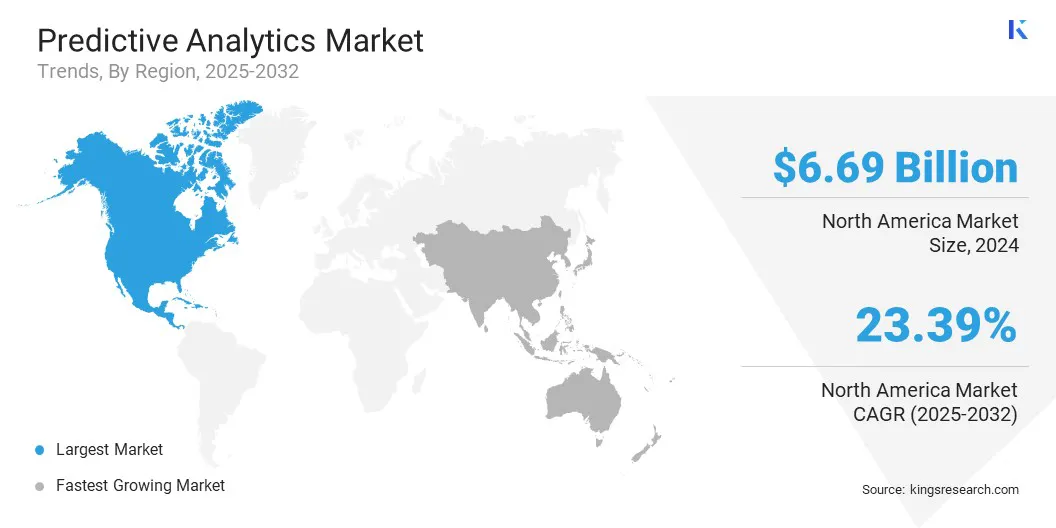
North America predictive analytics market share stood at 36.25% in 2024, valued at USD 6.69 billion. This dominance is attributed to the region’s advanced digital infrastructure, strong presence of cloud and AI technology providers, and early adoption of analytics-driven decision-making across industries.
Organizations in the region have embraced this approach by investing in enterprise data platforms, integrating AI and machine learning tools into core operations, and embedding predictive models into business processes such as demand forecasting, risk management, and customer analytics.
Increasing demand from sectors such as banking, healthcare, retail, and manufacturing continues to drive large-scale deployment of predictive analytics solutions to enhance operational efficiency and customer engagement.
Enterprises in North America are rapidly integrating predictive models into business intelligence and automation platforms to improve forecasting accuracy and strategic planning. The rising use of machine learning algorithms, coupled with growing investment in data management and governance frameworks, is further advancing analytics maturity across the region.
Moreover, partnerships between technology vendors and enterprises are fostering innovation in real-time data processing, enabling organizations to extract actionable insights and maintain a competitive edge in the market.
Asia Pacific predictive analytics industry is set to grow at a CAGR of 28.83% over the forecast period. This growth is driven by increasing digitalization across key sectors, rapid expansion of e-commerce and financial services, and growing reliance on data analytics for business optimization and customer engagement. Expanding cloud infrastructure and supportive government initiatives encouraging artificial intelligence adoption are further stimulating market development.
Additionally, enterprises are increasingly implementing predictive models to enhance operational efficiency, risk management, and demand forecasting. Continuous investment in analytics talent, software innovation, and regional data centers is improving accessibility and scalability of predictive solutions.
These advancements, combined with the growing presence of global and regional technology providers, are strengthening Asia Pacific’s position as one of the fastest-growing markets for predictive analytics worldwide.
Companies in the predictive analytics industry are strengthening their competitive position through investments in artificial intelligence, machine learning, and cloud-based analytics platforms. They are focusing on enhancing model accuracy, data integration, and real-time insight generation to meet diverse enterprise requirements across industries such as finance, healthcare, retail, and manufacturing.
Market players are expanding their portfolios with low-code platforms, automated workflows, and industry-specific predictive solutions to improve accessibility and scalability. Additionally, they are advancing their global presence and customer engagement through strategic partnerships, acquisitions, and collaborations with cloud providers, data management firms, and consulting organizations.
Frequently Asked Questions

Over the years, Versha brings over 15 years of experience managing consulting assignments across industries, including Food and Beverage, Consumer Goods, ICT, Aerospace, and more. Her work has spanned diverse sectors. Her cross-domain expertise and adaptability make her a versatile and dependable professional. She is known for her keen business insight and foresight. With sharp analytical skills and a curious mindset, Versha excels at transforming complex data into actionable insights. She has a proven track record of unraveling market dynamics, identifying trends, and delivering tailored solutions to meet client needs. As a skilled leader, Versha has successfully mentored research teams and directed projects with precision, ensuring high-quality outcomes. Her collaborative approach and strategic vision enable her to turn challenges into opportunities and consistently deliver impactful results. Whether analyzing markets, engaging stakeholders, or crafting strategies, Versha draws on her deep expertise and industry knowledge to drive innovation and deliver measurable value.

Ganapathy Subramaniam Suresh
With over a decade of research leadership across global markets, Ganapathy brings sharp judgment, strategic clarity, and deep industry expertise. Known for precision and an unwavering commitment to quality, he guides teams and clients with insights that consistently drive impactful business outcomes.



.webp&w=128&q=75&dpl=dpl_DPva2LrvfsBdTJm1XZj67UTrvMHL)