
Inquire Now
Key Strategic Points
The fiber glass market focuses on the production, distribution, and sale of fiber glass, a reinforced plastic material made from fine glass fibers. The market encompasses a range of products and applications, including building materials, automotive parts, wind power, electronics, and consumer goods. The industry comprises raw material suppliers, manufacturers, distributors, and end-users who use fiber glass for its lightweight nature, durability, and versatility.
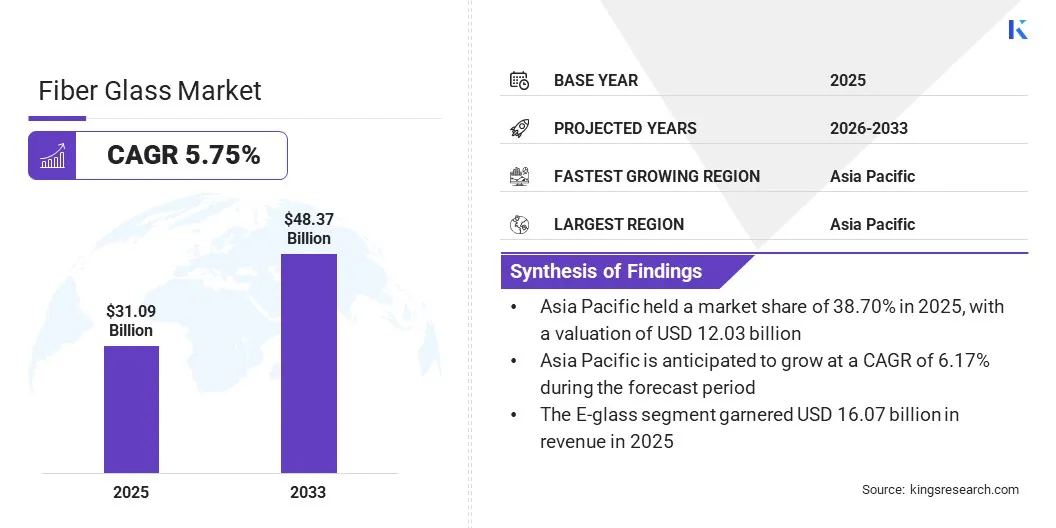
The global fiber glass market size was valued at USD 31.09 billion in 2025 and is projected to grow from USD 32.70 billion in 2026 to USD 48.37 billion by 2033, exhibiting a CAGR of 5.75% over the forecast period. This growth is fueled by the increasing penetration of fiber glass-based products in various industries, which in turn increases demand for advanced materials with enhanced durability and performance characteristics. Furthermore, changes in industry standards and quality expectations are prompting manufacturers to improve production systems, resulting in greater consistency and adherence to international specifications.
Major companies operating in the global fiber glass industry are Owens Corning, China Jushi Co., Ltd., Johns Manville, Knauf Group, Chongqing Polycomp International Corporation (CPIC), 3B - the fiberglass company, CHANGZHOU TIANMA GROUP CO., LTD., Augusta Fiberglass Coatings, CTG Group, CHANGZHOU JLON COMPOSITE CO., LTD., Strongwell Corporation, Bedford Reinforced Plastics, SAERTEX GmbH & Co. KG., AGY Holding Corp, and Shandong fiber glass Group Corp.
Market players are expanding their portfolios by launching innovative fiber glass solutions for specific applications. Major players are adopting advanced manufacturing technologies and automation to improve efficiency and quality control, and are strengthening their supply chain networks to meet regional demand fluctuations and drive continued market growth.
Fiber glass is widely used in construction for insulation, cladding, roofing, and reinforcement materials owing to its excellent strength-to-weight ratio, durability, and resistance to moisture and corrosion. Additionally, the thermal and acoustic insulation properties make it a preferred choice in residential and commercial buildings, contributing to better energy efficiency and occupant comfort.
In addition, the increased emphasis on sustainable and green building practices has driven the use of fiber glass products that help in reducing energy consumption and meeting stringent regulatory requirements. The demand for fiber glass is likely to remain strong amid rising global construction activities.
Raw materials such as silica sand, limestone, soda ash, and specialty resins can be subject to price volatility due to supply and demand imbalances, geopolitical tensions, and energy price fluctuations. Such unexpected price fluctuations can hurt manufacturers’ profit margins, impair long-term planning, and lead to variability in consumer prices.
To overcome this challenge, industry players are increasingly focusing on advanced contracts and forming strategic partnerships with raw material suppliers. In addition, investments in recycling initiatives and alternative sourcing strategies can help stabilize manufacturing costs and protect businesses from market volatility.
Manufacturers are increasingly leveraging automation, robotics, and digital monitoring systems to optimize their production processes, improve product consistency, and enhance operational efficiency. These technologies enable real-time quality control, reduce human error, and minimize waste, leading to cost savings and higher-quality outputs.
Additionally, the adoption of Industry 4.0 principles, such as IoT-enabled equipment and data analytics, is allowing companies to streamline supply chains and respond more effectively to market demands. This digital transformation boosts productivity and supports the development of innovative fiber glass products tailored to evolving customer needs.
|
Segmentation |
Details |
|
By Type |
A-Glass, C-Glass, E-Glass, AE-Glass, ECR-Glass, Others |
|
By End User Vertical |
Automotive, Aerospace and Defense, Building and Construction, Industrial, Others |
|
By Region |
North America: U.S., Canada, Mexico |
|
Europe: France, UK, Spain, Germany, Italy, Russia, Rest of Europe |
|
|
Asia-Pacific: China, Japan, India, Australia, ASEAN, South Korea, Rest of Asia-Pacific |
|
|
Middle East & Africa: Turkey, U.A.E., Saudi Arabia, South Africa, Rest of Middle East & Africa |
|
|
South America: Brazil, Argentina, Rest of South America |
Based on region, the global market has been classified into North America, Europe, Asia Pacific, Middle East & Africa, and South America.
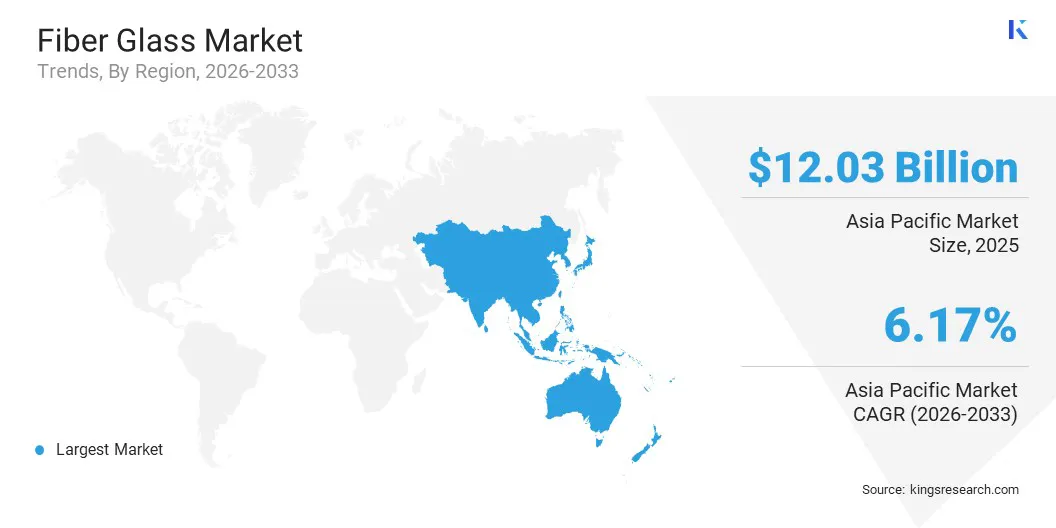
Asia Pacific fiber glass market share stood at 38.70% in 2025, with a valuation of USD 12.03 billion. This dominance is attributed to the region’s strong industrial base, rapid urbanization, and increasing infrastructure projects across various countries. The availability of large manufacturing hubs and supportive government policies prompting industrialization have resulted in growing investment in fiber glass manufacturing capacities.
Furthermore, increasing usage of fiber glass in the developing industries such as wind energy, electronics, and consumer durables has propelled regional market expansion. Competitive pricing, abundant raw material availability, and growing exports have also positioned Asia Pacific as a key region for fiber glass.
Europe fiber glass market is set to grow at a CAGR of 5.82% over the forecast period. This upward trajectory is facilitated by the region’s focus on technological innovation and the development of advanced composite materials for high-performance applications. The growing implementation of stringent energy efficiency standards and sustainability goals has increased the adoption of fiber glass in building renovation, automotive lightweighting, and renewable energy applications such as wind turbine manufacturing.
The strong partnerships between research institutions and industry players are generating opportunities for product innovation and enhanced material performance. In addition, the presence of well-established automotive and aerospace industries, coupled with rising investments in green construction materials, is anticipated to stimulate regional market growth.
The fiber glass market is characterized by the presence of several established global players alongside emerging regional manufacturers. The key players are concentrating on expanding their product portfolios and investing in R&D and innovative manufacturing techniques to stay competitive in the market. The companies are also concentrating on mergers and acquisitions, expansions, and collaborations to strengthen their market position and gain a new customer base.
In addition, leading players are focusing on sustainability by introducing eco-friendly and recyclable fiber glass products. The market's competitive intensity is also being boosted by the continuous launch of specialized solutions for the automotive, construction, aerospace, and renewable energy industries, leading to constant innovation and differentiation.
Key Companies in The Fiber Glass Market
Frequently Asked Questions

Aswathi holds cross-domain expertise, translating market trends and competitive intelligence into decision-ready insights. Her work helps clients interpret evolving market conditions and identify growth opportunities. She brings a focused, insight-led approach to research execution. She translates these findings into clear, prioritized action plans that align with client capabilities. Her research often includes scenario modeling to test growth strategies under varying economic conditions. She maintains a rigorous validation process, cross-checking primary and secondary sources to ensure reliability. Clients value her ability to synthesize noisy data into concise executive summaries that drive board-level discussions. Her sector-specific lens, combined with a pragmatic focus on execution, consistently delivers high-impact, commercially sound recommendations. Her structured yet flexible research frameworks adapt to client timelines without compromising depth. She is known for distilling complex trade-offs into straightforward, defensible positions that facilitate confident decision-making.
Habi is a seasoned research and consulting leader with renowned experience in guiding clients on strategic growth and transformation initiatives across global markets. He has led high-performing research teams that deliver actionable insights on market expansion, M&A strategies, opportunity assessment, new business development, and product launches. His project portfolio spans large petrochemical producers, electronic device manufacturers, lubricants companies, and other leading enterprises across diverse industrial and consumer sectors. He currently heads the research department at Kings Research, where he is responsible for setting the research agenda, mentoring analysts, and ensuring client-ready deliverables that support executive decision-making. With extensive experience in market intelligence, strategic research, and consulting, Habi brings a strong understanding of evolving industry dynamics, competitive landscapes, emerging opportunities, and business growth challenges. His expertise includes developing research frameworks, translating complex market data into actionable strategic recommendations, and working closely with senior stakeholders to address critical business questions. He has also contributed to building research capabilities, strengthening analytical methodologies, and driving a culture of quality and insight-led decision-making within research teams. His cross-industry exposure enables him to connect market trends with broader business implications and provide perspectives that help organizations identify opportunities, mitigate risks, and make informed strategic decisions.