
Inquire Now
Key Strategic Points
The dimethyl carbonate market encompasses the manufacturing, distribution, and commercialization of dimethyl carbonate (DMC). This chemical serves as a solvent, a methylating agent, and an intermediate in the manufacturing of different products. Its market includes multiple segments such as pharmaceuticals, polycarbonate plastics, paints & coatings, and fuel additives, which are utilized in various industrial applications that demand efficient and eco-friendly chemical solutions.
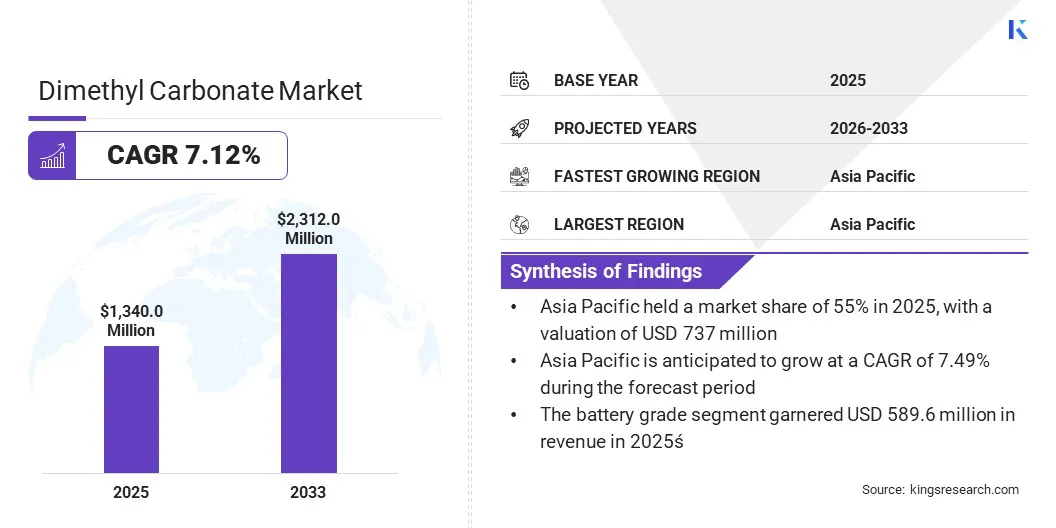
The global dimethyl carbonate industry size was valued at USD 1,340 million in 2025 and is projected to grow from USD 1,428.1 million in 2026 to USD 2,312 million by 2033, exhibiting a CAGR of 7.12% during the forecast period. This growth is driven by aggressive demand for high-purity DMC in lithium-ion batteries and advanced electronics. The market is witnessing advanced technological developments in the synthesis process that lead to higher product quality and efficiency.
Major companies operating in the global market are UBE Corporation, Shinghwa Advanced Material Group Co.,Ltd, KOWA AMERICAN CORPORATION, Hi-tech Spring, Shandong Hualu-Hengsheng Chemical Co., Ltd, Kishida Chemical Co., Ltd., LOTTE Chemical Corporation, Thermo Fisher Scientific Inc., Shandong depu chemical industry science & technology co.,ltd, Tokyo Chemical Industry Co.,Ltd, SMC GLOBAL, Henan GP Chemicals Co.,Ltd, Hefei TNJ Chemical Industry Co., Ltd., Mitsui Fine Chemicals, Inc., and Merck KGaA.
Companies in the market are building large-scale, eco-friendly production facilities and employing innovative purification processes to comply with high-quality standards already seen in the industry. The advancements help to ensure product uniformity and meet the performance needs of EVs and energy storage solutions. Consequently, greater supply reliability and product quality are boosting the role of DMC in key applications, thereby helping to drive the market growth during the forecast period.
The demand for polycarbonates across multiple industries is a significant driver for the dimethyl carbonate market. Polycarbonates possess high strength, transparency and versatility, desirable qualities that make them well-suited to the automotive, electronics, construction, consumer goods, and medical device sectors. Demand for DMC is growing along with the increasing use of polycarbonate products.
In the automotive sector, for instance, polycarbonate is used in the manufacture of lightweight parts to make vehicles more fuel-efficient; in electronics, it's employed in optical discs and electrical housings. The inclusion of polycarbonate across industries directly contributes to the growth of the demand for dimethyl carbonate, which plays a key role in the global supply chains.
Supply-demand imbalance and low production capacity are major market challenges for companies involved in the production of dimethyl carbonate. Many sectors, such as pharmaceuticals, polycarbonates, and battery manufacturing, have observed significant demand that has exceeded the production capacity, leading to shortages and volatility. The market is also constrained by the limited availability of raw materials and by the fact that production is complex and capital-intensive, which makes it difficult for companies to rapidly increase production.
To overcome these obstacles, firms are investing in new production plants, optimizing supply chains, and investing in new manufacturing technologies. In addition, strategic partnerships and sourcing diversification are underway to provide greater capacity, reliability and a better match of supply with the changing market demand.
The dimethyl carbonate market is shifting rapidly to battery-grade purity, as demand for high-performance lithium-ion batteries in electric vehicles and in portable electronics grows. Impurities in battery-grade DMA are extremely low to ensure the best battery efficiency, safety, and lifespan. Manufacturers are continuing to invest in state-of-the-art purification technologies and to improve their production processes to meet these high-quality standards.
This shift is gaining more investors and partnerships between chemical producers and battery manufacturers. Furthermore, with the increasing global electrification, the market is likely to strengthen on battery-grade dimethyl carbonate, with purity and quality emerging as key differentiators.
|
Segmentation |
Details |
|
By Grade |
Battery grade, Industrial grade, and Pharmaceutical grade |
|
By Synthesis Method |
Oxidative carbonylation of methanol, Transesterification, Urea transesterification, Phosgenation process, and CO₂-based direct synthesis |
|
By Application |
Battery electrolyte, Polycarbonate synthesis, Solvents, Reagents (methylating agents, intermediates), and Fuel additives/pesticides/others |
|
By End-Use Industry |
Plastics (polycarbonate production), Battery/Electronics, Paints & coatings, Pharmaceuticals, Agrochemicals, and Adhesives & sealants/others |
|
By Region |
North America: U.S., Canada, Mexico |
|
Europe: France, UK, Spain, Germany, Italy, Russia, Rest of Europe |
|
|
Asia-Pacific: China, Japan, India, Australia, ASEAN, South Korea, Rest of Asia-Pacific |
|
|
Middle East & Africa: Turkey, U.A.E., Saudi Arabia, South Africa, Rest of Middle East & Africa |
|
|
South America: Brazil, Argentina, Rest of South America |
Based on region, the global dimethyl carbonate market has been classified into North America, Europe, Asia Pacific, Middle East & Africa, and South America.
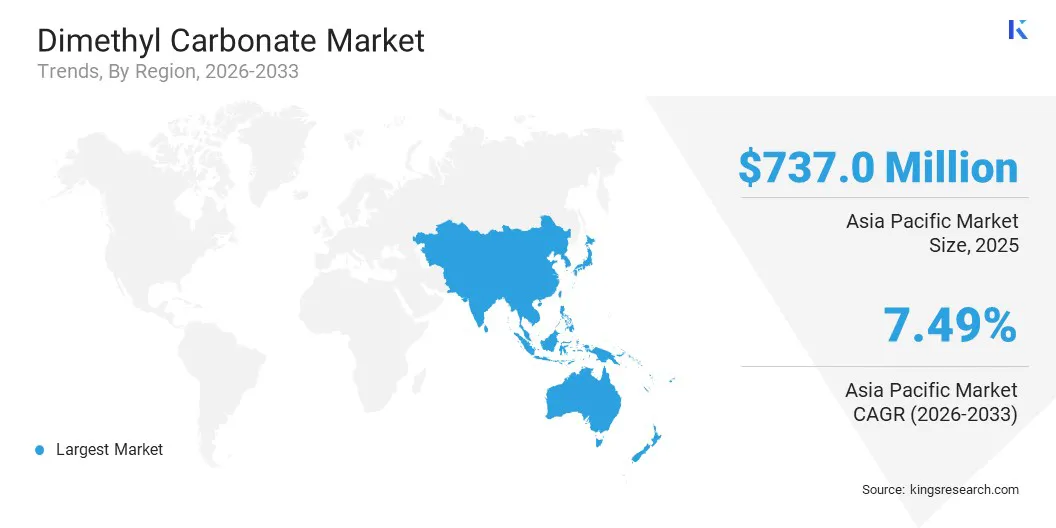
Asia Pacific dimethyl carbonate market share stood at 55% in 2025, valued at USD 737 million. This substantial market presence is supported by a strong regional manufacturing base, ongoing industrialization, and growing demand from critical industries like electronics, automotive, and chemicals. The region has access to low-cost raw materials, technological advancements, and skilled workforce, which, in combination, make it a leader in production and consumption. Moreover, the market opportunities are getting enhanced with the continuous rise in research and development investment and the introduction of eco-friendly and effective materials.
The Europe dimethyl carbonate industry is set to grow at a CAGR of 7.13% over the forecast period, with a focus on environmentally-friendly chemicals and stricter regulatory standards. The use of DMC is surging in various end-use applications, especially in industries seeking sustainable options to minimize carbon footprint and achieve green chemistry goals in the region.
On-going innovations in the chemical industry and the introduction of new advanced production processes are further driving market growth. Furthermore, industry collaborations with academia are driving new applications, while investments in research are stimulating innovative applications. This environment positions Europe as a progressive market, responsive to evolving industry trends and sustainability goals.
The dimethyl carbonate market is characterized by the presence of both global and regional players, each striving to strengthen their market position through strategic initiatives. The leading companies are interested in increasing their production capacity, improving product purity and investing in new technological manufacturing.
Expansion through partnerships, mergers and acquisitions are frequently used to diversify product lines and market opportunities. Besides, many participants are focusing on sustainability principles and working towards adopting eco-friendly production practices and adhering to new regulations. Staying competitive in the market depends on a company’s ability to innovate and respond to new market needs.
Frequently Asked Questions

Aswathi holds cross-domain expertise, translating market trends and competitive intelligence into decision-ready insights. Her work helps clients interpret evolving market conditions and identify growth opportunities. She brings a focused, insight-led approach to research execution. She translates these findings into clear, prioritized action plans that align with client capabilities. Her research often includes scenario modeling to test growth strategies under varying economic conditions. She maintains a rigorous validation process, cross-checking primary and secondary sources to ensure reliability. Clients value her ability to synthesize noisy data into concise executive summaries that drive board-level discussions. Her sector-specific lens, combined with a pragmatic focus on execution, consistently delivers high-impact, commercially sound recommendations. Her structured yet flexible research frameworks adapt to client timelines without compromising depth. She is known for distilling complex trade-offs into straightforward, defensible positions that facilitate confident decision-making.
Habi is a seasoned research and consulting leader with renowned experience in guiding clients on strategic growth and transformation initiatives across global markets. He has led high-performing research teams that deliver actionable insights on market expansion, M&A strategies, opportunity assessment, new business development, and product launches. His project portfolio spans large petrochemical producers, electronic device manufacturers, lubricants companies, and other leading enterprises across diverse industrial and consumer sectors. He currently heads the research department at Kings Research, where he is responsible for setting the research agenda, mentoring analysts, and ensuring client-ready deliverables that support executive decision-making. With extensive experience in market intelligence, strategic research, and consulting, Habi brings a strong understanding of evolving industry dynamics, competitive landscapes, emerging opportunities, and business growth challenges. His expertise includes developing research frameworks, translating complex market data into actionable strategic recommendations, and working closely with senior stakeholders to address critical business questions. He has also contributed to building research capabilities, strengthening analytical methodologies, and driving a culture of quality and insight-led decision-making within research teams. His cross-industry exposure enables him to connect market trends with broader business implications and provide perspectives that help organizations identify opportunities, mitigate risks, and make informed strategic decisions.