
Inquire Now
Key Strategic Points
The digital asset management (DAM) market offers software, tools, and services that help organizations store, manage, and organize digital assets and retrieve them. These resources include images, videos, documents, audio files, and other multimedia, and they can also be shared using DAM systems. These systems assist businesses in streamlining their digital content workflows, enhancing collaboration, and ensuring brand consistency.
They also improve general productivity through the provision of centralized repositories, metadata management, access controls, versioning, and the ability to integrate with other platforms.
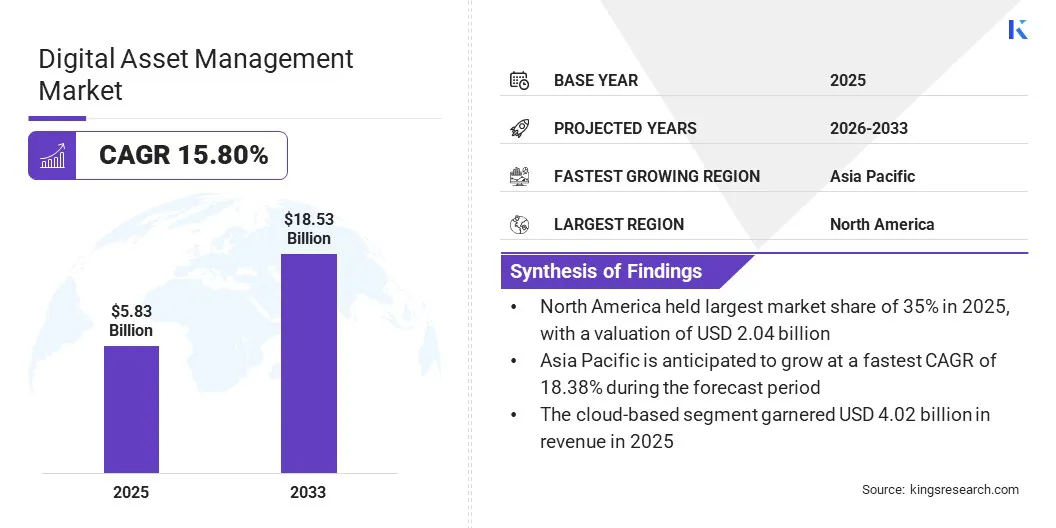
The global digital asset management market size was valued at USD 5.83 billion in 2025 and is projected to grow from USD 6.64 billion in 2026 to USD 18.53 billion by 2033, exhibiting a CAGR of 15.80% during the forecast period. This robust growth is being fueled by the increasing volume of digital content, the surge in omni channel marketing strategies, and the adoption of advanced technologies such as agentic AI.
Major companies operating in the global digital asset management industry are Adobe, Canto, Inc., Acquia, Inc., Oracle, Sitecore A/S, Bynder, Hyland, Aprimo, IBM, Brandfolder Digital Asset Management, Orange Logic, OpenText Corporation, MediaValet, Cloudinary, and CELUM.
Companies are investing in DAM solutions to automate asset workflows, improve brand consistency, and respond effectively to the evolving dynamics of digital channels. With businesses actively focusing on effective content management and faster asset delivery, the DAM market is poised to experience long-term growth and innovation in the years to come.
The rapid expansion of omnichannel marketing strategies is a pivotal driver. Contemporary organizations aim to deliver integrated and customized brand experiences across a multitude of digital touchpoints, including websites, social media, mobile applications, and email campaigns. This transition requires seamless coordination and allocation of digital assets to ensure consistency and relevance.
DAM solutions have become vital tools, allowing organizations to centralize their media libraries, automate their asset management processes, and ensure that the right content is delivered to the right audience at the right time. The necessity of effective asset management has been accelerating the adoption of DAM platforms as companies aim to engage customers with integrated, cross-channel campaigns.
Successfully integrating digital asset management (DAM) systems with existing enterprise software is one of the most persistent challenges organizations face. Companies often rely on a diverse ecosystem of software tools for marketing, content management, collaboration, and analytics. Ensuring seamless interoperability between DAM systems and these existing platforms can be technically difficult, time-consuming, and expensive. Without effective integration, digital assets remain siloed, resulting in workflow inefficiencies and reduced asset utilization.
To overcome these obstacles, businesses are considering DAM solutions that feature strong APIs and offer integration with popular enterprise apps. Additionally, companies are engaging IT stakeholders early in the selection and implementation process to achieve easier integrations and ensure long-term system compatibility.
Agentic AI adoption is rapidly shaping the market, driving innovation in the way organizations handle digital content. Companies are shifting toward using agentic AI capabilities to automate key DAM features, including smart asset tagging, content recommendations, and rights management. These technologies help companies improve their operations, reduce reliance on manual processes, and react faster to evolving market needs.
With the increasing volume of digital assets, agentic AI will enable teams to deliver more personalized and relevant content across various channels, ultimately improving user engagement and operational efficiency. This trend is accelerating the adoption of DAM platforms as organizations seek to leverage AI for greater agility and smarter asset management.
|
Segmentation |
Details |
|
By Component |
Solutions/Software, and Services |
|
By Deployment |
Cloud-based and On-premises |
|
By Asset Type |
Multimedia (Video, Images, Audio), and Documents & Other Digital Content |
|
By End-Use Industry |
Media & entertainment, Retail & E-commerce, BFSI, Healthcare, IT & Telecom, Government, and Manufacturing & Others |
|
By Region |
North America: U.S., Canada, Mexico |
|
Europe: France, UK, Spain, Germany, Italy, Russia, Rest of Europe |
|
|
Asia-Pacific: China, Japan, India, Australia, ASEAN, South Korea, Rest of Asia-Pacific |
|
|
Middle East & Africa: Turkey, U.A.E., Saudi Arabia, South Africa, Rest of Middle East & Africa |
|
|
South America: Brazil, Argentina, Rest of South America |
Based on region, the global market has been classified into North America, Europe, Asia Pacific, Middle East & Africa, and South America.
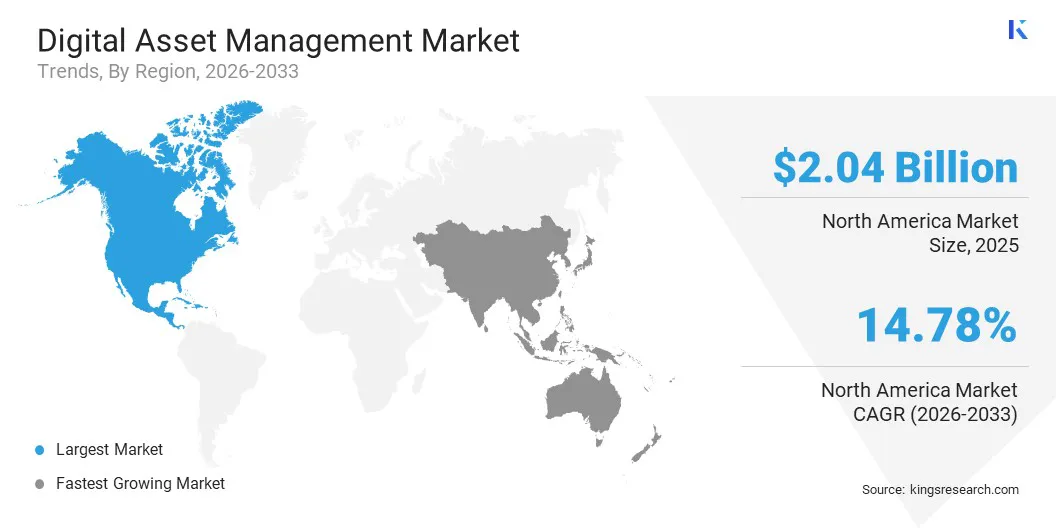
North America digital asset management market share stood at 35% in 2025, with a valuation of USD 2.04 billion. This dominance is attributed to the early adoption of advanced technologies, a highly digitalized business environment, and the presence of major DAM solution providers. The necessity for having scalable and secure asset management platforms is being propelled by high demand from industries such as media & entertainment, retail, and BFSI.
Moreover, North American companies are paying more attention to content workflow optimization and regulatory compliance, which are further driving the expansion of the regional market. The adoption of cloud-based DAM systems and the incorporation of AI-based capabilities are contributing to improved operational efficiency, making North America a leader in digital asset management innovation and implementation.
The Asia-Pacific digital asset management market is set to grow at a CAGR of 18.38% over the forecast period. This rapid growth is driven by the rising adoption of digital technologies across industries such as e-commerce, manufacturing, and education. With increasing internet penetration and expanding smartphone penetration, the region is experiencing a boom in digital content creation, prompting organizations to explore efficient DAM solutions.
Moreover, rising investments in cloud infrastructure and the growing awareness of the benefits of centralized asset management are accelerating the demand for digital asset management. Local enterprises are also focusing on enhancing customer experience and streamlining marketing operations, making DAM platforms a strategic priority. Subsequently, Asia Pacific is becoming an active hub for digital asset management innovation.
The digital asset management market is characterized by a dynamic and competitive environment, with several established vendors and new innovators aiming to increase market share. The development of technology, the adoption of artificial intelligence and automation, and the growing need for cloud-based solutions drive competition. Market players are differentiating themselves by offering scalable platforms, enhanced security features, and streamlined user experiences tailored to diverse industry needs.
Furthermore, there is a strong focus on developing flexible pricing frameworks and industry-specific solutions to appeal to a broader customer base. Strategic collaborations, product innovations, and regional expansions are common as companies aim to strengthen their market presence and respond to the evolving requirements of digital asset management users.
Frequently Asked Questions

Aswathi holds cross-domain expertise, translating market trends and competitive intelligence into decision-ready insights. Her work helps clients interpret evolving market conditions and identify growth opportunities. She brings a focused, insight-led approach to research execution. She translates these findings into clear, prioritized action plans that align with client capabilities. Her research often includes scenario modeling to test growth strategies under varying economic conditions. She maintains a rigorous validation process, cross-checking primary and secondary sources to ensure reliability. Clients value her ability to synthesize noisy data into concise executive summaries that drive board-level discussions. Her sector-specific lens, combined with a pragmatic focus on execution, consistently delivers high-impact, commercially sound recommendations. Her structured yet flexible research frameworks adapt to client timelines without compromising depth. She is known for distilling complex trade-offs into straightforward, defensible positions that facilitate confident decision-making.

Ganapathy Subramaniam Suresh
With over a decade of research leadership across global markets, Ganapathy brings sharp judgment, strategic clarity, and deep industry expertise. Known for precision and an unwavering commitment to quality, he guides teams and clients with insights that consistently drive impactful business outcomes.