
Inquire Now
Key Strategic Points
The biopolymer coatings market focuses on the research, development, manufacturing, and commercialization of coatings made from biopolymers. Biopolymers are defined as natural, renewable, and biodegradable materials derived from plant, animal, or microbial sources. Biopolymer coatings are an eco-friendly substitute for traditional coatings across different industries, including packaging, food and beverage, pharmaceutical, textile, and agricultural.
The market comprises different types of coatings, including starch-based coatings, cellulose-based coatings, protein-based coatings, and chitosan-based coatings, which provide benefits in terms of protection, antimicrobial action, and sustainability.
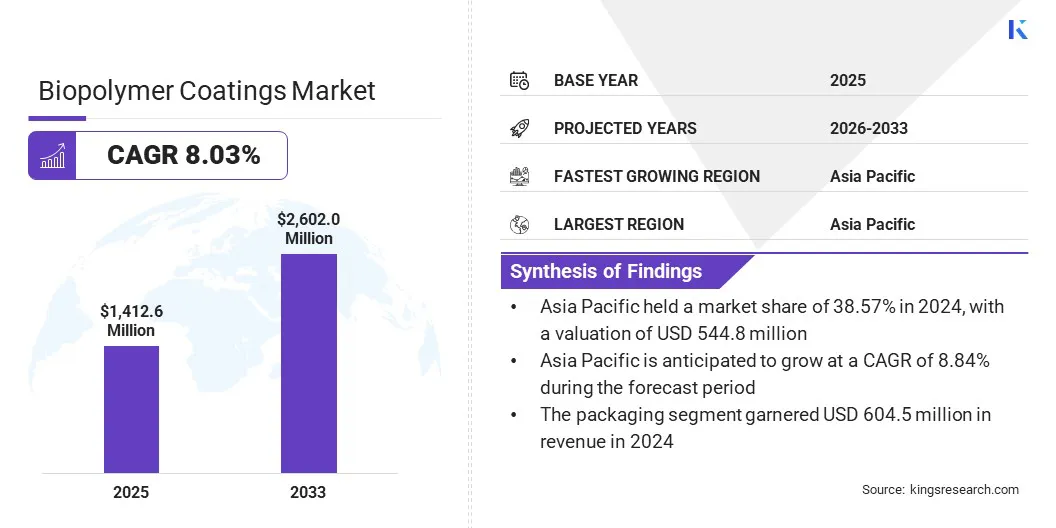
The global biopolymer coatings market size was valued at USD 1,412.6 million in 2024 and is projected to grow from USD 1,514.8 million in 2025 to USD 2,602.0 million by 2032, exhibiting a CAGR of 8.03% during the forecast period. The market is expected to grow significantly due to the increasing demand for sustainable and eco-friendly coating solutions in various industries such as packaging, food & beverages, and healthcare.
Major companies operating in the global biopolymer coatings industry are Arkema, Novamont S.p.A., BASF, Henkel Kenya Ltd., Danimer Scientific, Cargill, Akzo Nobel N.V., NatureWorks LLC., Earthodic Pty Ltd, Ecoat, Kelp Industries Ltd, Orineo, DuPont, TRACELESS MATERIALS GMBH, and ADM.
Environmental awareness and stringent government regulations to reduce plastic waste are driving the expansion of the market. Additionally, biopolymer coatings are becoming more favorable than conventional synthetic coatings due to increasing research and development activities to improve their properties.
Increasing environmental concerns are prompting businesses across different industries to adopt packaging materials that are more environmentally friendly and comply with the sustainability movement on a global level. Biopolymer coatings provide a greener option compared to traditional petroleum-based coatings, helping businesses lower their carbon footprint and make more environmentally responsible choices.
This shift can be seen in the food and beverage industry, the cosmetics industry, and the consumer goods industry. This is because these industries are adopting more environmentally friendly packaging materials to comply with the sustainability movement and evolving consumer demands. This emphasis on sustainability encourages manufacturers to innovate and produce more sophisticated biopolymer coatings.
One of the main hurdles hampering the development of the biopolymer coatings market is the higher production costs compared to conventional synthetic coatings. Since biopolymer coatings rely on renewable materials and often require specialized processing, their prices tend to be higher, which can make it challenging for some manufacturers to use them on a large scale. Additionally, fluctuations in the supply and cost of natural feedstocks can impact pricing stability.
To address this obstacle, companies are increasing investments in research and development, aiming to make production more efficient and reduce costs. By collaborating with research institutions and industry partners, companies are identifying more cost-effective approaches and expanding production capacity. These efforts are making biopolymer coatings a more viable and attractive option for businesses looking for sustainable solutions.
The rapid development of biopolymer technology and formulation is one of the most significant trends influencing the market. Innovation and research efforts are leading to the development of new biopolymer blends with enhanced properties, including improved barrier performance, greater flexibility, and better resistance to moisture and oxygen. Therefore, these developments enable biopolymer coatings to expand their application scope and enhance their competitiveness with conventional synthetic coatings.
Nanotechnology and bio-based additives are also being integrated to allow the creation of new coatings with added functionalities such as antimicrobial properties and extended shelf life. These technological innovations are helping manufacturers meet the needs of the industry, thereby propelling market expansion.
|
Segmentation |
Details |
|
By Type |
Polysaccharides-based Coatings, Proteins-based Coatings, Biopolyesters and Bio-Based Polymers, and Others |
|
By End Use Industry |
Packaging, Food & Beverages, Healthcare & Pharmaceuticals, Automotive, Construction, Textile, and Others |
|
By Region |
North America: U.S., Canada, Mexico |
|
Europe: France, UK, Spain, Germany, Italy, Russia, Rest of Europe |
|
|
Asia-Pacific: China, Japan, India, Australia, ASEAN, South Korea, Rest of Asia-Pacific |
|
|
Middle East & Africa: Turkey, U.A.E., Saudi Arabia, South Africa, Rest of Middle East & Africa |
|
|
South America: Brazil, Argentina, Rest of South America |
Based on region, the global market has been classified into North America, Europe, Asia Pacific, Middle East & Africa, and South America.
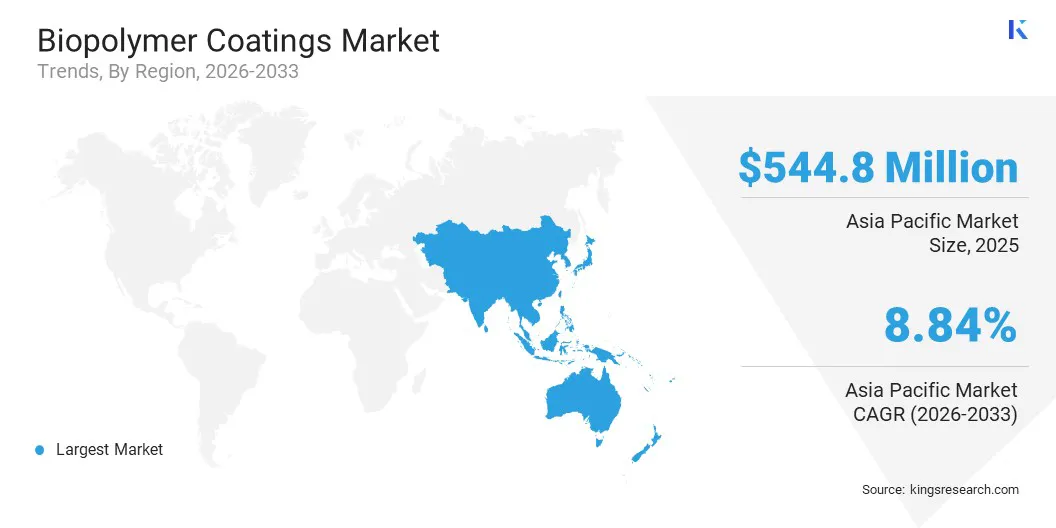
Asia Pacific biopolymer coatings market share stood at around 38.57% in 2024, valued at USD 544.8 million. This dominance is reinforced by the high level of industrialization, growing urbanization, and the rising demand for environmentally friendly packaging solutions across the region. Favorable government initiatives supporting the implementation of eco-friendly technologies, along with high investments in R&D activities, are also fueling regional market expansion.
Moreover, the strong industrial base and high level of awareness among consumers about environmental issues are also driving the market. Joint efforts by industry participants and researchers are also supporting regional market expansion.
The North America biopolymer coatings market is set to grow at a CAGR of 7.80% over the forecast period. Strong demand for innovative and high-performance coatings, coupled with increased consumer awareness of environmental sustainability, is driving adoption across the region. The presence of leading packaging, food processing, and pharmaceutical companies seeking eco-friendly solutions further supports domestic market expansion.
The regulatory frameworks and initiatives targeting single-use plastics are favorable, thereby encouraging businesses to invest in biopolymer alternatives. In addition, increasing research and development activities related to biopolymers, coupled with the support of academic institutions and industry players, are contributing significantly to regional market growth.
The biopolymer coatings market is highly competitive, with established companies and emerging players continually introducing new solutions to grow their presence and gain an edge in the industry. Organizations are placing strong emphasis on developing advanced and environmentally friendly coatings to meet evolving regulatory standards and growing consumer expectations for sustainable products. Strategic collaborations, mergers, and acquisitions are common, allowing firms to expand their product portfolios and global reach.
Partnerships with research institutions are fostering technological advancements, resulting in new product introductions and improved performance features. The involvement of regional companies is increasing competition and driving innovation tailored to local needs. Important factors shaping competition in this market include the ability to deliver high-quality products, offer cost-efficient solutions, adapt coatings for a wide range of uses, and consistently meet strict environmental requirements.
Frequently Asked Questions

Aswathi holds cross-domain expertise, translating market trends and competitive intelligence into decision-ready insights. Her work helps clients interpret evolving market conditions and identify growth opportunities. She brings a focused, insight-led approach to research execution. She translates these findings into clear, prioritized action plans that align with client capabilities. Her research often includes scenario modeling to test growth strategies under varying economic conditions. She maintains a rigorous validation process, cross-checking primary and secondary sources to ensure reliability. Clients value her ability to synthesize noisy data into concise executive summaries that drive board-level discussions. Her sector-specific lens, combined with a pragmatic focus on execution, consistently delivers high-impact, commercially sound recommendations. Her structured yet flexible research frameworks adapt to client timelines without compromising depth. She is known for distilling complex trade-offs into straightforward, defensible positions that facilitate confident decision-making.
Habi is a seasoned research and consulting leader with renowned experience in guiding clients on strategic growth and transformation initiatives across global markets. He has led high-performing research teams that deliver actionable insights on market expansion, M&A strategies, opportunity assessment, new business development, and product launches. His project portfolio spans large petrochemical producers, electronic device manufacturers, lubricants companies, and other leading enterprises across diverse industrial and consumer sectors. He currently heads the research department at Kings Research, where he is responsible for setting the research agenda, mentoring analysts, and ensuring client-ready deliverables that support executive decision-making. With extensive experience in market intelligence, strategic research, and consulting, Habi brings a strong understanding of evolving industry dynamics, competitive landscapes, emerging opportunities, and business growth challenges. His expertise includes developing research frameworks, translating complex market data into actionable strategic recommendations, and working closely with senior stakeholders to address critical business questions. He has also contributed to building research capabilities, strengthening analytical methodologies, and driving a culture of quality and insight-led decision-making within research teams. His cross-industry exposure enables him to connect market trends with broader business implications and provide perspectives that help organizations identify opportunities, mitigate risks, and make informed strategic decisions.